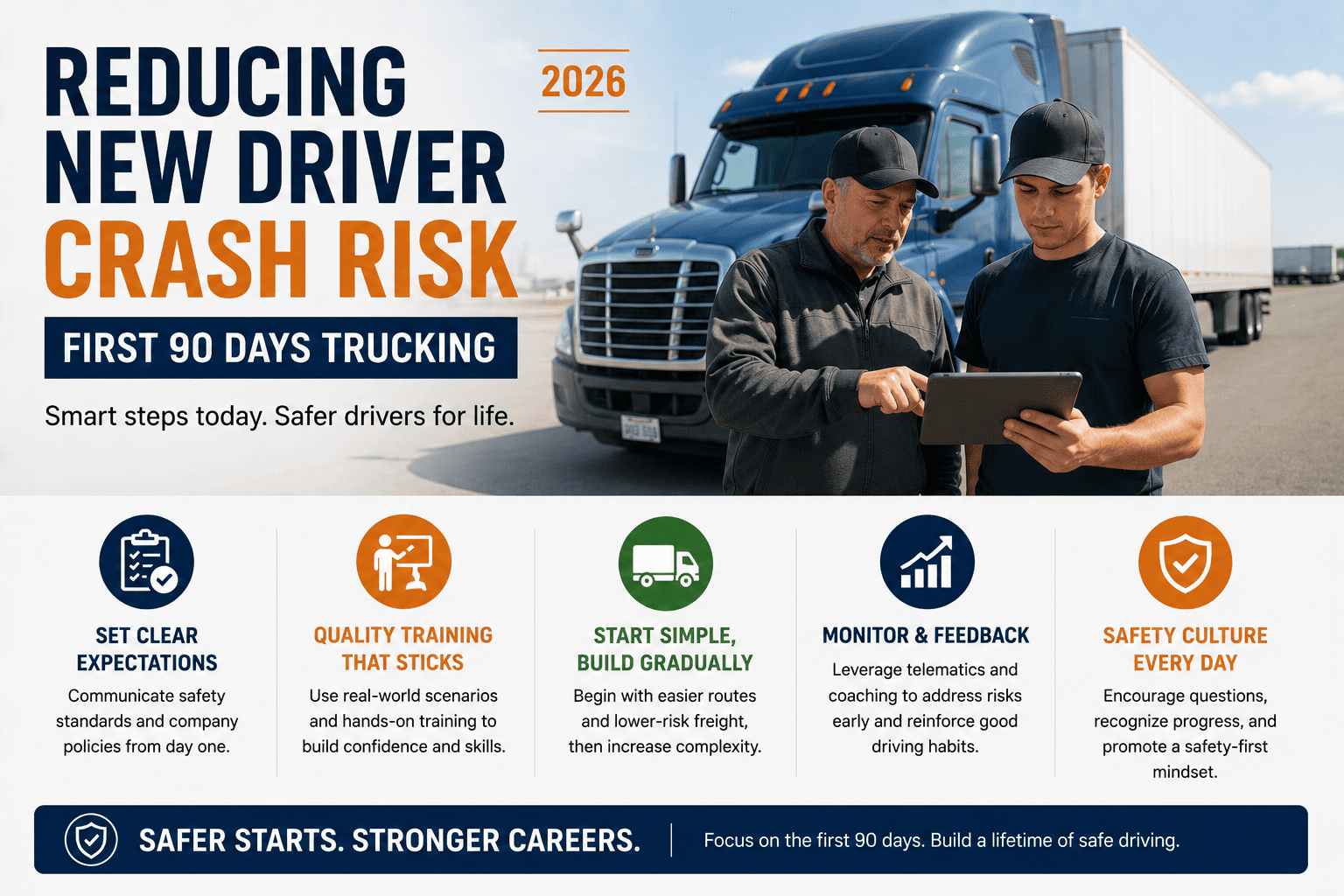
A brand-new driver pulls out of the yard for the first time with a real load behind him. He's passed every test, signed every form, and technically qualifies for the seat. But qualification and readiness aren't the same thing, and the data is blunt about what happens next: the first 90 days behind the wheel are statistically the most dangerous stretch of a trucking career. Most fleets know this in the abstract. Few have a structured plan to actually shrink that risk window.
Crash risk follows a predictable curve. It peaks in the earliest weeks, when instincts haven't formed yet, and gradually settles as a driver accumulates real road experience.
Why New Drivers Carry More Risk Than Experienced Ones
Inexperience shows up in ways that have nothing to do with effort or attitude. A new driver hasn't yet built the muscle memory to judge a closing gap, anticipate a merging vehicle, or feel a trailer starting to sway before it becomes a problem. Industry research comparing crash rates across experience levels consistently finds that novice drivers are involved in collisions at meaningfully higher rates than seasoned drivers, simply because those instincts take real miles to develop.
None of this means new drivers shouldn't be on the road. It means the first 90 days need deliberate structure instead of being treated like a formality after orientation ends. Fleets that build that structure consistently see lower incident rates among new hires, and you can start building it today when you sign up for FleetRabbit and put real-time monitoring behind every new driver from day one.
The Three Risk Windows of a New Driver's First 90 Days
Not every week of the first 90 days carries the same level of exposure. Understanding where risk concentrates helps fleet managers focus coaching and oversight where it matters most.
Days 1-14: The Adjustment Window
New routes, new equipment, and unfamiliar dispatch processes collide with raw nerves. This is when basic errors, missed blind spots, late braking, poor following distance, are most likely.
Days 15-45: The Confidence Gap
Drivers start feeling comfortable before their instincts have caught up to their confidence. This mismatch is where overconfidence-driven mistakes tend to spike.
Days 46-90: The Habit Formation Window
Whatever patterns took hold in the first six weeks, good or bad, start becoming permanent habits here. This is the last real opportunity to correct course before behaviors solidify.
FleetRabbit gives fleet managers real-time visibility into hard braking, speeding, and following distance for every new hire, so coaching happens in the moment instead of after an incident. Book a demo and see how early risk detection works.
What Actually Reduces Risk in This Window
Hope is not a strategy. The fleets that consistently bring new drivers through their first 90 days safely rely on a combination of structured mentoring, real-time monitoring, and coaching that happens close to the moment of the behavior, not weeks later in a quarterly review.
Real-Time Coaching Beats After-the-Fact Reviews
Telematics systems that flag hard braking, rapid acceleration, and following distance issues as they happen let fleet managers intervene immediately, while the moment is still fresh in the driver's mind. Studies on this kind of real-time feedback show unsafe driving events dropping by nearly half once monitoring and coaching are paired together consistently.
Structured Mentoring Closes the Experience Gap Faster
Pairing a new driver with an experienced mentor for the first several weeks transfers the instincts that can't be taught in a classroom, how to read traffic two cars ahead, when to back off a tight merge, how a loaded trailer behaves differently than an empty one.
Fatigue and Drowsiness Detection Adds a Safety Net
New drivers are still adjusting to irregular schedules and unfamiliar fatigue patterns. AI-powered monitoring that watches for signs of drowsiness, like delayed reaction time or inconsistent lane position, can flag a risk before it becomes a crash.
A 90-Day Coaching Framework That Actually Works
Structure beats improvisation. Here's a simple framework fleets can apply to every new hire, regardless of fleet size.
Daily check-ins with a mentor or safety manager. Review telematics data together every shift, not just when something goes wrong.
Shift to weekly coaching sessions. Focus specifically on any recurring flagged behaviors, hard braking patterns, speed variance, late lane changes, before they calcify.
Move to biweekly reviews. Confirm safety scores are trending toward fleet averages and address any remaining gaps directly.
Formal safety review comparing the driver's full 90-day telematics record against fleet benchmarks before transitioning to standard monitoring cadence.
This kind of structured cadence only works if the underlying data is actually visible and easy to act on. Fleets that try to track this manually across spreadsheets and memory consistently miss the early warning signs that matter most. You can put this entire framework into practice when you sign up for FleetRabbit and let automated alerts flag risk the moment it appears, not after it's already cost you an incident.
Frequently Asked Questions
The Bottom Line
New-driver crash risk isn't random, and it isn't something fleets have to simply absorb as a cost of growth. It follows a predictable curve, peaking early and settling as real experience accumulates, which means it can be managed with the right structure. Real-time monitoring, mentorship that tapers deliberately over 90 days, and coaching that happens close to the moment of the behavior are the difference between a new driver who becomes a long-term safety asset and one who becomes a statistic. The fleets getting this right aren't relying on luck. They're relying on data and a plan.
FleetRabbit gives you real-time visibility into every new driver's behavior, so coaching happens before a risky habit becomes an incident. Get started with no credit card required.