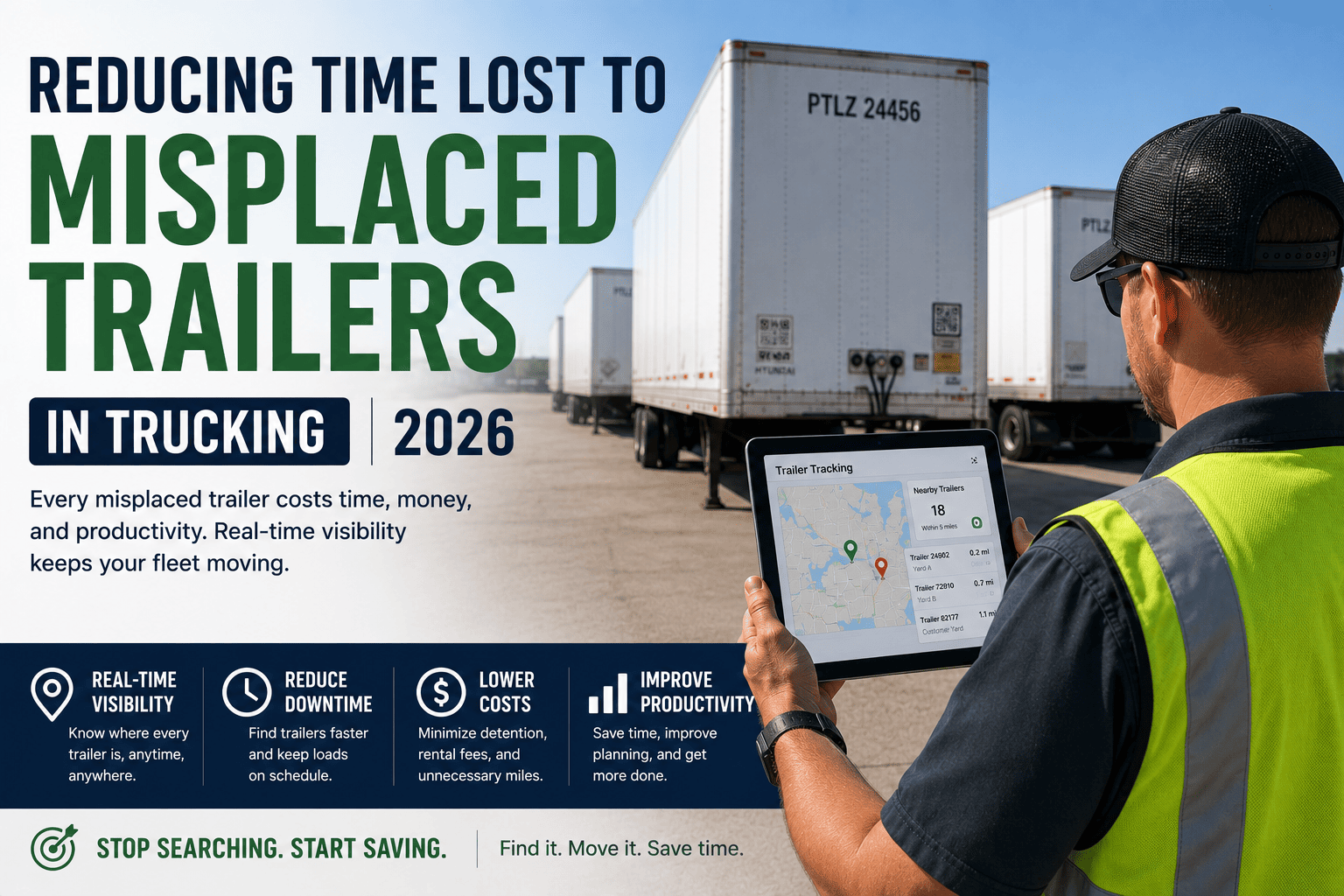
A trailer does not need to be stolen to cost your fleet hours. It just needs to be unaccounted for, and a phone call to figure out where it is. Without real-time visibility, your team fragments into disconnected pieces: dispatchers calling drivers, drivers checking with customers, customers guessing based on memory. A trailer disappears into the network, and someone spends the next hour calling around just to locate it. Multiply that by every misplaced unit across a busy week, and the hours add up to a real operational drag most fleets never formally measure.
Fleets relying on phone calls and driver memory instead of GPS visibility routinely lose 20 to 40 minutes of dispatcher time per day just answering location questions, before a single trailer search even begins. When a trailer genuinely goes missing in the network, locating it can consume hours of staff time, and battery-powered GPS trackers now run 3 to 5 years without charging, removing the excuse of installation friction.
Where The Hours Actually Go
Every fleet running without live trailer visibility has the same story on repeat. A load is ready, but nobody is sure which empty trailer is closest, so a dispatcher starts making calls. A driver reports dropping a unit at a customer dock last week, but nobody logged the exact spot in the yard. A customer asks for a delivery update, and the honest answer is a guess based on when the truck should have arrived, not where it actually is right now. None of these moments look like a crisis individually, but they are the same root problem showing up over and over: nobody can see the trailer without asking a person first.
The fix is not hiring more dispatchers to make more calls faster. It is removing the need for the calls in the first place. Real-time GPS tracking answers the location question with certainty, showing exactly where every trailer sits at any moment, along with departure times, arrival times, and every stop in between, so your team pulls up a live map instead of scrambling through dispatch logs.
Three Moments Where Search Time Piles Up
Assigning The Next Load
Without visibility, dispatchers default to the nearest known trailer rather than the actual nearest one, sending drivers 40 miles for a pickup when an available unit was sitting 8 miles away the whole time.
Answering Customer Location Questions
Every "where is my trailer" call that requires checking with a driver instead of a live map adds up to meaningful dispatcher time lost daily, time that customers experience as slow, uncertain service.
Recovering A Truly Misplaced Unit
When a trailer is dropped without a logged location and nobody remembers exactly where, recovering it can consume hours of staff time across multiple phone calls before it is found.
FleetRabbit shows real-time location for every trailer in your fleet, including units dropped at customer docks and yards, so your team answers location questions in seconds instead of phone calls. Start your free trial and see how much dispatcher time you could get back this week.
Search Method Versus Time Cost
Not every trailer location method costs the same amount of time. Comparing the common approaches side by side makes the case for real-time tracking clear.
| Location Method | Typical Time Cost | Main Weakness | Result |
|---|---|---|---|
| Phone Calls To Drivers | Several minutes per call, often multiple calls | Depends entirely on driver memory and availability | Slow, inconsistent, and unverifiable answers |
| Manual Dispatch Logs | Minutes to hours depending on log quality | Logs are only as accurate as the last manual entry | Outdated information leads to wrong decisions |
| Customer Callback Requests | Additional calls plus wait time for a response | Customers may not know exact trailer status either | Delayed, unreliable updates for your own team |
| Yard Walkthroughs | 30 minutes to several hours per search | Physically inefficient across large yards or multiple sites | Labor-intensive and only solves the immediate search |
| Real-Time GPS Tracking | Seconds on a live map | Requires upfront tracker installation across the fleet | Instant, verified location with full history attached |
Building Real-Time Trailer Visibility
Cutting search time down to seconds does not require overhauling your entire operation. It requires putting a tracker on every trailer, including the ones that sit dropped for days at a time, and giving dispatch one dashboard to check instead of a phone book of contacts.
Track Every Trailer, Not Just The Active Fleet
Dropped trailers at customer docks and drop yards are exactly the units most likely to become misplaced, since nobody is actively driving them or thinking about them day to day. Tracking needs to cover these units just as closely as trailers currently in transit.
Use Geofencing To Catch Movement Automatically
Geofenced alerts flag unauthorized movement or unexpected activity the moment it happens, protecting equipment and giving your team a head start if a trailer leaves a location it should not have left.
Give Dispatch One Dashboard For Every Asset
Viewing every trailer, vehicle, and piece of equipment in a single dashboard removes the need to check multiple systems or contact multiple people before making a dispatch decision.
A Quick Visibility Checklist
Install trackers on every trailer, including dropped and idle units. Set geofence alerts for customer docks, yards, and drop lots. Replace phone-call location checks with a live dashboard view. Log location history automatically instead of relying on manual entries.
FleetRabbit combines live GPS tracking, geofencing, and location history into one dashboard, so your dispatch team never has to guess where a trailer sits. Book a demo and see how quickly your team could locate any trailer in the network.
Benchmarks Worth Tracking Every Week
Fleets that keep search time under control track a small set of numbers rather than discovering the problem during a busy dispatch day. Measure how many minutes per day your dispatch team spends on manual location questions, and aim to push that number toward zero through live tracking rather than accepting it as routine. Track how often drivers get routed to a farther trailer than necessary simply because a closer one was not visible. Review how many trailers required a multi-call search in the past month, since a rising trend usually signals gaps in tracker coverage rather than bad luck. Fleets hitting these benchmarks consistently spend less staff time on searches and make faster, better-informed dispatch decisions.
Frequently Asked Questions
Every minute your team spends calling around for a trailer is a minute not spent moving freight. Closing that gap is one of the simplest operational wins available to a fleet, because the fix is not more staff or more trailers, it is simply knowing where the ones you already have are sitting right now.
FleetRabbit gives your dispatch team real-time location, geofenced alerts, and full location history for every trailer in the fleet, turning hours of searching into seconds of certainty. Start your free trial with no credit card required, or book a short call with our team to see full trailer visibility in action.