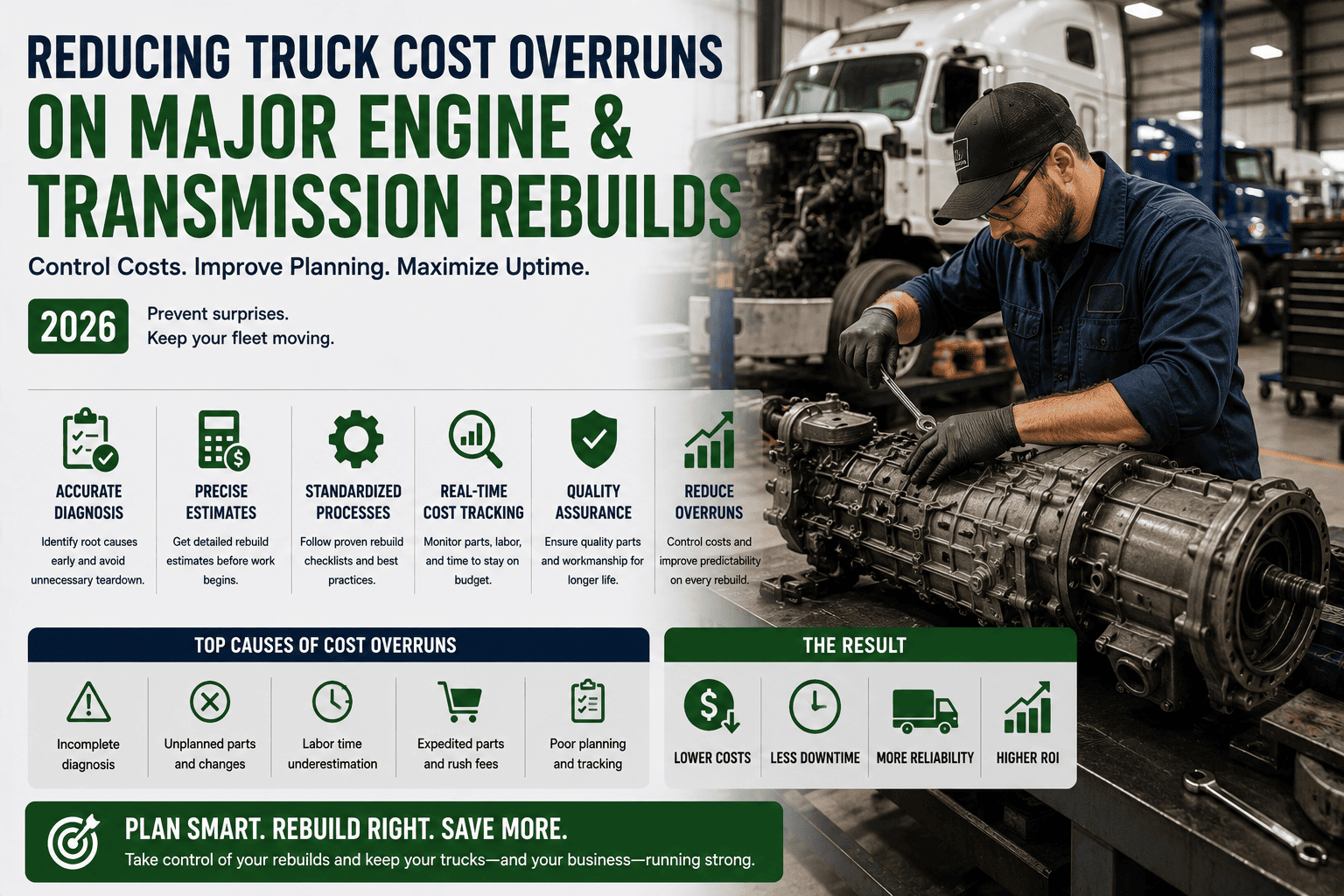
A quoted engine rebuild rarely stays at the quoted price. What starts as a 12,000 dollar in-frame job turns into an 18,000 dollar teardown once the shop finds worn bearings, a cracked liner, or a transmission that was already failing alongside it. These cost overruns are not random bad luck. They come from the same root cause almost every time: fleets wait for a warning light instead of tracking the asset's real condition, so every major rebuild starts from a position of surprise instead of a position of control.
Engine repairs in 2026 range from 5,000 dollars for limited internal work to 20,000 to 40,000 dollars for a full overhaul, while transmission work runs 5,000 to 8,500 dollars for a rebuild and 8,000 to 15,000 dollars for a full replacement. The gap between the low end and the high end of these ranges is almost always explained by one thing: how early the problem was caught. Fleets tracking component lifecycle data consistently land near the bottom of these ranges instead of the top.
Why the Same Repair Costs So Differently From Fleet to Fleet
Two trucks with the same engine platform can experience the exact same failure and end up on invoices that differ by 15,000 dollars or more. The difference is rarely the shop. It is almost always timing. An engine problem caught early is a repair. The same problem caught late is a rebuild, and a rebuild caught even later becomes a full replacement plus a tow bill, a rental truck, and a missed delivery window on top of it.
The Countdown Nobody Tracks
Every major failure has a runway leading up to it. Oil analysis shows rising wear metals weeks before a bearing lets go. Transmission fluid shows heat and contamination trends before a clutch pack fails. Fleets without a system for watching these trends only find out something is wrong when the truck stops moving, and by then the countdown has already run out.
What This Looks Like on Paper
A planned in-frame engine repair, caught early and scheduled into a shop bay, typically lands in the 12,000 to 14,000 dollar range. Wait too long and the same engine may need a full overhaul running 20,000 to 40,000 dollars, sometimes with a core charge and towing on top. That gap is not variance. It is the direct cost of not having visibility.
| Component | Caught Early | Caught Late | What Widens the Gap |
|---|---|---|---|
| Engine (In-Frame) | 12,000 to 14,000 dollars | 20,000 to 40,000 dollars for full overhaul | Delayed oil analysis, ignored wear-metal trends |
| Transmission | 1,500 to 5,000 dollars for component work | 8,000 to 15,000 dollars for full replacement | Skipped fluid changes, ignored heat and shift pattern data |
| Emissions System | 300 to 900 dollars for scheduled DPF service | 15,000 dollars or more on multi-component failure | Missed regeneration cycles, deferred sensor checks |
| Diagnostic Labor | 350 to 600 dollars with historical data on hand | Extended hours without OEM tooling or history | No maintenance ledger, shop starts from zero |
FleetRabbit keeps a running maintenance ledger for every truck, so wear trends on engines, transmissions, and emissions systems are visible long before a rebuild becomes unavoidable. You can sign up for FleetRabbit and connect your fleet data today, or book a demo to see a real cost-overrun example walked through live.
Rebuild or Replace: The Decision That Drives the Budget
Cost overruns often start with the wrong call at the decision point, not the repair itself. Choosing between a rebuild and a full replacement without solid lifecycle data leads to either overspending on a truck near retirement or under-investing in one that still has years of revenue left in it.
Where Warranty Coverage Quietly Prevents Overruns
Warranty terms are one of the most overlooked levers for controlling rebuild costs. Independent shops can save 5,000 to 10,000 dollars compared to dealer pricing, but only if certifications, parts quality, and warranty terms are confirmed in writing before the work begins. Fleets that skip this step often end up paying twice: once for the original rebuild, and again when a component fails outside the coverage window because nobody tracked when that window closed.
Building a Warranty Tracking Habit
Every rebuild and reman component should carry a documented warranty start date, mileage limit, and coverage scope inside the asset's maintenance record. Without that record, a covered failure can easily turn into an out-of-pocket repair simply because nobody caught it in time to file a claim.
Dealer Versus Independent, By the Numbers
Dealers typically charge 20 to 40 percent more than independent shops but bring OEM parts and factory-trained technicians to the table. Independent shops can close much of that gap on price if they have direct experience with the specific engine platform and can produce verifiable rebuild references.
A Simple Rule Worth Following
Never approve a rebuild quote without a written warranty term attached to it. A verbal promise of coverage disappears the moment the shop changes ownership or the technician who made the promise moves on.
Turning Lifecycle Data Into Budget Control
The fleets that consistently avoid five-figure surprises are the ones treating every engine and transmission as an asset with a documented lifecycle, not a black box that occasionally needs attention. That means logging every oil analysis result, every fluid change, every diagnostic code, and every prior repair in one place tied to the specific vehicle.
What a Complete Ledger Actually Prevents
A running maintenance ledger prevents three of the most common overrun triggers: repeating diagnostic work a previous shop already completed, missing the early window where a repair is still cheap, and losing track of warranty coverage that would have paid for the fix. Each of these on its own can add thousands of dollars to a single repair event.
Making the Rebuild-or-Replace Call With Confidence
When cost-per-mile, prior repair history, and remaining revenue life are all visible in one dashboard, the rebuild-or-replace decision stops being a guess made under pressure in the shop parking lot and becomes a planned budget conversation made weeks in advance.
FleetRabbit centralizes oil analysis, fluid trends, diagnostic history, and warranty terms so every rebuild decision is backed by real data instead of a rushed estimate. Book a free demo to see your own fleet's cost-per-mile trends, or sign up now to start building your maintenance ledger today.
Frequently Asked Questions
Wear metals, fluid trends, and shift patterns all send signals long before an engine or transmission fails. FleetRabbit puts those signals in one place so your next major repair is a planned budget line, not a surprise invoice. Explore the platform with a free sign-up or walk through a real rebuild scenario with our team.