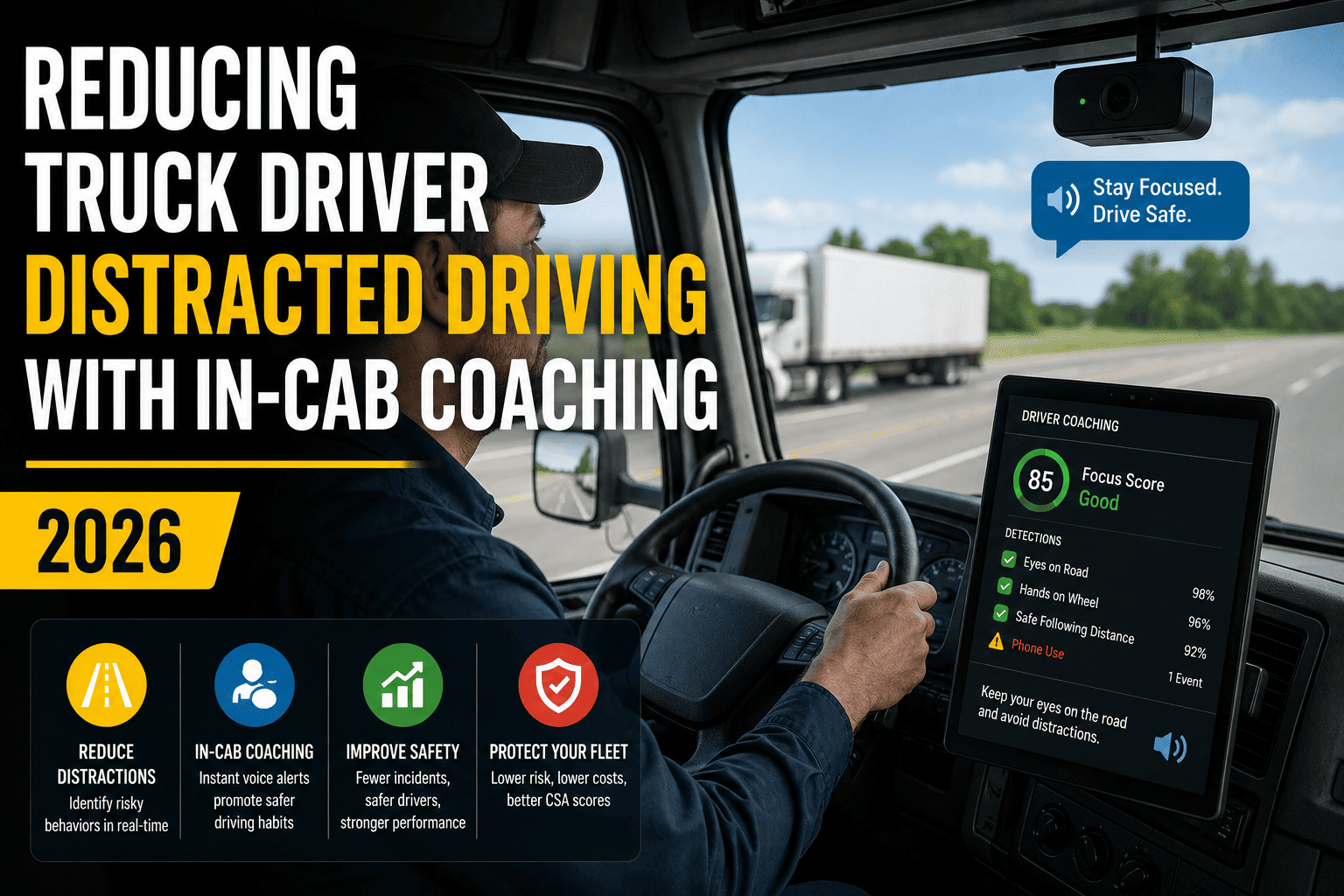
A driver glances at a phone for two seconds. At highway speed, that's the length of a football field traveled with nobody really watching the road. Most fleets don't find out about a moment like that until a claims adjuster is asking questions. In-cab coaching flips that timeline entirely, the correction happens the instant the risky behavior starts, not days later in a review meeting after something has already gone wrong.
In-cab coaching uses AI dash cams to detect distracted driving, phone use, drowsiness, prolonged gaze away from the road, in real time, and deliver an instant audio alert so the driver self-corrects before it becomes a collision. Fleets running full AI safety systems with real-time alerts commonly report crash rate reductions in the range of 60 to 80 percent within the first year or two of deployment. Sign up for free to see how in-cab coaching works for your fleet.
Why Distracted Driving Is A Trucking Problem, Not Just A Driving Problem
Distraction accounts for a large share of truck crashes, and the reasons are rarely dramatic. It's a text glanced at, a climate control adjusted for too long, a moment of fatigue mistaken for a quick blink. None of these feel dangerous in the moment, which is exactly why policy reminders alone rarely change behavior. A driver doesn't decide to be distracted, the distraction happens faster than a rule can be recalled. That's the gap real-time coaching is built to close.
Reactive Video Versus Real-Time Coaching
The biggest shift in dash cam technology isn't the camera, it's the timing of the intervention. A traditional system tells you what happened. A coaching system tells the driver what's happening, while there's still time to change it.
| Factor | Traditional Dash Cam | AI In-Cab Coaching |
|---|---|---|
| When The Driver Learns | Days later, during a manager review | Instantly, through an in-cab audio alert |
| What Gets Reviewed | Hours of footage, mostly after an incident | A short, tagged clip of the specific risky moment |
| Manager Involvement | Required for every review | Reserved for repeat patterns or high-risk events only |
| Driver Experience | Feels like surveillance after the fact | Feels like an in-cab safety net during the drive |
| Coaching Conversation | Often vague, memory-dependent, and defensive | Fact-based, tied to specific footage and events |
FleetRabbit delivers real-time distraction alerts and tagged event footage, so coaching happens the moment risk appears instead of a week later in a review meeting. Sign up for free and equip your fleet today.
Rolling Out In-Cab Coaching Without Losing Driver Trust
The technology only works if drivers accept it, and acceptance depends entirely on how it's introduced. Fleets that treat cameras as a safety net for the driver, not just a monitoring tool for management, see far better long-term results.
Lead With What Protects The Driver
Dual-facing footage doesn't just catch risky behavior, it also exonerates drivers in the majority of accidents that aren't their fault. Leading with that protection first makes the coaching conversation land as support instead of suspicion.
Let Drivers Self-Correct Before Managers Get Involved
Systems built around instant in-cab alerts let a driver correct their own behavior in the moment. Only repeated or high-severity events need to escalate to a manager, which keeps the coaching relationship collaborative rather than constantly supervised.
Why This Sequence Matters
A driver who self-corrects a hundred times without ever needing a manager conversation experiences the system as help. A driver who only hears about their behavior in a disciplinary meeting experiences the same system as punishment, even if the technology is identical.
Use Real Footage, Not Vague Feedback
A coaching conversation built around "here's the clip, here's what it shows, here's the fix" moves faster and lands better than a general reminder about company policy. Specific, evidence-backed coaching is what actually changes habits.
Track Trends, Not Just Individual Events
A single distraction event tells you about one driver on one day. A safety scorecard across weeks tells you which routes, shifts, or drivers need targeted attention versus a company-wide reminder.
FleetRabbit's safety scorecards make it easy to spot patterns early and coach with real footage instead of guesswork. Book a free demo to see the coaching workflow in action.
What Better Coaching Does For The Rest Of The Business
Fewer distraction events don't just mean fewer accidents. They ripple into lower insurance costs, since insurers increasingly treat a documented, technology-backed safety program as a materially lower risk profile than policy alone. They also mean fewer disputed claims, since footage that exonerates a driver in an incident they didn't cause can save a fleet from paying out on a claim it never should have owed. The financial case for in-cab coaching rarely rests on accident prevention alone, it's supported just as much by the disputes it prevents and the premiums it helps lower.
Frequently Asked Questions
Every distracted driving event that goes uncorrected is a near-miss waiting to happen again. FleetRabbit's real-time in-cab coaching catches the moment it happens, protects your drivers with footage, and turns risky habits into safer ones faster than policy reminders ever could.