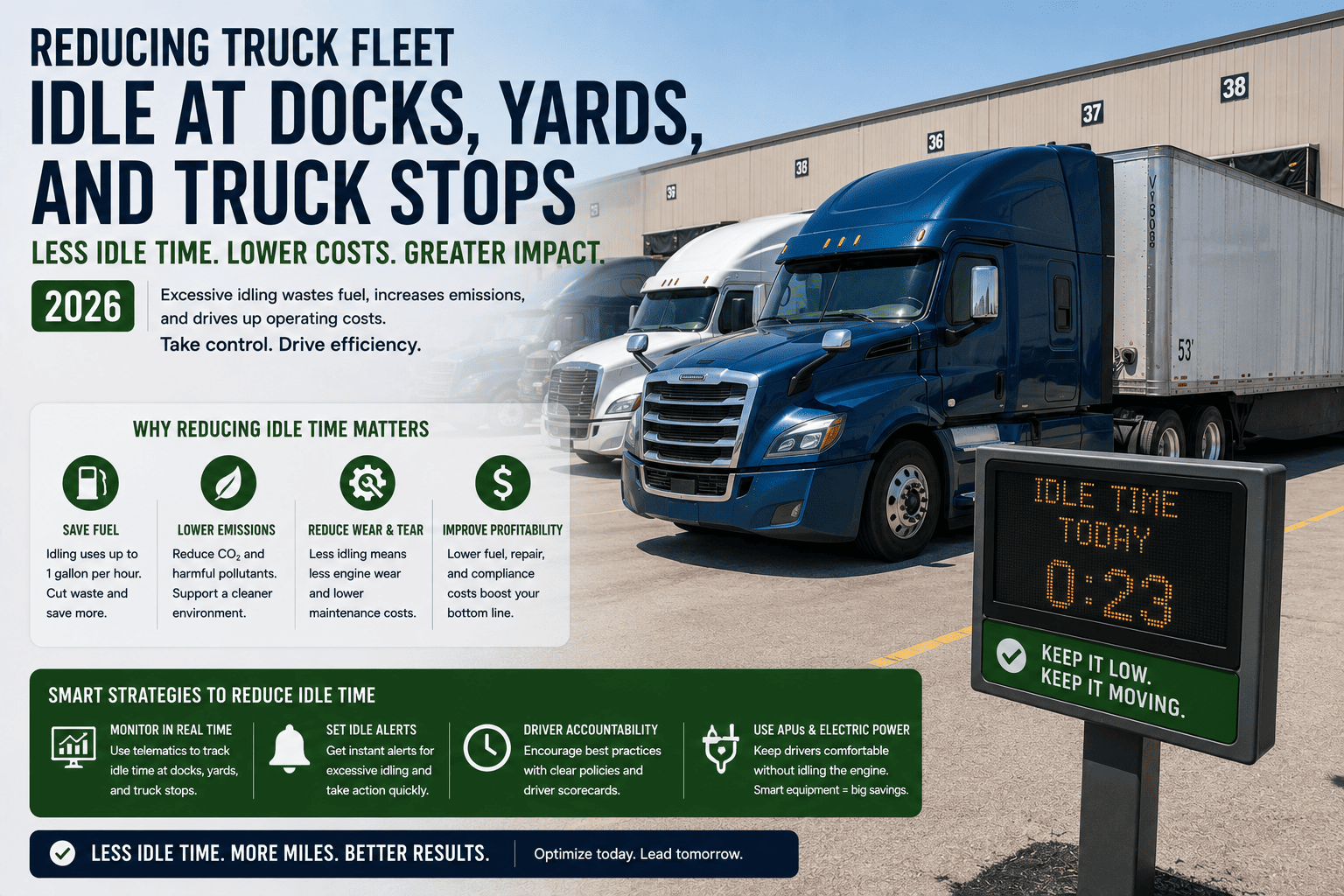
Walk any distribution yard at 6 a.m. and you will hear it before you see it: dozens of diesel engines running while trailers sit untouched at the dock door. Idle time at docks, yards, and truck stops is one of the quietest budget leaks in trucking because no single hour looks expensive. It is the accumulation across hundreds of trucks, hundreds of days, that turns into six-figure fuel losses and engines that wear out years before their time. Most fleets are only funding this leak because they cannot see it happening in real time.
A heavy-duty truck burns roughly 0.8 to 1 gallon of diesel per hour at idle. A fleet of 100 trucks idling just 6 hours a day at docks, yards, and truck stops burns through 180,000 gallons a year, worth over 700,000 dollars at current fuel prices. One hour of idling also creates engine wear comparable to 30 to 60 miles of highway driving. GPS-based idle monitoring and geofenced alerts typically cut idle hours by 20 to 30 percent within the first quarter.
Where All That Idle Time Actually Hides
Idling is rarely one bad habit. It is three separate problems stacking on top of each other, and each location on a route contributes its own share of wasted fuel and engine hours.
FleetRabbit flags idle events the moment they cross your threshold, tagged by location: dock, yard, or truck stop. Stop guessing where the fuel is going and start fixing it. Sign up free and see your idle map within minutes.
What Idling Really Costs You, Location By Location
Not every idle hour costs the same. Dock idling is short but frequent, yard idling is habitual, and truck stop idling runs for hours at a stretch overnight. Breaking the cost down by location shows fleet managers exactly where a fix pays off fastest.
| Location | Typical Idle Duration | Annual Fuel Cost Per Truck | Primary Fix |
|---|---|---|---|
| Loading Docks | 45 to 90 minutes per stop, 2 to 4 stops daily | 900 to 1,600 dollars | Geofenced dock zones with automatic idle alerts |
| Fleet Yards | 15 to 30 minutes before every shift | 500 to 900 dollars | Scheduled dispatch times and pre-trip idle limits |
| Truck Stops | 6 to 10 hours during overnight rest | 1,800 to 3,000 dollars | Auxiliary power units or driver idle-time coaching |
| Traffic and Detours | 10 to 25 minutes per occurrence | 300 to 600 dollars | Route optimization and real-time traffic rerouting |
Why Idle Time Piles Up At Each Stop
Understanding the reason behind the habit is the first step toward changing it. Each location has its own trigger, and the right fix depends on matching the solution to the cause.
Loading Docks: Comfort While Waiting
Drivers sitting in a queue for an open bay rarely shut the engine off for a wait they expect to be short. The trouble is that a 20-minute estimate frequently becomes 60 minutes once dock congestion, staffing gaps, or paperwork delays are added in. Multiply that across a route with several delivery stops and the truck can spend more time idling at docks than it does actually driving between them.
What actually helps
Geofencing dock zones lets a fleet management platform automatically flag any truck idling past a set threshold inside that zone, so dispatchers can coach drivers using real data instead of guesswork.
Fleet Yards: The Habit Nobody Questions
Yard idling is the least visible because it happens before the workday officially starts. Drivers warm the cab, run the defroster, or simply let the truck run out of routine while completing inspections. Because it happens on home turf, it rarely gets flagged as a cost problem, even though it is one of the easiest to fix.
What actually helps
Setting a yard idle-time limit inside your telematics system and pairing it with a short dispatch checklist keeps trucks running only as long as genuinely needed before pulling out.
Truck Stops: The Biggest Single Source
Overnight rest periods are non-negotiable for driver safety, but running a full engine for eight to ten hours just to power a cab is enormously wasteful. This single category accounts for a large share of nationwide idle fuel consumption because it happens every single night, for every truck on a multi-day route.
What actually helps
Auxiliary power units and battery-based climate systems can supply heat, air conditioning, and electronics using a fraction of the fuel a full engine burns, while telematics tracks which trucks and drivers still default to full-engine idling.
The Technology Stack That Actually Reduces Idle Time
Cutting idle time is not about telling drivers to stop idling. It is about giving fleet managers visibility and giving drivers a comfortable, low-cost alternative.
Every truck reports engine status continuously, so idle events are logged automatically instead of relying on driver logs or spot checks.
Docks, yards, and truck stops get their own idle thresholds, so a 10-minute wait at a dock and a 6-hour overnight rest are judged by different rules.
Dispatchers and drivers get notified the moment idle time crosses a threshold, allowing correction before the habit becomes a pattern.
Idle data rolled up by driver turns a vague policy into a specific, measurable conversation, and rewards the drivers already doing it right.
FleetRabbit combines GPS tracking, geofencing, and driver scorecards into a single view, so you can see exactly which trucks, drivers, and locations are burning the most fuel for nothing. Book a free demo and walk through your own fleet's idle data with our team.
Benchmarks Worth Tracking
A handful of numbers tell you whether your idle problem is normal or out of control. Idle percentage, the share of total engine hours spent stationary with the engine running, should sit below 20 to 25 percent for most over-the-road fleets. Idle-to-drive ratio compares idle hours to driving hours; a ratio creeping above 1 idle hour for every 3 to 4 driving hours signals a habit worth addressing. Fuel cost per mile that climbs without a matching increase in miles driven is often idle time hiding in plain sight. Fleets that start tracking these three numbers typically find their real idle percentage is 30 to 50 percent higher than what they assumed before they had data.
Frequently Asked Questions
Turning Idle Hours Back Into Profit
Idle time at docks, yards, and truck stops will never hit zero, and it shouldn't. Drivers need rest, comfort, and safety. But the gap between necessary idling and habitual idling is where thousands of dollars per truck disappear every year, unnoticed and unmanaged. The fleets that close that gap are not the ones that ban idling outright. They are the ones that can finally see it, measure it by location, and give drivers a better option than running a full engine for hours at a time.
FleetRabbit shows you idle time by truck, driver, and location, so you can turn a vague fuel bill into a specific, fixable list. Start free with three vehicles or walk through your own idle data with our team on a live call.