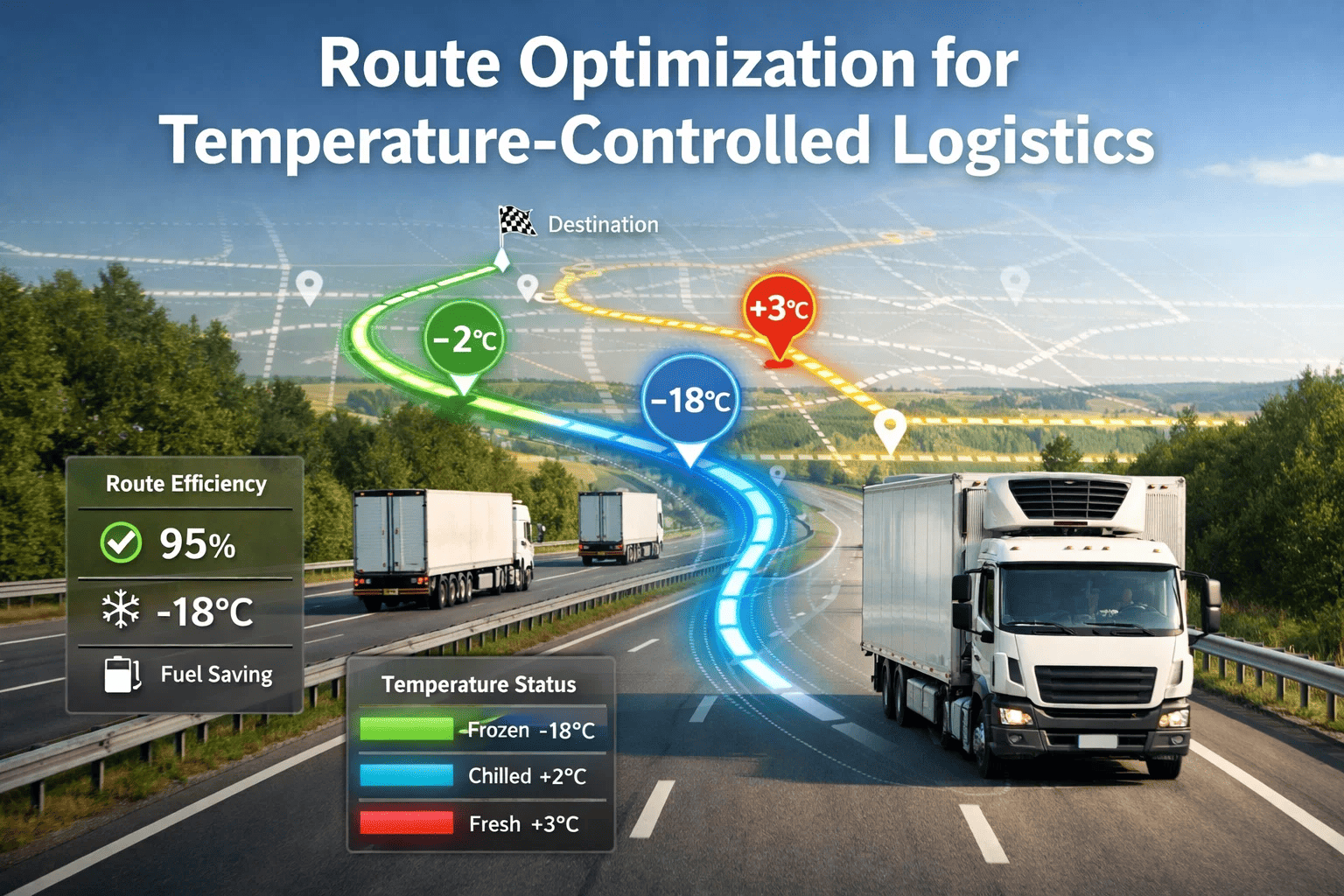
Temperature-controlled logistics represents one of the most technically demanding segments of commercial trucking, where the margin for operational error is measured not in dollars but in product safety, regulatory liability, and customer contract survival. A reefer carrier managing pharmaceutical distribution, fresh produce lanes, or frozen food delivery operates under a dual set of performance requirements that standard dry van logistics does not face: every load must arrive at the right location at the right time, and it must arrive at the right temperature, with an unbroken documentary record proving that the cold chain was maintained from pickup through delivery. Route optimization in this environment is not simply about finding the shortest path between two points — it is about engineering every movement in the delivery sequence to protect cargo temperature integrity while simultaneously controlling fuel expenditure on power units running refrigeration units from departure to delivery. FleetRabbit provides temperature-controlled fleet operators with the integrated analytics, inspection documentation, preventive maintenance scheduling, and dispatch coordination tools required to build and sustain an operationally excellent cold chain logistics program. Book a demo to see how FleetRabbit supports route optimization and cold chain compliance for temperature-controlled fleets at your scale.
This operational guide covers the core principles of route optimization for temperature-controlled logistics, the specific planning variables that differ from dry van optimization, the regulatory documentation requirements under FSMA and FDA food safety frameworks, and how FleetRabbit's integrated fleet management platform gives reefer fleet managers and operations executives the operational visibility and documentation infrastructure required to run compliant, efficient cold chain logistics at scale.
Why Temperature-Controlled Route Optimization is Fundamentally Different
Fleet managers and operations executives with backgrounds in dry van or flatbed logistics frequently underestimate the degree to which temperature requirements reshape every assumption that guides standard route optimization logic. In conventional trucking, route optimization seeks to minimize total miles driven, transit time, and fuel expenditure within delivery window constraints — a problem that modern routing software handles reasonably well when given accurate inputs about traffic patterns, transit times, and delivery windows. In temperature-controlled logistics, the optimization problem has multiple additional dimensions that interact with each other in ways that cannot be resolved by applying standard routing logic.
The first additional dimension is cargo compatibility. A reefer trailer serving a mixed-temperature route — carrying produce requiring 34 to 38 degrees Fahrenheit alongside dairy requiring 34 to 36 degrees and frozen goods requiring minus 10 degrees — has physical partition requirements that affect load sequencing, because the sequence in which stops are served determines how long each cargo type is exposed to ambient conditions during door-open intervals. A routing decision that appears optimal from a mileage perspective may require opening the trailer doors to service a frozen goods stop before the fresh produce stop in a sequence that exposes the fresh produce compartment to a brief ambient temperature pulse — a physically small event that, repeated across multiple routes and days, creates a measurable cumulative cold chain risk that does not appear in the mileage or transit time metrics that standard route optimization tracks.
The second dimension is time-window enforceability. Delivery windows in temperature-controlled logistics are frequently tighter than in ambient logistics because the receiving facility's cold storage capacity determines how long product can sit on the dock before it must be moved to controlled storage. A delivery that arrives 30 minutes late at a fresh distribution center may find that the receiving dock is committed to the next scheduled arrival, forcing the driver to wait with doors open in a loading dock bay that may be warmer than the trailer set point — generating a documented temperature excursion that the customer can use to reject the load or assess a quality claim against the carrier.
The third dimension is refrigeration unit fuel management. The refrigeration unit on a reefer trailer is a diesel-powered machine that consumes fuel continuously during transport, conditioned on the temperature differential between the ambient environment and the trailer set point. Route decisions that route a trailer through high-temperature urban environments during peak afternoon hours generate higher refrigeration fuel consumption than routes scheduled for overnight or early morning hours when ambient temperatures are lower. In a fleet operating dozens of reefer trailers, the scheduling choices that determine what time of day each route departs — which is a route optimization decision, not just a dispatch convenience — directly affect total reefer fuel expenditure in ways that are quantifiable with the right analytics data.
Core Route Optimization Variables Specific to Temperature-Controlled Logistics
FSMA Sanitary Transportation Rule: The Compliance Backbone of Cold Chain Documentation
The Food Safety Modernization Act's Sanitary Transportation of Human and Animal Food rule, which took effect for large carriers in 2017, established the first federal regulatory framework specifically governing the hygienic practices and temperature control documentation requirements for food transportation in the United States. For reefer carriers transporting food for human or animal consumption, compliance with the Sanitary Transportation Rule is not optional — it is a condition of participation in food-grade transportation that an increasing number of shipper customers enforce through carrier certification programs and load-level documentation requirements.
The rule imposes documentation obligations that cannot be satisfied by oral agreement or after-the-fact reconstruction. Carriers must maintain written procedures for vehicle and equipment inspections and cleaning, records of temperature conditions during transport where applicable, and evidence that training requirements have been met for personnel involved in food transportation operations. When a food safety authority or a shipper's own quality assurance team requests documentation demonstrating that a specific load was transported under appropriate temperature conditions, the carrier must be able to produce that documentation in a format that is organized, attributable, and complete.
Reefer Fleet Preventive Maintenance: The Infrastructure of Cold Chain Reliability
Route optimization in temperature-controlled logistics cannot achieve its intended performance outcomes if the refrigeration equipment supporting the routes is not maintained to operational reliability standards. A reefer unit that fails mid-route — whether due to a belt failure, a refrigerant leak, a fuel system problem, or a controller malfunction — does not produce a minor inconvenience. It produces a cargo temperature excursion that may be sufficient to compromise the entire load, with regulatory, customer, and insurance consequences that dwarf the cost of the preventive maintenance that would have prevented the failure.
The preventive maintenance requirements for reefer trailer refrigeration units are distinct from and additional to the tractor and trailer PM schedules that most fleet managers are familiar with. Refrigeration unit manufacturers specify their own service intervals for belt changes, fuel filter replacements, compressor oil changes, refrigerant charge checks, and controller calibration verifications — intervals that are measured in operating hours rather than vehicle miles, creating a scheduling challenge that is not solved by mileage-based PM planning alone. A reefer unit that runs continuously for long-haul routes accumulates operating hours far faster than its mileage-based interval would suggest, while a unit used for short regional routes may accumulate relatively few hours per mile — making a uniform mileage-based service interval inapropriate for a mixed fleet with varied usage patterns.
FleetRabbit's preventive maintenance scheduling system supports operating-hour-based PM intervals for reefer units, independent of the mileage-based intervals configured for the tractor. Fleet managers can configure separate PM schedules for each reefer unit in the asset registry, with alerts triggered by either elapsed calendar time or accumulated refrigeration operating hours depending on which interval the manufacturer specifies. This means that a heavily used reefer unit running 20 hours per day on a long-haul perishables lane triggers its PM alert within weeks of the prior service, while a lightly used unit on a regional multi-drop route with shorter daily operating hours generates the same alert based on the calendar interval — each asset receiving PM recommendations calibrated to its actual usage pattern rather than a uniform assumption.
| PM Task | Typical Interval | Failure Risk if Deferred | FleetRabbit Scheduling |
|---|---|---|---|
| Drive Belt Inspection and Replacement | 1,500 to 2,000 operating hours | Belt failure causes immediate refrigeration unit shutdown — full cargo temperature excursion | Operating-hour-based alert with advance notification at 80 percent of interval |
| Fuel Filter Replacement | 1,000 operating hours or annually | Restricted fuel flow causes capacity degradation, unit unable to maintain set point in high ambient temperature | Calendar and hour dual-interval tracking — whichever threshold is reached first |
| Compressor Oil and Filter Service | 1,200 hours or annually | Compressor wear accelerates — premature compressor failure and loss of refrigerant charge | Hour-based tracking with alert generated to fleet manager and maintenance coordinator |
| Refrigerant Charge Verification | Semi-annual inspection | Low refrigerant charge reduces cooling capacity — unit runs continuously without reaching set point | Calendar-based semi-annual alert linked to asset inspection record |
| Electronic Controller Calibration Check | Annual | Controller temperature reading drift — unit maintains incorrect temperature while logging compliance | Annual calendar alert with work order generated and linked to unit asset record |
| Evaporator and Condenser Coil Cleaning | 6 months or 1,000 hours | Restricted airflow reduces cooling efficiency — increased fuel consumption and capacity degradation | Dual-interval tracking at 500-hour midpoint inspection with full service at interval |
| Door Gasket and Seal Inspection | Quarterly | Air infiltration through damaged seals increases refrigeration load — temperature excursion risk during door cycles | Quarterly calendar alert with DVIR inspection checklist point included in driver pre-trip |
Multi-Stop Cold Chain Sequencing: The Optimization Problem in Detail
The most operationally complex route challenge in temperature-controlled logistics is the multi-stop delivery sequence — a route where a single trailer serves multiple delivery locations with a mixture of cargo types, temperature requirements, and delivery window stringencies. The sequencing decisions for a multi-stop reefer route carry consequences that dry van multi-stop routes do not face, because each stop sequence position determines not only the transit time and mileage to that delivery but also the cumulative door-open exposure for the cargo still on board when that stop is served.
Professional cold chain route planners apply several principles to multi-stop sequencing that counterintuitively deviate from pure geographic optimization. The first is to serve the most temperature-sensitive stops earliest in the route, when the trailer interior is closest to set point and has experienced the fewest door-open events. A pharmaceutical load delivered first has experienced no prior door-open events when the driver arrives — a fundamentally safer temperature condition than if that same load were delivered third or fourth after the trailer interior has experienced two or three door cycles. The second principle is to sequence frozen cargo deliveries before fresh cargo deliveries within the same temperature zone, because frozen cargo has a larger thermal mass buffer against temperature excursions than fresh cargo that is already near the upper boundary of its acceptable range.
The third principle — which directly involves FleetRabbit's analytics capability — is to use historical delivery data to identify which customer locations consistently generate long door-open dwell times due to receiving process inefficiencies, and to schedule those stops at times of day when the ambient temperature is lower, reducing the thermal impact of the extended door-open period. This data-driven scheduling refinement requires access to delivery event timestamps that link driver arrival, door-open event, and departure times at each customer location — exactly the data that FleetRabbit's inspection and work order records generate as a byproduct of normal operational documentation.
Reefer Fuel Cost Management: Integrating Route and Equipment Decisions
The total fuel cost of a temperature-controlled trucking route includes both tractor fuel — which standard fleet fuel management analytics address — and refrigeration unit fuel, which operates on a separate fuel circuit that many carriers track inadequately or not at all at the individual unit and route level. For fleets where reefer fuel is simply pooled into a total fuel card spend without separation by unit or route, the fleet manager has no visibility into which routes, which units, or which operational patterns are generating the highest reefer fuel costs — and correspondingly no analytical foundation for decisions that could reduce them.
FleetRabbit's fuel management and analytics capabilities provide the fleet manager with the data foundation to analyze reefer-specific fuel consumption patterns when fuel card transaction data is connected to the platform. Routes with disproportionately high fuel card expenditure per mile — when analyzed alongside GPS route data, delivery timing records, and ambient temperature data for the route period — can be investigated for the specific drivers of elevated fuel cost: excessive reefer operating hours relative to transit distance, departure times that maximize ambient temperature exposure, reefer units with maintenance deferred items reducing efficiency, or driver habits like unnecessary door-open periods during rest stops that run the reefer longer than cargo requirements dictate.
How FleetRabbit Supports Temperature-Controlled Fleet Operations End to End
The operational performance of a temperature-controlled logistics operation depends on the integration of equipment maintenance, driver compliance documentation, route execution tracking, and customer documentation delivery into a coherent daily workflow that does not break down under the operational pressures of a busy perishables lane or a multi-customer pharmaceutical distribution run. FleetRabbit's platform is designed to provide that integrating infrastructure — connecting the inspection records, maintenance schedules, fuel analytics, and compliance documentation into a single operational environment that fleet managers and operations executives can use to monitor performance and address issues in real time.
What Shippers and Receivers Require from Temperature-Controlled Carriers in 2025
The documentation expectations that food, pharmaceutical, and specialty temperature-controlled shippers bring to carrier qualification and ongoing service relationships have become substantially more rigorous over the past five years, driven by FSMA implementation, the expansion of pharmaceutical GDP guidelines into US distribution practice, and the increasing sophistication of shipper quality assurance programs that apply retailer-side food safety standards to carrier partners. Fleet managers who treat cold chain documentation as a regulatory compliance exercise rather than a commercial competency are increasingly finding that the documentation rigor their competitors demonstrate is becoming a differentiator in carrier selection decisions — and a qualification barrier for the highest-margin perishable and pharmaceutical freight lanes.
The shipper requirements that create the most administrative friction for reefer carriers without structured documentation platforms include on-demand temperature excursion reports for specific loads, carrier inspection record production within 24 to 48 hours of a shipper quality inquiry, annual carrier certification requirements that include inspection program documentation review, and load-level documentation packages that include pre-trip inspection records, temperature data from the reefer controller, delivery confirmation with receiver signature, and any defect findings and corrective action records for the equipment used on the load. A carrier using FleetRabbit for inspection, maintenance, and driver compliance records can produce all of these documentation components from a single platform without manual assembly across multiple systems — a commercial capability that directly affects the carrier's ability to qualify for and retain temperature-controlled shipper relationships.
Frequently Asked Questions: Route Optimization for Temperature-Controlled Logistics
Build a Compliant and Efficient Temperature-Controlled Fleet with FleetRabbit
FleetRabbit gives reefer fleet managers and operations executives the inspection documentation, preventive maintenance scheduling, fuel analytics, and compliance records management required to run temperature-controlled logistics operations that satisfy shipper quality programs, meet FSMA regulatory requirements, and continuously improve route efficiency and cold chain reliability across every lane in the fleet.