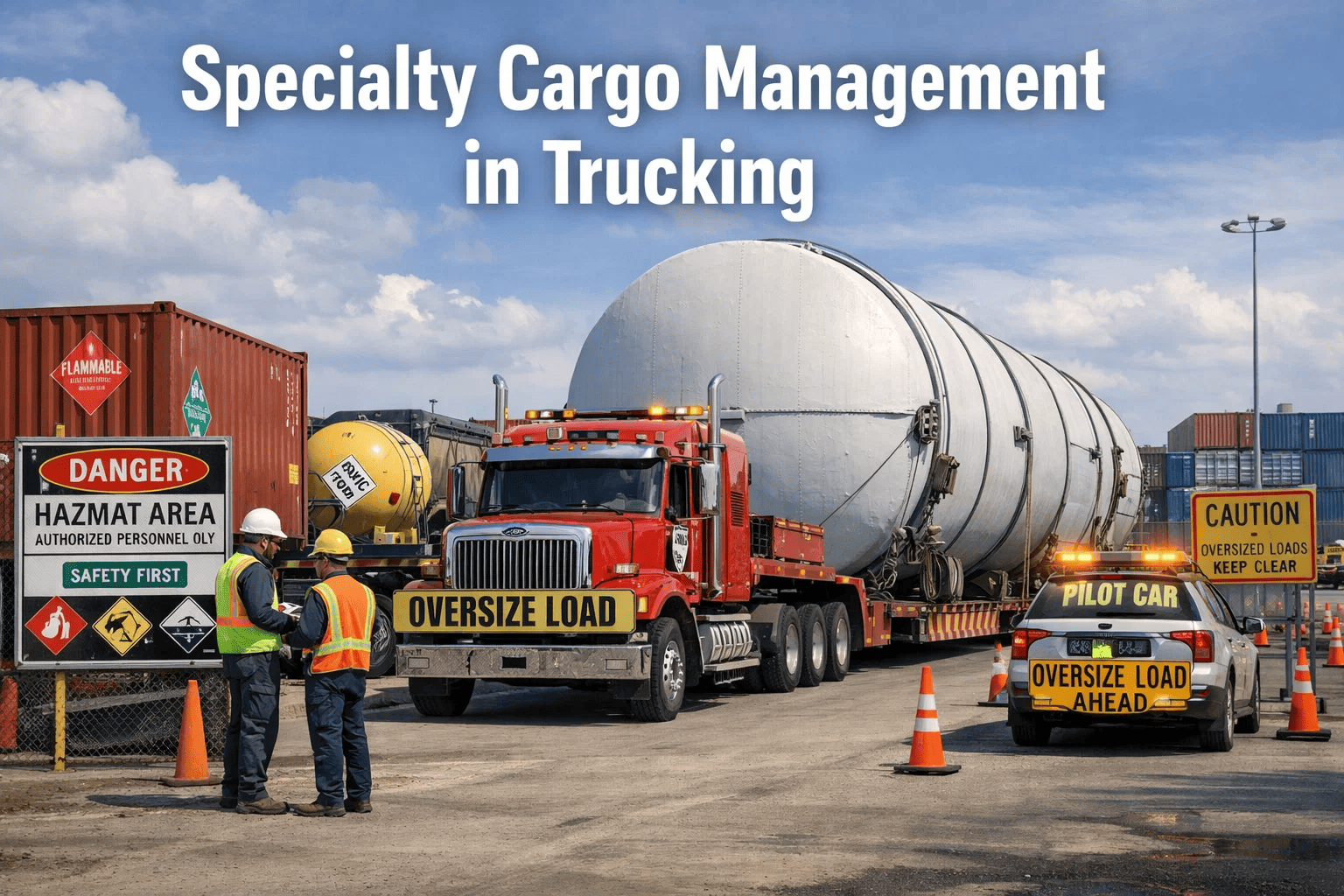
Specialty cargo operations encompassing hazardous materials transport regulated under 49 CFR Parts 171-180, oversized and overweight loads requiring state permits and pilot car escorts, temperature-controlled pharmaceutical freight, and high-value or security-sensitive shipments impose compliance obligations, equipment requirements, driver qualification standards, and documentation disciplines that go substantially beyond the baseline requirements for general freight. Carriers who enter specialty cargo markets without a systematic compliance infrastructure consistently underestimate the operational complexity accepting loads they are not permitted or equipped to carry, dispatching drivers who lack specific endorsements or training certifications for the cargo type, generating incomplete shipping papers that create regulatory exposure at inspection, and managing post-incident situations without the documentation that proves regulatory compliance at the time of the event. Book a demo to see how FleetRabbit's driver management, vehicle records, compliance tracking, and maintenance documentation support specialty cargo operational requirements.
Specialty cargo management requires carriers to maintain a compliance infrastructure that matches the specific regulatory tier of each cargo type they transport driver endorsements and training certifications, vehicle equipment and placard requirements, shipping paper documentation, emergency response planning, and route restrictions all vary by cargo classification in ways that create genuine complexity for carriers managing mixed specialty freight portfolios. This guide covers each major specialty cargo category's primary requirements, the fleet management system capabilities that support compliance documentation, and how FleetRabbit's driver credentials, vehicle records, and maintenance management apply to specialty cargo operational requirements.
Hazardous Materials: The Most Regulated Specialty Cargo Category
Hazardous materials transportation under 49 CFR Parts 171 through 180 represents the most extensively regulated specialty cargo category in commercial trucking — encompassing the classification, packaging, marking, labeling, placarding, shipping paper, emergency response information, driver training, vehicle inspection, and incident reporting requirements that collectively constitute the Hazardous Materials Regulations (HMR). Carriers authorized to transport hazardous materials must maintain an operational compliance infrastructure that satisfies all of these requirements simultaneously , a shipping paper missing one required field is a violation regardless of how thoroughly the other requirements were met.
Oversize and Overweight Loads: Permit Operations and Safety Escorts
Oversized and overweight load transportation — loads exceeding statutory width (8.5 feet), height (13.5 to 14 feet depending on state), length (typically 48 or 53 feet for commercial vehicles), or weight (80,000 pounds gross vehicle weight for standard 5-axle configuration) — requires state-issued special permits, route-specific authorization, pilot car escorts in most configurations, travel time restrictions, and flagging or lighting requirements that vary materially by state. A carrier managing oversize loads across multiple states must navigate the permit requirements of each state traversed — a single interstate oversize move may require permits from 3 to 5 states, each with different dimensional thresholds, different route restrictions, and different escort configuration requirements.
| Dimension Exceeded | Typical Threshold | Permit Required | Escort Typical Requirement | Travel Restriction |
|---|---|---|---|---|
| Width | Over 8.5 feet | State oversize permit — all states traversed | Rear escort at 12-14 ft; front escort typically required at 16+ ft | Daylight travel only in most states above 14 ft wide |
| Height | Over 13.5-14.5 ft (varies by state) | State permit with route survey for clearance structures | Height pole vehicle for low-clearance structures on route | Route-specific based on structure survey results |
| Length | Over 53-65 ft (varies by state) | State permit — some states require route approval | Rear escort in many states above 75 ft | No travel on restricted roads — route permit specific |
| Weight — Single Axle | Over 20,000 lbs | State overweight permit — bridge formula analysis | Escort varies by GVW and state policy | Spring weight restrictions apply on rural roads |
| Weight — Gross | Over 80,000 lbs | State overweight permit — all states traversed | Escort requirement increases with GVW above 105K lbs in many states | Night travel often prohibited; designated routes only |
Manage Driver Credentials, Vehicle Records, and Compliance Documentation for Specialty Cargo in FleetRabbit
FleetRabbit's driver management module tracks endorsements, certifications, and training dates — alerting fleet managers before credentials expire so specialty cargo operations are not interrupted by compliance gaps. Book a demo to review FleetRabbit's credential tracking and compliance documentation for your specialty cargo operations.
Temperature-Controlled Freight: FDA FSMA and Operational Requirements
Temperature-controlled freight — pharmaceutical products, food products subject to FDA Food Safety Modernization Act (FSMA) Sanitary Transportation of Human and Animal Food rule, and temperature-sensitive chemical or biological shipments — imposes equipment qualification, temperature monitoring, sanitation, and documentation requirements that span both federal regulatory obligations and shipper contractual specifications. The FDA FSMA Sanitary Transportation rule (21 CFR Part 1, Subpart O) establishes temperature controls, vehicle and equipment conditions, training, and records requirements for shippers and carriers of food requiring temperature control for safety.
Driver Credential Management for Specialty Cargo Operations
Specialty cargo operations impose specific driver qualification requirements that layer on top of the baseline FMCSA driver qualification standards — CDL endorsements (hazmat, tanker, doubles/triples), cargo-specific training certifications (hazmat employee training, FSMA sanitary transportation training, security awareness training for certain shipments), and any shipper-mandated qualification standards. Managing these layered credential requirements across a fleet of drivers who may have different combinations of specialty cargo qualifications — some hazmat-endorsed, some tanker-endorsed, some with both, some with neither — requires a credential tracking system that captures each driver's specific authorization matrix and alerts fleet managers before any credential expires or a driver who takes a specialty load is not qualified for it.
FleetRabbit's driver management module tracks driver credentials including CDL endorsement types, medical certificate expiration, training completion records, and any custom credential categories the carrier creates for specialty cargo authorization tracking. When a specialty load is assigned to a driver, FleetRabbit's driver profile shows whether that driver's credentials are current for the specific cargo type — preventing dispatch of an unqualified driver on a specialty load. For drivers approaching credential expiration, FleetRabbit's alert system notifies fleet managers before the expiration date — allowing credential renewal to be scheduled without the operational disruption of a lapsed credential audit failure. Book a demo to review FleetRabbit's driver credential tracking configuration for specialty cargo operations.
| Cargo Type | CDL Endorsement | Required Training | Retention Period | FleetRabbit Tracking |
|---|---|---|---|---|
| Hazardous Materials | H Endorsement (TSA Cleared) | HM Employee Training — 49 CFR 172.700 | 3 years from training date | Endorsement expiry + training completion date tracked with alerts |
| Bulk Liquid (Tank Vehicle) | N Endorsement | Tank vehicle operation — CDL skills test | CDL renewal cycle | Endorsement recorded in driver credential record |
| HazMat in Tank Vehicle | X Endorsement (H + N combined) | Both HM Employee Training and tank vehicle qualification | 3 years for HM training; CDL cycle for endorsement | Combined endorsement tracked — both training and credential expiry alerts |
| Temperature-Controlled Food (FSMA) | No additional endorsement | FDA Sanitary Transportation training per carrier program | Carrier-defined; 3 years recommended to align with HM | Custom training certification tracked in driver records |
| Oversized / Overweight Load | No separate endorsement | Carrier oversize load procedure training; some states require escort driver certification | Carrier-defined refresh cycle | Custom oversize qualification flag in driver profile |
Frequently Asked Questions
Build the Compliance Infrastructure Your Specialty Cargo Operations Require
FleetRabbit's driver credential tracking, vehicle maintenance records, inspection documentation, and load record management provide the fleet management foundation for hazardous materials, oversize load, temperature-controlled, and high-value specialty cargo compliance.