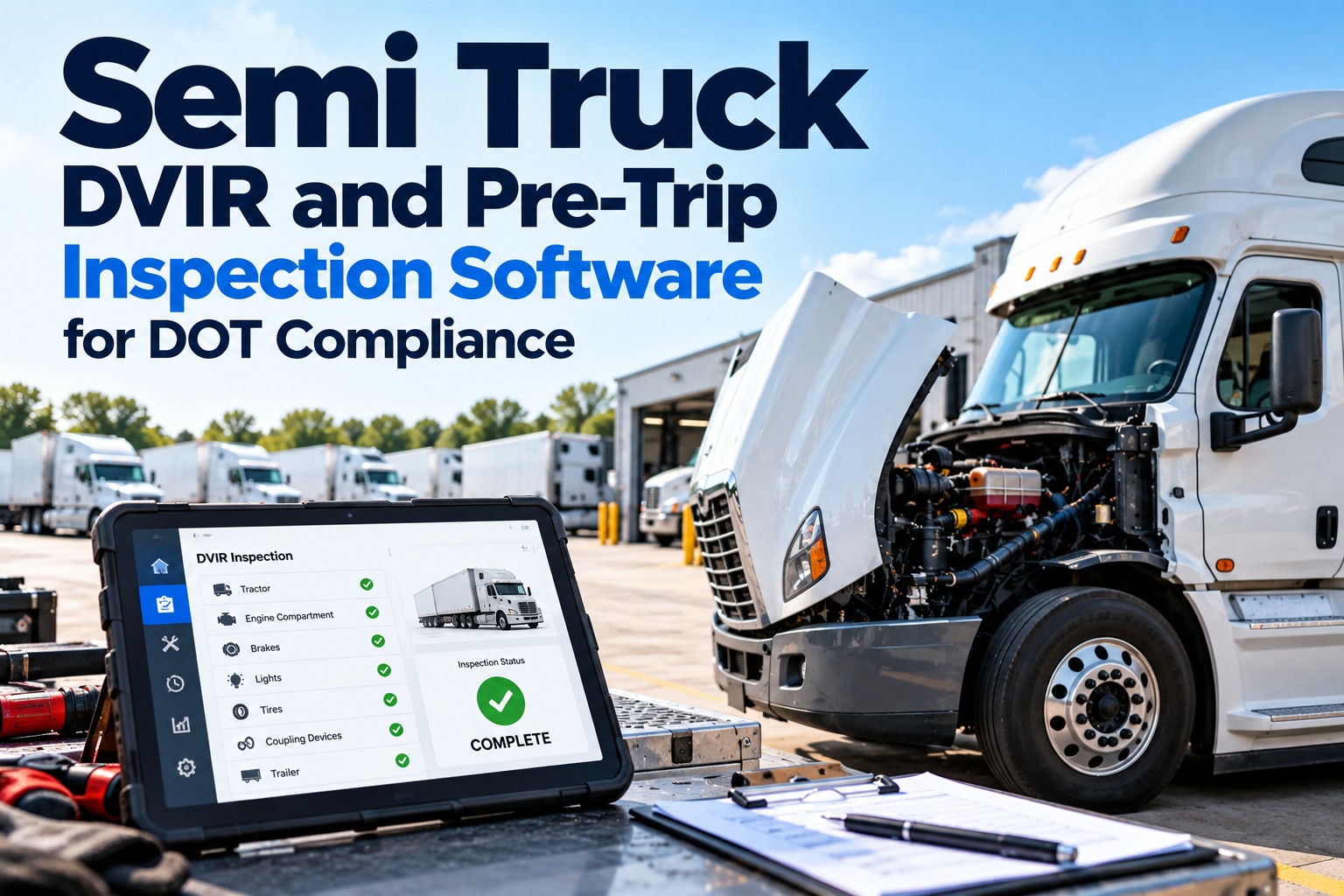
The daily vehicle inspection report stands between your fleet and thousands of dollars in DOT fines, civil penalties, and crash liability. Yet across the trucking industry, driver vehicle inspection reports remain inconsistent — some drivers complete thorough walkarounds and document every deficiency while others rush through the process or skip inspections entirely. The difference comes down to the inspection tool itself. A well-designed DVIR template guides drivers through a complete, DOT-compliant inspection sequence, documents defects unambiguously, and creates auditable records that protect your fleet during roadside inspections and litigation. Poorly designed forms produce inconsistent results, missed defects, and compliance exposure.
DVIR
Compliance
High Priority
8 min read
Template Overview
This guide provides a complete driver vehicle inspection report framework for commercial motor carriers — including a DOT-compliant DVIR template structure, pre-trip and post-trip inspection sequences, defect documentation standards, certification requirements, and implementation guidance for fleets transitioning from paper to digital inspection systems. The template meets Federal Motor Carrier Safety Administration requirements under 49 CFR Part 396 and applies to all commercial motor vehicles operating in interstate commerce.
30%
of roadside out-of-service violations involve brake system defects that a proper DVIR inspection would have identified before the vehicle entered service
7%
reduction in crash risk for fleets with consistently completed, high-quality daily vehicle inspection reports compared to fleets with incomplete or inconsistent inspection documentation
$8,000
to $15,000 — typical civil penalty range for carriers cited for falsified or missing DVIR records during a compliance review
14,000+
annual DOT roadside inspections where missing or incomplete DVIRs contribute to out-of-service orders
Why DVIR Compliance Matters More Than Ever
The Federal Motor Carrier Safety Administration has intensified enforcement of daily inspection documentation requirements. Under 49 CFR 396.11, every driver of a commercial motor vehicle must prepare a written report at the completion of each day's work documenting any defects or deficiencies discovered during inspection. Carriers must maintain these records for three months and make them available during compliance reviews and roadside inspections. Failure to produce complete, accurate DVIRs triggers civil penalties that range from hundreds to thousands of dollars per violation — and repeat violations can escalate to willful non-compliance charges with substantially higher fines.
Beyond regulatory compliance, DVIR documentation serves as your fleet's primary defense in crash litigation. Plaintiff attorneys routinely request DVIR records in truck accident cases. Missing reports, incomplete inspections, or unsigned certifications become evidence of negligent maintenance practices. A complete, properly executed DVIR demonstrates that your fleet met its regulatory obligation to inspect vehicles and correct identified defects — a crucial element of the legal standard of care for motor carriers.
Compliance Requirement
Driver Certification of Post-Trip Inspection
Every driver must prepare a written report at the completion of each day's work. The report must identify the vehicle, list any defects discovered, and include the driver's signature and certification date. If no defects are found, the driver must still prepare a report indicating that no defects were discovered. The certification cannot be completed before the driver actually performs the inspection — pre-dating inspection reports constitutes falsification under FMCSA enforcement policies.
Compliance Requirement
Motor Carrier Review and Certification
Carriers must review each DVIR and certify that any listed defects have been repaired before permitting the driver to operate the vehicle again. The repair certification must include the date of repair and the name of the mechanic or repair facility. Carriers cannot simply acknowledge defects — they must document correction. This review and certification obligation applies regardless of whether the defect was discovered during pre-trip or post-trip inspection.
Compliance Requirement
Pre-Trip Inspection Responsibility
While FMCSA regulations require written post-trip reports, the pre-trip inspection remains a driver responsibility whether or not regulation explicitly requires a written pre-trip DVIR. Drivers operating a vehicle from a previous driver must review the prior driver's post-trip report and conduct their own pre-trip inspection. Any defects discovered during pre-trip must be reported before the vehicle enters service — and carriers cannot dispatch a vehicle with known safety defects.
Compliance Requirement
Record Retention Requirements
Carriers must retain all DVIRs for at least three months from the date of the report. Records must be maintained in an organised system that allows for retrieval during compliance reviews and roadside inspections. Electronic DVIR systems must include audit trail functionality that prevents alteration of completed reports and documents any changes made after initial certification.
Essential Components of a DOT-Compliant DVIR Template
DVIR templates vary widely in quality and completeness. Effective inspection forms include ten essential components that together satisfy FMCSA regulatory requirements while providing useful maintenance data to fleet managers. Each component serves a specific documentation or compliance function.
01
Vehicle Identification Section
The template must uniquely identify the inspected vehicle — typically through fleet ID number, license plate, VIN, trailer number, and vehicle type designation. This information links the inspection record to the correct asset in maintenance and compliance systems. For combination vehicles, the template must identify both tractor and trailer separately, as each requires its own inspection and defect documentation.
02
Driver Information and Certification
The driver's printed name, signature, employee ID or license number, and certification date establish who performed the inspection and when. The signature block must include a certification statement indicating the driver personally conducted the inspection and accurately reported all defects. Unsigned or undated DVIRs are invalid for compliance purposes and provide no litigation protection.
03
Mileage and Hours Documentation
Current odometer reading and engine hour meter reading (if available) create a temporal record linking the inspection to a specific point in vehicle operation. These values also support maintenance scheduling by documenting the operating conditions at the time of inspection. Inconsistent or missing mileage readings are common findings during FMCSA compliance reviews.
04
Inspection Type and Date-Time Stamp
The template must distinguish between pre-trip and post-trip inspections. For post-trip reports, the date and time of inspection are required. For pre-trip reports where a driver is reviewing a prior driver's post-trip findings, the template must capture both the previous driver's report date and the current driver's review date. Electronic systems must generate unalterable time-date stamps for all records.
05
Complete Inspection Checklist
The checklist must cover all FMCSA-required inspection items as defined in 49 CFR 396.13: brake system, steering system, lighting devices and reflectors, tyres and wheels, coupling devices, windshield and mirrors, exhaust system, fuel system, emergency equipment, and cargo securement. Each system requires a simple pass-fail indicator with space for defect description when failed. Generic checklists that skip safety-critical systems do not satisfy regulatory requirements.
06
Defect Documentation Section
When a driver identifies a defect, the template must provide space for specific documentation: which component is affected, the nature of the defect (using standard terminology), and whether the defect constitutes an out-of-service condition under FMCSA regulations. Vague defect descriptions such as brake problem or light out create ambiguity and complicate repair verification. The template should guide drivers to provide specific, actionable defect descriptions.
07
Unscheduled Repair Log
The template should include a dedicated section listing any repairs performed outside the normal maintenance schedule — including field repairs, roadside fixes, and emergency maintenance. This log creates visibility into reliability issues that may indicate component quality problems or undetected operating conditions. Unscheduled repairs recorded on DVIRs provide early warning of developing maintenance patterns.
08
Motor Carrier Review and Repair Certification
The carrier certification section must provide space for the reviewing fleet manager or mechanic to document review date, certification of defect correction, and repair facility or mechanic identification. This section satisfies the regulatory requirement that carriers review all DVIRs and certify repair of reported defects before the vehicle returns to service. Absence of carrier certification renders the DVIR incomplete for compliance purposes.
09
Safety-Related Defect Priority Indicator
While not a regulatory requirement, effective DVIR templates include a priority indicator allowing drivers to flag safety-critical defects requiring immediate attention: brakes, steering, tyres, lights, and coupling devices. This feature ensures that urgent maintenance needs bypass normal workflow queues and receive immediate repair action. Many out-of-service violations occur because safety-critical defects captured on DVIRs were not prioritised for rapid correction.
10
Qualified Inspector Certification Statement
The template must include a certification statement where the driver affirms that they are qualified to perform the inspection — meaning they understand what constitutes a defect and possess the training to identify safety-critical conditions. This certification, combined with the driver signature, establishes the legal foundation for compliance enforcement. Drivers cannot delegate inspection responsibility to unqualified assistants.
Pre-Trip vs. Post-Trip DVIR Requirements
Many drivers and fleet managers misunderstand the distinct regulatory requirements for pre-trip and post-trip inspections. While both are essential for safety and compliance, the regulatory obligations differ. The table below clarifies the requirements for each inspection type and the DVIR documentation each requires.
Inspection Type
Regulatory Requirement
Documentation Required
Post-Trip Inspection
Required by 49 CFR 396.11 — driver must prepare written report at completion of each day's work identifying defects discovered
Complete DVIR with driver signature, vehicle identification, defect listing or no-defect declaration, date and time of inspection, current odometer reading
Pre-Trip Inspection
Required by 49 CFR 396.13 — driver must review prior driver's post-trip report and conduct inspection; no separate written pre-trip report required unless defect found
Driver review of previous DVIR documented in carrier records; written pre-trip report only required if defects discovered before vehicle enters service
Driver Review of Prior Report
Required each time a driver operates a vehicle not previously inspected by that driver — driver must review prior driver's post-trip report before operating
No separate document required — but carrier must demonstrate during audit that review process exists and driver conducted review
No-Defect Report
Required even when no defects discovered — every post-trip inspection requires a written report documenting zero defects
Complete DVIR indicating no defects discovered — driver signature, vehicle ID, date, odometer reading, and certification statement required
Fleet managers should implement documented procedures covering both inspection types. Post-trip DVIRs create the permanent record. Pre-trip inspection completion requires training and accountability but does not generate a separate written report unless the driver discovers a defect that makes the vehicle unsafe. Many fleets choose to require written pre-trip DVIRs anyway — this practice creates additional documentation of inspection completion but is not mandated by regulation.
DVIR Template Structure for Commercial Vehicles
The inspection checklist included in your DVIR template must cover all FMCSA-required inspection items. The following structure organises inspection items by vehicle system and provides clear pass-fail criteria for each component.
Brake System Inspection
Brake pedal feel and reserve distance — Air brake system pressure build time (2 psi per second minimum) — Low pressure warning device function — Parking brake hold — Brake lining thickness (visual) — Chamber stroke length — Slack adjuster operation — ABS malfunction indicator lamp. Any defect in brake system constitutes an out-of-service condition under FMCSA standards and requires immediate repair before vehicle dispatch.
Lighting and Electrical
Headlamps (high and low beam) — Turn signals (front and rear) — Brake lamps (all) — Tail lamps — Running lamps (including clearance and identification lamps) — Reverse lamps — License plate lamp — Hazard warning lamps — Reflector condition. Lighting defects are the most commonly cited roadside violation and the most frequently discovered deficiency on DVIRs. Each non-functioning lamp requires documentation with specific location (which lamp on which side of the vehicle).
Tyre and Wheel Inspection
Tyre tread depth measured in 32nds of an inch — Tyre pressure (cold) — Sidewall condition (cuts, bulges, weather cracking) — Wheel fastener torque indicators — Rim condition (cracks, dents, corrosion) — Hub seal leakage — Valve stem condition and caps. FMCSA requires minimum tread depth of 4/32-inch on steering axle tyres and 2/32-inch on all other positions. Any exposed belt material or significant sidewall damage constitutes out-of-service condition regardless of tread depth.
Coupling Devices
Fifth wheel mounting bolts — Fifth wheel locking mechanism — Release handle position and condition — Kingpin condition — Trailer electrical connection — Trailer air connection — Gladhand seals and alignment — Suspension air lines — Breakaway cable condition. Improper coupling or damaged coupling components create immediate crash risk. Any defect in coupling devices documented on DVIR requires correction before movement or immediate tow.
Steering and Suspension
Steering wheel free play (less than 10 degrees or 2 inches on 20-inch wheel) — Power steering fluid level and condition — Steering linkage wear (tie rod ends, drag link, kingpins) — Steering gear mounting — Suspension spring or air bag condition — Shock absorber condition — U-bolt torque — Axle alignment indicators. Steering defects are always out-of-service conditions. Drivers discovering steering play, loose components, or unusual steering feel must document the defect and refuse dispatch until repairs complete.
Glass, Mirrors, and Visibility
Windshield condition (no cracks affecting driver vision) — Side window condition — Rear window condition (if equipped) — Driver side mirror condition and adjustment — Passenger side mirror condition — Heated mirror function — Wiper blade condition — Washer fluid level — Washer function — Defroster and defogger function. Windshield cracks over 1/2-inch at any point or cracks intersecting the driver's primary field of view require repair before dispatch in most enforcement jurisdictions.
Exhaust and Fuel Systems
Exhaust system leaks (audible or visible) — Exhaust pipe condition — Mounting hardware — Fuel tank cap seal — Fuel tank strap condition — Fuel line condition (cracking, chafing, leakage) — Fuel crossover line condition — No visible fuel leakage from any component. Exhaust leaks entering driver compartment are out-of-service conditions due to carbon monoxide exposure risk. Fuel leaks regardless of size require immediate correction due to fire hazard and environmental release liability.
Emergency Equipment
Fire extinguisher — charge indicator in green zone, seal intact — Three reflective triangles — condition and quantity — Spare fuses (if equipped) — Emergency contact information in cab — First aid kit (if required) — Reflective vest condition and accessibility. Missing emergency equipment is a citable violation during roadside inspection. Drivers must verify equipment presence and condition during each post-trip inspection and document any deficiencies.
Cargo Securement
Cargo securement devices — number and condition — Working load limit of securement devices — Tiedown arrangement (number of tiedowns based on cargo length) — Blocking and bracing condition — Edge protection condition — Cargo retention devices (headache rack, bulkhead) condition — Cargo weight distribution. Defective cargo securement is a primary focus of roadside enforcement. Drivers discovering securement defects during pre-trip inspection must refuse dispatch or obtain correction before movement.
Driver Certification and Sign-Off
Driver printed name — Driver signature — Date of inspection — Time of inspection (post-trip only) — Odometer reading at time of inspection — Engine hour reading — No-defect certification check box — Driver qualification self-certification — Responsible carrier name and USDOT number. This section creates the legal record of inspection completion. No DVIR is valid for compliance purposes without driver signature and date.
Defect Documentation Standards for DVIRs
The quality of defect documentation on DVIRs directly affects repair effectiveness and regulatory defence. Vague defect descriptions such as brake issue do not provide sufficient information for mechanics to locate and correct the problem — and do not satisfy regulatory requirements for specific defect identification. Effective DVIR defect documentation follows a standardised format.
Required Documentation Elements
Specific Component Identification
Every defect description must identify exactly which component failed — by position on the vehicle when applicable (left front, right rear, trailer third axle left side). Component identification reduces diagnostic time and ensures mechanics inspect the correct part. Example: Right front brake chamber instead of just brake problem. Left rear turn signal instead of light out.
Required Documentation Elements
Defect Nature and Severity
Describe the specific condition discovered rather than the suspected cause. Use standard mechanical terminology to ensure the repair technician understands the observation. Include measurements when applicable. Example: Brake lining 1/8-inch remaining above wear indicator instead of brakes low. Tyre tread depth 2/32-inch at center groove — down to wear bars instead of tyre low on tread.
Required Documentation Elements
Out-Of-Service Status Indicator
Drivers must indicate whether each discovered defect would place the vehicle out-of-service under FMCSA criteria. This determination requires driver training on out-of-service criteria. False identification of non-critical defects as out-of-service conditions creates unnecessary downtime. Failure to identify true out-of-service conditions results in compliance violations if the vehicle is dispatched or continues operating with the defect uncorrected.
Required Documentation Elements
Driver-Fixable Defect vs. Shop Repair
Distinguish between defects the driver can correct without maintenance facility support — burned-out light bulbs, low tyre pressure, low fluid levels — and defects requiring shop intervention. Driver-fixable defects should be corrected before the next dispatch and documented on the DVIR along with the driver's corrective action. Shop-required defects must route to maintenance facility with appropriate priority based on safety severity.
From Paper to Digital DVIR: Implementation Roadmap
Paper DVIR forms create three structural problems for fleet compliance: lost or damaged records, illegible handwriting that complicates defect interpretation, and manual data entry overhead for maintenance tracking. Electronic DVIR systems eliminate these problems while adding automated compliance features. The implementation roadmap below guides fleets transitioning from paper to digital inspections.
Phase One: Driver Mobile App Deployment
Deploy mobile inspection application to all drivers. The app must replicate the complete DVIR template structure while adding digital convenience features: photo capture for defect documentation, speech-to-text defect description, electronic signature capture, and geotagged time-date stamps. Train drivers on app navigation and defect documentation standards. Run paper and digital DVIRs in parallel for 30 to 45 days to validate system functionality and driver proficiency.
Phase Two: Maintenance Workflow Integration
Configure digital DVIR system to automatically route defect reports to maintenance management system. Defects flagged as safety-critical or out-of-service conditions trigger immediate notification to shop supervisors. Non-critical defects populate next-service work orders. This integration eliminates manual data entry from paper DVIRs and reduces the delay between defect discovery and repair action.
Phase Three: Compliance Audit Trail Implementation
Electronic DVIR systems must include audit trail functionality that meets FMCSA electronic record requirements. The system must prevent alteration of completed DVIRs, document any changes made to records, maintain unalterable time-date stamps for all transactions, and produce retrievable records for compliance reviews. Systems lacking these features do not satisfy electronic record retention requirements despite being digital.
Phase Four: Continuous Quality Monitoring
Use digital DVIR data to monitor inspection quality across the fleet. Track completion rates by driver, defect discovery rates compared to fleet average, defect description quality scores, and timeliness of repair certification. Identify drivers with unusually low defect discovery rates — these drivers may be skipping inspection steps or failing to recognise defects. Target low performers for retraining.
Digitise Your DVIR Process with FleetRabbit
FleetRabbit's digital DVIR module provides DOT-compliant inspection forms, defect photo capture, automated maintenance workflow routing, and complete compliance audit trails — eliminating paper records and reducing inspection gaps across your fleet.
Common DVIR Mistakes That Trigger DOT Citations
FMCSA compliance reviewers and roadside inspectors look for specific DVIR deficiencies during audits. The most common mistakes documented during compliance reviews lead directly to citations, fines, and in severe cases, out-of-service orders for the entire fleet. Avoiding these errors requires both driver training and management oversight.
Mistake 1: Missing or Incomplete Driver Signature
Unsigned DVIRs are invalid for compliance purposes. Partial signatures, missing dates, or signature blocks completed by someone other than the driver invalidate the entire inspection record. Solution: require electronic signature capture at completion of each DVIR with system-enforced requirement that signature block cannot be bypassed. Conduct random audits verifying that signatures match driver identity.
Mistake 2: No-Defect Reports Missing or Incomplete
Every post-trip inspection requires a written report regardless of whether defects were discovered. Fleets that require reports only when drivers find defects are non-compliant. Solution: require DVIR completion after every dispatch regardless of inspection findings. Digital systems should not permit driver logout without completing the inspection report.
Mistake 3: Vague Defect Descriptions
Defect descriptions must provide sufficient specificity for mechanics to locate and repair the issue. Light out without location specification provides no actionable information. Solution: train drivers to include component position in every defect description. Example: Left rear turn signal not flashing instead of light out.
Mistake 4: Missing Carrier Repair Certification
DVIRs documenting defects are incomplete until the carrier certifies that defects have been repaired. Many fleets capture driver inspection reports but fail to complete the repair certification section before returning the vehicle to service. Solution: establish workflow requiring maintenance sign-off on all DVIR-identified defects before vehicle dispatch clearance.
Mistake 5: Pre-Dated or Back-Dated Inspections
Drivers completing inspection reports before conducting actual inspections falsify records. Pre-dating DVIRs also misrepresents inspection timing relative to vehicle operation. Solution: digital DVIR systems with unalterable time-date stamps and geotagging prevent pre-dating and provide enforcement auditors positive proof of inspection timing.
Mistake 6: Failure to Document Prior Report Review
Drivers have a regulatory obligation to review prior driver's post-trip report before operating a vehicle. Fleets without documented procedures or systems to track this review cannot demonstrate compliance. Solution: digital DVIR systems that require driver acknowledgment of prior report review before accepting dispatch.
What Industry Leaders Say About DVIR Implementation
Our paper DVIR system was generating thousands of forms each year that we stored in boxes and never reviewed for maintenance trends. Drivers hated the clipboard routine. Mechanics complained about illegible handwriting. And we had no way to verify that inspections were actually happening. Moving to digital DVIRs changed everything. Now we know within minutes when a driver discovers a defect, maintenance gets the repair order automatically, and our compliance audit trail is complete. Our roadside violation rate dropped by 40 percent in the first six months.
Safety and Compliance Director
Regional Carrier, 175 Power Units
The DVIR templates we designed with FleetRabbit have completely standardised how our drivers document defects. Before the template, we received defect reports like trailer issue — useless for maintenance planning. Now every defect includes the specific component, location on the vehicle, and measured condition. Our shop supervisor can look at the DVIR and know exactly what part to pull before the truck even arrives. That efficiency saves us hours of diagnostic time every week.
Maintenance Manager
Food-Grade Tanker Fleet, 85 Vehicles
Is a DVIR required every day for every commercial vehicle?
Yes. Under 49 CFR 396.11, every driver who operates a commercial motor vehicle must prepare a written DVIR at the completion of each day's work — or at the completion of each trip if the trip exceeds one day. The requirement applies regardless of whether the driver discovers any defects. No-defect reports satisfy the regulatory requirement. Vehicles operated by multiple drivers in a single day require a DVIR from each driver at the completion of their driving segment.
What is the difference between a DVIR and a pre-trip inspection?
The regulatory DVIR requirement specifically applies to post-trip inspections — written reports prepared after driving is complete. Pre-trip inspections are separately required under 49 CFR 396.13, which requires drivers to review the prior driver's DVIR and conduct their own inspection before operating the vehicle. However, the regulation does not require a separate written report for pre-trip inspections unless the driver discovers defects that make the vehicle unsafe. Many carriers require written pre-trip DVIRs anyway as a best practice for documentation and driver accountability.
How long must carriers retain DVIR records?
FMCSA requires carriers to retain all DVIRs for at least three months from the date of the report. However, records related to accidents, enforcement actions, or compliance reviews should be retained for the duration of any related legal proceeding plus the applicable statute of limitations — typically three to five years. Electronic DVIR systems must maintain unalterable records with audit trails for the entire retention period.
Book a demo to see how FleetRabbit manages DVIR retention and compliance audits.
Can a driver perform a DVIR inspection on their phone or tablet?
Yes. FMCSA regulations permit electronic DVIRs on mobile devices provided the system meets electronic record requirements: unalterable time-date stamps, secure driver authentication, complete audit trails, and ability to produce records during roadside inspections or compliance reviews. Mobile DVIR apps must also capture driver signature electronically. Paper printouts of electronic records satisfy inspection documentation requirements if produced on demand.
Book a demo to see FleetRabbit's mobile-first DVIR application.
What happens if a driver discovers an out-of-service defect during pre-trip inspection?
When a driver discovers an out-of-service defect during pre-trip inspection, the vehicle cannot enter service until the defect is corrected. The driver must document the defect on a DVIR — either the prior driver's post-trip report addendum or a new pre-trip DVIR depending on carrier procedure. The carrier must certify repair completion before permitting dispatch. Operating a vehicle with a known out-of-service defect exposes the carrier to significant civil penalties, potential criminal charges if an accident occurs, and immediate out-of-service order from any inspecting officer.
Download Your DOT-Compliant DVIR Template and Start Digitising Today
FleetRabbit's digital DVIR system provides complete FMCSA-compliant inspection forms for tractors and trailers, defect photo capture, automated maintenance alerts, and compliance-ready record keeping — eliminating paper forms and reducing inspection gaps across your fleet.
DVIR Template
Driver Vehicle Inspection Report
FMCSA Compliance
Digital Inspection
Defect Tracking
DOT Inspection Forms
April 25, 2026
By Jason Smith
All Posts