Fleet maintenance has a predictable pattern across the industry: a truck misses a scheduled oil change, then a brake inspection is deferred, and six months later, that same vehicle is on the shoulder of a highway with a preventable failure and a tow truck bill that exceeds the cost of an entire year of preventive maintenance. Preventive maintenance scheduling is fleet management's highest-return activity — every dollar invested in planned maintenance returns three to five dollars in avoided breakdown costs, reduced downtime, and extended vehicle life. Yet many commercial fleets still rely on manual spreadsheets, scattered service records, and maintenance supervisor memory to schedule PM services. The result is missed intervals, reactive repairs, and vehicle lifecycles shortened by thousands of operating hours.
Preventive Maintenance
Fleet Templates
High Priority
8 min read
Template Overview
This guide provides a complete preventive maintenance schedule framework for commercial trucks and fleet vehicles — including interval specifications by mileage and engine hours, inspection checklists for Class 5 through Class 8 vehicles, seasonal maintenance requirements, and a downloadable template structure that integrates with existing fleet management workflows. Use this template to standardise PM procedures across your fleet, document service completion, and build the maintenance history that supports resale value and regulatory compliance.
3 TO 5 TIMES
return on preventive maintenance investment — every dollar spent on planned service avoids three to five dollars in breakdown repairs and downtime costs
22%
reduction in roadside breakdowns when fleets implement a standardised PM schedule with documented inspection procedures
40%
longer vehicle life achievable through consistent preventive maintenance compared to reactive maintenance programmes
18-24 MONTHS
payback period for implementing a fleet-wide preventive maintenance scheduling system — including software and process changes
Why Your Fleet Needs a Standardised Preventive Maintenance Template
Fleet maintenance supervisors face a fundamental information problem. Service intervals vary by vehicle make, model, engine type, operating conditions, and duty cycle. Component replacement schedules differ for oil, filters, brakes, tyres, transmission fluid, coolant, and dozens of other wearable parts. Without a standardised template that consolidates these requirements into a single vehicle-specific schedule, maintenance becomes inconsistent — and inconsistency is the root cause of most preventable breakdowns.
A standardised preventive maintenance template accomplishes three critical objectives. First, it eliminates the reliance on institutional knowledge that walks out the door when experienced technicians retire or change employers. Second, it creates service consistency across the fleet — every vehicle receives the same inspection depth and component replacement criteria regardless of which technician performs the work. Third, it generates the documentation required for warranty claims, DOT inspections, and resale transactions. Fleets operating without a standardised PM template typically experience 15 to 25 percent higher unscheduled maintenance ratios than fleets with documented, consistently applied schedules.
Template Benefit
Reduced Breakdown Frequency
Standardised PM templates ensure every vehicle receives complete, consistent inspections at proper intervals. When fleets implement documented inspection checklists tied to mileage and hour thresholds, roadside breakdowns from preventable causes — failed belts, low fluid levels, worn brake components — drop by 20 to 25 percent within the first six months. The template creates accountability: service completion is documented, and missed intervals become immediately visible to maintenance supervisors.
Template Benefit
Extended Component Life
Preventive maintenance templates that specify replacement intervals for wearable components extend the useful life of those components. Engines maintained on documented schedules last 30 to 40 percent longer than those receiving irregular service. Brake component life increases by 20 to 25 percent with consistent inspection and timely replacement. Tyre life improves by 15 percent with regular rotation and pressure checks specified in the PM template.
Template Benefit
Lower Total Cost of Ownership
The total cost of ownership for a Class 8 truck operating over 500,000 miles ranges from $0.85 to $1.15 per mile when maintenance is included. Fleets with documented, consistently applied preventive maintenance schedules achieve TCO in the lower half of this range. Fleets with reactive or inconsistent maintenance consistently exceed the upper range — typically by 10 to 15 percent — due to accelerated component wear and unscheduled downtime.
Template Benefit
Regulatory and Warranty Compliance
DOT roadside inspections examine maintenance records. Warranty claims require documented service history. Standardised PM templates generate the documentation both require — records that show services were performed at specified intervals using approved procedures and components. Fleets with complete maintenance documentation experience fewer compliance issues and higher warranty claim approval rates.
Essential Components of an Effective Truck PM Template
Not all preventive maintenance templates deliver equal value. Effective fleet PM templates include five essential components that transform a simple checklist into a complete fleet maintenance management tool. Each component addresses a specific gap in traditional maintenance tracking.
01
Vehicle Identification and Specification Data
The template must capture vehicle-specific information — make, model, year, VIN, engine type, transmission specification, GVWR classification, and current odometer reading and engine hours. This data determines which service intervals apply and which inspection items are relevant to that specific vehicle configuration. A single template that works across a mixed fleet requires fields for vehicle classification to trigger appropriate checklists.
02
Service Interval Schedule by Mileage and Hours
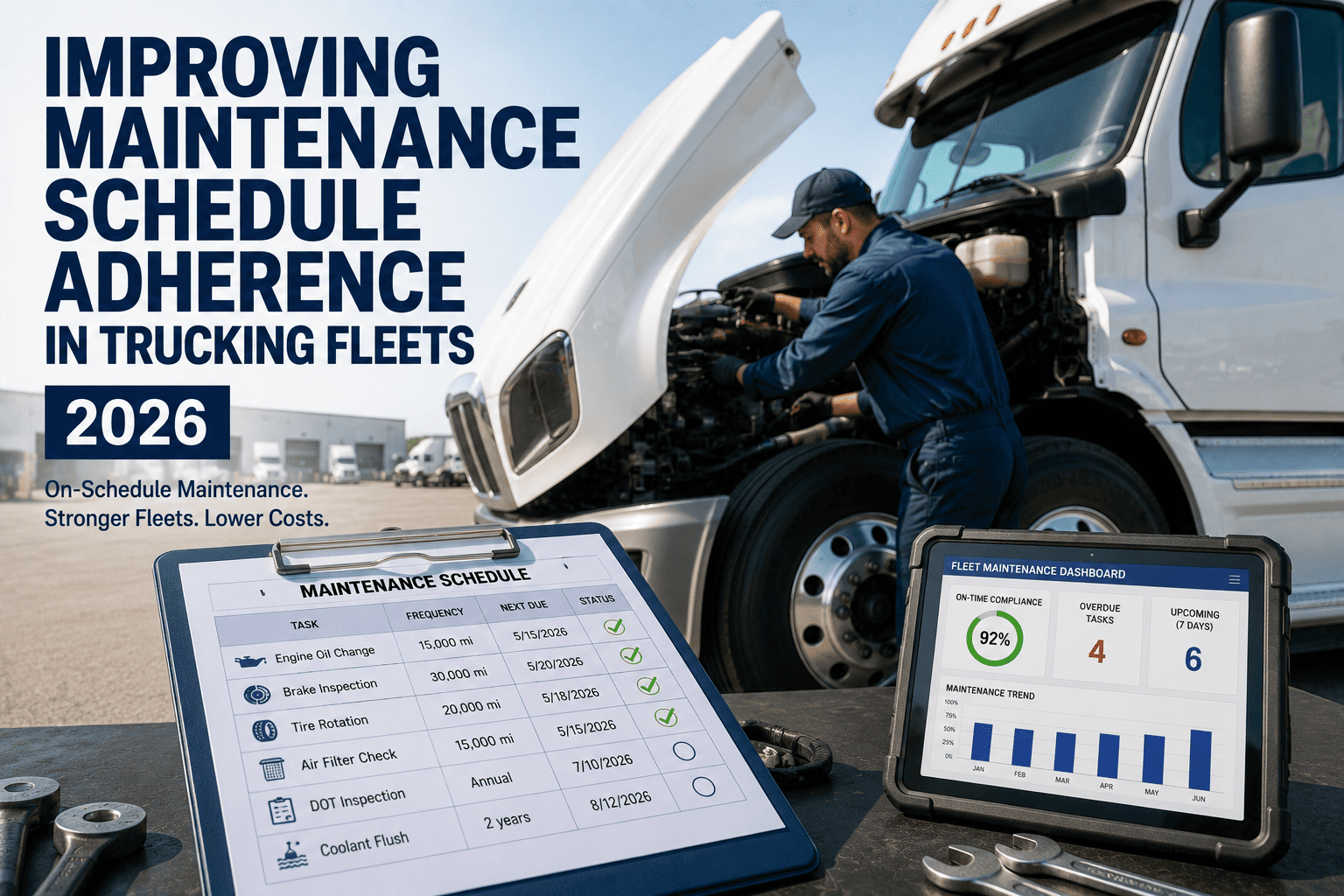
The template must specify exactly when each service is due — typically in 10,000 to 25,000 mile increments for most commercial truck applications, with engine-hour thresholds for vehicles that experience significant idle time. Service level definitions (PM-A, PM-B, PM-C) allow the template to distinguish between light inspections and comprehensive services. Each interval should list required tasks and component replacement criteria.
03
Inspection Checklist with Pass-Fail Criteria
The core of any PM template is the inspection checklist — a line-by-item list of every component requiring visual inspection, measurement, or operational test. Effective checklists include fluid levels and condition, belt and hose condition, brake system measurements, tyre tread depth and pressure, lighting system function, steering and suspension component wear, and exhaust system integrity. Each item must include clear pass-fail criteria that any qualified technician can apply consistently.
04
Service Documentation Section
The template must capture who performed the service, when it was completed, the odometer and hour readings at service time, which components were replaced, any deficiencies found and corrected, and any items deferred for future attention. This documentation section creates the maintenance history that supports resale value, warranty claims, and compliance audits. Without complete documentation, the service might as well not have occurred for compliance and resale purposes.
05
Next Service Due Calculation
An effective PM template drives future action, not just historical documentation. The template must include fields for calculating and recording the next service due mileage and due date based on the interval type performed. This forward-looking information enables the maintenance scheduler to pre-schedule upcoming services and prevents the missed intervals that lead to preventable failures. The template becomes a planning tool rather than merely a record-keeping document.
06
Seasonal and Operating Condition Addendums
Standard intervals assume standard operating conditions. Fleets operating in extreme environments — severe cold, high dust, stop-and-go urban routes, heavy gross weights, off-road applications — require shortened intervals and additional inspection items. The template must include addendum sections for seasonal requirements (winterisation, summer coolant checks) and operating condition adjustments (severe duty inspection items, extra lubrication points).
Preventive Maintenance Intervals for Commercial Trucks
Service intervals vary significantly based on vehicle class, engine type, duty cycle, and operating environment. The table below provides recommended preventive maintenance intervals for Class 5 through Class 8 commercial trucks operating under standard conditions. Fleets operating in severe duty environments should reduce these intervals by 20 to 30 percent.
Service Type
Diesel Engine Vehicles
All Vehicles
Oil and Filter Change
15,000 to 25,000 miles or 400 to 600 engine hours
Not applicable — electric vehicles require gearbox oil inspection every 50,000 miles
Fuel Filter Replacement
Every other oil change — 30,000 to 50,000 miles
Not applicable
Air Filter Inspection
Every 10,000 miles — replace at 25,000 to 40,000 miles depending on conditions
Cabin air filter inspection every 15,000 miles — replace at 30,000 miles
Brake Inspection
Every 25,000 miles — full brake service including lining measurement and chamber stroke check
Same interval — brake wear patterns differ but inspection requirements are identical for safety systems
Tyre Rotation and Inspection
Every 15,000 to 20,000 miles — including tread depth measurement, pressure check, and sidewall inspection
Same interval — tyre wear on electric vehicles may be accelerated due to higher torque and regenerative braking
Coolant System Service
Coolant level and freeze point check every oil change — full flush and replacement at 100,000 to 150,000 miles or 3 years
Battery thermal management coolant check every 25,000 miles — full replacement per manufacturer specification
Transmission Service
Fluid level and condition check every oil change — full fluid and filter change at 100,000 to 150,000 miles
Not applicable — electric drive units require fluid inspection at 50,000 mile intervals
Drive Belt Inspection
Every 25,000 miles — replace at 75,000 to 100,000 miles or at first sign of cracking or glazing
Not applicable — no engine drive belts on most electric vehicles
Chassis Lubrication
Every oil change — all grease fittings on steering, suspension, driveline, and fifth wheel components
Same interval — suspension and steering components require identical lubrication regardless of powertrain
Preventive Maintenance Checklist Template Structure
The template structure below provides a complete framework for documenting preventive maintenance on commercial trucks. Fleet managers can adapt this structure to their specific vehicle types, operating conditions, and service interval requirements. Each section of the template serves a specific documentation and compliance function.
Section 1: Vehicle Identification
Fleet ID Number, License Plate, VIN, Make, Model, Year, GVWR Classification, Primary Operating Location, Assigned Driver or Operator. This section uniquely identifies the vehicle and links the PM record to the correct asset in fleet management systems.
Section 2: Service Information
Service Date, Technician Name or ID, Current Odometer Reading, Current Engine Hours, Service Type Performed (PM-A, PM-B, PM-C), Next Service Due Odometer, Next Service Due Date. This section documents when service occurred and drives future scheduling.
Section 3: Fluid Inspection and Service
Engine Oil Level and Condition, Oil Filter Replacement, Coolant Level and Freeze Point, Transmission Fluid Level and Condition, Differential Fluid Level, Power Steering Fluid Level, Brake Fluid Level and Condition, Windshield Washer Fluid. Each item requires check-off and notes for off-specification conditions.
Section 4: Engine and Underhood Inspection
Air Filter Condition, Fuel Filter (primary and secondary), Drive Belt Condition and Tension, Hoses for Cracking or Softening, Exhaust System for Leaks or Damage, Engine Mounts, Turbocharger Inspection (diesel), Cooling Fan Operation. This section captures the component inspections that prevent underhood failures.
Section 5: Brake System Inspection
Brake Lining Thickness (steer, drive, trailer), Drum or Rotor Condition, Brake Chamber Stroke Measurement, Slack Adjuster Function, Air System Pressure Build Time, Low Pressure Warning Function, Parking Brake Hold Test, ABS Indicator Light Function. Brake inspection is the most safety-critical component of any PM template and requires documented measurements.
Section 6: Tyre and Wheel Inspection
Tyre Tread Depth (all positions) in 32nds of an inch, Tyre Pressure (cold), Sidewall Condition for Cuts or Bulges, Valve Stem Condition, Wheel Fastener Torque, Rim Condition, Hub Seal for Leaks. Tyre condition directly affects fuel efficiency, safety, and operating cost — each position requires individual recording.
Section 7: Steering and Suspension
Steering Linkage for Wear or Play, Kingpin Condition, Tie Rod Ends, Drag Link, Steering Gear Mounting, Shock Absorber Condition, Spring or Air Bag Condition, U-Bolt Torque, Alignment Inspection Notes. Worn steering and suspension components create safety hazards and accelerate tyre wear.
Section 8: Lighting and Electrical
All Forward Lighting Function (headlamps, turn signals, markers), All Rear Lighting Function (stop, tail, turn, reverse, markers), Clearance and Identification Lamps, Reflector Condition, Wiring Harness Condition, Battery Terminal Condition and Corrosion, Alternator Output. Lighting and electrical failures are among the most common roadside violations and DOT inspection findings.
Section 9: Cab and Body Inspection
Windshield Condition, Wipers and Washer Function, Mirror Condition and Adjustment, Horn Function, Heater and Defroster Operation, Seat Belt Condition and Function, Door Latches and Hinges, Cargo Securement Hardware, Liftgate Function (if equipped). Cab and body condition affects driver safety and DOT compliance.
Section 10: Road Test and Final Documentation
Road Test Performed (yes/no), Steering Feel and Return, Brake Pull or Vibration, Transmission Shift Quality, Unusual Noises or Vibrations, Dashboard Warning Lamps Post-Service, All Deficiencies Corrected, Any Deferred Items Noted, Supervisor Sign-Off. The road test validates that repairs were effective and identifies issues not detectable on a lift.
Seasonal Preventive Maintenance Requirements
Seasonal changes create additional maintenance requirements that standard mileage-based PM templates often miss. Fleet managers should incorporate seasonal addendums into their PM templates to address cold-weather preparation, summer cooling system demands, and the transition periods between seasons.
A well-designed PM template delivers no value if it sits in a shared drive rather than guiding daily maintenance activity. Successful implementation requires integration into existing fleet workflows, technician training, and a management process that uses template data to drive continuous improvement. The implementation roadmap below provides a structured approach for fleets adopting or upgrading their PM documentation.
Step One: Template Customisation for Your Fleet
Begin by adapting the template structure to your specific fleet composition. Different vehicle types require different inspection items and interval schedules. Create vehicle class-specific template versions rather than a single generic template. Configure interval thresholds based on manufacturer recommendations adjusted for your duty cycles and operating conditions. Establish clear pass-fail criteria for each inspection item — ambiguity in inspection criteria is the primary source of inconsistent service quality across different technicians and shops.
Step Two: Technician Training and Standardisation
Train all maintenance technicians on the template format, inspection criteria, and documentation requirements. Conduct side-by-side inspections where multiple technicians inspect the same vehicle using the template to identify and resolve interpretation differences. Establish that the template is not optional — every PM service must be documented completely before the vehicle returns to service. Incomplete or inaccurate documentation should trigger retraining rather than acceptance.
Step Three: Scheduling and Workflow Integration
Integrate the template data fields with your maintenance scheduling system. Use the next service due mileage calculated on each PM to automatically trigger future service work orders. Establish a vehicle out-of-service process for vehicles that exceed their PM interval by more than a specified threshold — typically 1,000 miles or 30 days. The PM template becomes the data source for the scheduling system rather than an independent record-keeping form.
Step Four: Quality Assurance and Continuous Improvement
Implement a quality assurance process that audits completed PM templates for completeness, accuracy, and appropriate deficiency documentation. Review patterns in the deficiencies found during PM inspections — recurring issues indicate either component quality problems, incorrect service intervals, or technician training gaps. Use template data to identify the vehicles and components generating the most inspection findings, then adjust preventive maintenance programmes accordingly.
Even well-intentioned fleets make predictable errors when implementing PM templates. Avoiding these common mistakes dramatically increases the likelihood that your template will drive actual maintenance improvement rather than becoming administrative overhead.
Mistake 1: Generic Templates Applied to All Vehicles
Using the same inspection checklist for a long-haul Class 8 tractor, a stop-and-go delivery box truck, and a construction dump truck creates false efficiency. Inspection items relevant to one application may be irrelevant to another, and interval thresholds that work for highway miles do not apply to urban duty cycles. Solution: create vehicle class-specific template versions with appropriate inspection items and interval tables.
Mistake 2: Missing Pass-Fail Criteria
Templates that ask technicians to inspect components without specifying what constitutes acceptable condition produce inconsistent results. One technician replaces a belt with minor surface cracking; another notes the cracking but leaves the belt in service. Both believe they followed the template. Solution: include specific measurement thresholds and visual condition descriptions for every inspection item.
Mistake 3: No Documentation of Deferred Items
When technicians find issues during PM that cannot be corrected immediately due to parts availability or time constraints, those issues must be documented and tracked. Templates without deferred item sections create invisible maintenance needs that are forgotten until they cause breakdowns weeks later. Solution: include a deferred items section that captures each finding, planned correction date, and responsible technician.
Mistake 4: Template as End Rather Than Means
Some fleets treat the completed PM template as the objective rather than as documentation of the service objective. Technicians rush through checklists without thorough inspection, prioritising template completion over actual maintenance quality. Solution: implement random quality audits where a supervisor re-inspects vehicles immediately after PM to verify template accuracy and inspection thoroughness.
Mistake 5: No Link to Parts Inventory
PM templates that specify component replacement but lack integration with parts inventory create delays when required parts are not in stock. Vehicles return to service without completed work, or services are postponed until parts arrive — extending intervals beyond acceptable thresholds. Solution: review PM-specified replacement items against parts inventory regularly. Stock critical PM parts — filters, belts, lubricants — based on scheduled service volume.
Mistake 6: Paper-Based Templates in a Digital Era
Paper PM templates create data entry overhead, handwriting interpretation errors, lost records, and no automated scheduling links. Maintenance history becomes difficult to query for component life analysis or warranty documentation. Solution: transition to digital templates within a fleet maintenance platform. Digital templates eliminate data entry, enable real-time scheduling updates, and create queryable maintenance history accessible from any location.
What is the standard preventive maintenance interval for Class 8 trucks?
Standard preventive maintenance intervals for Class 8 trucks typically range from 15,000 to 25,000 miles for oil and filter changes, with comprehensive PM inspections every 25,000 to 50,000 miles depending on manufacturer recommendations and duty cycle. Severe duty operations — heavy gross weights, mountainous terrain, extreme temperatures, or significant off-road operation — require 20 to 30 percent shorter intervals. Engine-hour based intervals of 400 to 600 hours are preferable for vehicles that experience extended idle time or low average speeds.
What should be included on a truck preventive maintenance checklist?
A complete truck PM checklist includes fluid level and condition inspection for all systems (engine oil, coolant, transmission, differential, brake system), filter inspection and replacement (oil, fuel, air, cabin), brake system inspection with lining thickness measurements, tyre inspection including tread depth and pressure at all positions, steering and suspension component inspection for wear, lighting and electrical system function checks, underhood component inspection (belts, hoses, exhaust), chassis lubrication, and a post-service road test. Each checklist item must include specific pass-fail criteria.
Book a demo to see how FleetRabbit digitises this checklist for your fleet.
How do I create a preventive maintenance schedule for a mixed fleet?
Creating PM schedules for a mixed fleet requires vehicle-specific intervals based on each unit's make, model, engine type, and duty cycle rather than a single fleet-wide interval. Start by collecting manufacturer maintenance recommendations for each vehicle class. Adjust intervals downward for severe duty applications. Establish a scheduling system that tracks each vehicle's current odometer and engine hours against its next service due threshold. Use a fleet maintenance platform that sends automated service reminders based on each vehicle's individual schedule rather than calendar-based scheduling.
Book a demo to see FleetRabbit's mixed-fleet PM scheduling capabilities.
How does preventive maintenance reduce total cost of ownership for trucks?
Preventive maintenance reduces total cost of ownership through four mechanisms: extended component life (engines maintained on schedule last 30 to 40 percent longer), reduced breakdown frequency (preventable roadside failures drop by 30 to 50 percent with consistent PM), lower repair intensity (planned maintenance catches small issues before they become major failures), and preserved resale value (complete maintenance documentation adds $5,000 to $10,000 to used truck values). The net effect is TCO reduction of 10 to 15 percent for fleets with disciplined PM programmes compared to reactive maintenance fleets.
How do I track preventive maintenance for a fleet without a maintenance software system?
Fleets without dedicated maintenance software can track PM using a spreadsheet-based system that records each vehicle's current odometer, next service due odometer, last service date, next service due date, and service history. Create a master vehicle roster sheet and an individual maintenance log for each vehicle using the template structure provided in this guide. Schedule a weekly review of vehicles approaching their service thresholds. However, spreadsheet-based tracking scales poorly beyond 20 to 30 vehicles and lacks automated reminders — fleets with more than 25 vehicles should evaluate purpose-built maintenance platforms like FleetRabbit that automate scheduling and documentation.
April 25, 2026
By Jason Smith
All Posts