Tires are the single most expensive consumable component in commercial fleet operations — and the most consequential when they fail. A Class 8 tractor-trailer operates on 18 tire positions, each capable of initiating a blowout, roadside breakdown, or extended service failure when pressure is chronically mismanaged. Across a 100-truck fleet, undetected tire pressure deviations generate tens of thousands of dollars in premature tire replacement, excess fuel consumption, and unplanned downtime annually.
FleetRabbit integrates tire pressure monitoring system data, maintenance service records, and vehicle performance telemetry into a unified tire management platform. Real-time pressure deviation alerts, structured wear tracking, and replacement forecasting transforms tire management from a reactive cost center into a proactive operational discipline — with measurable ROI in the first quarter.
The Real Cost of Tire Mismanagement
$331,100 in Annual Tire Waste Per 100-Truck Fleet — Recoverable with Systematic Monitoring
Undetected tire pressure deviations drive premature replacement, excess fuel consumption, roadside breakdowns, and accident liability simultaneously. The math is straightforward — and every dollar of this exposure is preventable with FleetRabbit's tire management platform deployed from week one.
See How FleetRabbit Reduces This Cost →
$1,800Annual tire waste per truck from under-inflation alone
23%Of all commercial vehicle roadside breakdowns are tire-related
3.3%Fuel efficiency loss per 10 PSI under-inflation deviation
40%Tire life extension achieved with systematic pressure management
How FleetRabbit Tire Management Works — Four Integrated Capabilities
From real-time TPMS integration to predictive blowout risk scoring, FleetRabbit's tire management system covers the complete lifecycle of fleet tire operations. Each capability closes a specific gap that manual inspection programs structurally cannot address at scale.
1
TPMS Sensor Integration and Real-Time Pressure Monitoring
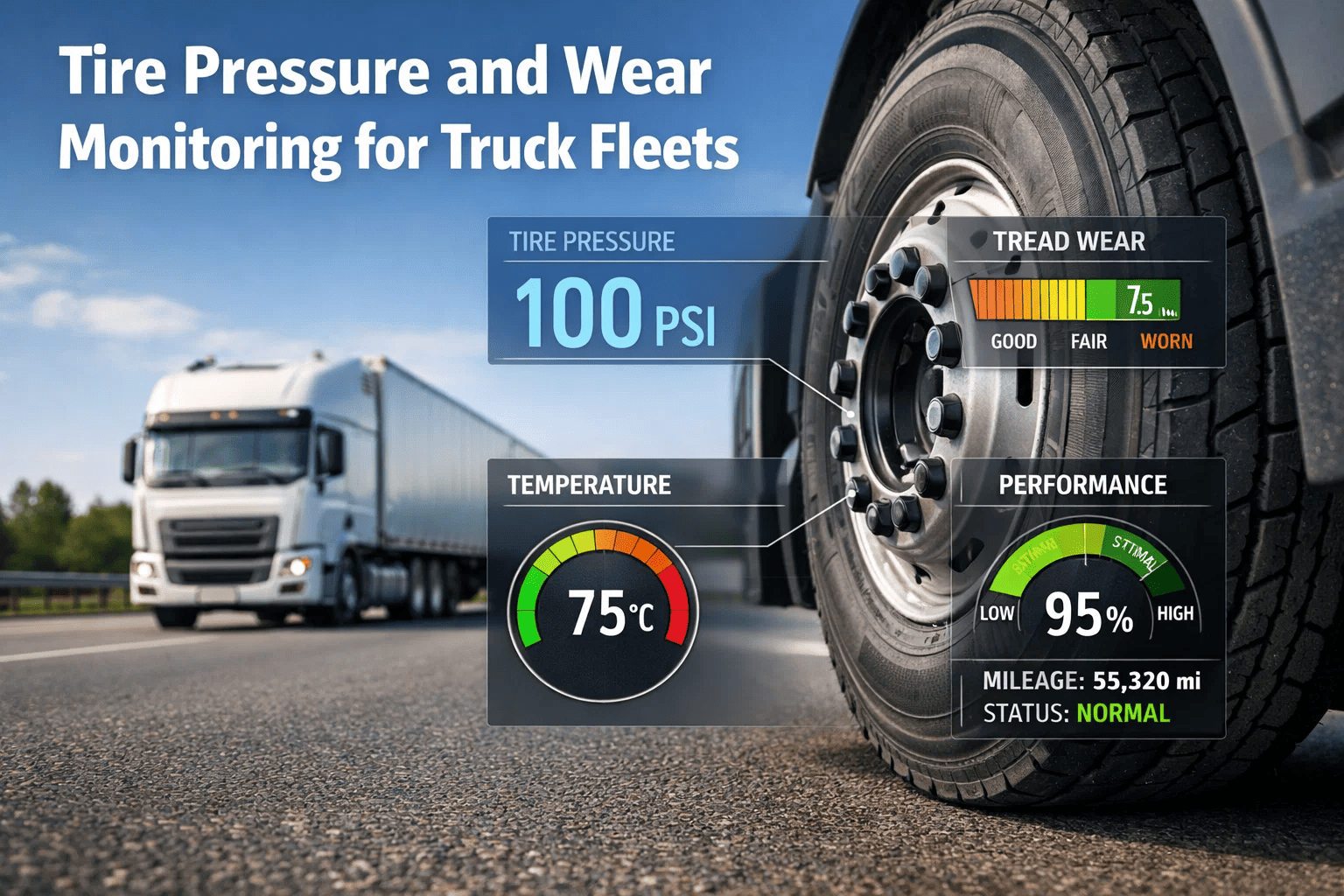
FleetRabbit integrates with commercial tire pressure monitoring systems to provide continuous real-time pressure readings across all tire positions on equipped vehicles. Pressure data streams into the FleetRabbit dashboard with position-specific display. Automated alerts trigger when pressure on any position deviates from configured thresholds — whether from a slow leak, valve failure, or gradual temperature-driven change during route operation. Eliminates the 200+ mile window where undetected pressure loss drives hidden damage.
Real-time TPMS · Position-specific alerts · Mobile + dashboard routing · Threshold configuration
2
Tire Position Mapping and Rotation Tracking
FleetRabbit maintains a digital tire position map for each vehicle, tracking which physical tire occupies each position at every point in the vehicle's service history. When tires are rotated, replaced, or retreaded, position changes are logged — enabling accurate wear rate calculation by position and identification of positions with systematic premature wear that indicates underlying alignment or suspension problems consuming tire sets across vehicles.
Position-level wear tracking · Rotation interval alerts · Suspension issue identification
3
Tread Depth Recording and Wear Rate Analytics
FleetRabbit's maintenance workflow integrates structured tread depth measurement capture at each service interval. Sequential tread depth records generate wear rate calculations by tire, position, and vehicle — enabling maintenance managers to project precisely when each tire will reach replacement threshold under current operating conditions. Wear rate analytics reduce replacement costs by $340 per truck annually through optimized timing versus visual judgment scheduling.
Tread depth tracking · Wear rate projection · Replacement forecast · $340/truck annual savings
4
Blowout Risk Scoring and Predictive Failure Prevention
FleetRabbit combines real-time TPMS data, tread depth records, vehicle load factors, route temperature profiles, and historical failure patterns to generate blowout risk scores for flagged tire positions. High-risk tires surface in maintenance dashboards with replacement priority recommendations before failure occurs — enabling scheduled replacements during planned maintenance windows rather than unplanned roadside breakdowns and their cascading costs. Predictive risk scoring reduces roadside tire failures by 67% within the first operating year.
Blowout risk scoring · Predictive alerts · Maintenance priority ranking · 67% fewer roadside failures
FleetRabbit Tire Management — Built for Every Role in Your Fleet
FleetRabbit's tire management capabilities serve drivers, maintenance teams, and fleet executives simultaneously — delivering the real-time intelligence each role needs through one unified platform with no duplicate data entry required anywhere in the workflow.
Real-Time Pressure Monitoring at Every Position
FleetRabbit streams TPMS sensor data continuously across all 18 tire positions on Class 8 equipment. Pressure alerts route simultaneously to the driver's mobile app and the maintenance dashboard — the moment any deviation exceeds configured thresholds. No waiting for end-of-route check-ins; intervention happens while the truck is still on the road, when correction prevents damage rather than responding to it.
Continuous monitoring · Dual alert routing · Driver + maintenance simultaneous notification
Dual Tire Mismatch Alerts
Detects adjacent tire pressure variance greater than 5 PSI — the hidden cause of uneven drive axle wear that accelerates both tires toward early failure simultaneously. Alerts trigger before mismatch compounds into premature dual replacement.
Seasonal Adjustment Reminders
Configures automated seasonal pressure adjustment reminders as ambient temperatures change — proactive management that prevents the pressure drift that costs fleets 3.3% MPG per 10 PSI deviation fleet-wide.
Wear Pattern Analytics by Position
Identifies irregular wear patterns — one-sided wear, cupping, center wear — that signal alignment problems or suspension defects consuming tire life rapidly. Position-level data pinpoints vehicles requiring mechanical attention before additional tire sets are consumed on the same positions.
Retread Candidate Tracking
Tracks casing condition data for retread qualification scoring — enabling fleets to recover value from eligible casings instead of treating every removal as a full-cost replacement. Documented casing quality data supports retread vendor negotiations with factual performance records.
45-Day Replacement Forecasting
Projects replacement schedules 45 days in advance using measured wear rate data — enabling budget planning and vendor scheduling that eliminates emergency tire procurement at premium unplanned pricing.
Cost-Per-Mile Performance Data
Tracks tire cost per mile by brand, position type, and vehicle model — creating documented performance data that directly informs procurement decisions and vendor negotiations with factual real-world fleet evidence.
FleetRabbit Tire Management Platform
Stop Replacing Tires Too Early — or Too Late
Real-time tire pressure monitoring and systematic wear tracking are among the highest-ROI maintenance disciplines available to fleet managers. On a 50-truck fleet, $90,000 in recoverable annual tire waste exists from under-inflation alone — before adding fuel recovery (3.3% per 10 PSI) and roadside breakdown prevention.
Five Tire Risks That Systematic Monitoring Directly Eliminates
Each risk below represents an active cost and safety exposure pattern in commercial fleet tire operations today. FleetRabbit's tire management system is built specifically to neutralise each one — before they reach the roadside or maintenance bay as emergency failures with full cascading costs.
Invisible Under-Inflation Driving Structural Tire Failure
A commercial tire at 75 PSI — 20 pounds under typical 95 PSI recommended pressure — shows no visually detectable deflection. Drivers performing pre-trip inspections cannot identify 10–25 PSI deviations without actual pressure measurements at every position. These invisible deviations reduce tire life by 35%, cut fuel efficiency by 6.8%, and create internal heat buildup that structurally degrades the tire carcass — causing a blowout risk that no visual inspection can detect or prevent. TPMS integration provides the continuous measurement that manual inspection programs structurally cannot deliver at commercial fleet scale.
Dual Tire Mismatch Accelerating Both Tires to Early Failure
When dual tires differ by more than 5 PSI, the higher-pressure tire bears the majority of the load — creating accelerated wear on one tire and de-treading risk on the other. Both tires fail earlier than they would otherwise, multiplying the replacement cost of a single mismatch event. A common and invisible cost driver across drive axles, dual mismatch is undetectable through visual inspection alone and rarely caught in manual maintenance programs until both tires show advanced wear. FleetRabbit's mismatch alerts identify these conditions the moment they develop — not after both tires are damaged beyond economic reconditioning.
In-Route Pressure Loss — the Blowout Window Pre-Trip Checks Cannot Protect
Tire pressure changes continuously during operation from temperature buildup, ambient fluctuations, altitude changes, and slow air migration. A tire checked at pre-trip at proper pressure may be 10–15 PSI below target after 200 miles of highway operation — a condition invisible to drivers and unreachable by yard inspection programs. This in-route pressure loss window is where blowouts originate: not from tires that were out of spec at departure, but from tires that degraded during the route. Continuous TPMS monitoring detects this degradation in real time, when intervention is still possible and a tire service call avoidable.
Replacement Timing Guesswork Costing $340+ Per Truck Annually
Without systematic tread depth tracking and wear rate projection, maintenance managers choose between replacing tires too early to avoid failures or running tires to failure to extract maximum value. Both choices are financially suboptimal. Data-driven replacement timing — projecting remaining tread life based on measured wear rate — optimizes both safety and cost simultaneously, which intuition-based scheduling cannot achieve. FleetRabbit's wear analytics reduce replacement costs by $340 per truck annually through optimized timing versus visual judgment scheduling — measurable ROI in the first deployment year.
Alignment and Suspension Issues Consuming Tire Sets Invisibly
Irregular wear patterns — one-sided wear, cupping, center wear — signal alignment problems, inflation issues, and suspension defects that consume tire life rapidly. Identifying these patterns requires calibrated measurement across multiple positions at defined intervals. Manual maintenance records rarely capture this data comprehensively enough to generate actionable trend analysis. FleetRabbit's position-level wear tracking surfaces these patterns systematically — identifying the underlying mechanical problem before it consumes additional sets of tires on the same positions across additional service cycles.
Measured Outcomes — FleetRabbit Tire Management Deployments
The performance metrics below reflect results from FleetRabbit tire management deployments across active commercial trucking operations measured over a 12-month period following platform adoption.
40%
Extension in Average Tire Life
Through systematic pressure management and optimized rotation programs
$340
Annual tire cost savings per truck through data-driven replacement timing
67%
Reduction in roadside tire failures within first operating year
3.3%
Fuel efficiency recovered through fleet-wide pressure compliance
$331K
Recoverable annual tire mismanagement cost per 100-truck fleet
45 days
Advance replacement forecasting window for budget and vendor planning
12–18 mo
Typical TPMS hardware ROI recovery through tire life and fuel savings
Questions Fleet Managers Ask Before Deploying FleetRabbit Tire Management
Does FleetRabbit require vehicles to have TPMS sensors installed to benefit from tire management features?
No. FleetRabbit's tire management capabilities operate at two levels. For vehicles equipped with compatible TPMS, FleetRabbit provides real-time pressure integration with automated alerts. For vehicles without TPMS hardware, FleetRabbit's maintenance module provides structured manual tire tracking — capturing tread depth measurements, rotation records, pressure check results at maintenance intervals, and tire position mapping. Most fleets use both capabilities simultaneously across mixed equipment generations and find measurable value from both approaches.
Discuss your specific fleet configuration in a free demo.
How does FleetRabbit handle tire data for trailer fleets that change tractor-trailer combinations frequently?
FleetRabbit tracks tire data at the individual tire level using DOT serial numbers — not just by vehicle assignment. When trailers are reassigned between tractors, FleetRabbit's maintenance records maintain each tire's complete service history regardless of which combination it is operating in. This is particularly valuable for trailer pools where drop-hook operations create frequent reassignments, as it prevents the tire service history discontinuities that occur when records are maintained only at the vehicle unit level rather than the individual tire level.
Can FleetRabbit help build the business case for TPMS investment for our trailer fleet?
Yes. FleetRabbit's tire cost analytics can track current tire-related costs by category — premature replacements, roadside service calls, fuel inefficiency attributed to pressure issues — providing the baseline cost data needed to model TPMS investment ROI. By documenting the current cost of tire mismanagement before implementing TPMS sensors, fleet executives have the pre-investment baseline required to calculate actual ROI after sensor deployment. Most fleets find that TPMS hardware costs are recovered within 12–18 months through tire life extension and fuel savings alone.
How does FleetRabbit's tire wear data help with specification decisions on new equipment purchases?
FleetRabbit's tire analytics generate cost-per-mile performance data by tire brand, size specification, position type, and vehicle model — creating a documented performance record that directly informs new equipment specification decisions. When evaluating tire specifications for new vehicle orders, fleet managers can review actual wear rate data from current operations to determine which specifications deliver the lowest cost-per-mile in your specific operating environment. This data-driven approach consistently outperforms vendor-supplied lifecycle estimates derived from controlled testing rather than real-world fleet operations.
See how tire analytics work in a free demo.
Protect Your Fleet's Largest Consumable Cost
Systematic Tire Management Pays for Itself in the First Quarter.
Real-time pressure monitoring, wear analytics, and predictive replacement forecasting transform tire management from a reactive cost center into a measurable ROI discipline. On a 50-truck fleet, $90,000 in recoverable annual tire waste exists from under-inflation alone — before adding fuel recovery and roadside breakdown prevention.
What You Get with FleetRabbit Tire Management
- ✓ Real-time TPMS integration across all tire positions
- ✓ Dual mismatch alerts at 5 PSI variance threshold
- ✓ Individual tire tracking by DOT serial number
- ✓ Tread depth wear rate analytics and replacement forecasting
- ✓ Blowout risk scoring by position and vehicle
- ✓ 45-day advance replacement schedule generation
- ✓ Cost-per-mile data by brand and position type
- ✓ Retread candidate tracking with casing condition scoring
Get Started — Free Demo
No hardware commitment required. See real-time pressure monitoring and wear analytics working in your fleet from deployment week one.
Book Your Free Demo
Start Free Trial
40% Longer Tire Life
$3/vehicle/mo
No Contracts
April 11, 2026
By Nathan Smith
All Posts