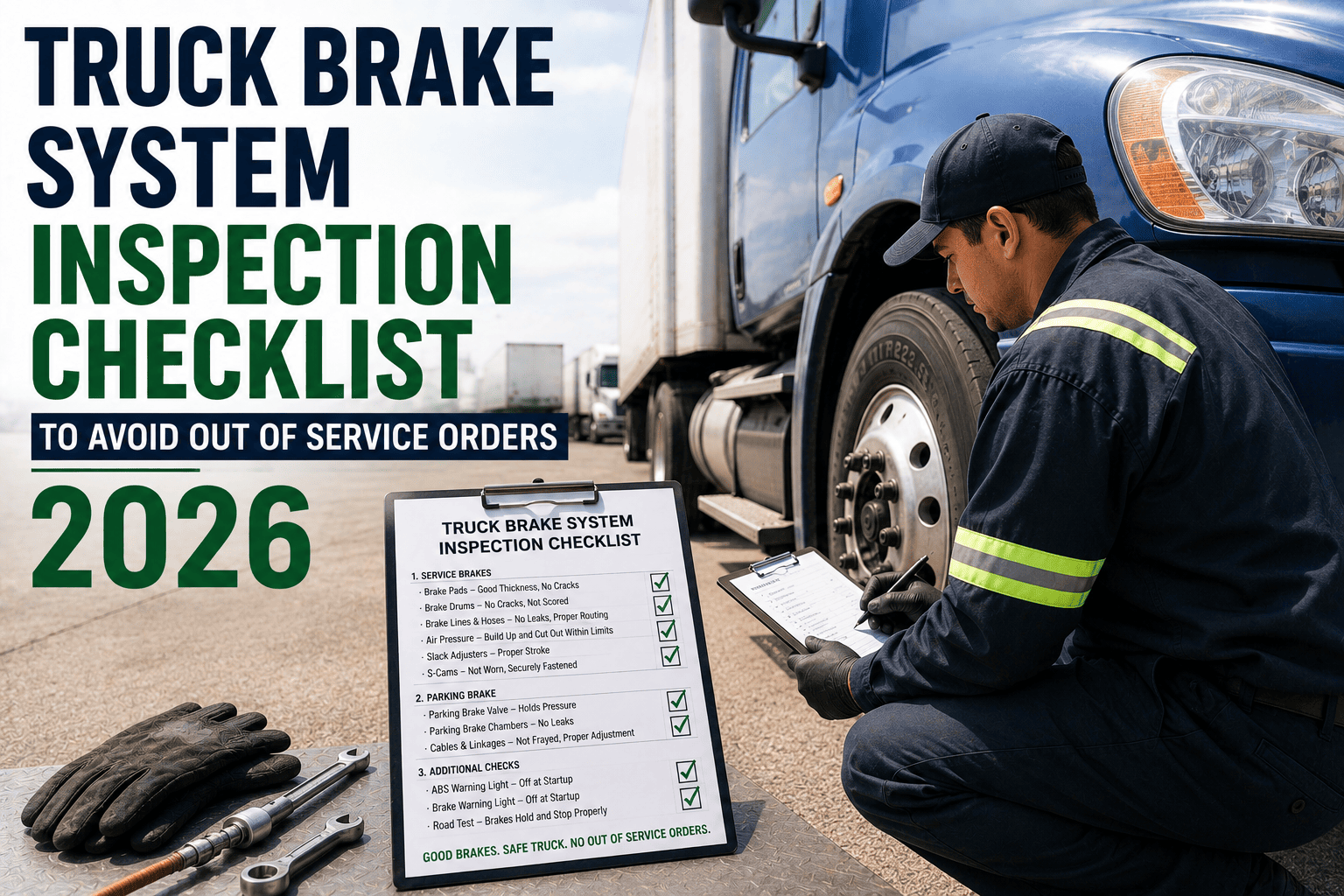
Brake violations are not a small line item in DOT enforcement, they are the leading reason trucks get pulled off the road entirely. During the most recent CVSA International Roadcheck, brake system defects accounted for roughly a quarter of every out-of-service violation issued nationwide, and the rule that triggers most of those orders is brutally simple: once 20 percent of a vehicle's service brakes are defective, the entire truck is parked until a certified technician fixes it. For a standard five-axle combination with ten brakes, that means just two bad brakes can shut down the whole rig.
Under CVSA's North American Out-of-Service Criteria, a vehicle is placed out of service the moment 20 percent or more of its service brakes are defective or out of adjustment. Pushrod stroke must be measured at 90 to 100 psi with the engine off, against limits that vary by chamber type, a Type 30 standard chamber fails at 2 inches of travel. Brake-related violations made up roughly 15 percent of all vehicles placed out of service during the most recent Brake Safety Week alone.
The 20 Percent Rule That Shuts Trucks Down
Most drivers know brakes matter. Fewer realize exactly how the out-of-service math works, and that gap is what catches fleets off guard at roadside. CVSA calculates the threshold by multiplying total brakes on the vehicle or combination by 0.2. A ten-brake combination needs only two fully defective brakes to cross the line. A twelve-brake combination rounds 2.4 up to 3. The math is unforgiving and entirely mechanical, inspectors are not making a judgment call about how the truck felt on the way to the scale, they are counting.
Brake adjustment defects do not even need to be total failures to count. A brake that is 1/8 inch beyond its adjustment limit counts as half-defective. One that is 1/4 inch or more beyond the limit counts as fully defective. Mixed combinations add up fast: one fully defective brake plus two half-defective brakes reaches the same 20 percent threshold as two fully defective ones on their own.
Standalone Violations That Skip The 20 Percent Math Entirely
Some brake defects do not need to reach the 20 percent threshold at all, a single problem is enough on its own. Any defect on a steering axle brake places the vehicle out of service immediately, even if every other brake on the truck is perfect. The same applies to a spring brake chamber with cracks or unauthorized holes in the parking brake housing, a missing or improperly mounted breakaway braking system on a trailer, and visible smoke or fire coming from a wheel end due to a brake malfunction.
FleetRabbit logs pushrod stroke measurements per axle, flags readings approaching the out-of-service limit, and routes defects straight to maintenance. Sign up free and keep every brake on every truck within spec.
How To Measure Pushrod Stroke Like An Inspector
Out-of-adjustment pushrod stroke is consistently the single most common brake violation found at roadside, and the procedure for measuring it correctly is exact. Get the air pressure wrong and a perfectly fine brake can read as a failure, or worse, a bad brake can read as fine.
Why A 20 PSI Error Can Flip A Pass Into A Fail
Pressure matters more than most drivers realize. Stroke readings shift by roughly 0.1 inch for every 10 psi of pressure variation, which means a 20 psi error in either direction can swing a measurement by nearly a quarter inch, enough to turn a passing brake into a failing one or hide a real defect entirely. This is exactly why CVSA inspectors hold strictly to the 90 to 100 psi window, and why fleets that skip this step in daily checks get inconsistent results between the yard and the scale.
Brake Chamber Stroke Limits By Type
Every brake chamber has its own out-of-service stroke limit, and mixing up short-stroke and long-stroke chambers on the same axle is itself a violation. Knowing your fleet's chamber types in advance turns a confusing roadside measurement into a quick pass-fail check.
| Chamber Type | Stroke Limit | Common Application |
|---|---|---|
| Type 20 Standard | 1 3/4 inches | Common on steer axles and lighter duty positions |
| Type 24 Standard | 1 3/4 inches | Mid-size drive and trailer axle applications |
| Type 30 Standard | 2 inches | Common drive axle chamber on tractors and trailers |
| Type 30 Long Stroke | 2 1/2 inches | Heavy duty drive and trailer positions |
Automatic Slack Adjusters Are Not A Set-And-Forget Fix
Automatic slack adjusters have been mandatory on US-built trucks since 1994, and in theory they keep pushrod stroke within spec without manual intervention. In practice, they still drift out of adjustment over time, which is why CVSA recommends checking stroke during every pre-trip, not only during scheduled maintenance. Manually cranking a slack adjuster to mask an out-of-adjustment reading hides the underlying mechanical problem, can damage the adjuster internally, and is itself a violation in many jurisdictions. If a brake reads out of spec, it needs a qualified technician, not a wrench in the yard.
The Defects That Count Toward Your 20 Percent Total
Beyond stroke, a long list of physical conditions also count as a defective brake toward the 20 percent threshold. Each defective brake counts as one toward the total, regardless of how many separate problems it has.
FleetRabbit builds chamber-specific stroke fields, photo verification, and auto-flagging directly into daily inspections, so defects surface before a roadside officer finds them. Book a demo to see it on your own fleet data.
Building Brake Checks Into Daily Routine, Not Just PM Service
Brake stroke measurement takes roughly two minutes per axle, yet it remains one of the most frequently skipped pre-trip items because it requires getting under the vehicle rather than a quick visual glance. CVSA recommends checking stroke as part of every pre-trip inspection, after every brake service, throughout the 500 to 2,000 mile break-in period following a relining, and weekly for vehicles in heavy-use service.
Document Everything In The DVIR Chain
Any brake defect found, whether stroke, drum condition, or a contaminated lining, must be documented on the Driver Vehicle Inspection Report and repaired before the vehicle is dispatched again. A signed and verified repair closes the loop that auditors and roadside inspectors both check, and it is the same documentation chain that protects a fleet during a compliance review months later.
Brake Drums And Rotors Are 2026's Special Focus
CVSA has announced that brake drums and air disc brake rotors receive special inspection attention again this year. Cracks extending through the outer portion of a drum, visibly broken or missing pieces, and excessive rotor rust or metal-to-metal contact are all specific items inspectors are trained to look for closely, making these components worth extra attention during routine fleet checks ahead of enforcement events.
Building this level of discipline into a fleet's daily routine is exactly where most paper-based systems fall apart, defects get noted on a clipboard and never make it to the shop. A digital inspection workflow closes that gap automatically. You can sign up and put brake stroke tracking on every truck's daily checklist starting today.
Frequently Asked Questions
Keep Every Brake Within Spec, Every Day
Brake violations dominate out-of-service orders not because trucks are poorly built, but because pushrod stroke and component wear drift gradually, between inspections, in ways a quick glance cannot catch. The 20 percent rule is unforgiving math, and the fleets that avoid getting caught by it are the ones treating brake stroke measurement as a daily habit rather than a once-a-quarter task. With CVSA's 2026 criteria now in effect and Brake Safety Week approaching in August, now is the time to tighten that routine.
FleetRabbit builds chamber-specific stroke tracking, photo-verified inspections, and instant defect routing into your fleet's daily workflow. Start free and keep every brake on every truck within spec, every single day.