A fender-bender at 35 miles per hour shouldn't be able to bankrupt a trucking company. Yet every year, minor incidents turn into eight-figure jury awards, and the difference between the two outcomes almost never comes down to who was actually at fault. It comes down to what got documented in the first hour after the incident, and how well that documentation held up months later in a deposition room.
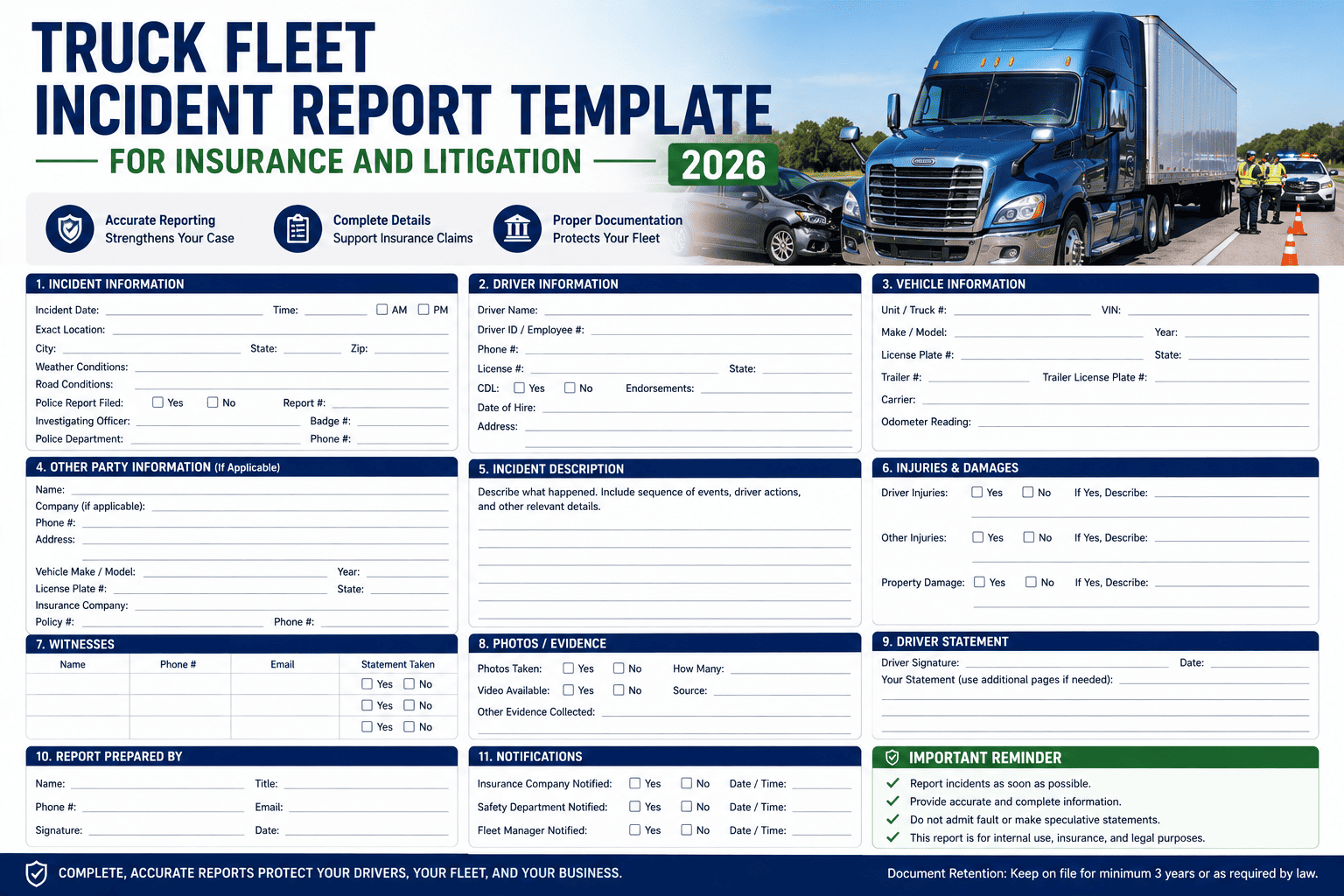
Plaintiff attorneys in commercial trucking cases know exactly what evidence to request, and they know exactly how to use a documentation gap against a carrier. A truck fleet incident report template built for insurance and litigation isn't paperwork, it's the foundation of your legal defense. This guide breaks down what a complete incident report needs to include for 2026, and how FleetRabbit helps fleets capture that evidence automatically instead of relying on a driver's memory hours after the adrenaline wears off.
Jury awards in trucking cases now regularly exceed ten million dollars, with average awards climbing past twenty million when a fleet lacks strong documentation to defend its driver. Fleets that capture photos, telematics, and witness statements within the first hour consistently settle faster and for far less than those relying on memory and paperwork filled out days later.
Why the First Hour Decides the Outcome
Physical evidence at an accident scene disappears fast. Skid marks fade, debris gets swept away, other vehicles leave, and witnesses who saw the whole thing move on with their day within minutes. Everything you fail to capture in that first hour becomes something you can never recover, no matter how good your legal team is later.
What Plaintiff Attorneys Are Actually Looking For
Sophisticated plaintiff attorneys don't just build a case around the accident itself. They build a narrative around your company's operational history, and a documentation gap is exactly the kind of evidence they use to suggest a pattern of carelessness. A missing photo or an incomplete witness statement can matter far more than the accident's actual severity once the story reaches a jury.
What Belongs in a Complete Incident Report
A defensible incident report is built from five categories of evidence, captured as close to the moment of impact as possible.
A note on retention timelines
Federal rules require accident registers to be kept for three years and supporting documentation for one year. From a litigation standpoint, though, retaining full incident files for seven to ten years is the safer practice, since injury claims involving minors can surface years after the fact and state statutes of limitation vary widely.
FleetRabbit combines telematics, dash cam data, and a guided driver reporting workflow so every incident gets fully documented from the first minute. You can sign up for a free trial to see it running on your fleet, or book a demo to walk through a real incident scenario with our team.
Documentation Gaps That Turn Minor Incidents Into Major Liabilities
Most costly incident outcomes don't come from a single dramatic failure. They come from small, avoidable gaps that add up into a story a plaintiff attorney can use against the carrier.
Debris gets cleared and vehicles get moved long before a report gets filed back at the yard, leaving a gap that opposing counsel will highlight as evidence tampering or carelessness.
Bystanders who saw the actual sequence of events leave the scene within minutes. Without their contact information captured immediately, that testimony is gone permanently.
A carrier that cannot produce speed and braking data is often assumed to be hiding something, even when the truth is simply that the system was never set up to preserve it.
When a driver's verbal account, the written report, and the telematics data don't match, that inconsistency becomes the centerpiece of the plaintiff's argument regardless of what actually happened.
Building a Same-Day Reporting Workflow
Check on everyone involved and contact emergency services before anything else. Documentation always comes second to safety.
Photograph everything, collect witness contacts, and record the driver's account while memory is fresh and the scene is intact.
A same-day notification chain ensures decisions about settlement, investigation, and public statements happen with full information, not guesswork.
Dash cam loops and some telematics buffers overwrite themselves within days. Export this data the same day the incident occurs.
Merge photos, statements, telematics, and compliance records into a single incident file so nothing is scattered across separate systems when it's needed.
Why a Single Consolidated File Matters More Than Any One Document
An insurer or attorney reviewing a scattered collection of emails, photos, and paper forms takes longer to build confidence in your version of events. A single, timestamped digital file that ties every piece of evidence together tells a consistent story from the first review, which is often what separates a fast, fair settlement from a prolonged legal battle.
FleetRabbit automatically pulls telematics and camera data into a single incident record the moment a hard-braking or collision event is detected. Sign up free to see your fleet's incident workflow in action, or book a 30-minute demo with our team.
A minor incident should never become a multi-million dollar liability because evidence disappeared before anyone thought to capture it. FleetRabbit builds a complete, defensible incident record automatically, from the first hard-braking alert through final settlement. Get started free, no credit card required, or talk to our team first.