Most roadside violations are not surprises. They are defects that were sitting on the truck before it ever left the yard, the kind a careful pre-trip inspection would have caught in fifteen minutes flat. During the most recent CVSA International Roadcheck, nearly one in five trucks inspected was placed out of service, and the majority of those defects, worn brakes, bad tires, a dead marker light, were exactly the items a proper walkaround is designed to find. The checklist below gives drivers and fleet managers a clear, repeatable system for catching problems before a roadside officer does.
Under 49 CFR 392.7 and 396.13, every CDL driver must be satisfied a commercial vehicle is safe to operate before driving, and must review and sign the prior driver's DVIR. A thorough pre-trip covers roughly 45 checkpoints on the power unit plus 15 more on a trailer, takes 10 to 15 minutes with a digital tool, and directly affects your carrier's CSA Vehicle Maintenance score under the 2026 scoring overhaul, which now scores driver-observed defects separately.
Why The Pre-Trip Walkaround Matters More In 2026
FMCSA estimates that thorough pre-trip inspections prevent roughly 14,000 accidents every year simply by catching defects before a vehicle is dispatched. That number alone makes the walkaround one of the highest-value five minutes a driver spends all day. The 2026 CSA scoring overhaul raises the stakes further by splitting Vehicle Maintenance violations into a standard category and a separate Driver Observed category, meaning the defects your drivers catch, or miss, during the walkaround now show up distinctly in your carrier safety score.
Brake problems remain the single biggest cause of out-of-service orders at roadside, and tire issues are not far behind. Both are checkable in under a minute per axle with the right routine, which is exactly why a structured checklist beats an informal glance every single time.
Pre-Trip Inspection Versus The DVIR
These two requirements get confused constantly, so it helps to separate them clearly. The pre-trip inspection under 392.7 is the physical walkaround a driver performs before driving, confirming the truck is safe to operate. The DVIR under 396.11 is the written report completed at the end of the day, and for property-carrying vehicles it is only required when a defect is actually found. Before driving, the current driver must also review and sign the last DVIR on file, confirming any reported defects were repaired. Skip that signature and you have a separate, commonly cited violation on your hands.
FleetRabbit walks every driver through each required checkpoint, captures photo proof of defects, and routes issues to maintenance instantly. Sign up free and get every truck inspection ready in minutes, not yard time.
The 7-Point Walkaround, Step By Step
FMCSA training programs and CDL schools nationwide teach the walkaround in a fixed sequence so nothing gets missed. Following the same order every single time, regardless of how rushed the morning feels, is what separates a thorough inspection from a quick glance that misses the one defect that matters.
The Air Brake Test Sequence Drivers Skip Most
The air brake test is required, not optional, and it is also the step most often rushed or skipped entirely. With the engine running, air pressure should build from 85 to 100 psi up to governor cut-out around 120 to 140 psi within 45 seconds. Excessive leak rates or a failure to trigger the low air warning at the correct threshold both signal problems that tend to worsen mid-route, which is exactly the kind of failure that turns into a roadside out-of-service order hours later.
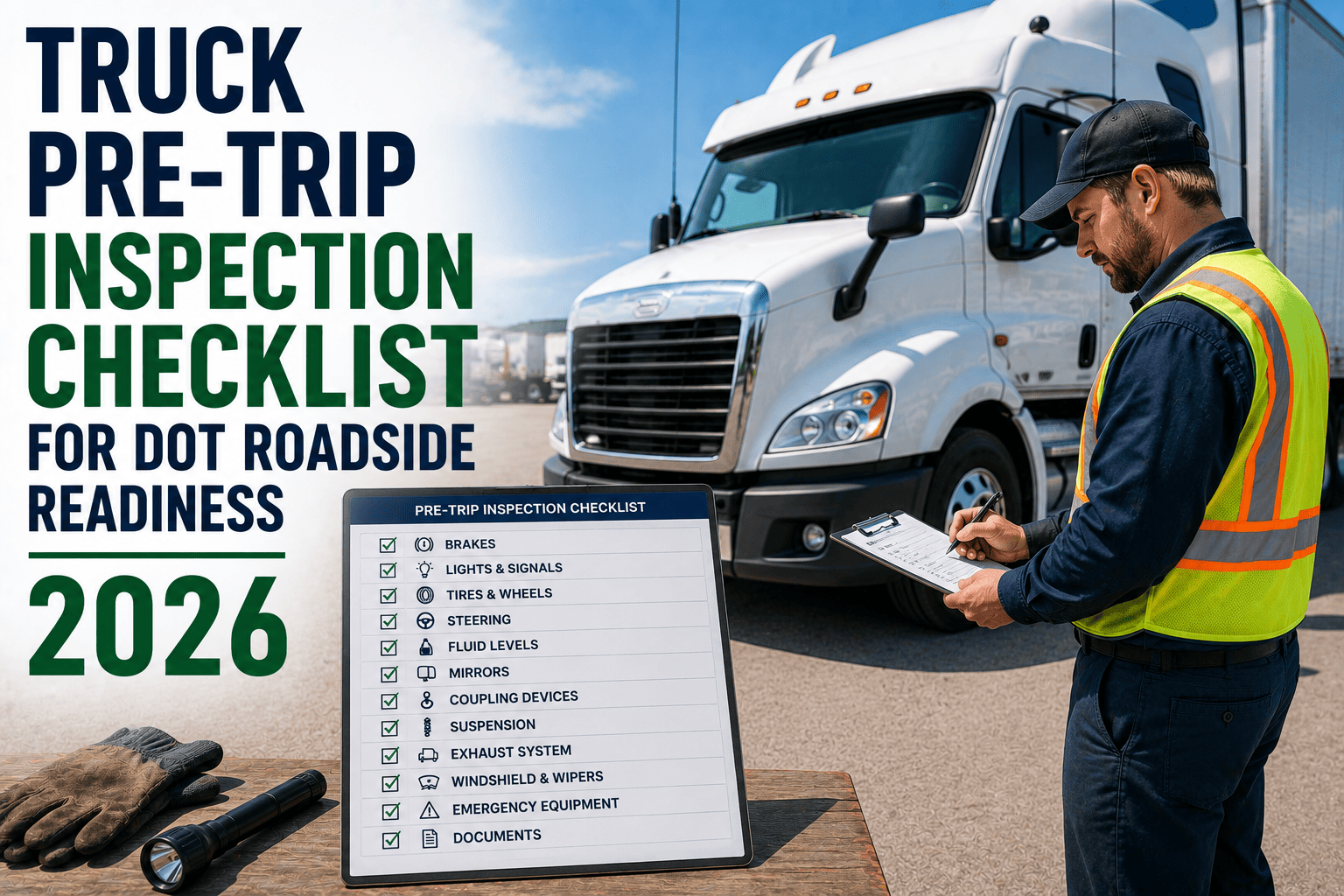
The 11 Components Every Inspection Must Cover
Both the pre-trip walkaround and the DVIR are harmonized around the same eleven safety-critical categories defined in federal regulation. Knowing this list cold makes the inspection faster and far less likely to miss something.
| Component | What To Verify | Common Defect Found |
|---|---|---|
| Service And Parking Brakes | Pressure buildup, leak rate, slack adjuster stroke, trailer connections | Excessive pushrod travel or slow air buildup |
| Tires And Wheels | Tread depth with a gauge, sidewall condition, lug nut torque | Under-inflation invisible to a visual check alone |
| Steering Mechanism | Free play at the wheel, steering box leaks, linkage condition | Excess play beyond manufacturer tolerance |
| Lighting And Reflectors | Headlights, brake lights, turn signals, marker lights, reflective tape | Single burned-out bulb, the most cited violation nationally |
| Coupling Devices | Fifth wheel locking, kingpin wear, safety chains or cables | Improper fifth wheel engagement |
| Horn, Wipers, Mirrors | Functional test of each before the truck leaves the yard | Worn wiper blades reducing visibility |
Tires Are A Bigger Risk Than Most Drivers Assume
Tire violations accounted for over a fifth of all out-of-service orders during the most recent national Roadcheck, and a tire can run twenty percent under-inflated while still looking completely normal to the eye. FMCSA's minimum tread depth standard is 4/32 of an inch on steer axle tires and 2/32 on all other positions, though many fleets set tighter internal standards. A gauge in hand, not a glance, is the only way to catch this reliably every single morning.
Building The DVIR Chain Without Breaking It
Federal rule requires three separate signatures to close out a defect properly: the driver who finds it, the carrier who certifies the repair, and the next driver who reviews and signs off before operating the vehicle. This chain breaks constantly on paper, a DVIR sits in a folder, the next driver grabs the keys, and nobody signs the acknowledgment. That broken link is one of the most frequently cited findings during DOT audits, and it is entirely avoidable with the right process.
FleetRabbit requires the next driver to review and sign the prior DVIR before their own pre-trip can start, keeping the full three-signature chain complete every time. Book a demo and see the workflow in action.
What Happens When A Defect Is Found
A motor carrier cannot dispatch a vehicle again until any defect affecting safe operation has been repaired and certified on the original DVIR. Sending a truck out with a known, unrepaired safety defect is one of the costliest violations a carrier can rack up, and it puts both the driver and the company at direct legal risk if anything goes wrong on the road afterward.
Digital Records Now Carry Federal Backing
FMCSA finalized a rule explicitly authorizing electronic DVIRs, formally removing any lingering doubt about digital inspection records. Carriers still running paper checklists are now actively encouraged to move to electronic methods, since digital records create a timestamped, photo-backed audit trail that paper simply cannot match during a compliance review.
Making Pre-Trip Inspections A Habit, Not A Hurdle
The fleets with the cleanest CSA scores are not the ones with the most rules on paper, they are the ones where the walkaround is fast, guided, and impossible to skip. A digital checklist that walks a driver through each of the eleven required components, captures a photo of anything questionable, and instantly notifies maintenance the moment a defect is logged removes the guesswork and the temptation to rush. You can sign up and put your entire fleet's pre-trip routine on a single guided system today.
Frequently Asked Questions
Keep Every Truck Roadside Ready
A pre-trip inspection is the cheapest insurance policy a fleet has against out-of-service orders, missed deliveries, and the kind of brake or tire failure that turns into a far worse problem on the highway. The checklist itself has not changed much in years, what has changed is how unforgiving the 2026 CSA scoring system is toward defects a proper walkaround should have caught. Fleets that build a fast, guided, repeatable routine catch problems in the yard instead of finding out about them from a roadside officer.
FleetRabbit turns the federal checklist into a guided digital walkaround with photo capture, instant defect routing, and a complete DVIR chain that never breaks. Start free and see roadside-ready compliance across your entire fleet.