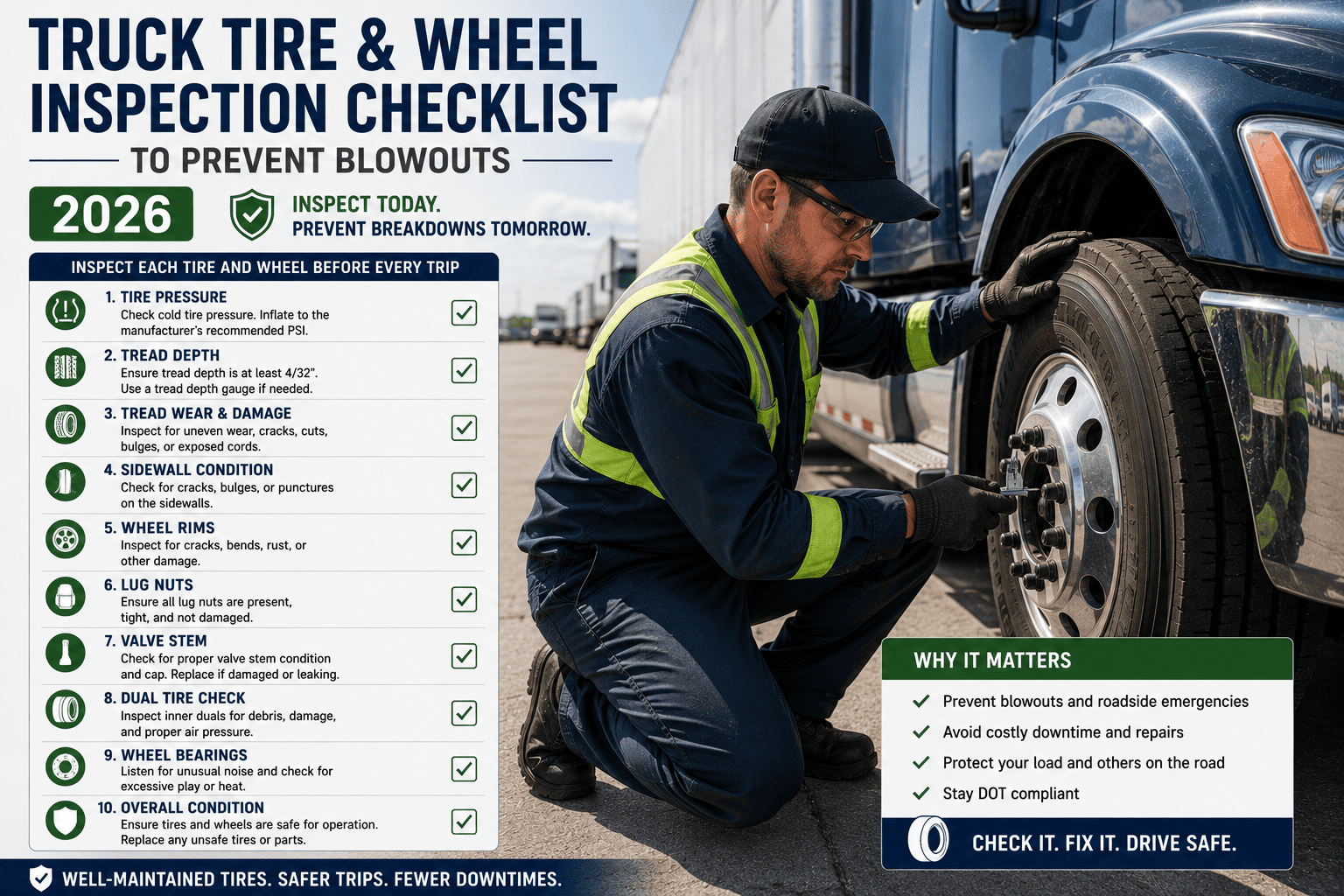
Tires cause more roadside breakdowns than any other truck component, and most of those failures were visible the morning they left the yard. A tire that looks fine from five feet away can be a full 32nd of an inch below the legal minimum, or three pounds of pressure away from the danger zone where blowouts actually happen. A truck tire and wheel inspection checklist is not paperwork. It is the difference between catching a problem in the yard and losing hours on the shoulder of a highway.
Steer tires need at least 4/32 inch of tread depth, while drive and trailer tires need at least 2/32 inch, measured with a gauge in a major groove, not estimated by eye. Every tire needs a cold pressure check against the sidewall rating, a sidewall inspection for cuts and bulges, and a wheel-end check for loose lug nuts, cracked rims, and hub oil leaks. Tires account for roughly a fifth of all out-of-service violations at roadside inspections, and nearly all of them are catchable before dispatch.
The Tread Depth Rule Most Drivers Get Wrong
The federal minimum is not the same across every axle. Steer tires carry a stricter standard because they control direction and steering response, while drive and trailer tires get more margin. Visual estimation is the single biggest reason tire violations slip through pre-trip inspections, because a tire can look "fine" while sitting a full 32nd below the legal line.
What a Calibrated Gauge Catches That Your Eyes Miss
A ten-dollar tread depth gauge takes about fifteen seconds per tire and eliminates the guesswork entirely. Set it in a clean, debris-free major groove rather than on the tread block surface, and check more than one spot around the tire since wear is rarely uniform. Skipping the gauge in favor of a visual glance is the most common way a below-minimum tire makes it out of the yard.
Reading Wear Patterns Before They Become Violations
The shape of a tire's wear tells you exactly what is going wrong underneath it. Catching the pattern early lets you fix the root cause instead of just replacing the tire and watching the same problem show up again on the next one.
| Wear Pattern | Likely Cause | What to Check Next |
|---|---|---|
| Wear centered on the tread | Overinflation | Compare current pressure to the sidewall rated maximum |
| Wear on both shoulders | Underinflation | Cold pressure check with a calibrated gauge, not a thump test |
| Wear on one side only | Alignment issue (toe or camber) | Schedule an alignment inspection before rotating or replacing |
| Scalloped or cupped wear | Worn shocks or suspension components | Inspect shocks, bushings, and suspension mounts |
| Flat spots on the tread | Hard braking or extended parking under load | Review driver braking habits and parking duration patterns |
FleetRabbit's mobile inspection app prompts drivers through gauge readings, sidewall photos, and wheel-end checks for all 18 positions, then flags anything approaching the legal minimum before it becomes a violation. Sign up for a free trial to see it on your own fleet.
Beyond the Tread: Pressure, Sidewalls, and the Wheel End
Tread depth gets the attention, but a thorough inspection covers the whole assembly. Skipping any one of these steps leaves a real failure point unchecked.
Cold Pressure Is the Only Pressure That Counts
Tire pressure should always be checked cold, before the truck has been driven, since heat from driving inflates the reading and hides a real problem. A calibrated gauge is required. The thump test can identify a completely flat tire, but it cannot detect the ten to twenty percent underinflation range where blowout risk actually spikes.
Sidewalls, Valve Stems, and Dual Spacing
Check both the inner and outer sidewall for cuts, bulges, and cracking, and look at the point where tread meets sidewall for the gaps or waviness that signal a developing separation. Confirm every valve stem has a cap, since a missing cap lets in dirt and moisture that cause slow leaks. On dual assemblies, verify the tires are not touching each other and check between the duals for lodged debris.
The Wheel-End Check Most Inspections Skip
A tire can be perfect and the wheel end can still fail. Look for rust streaks trailing from a lug nut to the rim, which is a clear sign the nut has been moving. Inspect rims for cracks, bends, or elongated lug holes, and check hub seals for oil leaks, since a leaking seal can also contaminate nearby brake components.
FleetRabbit logs every tire and wheel-end defect with a photo and a timestamp, so nothing gets missed between one pre-trip and the next. Book a demo to see how the checklist adapts to your fleet's exact tire positions.
Frequently Asked Questions
Tire and wheel failures are among the most preventable roadside breakdowns in trucking, because nearly every defect that causes them is visible with the right tool and a few extra minutes at the yard. Build the tread, pressure, sidewall, and wheel-end checks into every pre-trip routine, and the blowouts stop being a mystery. Sign up for FleetRabbit to put this checklist on your drivers' phones, or book a demo to walk through it with our team.
FleetRabbit guides drivers through gauge-based tread checks, cold pressure readings, and wheel-end inspections, then builds a photo-verified record for every trailer position automatically. Start free, no credit card required.