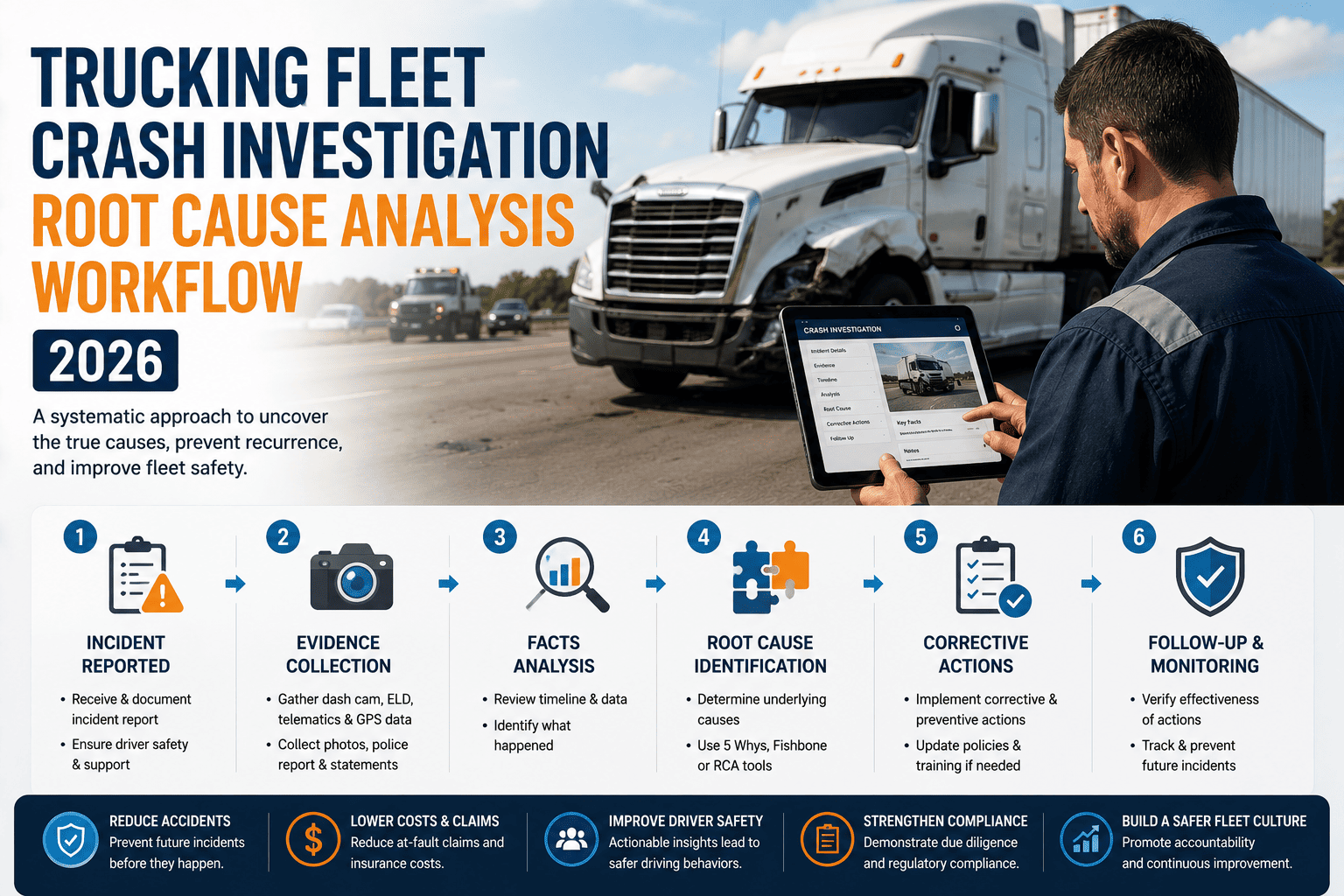
Effective crash investigation and root cause analysis are essential for trucking fleets to improve safety and prevent repeat incidents. In 2026, fleets use telematics, AI dash cams, digital inspections, and incident reporting tools to gather accurate evidence and identify the underlying causes of accidents. These technologies help managers analyze driver behavior, vehicle conditions, and environmental factors that contribute to crashes. By implementing a structured investigation workflow, trucking companies can reduce risks, strengthen safety programs, improve compliance, and take proactive steps to prevent future accidents.
Trucking Fleet Crash Investigation & Root Cause Analysis Workflow in 2026
Every crash leaves clues. The fleets that find them faster spend less on liability, prevent repeat incidents, and build a culture of safety that compounds over time. Here's the exact workflow leading fleets use in 2026.
A proper trucking crash investigation in 2026 involves five core phases: immediate scene response, evidence collection using telematics and dash cam footage, driver and witness interviews, root cause analysis using structured frameworks like the 5-Whys or Fishbone method, and a corrective action plan with follow-up verification. Fleets using digital investigation workflows with platforms like FleetRabbit reduce repeat incidents by up to 60 percent and lower liability exposure significantly.
Why Crash Investigation Matters More Than Ever in 2026
The commercial trucking industry faces increasing scrutiny from regulators, insurers, and the public. A single serious crash can trigger FMCSA interventions, spike insurance premiums by 20 to 40 percent, and expose your company to nuclear verdicts that run into millions. Yet many fleets still treat crash investigation as paperwork rather than a strategic safety function.
In 2026, modern telematics, AI-powered dash cams, and cloud-based incident platforms have transformed what's possible. A fleet manager can now reconstruct an incident within minutes using GPS data, video footage, engine diagnostics, and driver behavior scores — all from a single dashboard. The fleets that leverage these tools consistently outperform peers on safety ratings, insurance costs, and operational reliability. Sign up with FleetRabbit to see how this works in practice, or book a demo to walk through a live example.
The 5-Phase Crash Investigation Workflow
Structured investigation is not optional for serious fleets. Here is the proven workflow used by top-performing trucking operations in 2026.
Immediate Scene Response
Secure the scene, ensure driver safety, notify dispatch, and preserve all physical and digital evidence. First 30 minutes are critical for data preservation.
Evidence Collection
Pull telematics data, dash cam footage, ELD logs, vehicle inspection records, and GPS history. Document weather, road conditions, and third-party witness accounts.
Driver & Witness Interviews
Conduct structured interviews within 24 hours while memory is fresh. Use standardized question sets to gather consistent, comparable data across all incidents.
Root Cause Analysis
Apply structured RCA methods — 5-Whys, Fishbone Diagrams, or Fault Tree Analysis — to identify the true causes beneath surface-level events.
Corrective Action & Follow-Up
Implement targeted corrective actions, assign accountability, set deadlines, and verify completion. Track whether similar incidents recur to measure effectiveness.
Phase 1 — Immediate Scene Response Protocol
The First 30 Minutes Determine Investigation Outcome
What happens immediately after a crash largely determines how successful the investigation will be. Physical evidence degrades. Witnesses leave. Digital data overwrites itself. Fleet managers and safety teams need a clear, practiced protocol that drivers can follow even in stressful post-crash situations.
Driver Responsibilities at Scene
- Check for injuries and call emergency services if needed
- Move vehicle only if it creates an immediate hazard
- Photograph the scene from multiple angles before anything moves
- Collect names and contact info from witnesses
- Call dispatch immediately and report to safety manager
- Do not admit fault or discuss details with other parties
- Complete a post-crash drug and alcohol test if required
Fleet Manager Responsibilities
- Remotely lock and preserve telematics and dash cam data immediately
- Notify insurance carrier within required timeframe
- Deploy an accident response kit or send a field investigator
- Pull ELD records and preserve electronic evidence
- Begin incident report documentation in fleet management system
- Notify legal counsel if injuries or significant damage are involved
- Schedule driver interview within 24 hours
Phase 2 — Evidence Collection Using Modern Fleet Technology
Telematics, Dash Cams, and ELD Data Transform Investigations
In 2026, the evidence available from a modern fleet vehicle is dramatically richer than even five years ago. Telematics systems capture speed, braking force, steering input, acceleration patterns, and engine fault codes in the moments before impact. AI-enabled dash cams record forward-facing, driver-facing, and sometimes side-facing video with automatic event tagging. ELD systems provide Hours of Service data showing driver fatigue risk. All of this evidence can be accessed remotely through platforms like FleetRabbit within minutes of an incident being reported. Start a free trial and see how fast evidence collection becomes when everything is connected.
Telematics Data
Speed, braking, acceleration, steering angle, and GPS position in 1-second intervals. Reconstructs exactly what the vehicle was doing in the minutes before impact.
Dash Camera Footage
Forward and driver-facing video with audio. AI systems automatically flag harsh events and upload footage to the cloud before it can be overwritten or lost.
ELD and HOS Records
Hours of Service logs reveal driver fatigue risk and regulatory compliance status. ELD data is legally admissible and cannot be manually altered after the fact.
Vehicle Inspection History
DVIR records and maintenance logs reveal whether mechanical defects were reported before the crash. A pattern of deferred repairs significantly changes liability analysis.
GPS Route History
Full route playback shows whether the driver was following assigned routes, making unauthorized stops, or operating in areas with known hazards or restrictions.
Scene Documentation
Geotagged photos, weather data, road surface conditions, lighting conditions, and traffic signage documentation complete the physical evidence picture.
Phase 3 — Driver and Witness Interview Framework
Structured Interviews Yield Consistent, Usable Data
Unstructured post-crash conversations produce inconsistent information that is difficult to compare across incidents or use in court. Leading fleet safety teams use standardized interview frameworks that cover the same topics in every investigation. Interviews should be conducted within 24 hours — ideally within hours of the incident — because memory accuracy degrades rapidly. A calm, non-accusatory approach produces better information than an interrogation style, and drivers who feel psychologically safe are more likely to surface the systemic issues that caused the crash.
| Interview Category | Key Questions to Cover | What You're Looking For |
|---|---|---|
| Pre-Trip Condition | Hours slept last night, how driver felt before departure, any pre-trip inspection findings | Fatigue indicators, deferred mechanical defects, pressure to skip pre-trip checks |
| Route and Schedule | Assigned route vs actual route, delivery time pressures, any rerouting or delays | Schedule pressure contributing to speeding, unfamiliar roads, decision to cut corners |
| Event Sequence | What driver was doing 5 minutes before the crash, what they saw, what they did first | Distraction, delayed reaction, environmental hazards not visible in dash cam |
| Vehicle Condition | Any unusual vehicle behavior noticed before crash, warning lights, sounds, handling issues | Mechanical failure contribution, deferred maintenance, DVIR process compliance |
| Systemic Factors | Any policy, training, or equipment gaps the driver feels contributed to the incident | Root systemic causes beyond individual error — the most valuable data for prevention |
Phase 4 — Root Cause Analysis Methods for Fleet Crashes
Going Beyond "Driver Error" to Find the Real Causes
The most common mistake in fleet crash investigations is stopping at the surface cause. A crash report that says "driver was distracted" has not found the root cause. It has found a symptom. Why was the driver distracted? Was there a cell phone policy that wasn't enforced? Was the driver under time pressure that encouraged ignoring safety rules? Did training fail to address distraction risk? Root cause analysis frameworks force investigators to keep asking why until they reach causes that are actually actionable.
The 5-Whys Technique
Start with the crash event and ask "Why did this happen?" five times. Each answer becomes the starting point for the next question. This linear approach works well for single-cause incidents.
Fishbone (Ishikawa) Diagram
Maps multiple contributing factors across six categories simultaneously. Best for complex incidents with multiple contributing causes from different operational areas.
Fault Tree Analysis for High-Severity Incidents
For incidents involving serious injuries, fatalities, or significant property damage, Fault Tree Analysis (FTA) provides the most rigorous structured investigation. FTA works top-down, starting with the undesired event and mapping all possible combinations of failures that could produce it. This method is particularly useful when working with legal counsel or accident reconstruction specialists, as it creates a defensible, documented reasoning chain. Book a demo to see how FleetRabbit's incident management module supports structured RCA documentation.
One Platform for Incident Management & RCA
FleetRabbit connects telematics data, dash cam footage, driver records, and maintenance history in one place — so your team can complete investigations in hours, not weeks. Build a safer fleet and protect your bottom line.
Phase 5 — Corrective Action Planning and Verification
Investigations Only Create Value When They Drive Change
The most thorough investigation produces zero safety improvement if corrective actions are not implemented, tracked, and verified. Many fleet safety programs fail at this final stage. A corrective action plan must assign specific accountability, set realistic deadlines, define measurable success criteria, and include a verification step to confirm the action was completed and effective.
Driver-Level Actions
Targeted retraining on identified skill gaps, coaching sessions, return-to-duty requirements, or mentorship with senior drivers. Actions tied to specific behaviors observed in the investigation.
Vehicle-Level Actions
Maintenance repairs, equipment upgrades, telematics alert threshold adjustments, or fleet-wide inspection of similar vehicles for the same defect identified in the crash vehicle.
Policy-Level Actions
Updated standard operating procedures, revised dispatch protocols, new communication rules for route changes, or revised loading and delivery window policies that reduce schedule pressure.
Training-Level Actions
Updated training modules for the entire fleet if a systemic knowledge gap is identified. Refresher courses, new onboarding curriculum elements, or scenario-based training using actual incident footage.
Crash Classification and Preventability Determination
Not All Crashes Are Created Equal
One of the most important outputs of any crash investigation is a formal preventability determination. The FMCSA's DataQ challenge process and the Compliance, Safety, Accountability (CSA) scoring system give fleets the ability to challenge crash assignments that were non-preventable — but only with documented evidence. A rigorous investigation workflow that consistently documents evidence, interview findings, and RCA conclusions creates the evidentiary foundation needed for successful DataQ challenges.
Preventable Crash
The driver could have taken a different action that would have avoided the crash. Examples include following too closely, distracted driving, speeding, or failure to yield. These require driver coaching and policy review.
Non-Preventable Crash
The driver took all reasonable precautions and the crash was caused entirely by factors outside their control. Proper documentation allows a DataQ challenge that can remove the crash from CSA scoring.
Mechanical Failure Crash
Vehicle defects contributed to the crash. Investigation must determine whether the defect was known and deferred, developed suddenly, or resulted from inadequate inspection protocol.
Key Metrics to Track After Every Investigation
Measure What Matters to Improve Fleet Safety Performance
Crash investigations generate data that, when tracked systematically, reveal patterns invisible in individual incident reviews. The fleets with the best safety records are not those with the best luck — they are the ones that track investigation metrics rigorously and act on the patterns they reveal. If you want to understand how FleetRabbit helps automate this tracking, sign up for a free trial or book a demo with our team.
From Reactive Investigations to Proactive Prevention
FleetRabbit's incident management platform gives your safety team the tools to investigate faster, document better, and prevent more crashes. Real-time telematics, integrated dash cam evidence, and automated RCA workflows in one connected platform.
Frequently Asked Questions
Key Takeaways
A structured 5-phase investigation workflow — scene response, evidence collection, interviews, RCA, and corrective action — produces consistently better safety outcomes than ad hoc approaches.
Modern telematics and dash cam systems make evidence collection faster and more complete than ever — but only if fleets have the systems to preserve and access that data immediately after an incident.
Root cause analysis methods like the 5-Whys and Fishbone Diagram move investigations beyond surface-level findings to systemic causes that are actually preventable.
Preventability determination and DataQ challenges can significantly reduce CSA scores and insurance costs — but require thorough investigation documentation as the foundation.
Fleets implementing structured investigation workflows with accountability tracking reduce repeat incidents by up to 60 percent within the first year of program deployment.
Build the Crash Investigation Program Your Fleet Deserves
Every incident your fleet doesn't investigate thoroughly is an accident waiting to repeat. FleetRabbit gives safety managers the tools to investigate faster, document better, and drive the corrective actions that actually prevent future crashes. Start today with no credit card required.