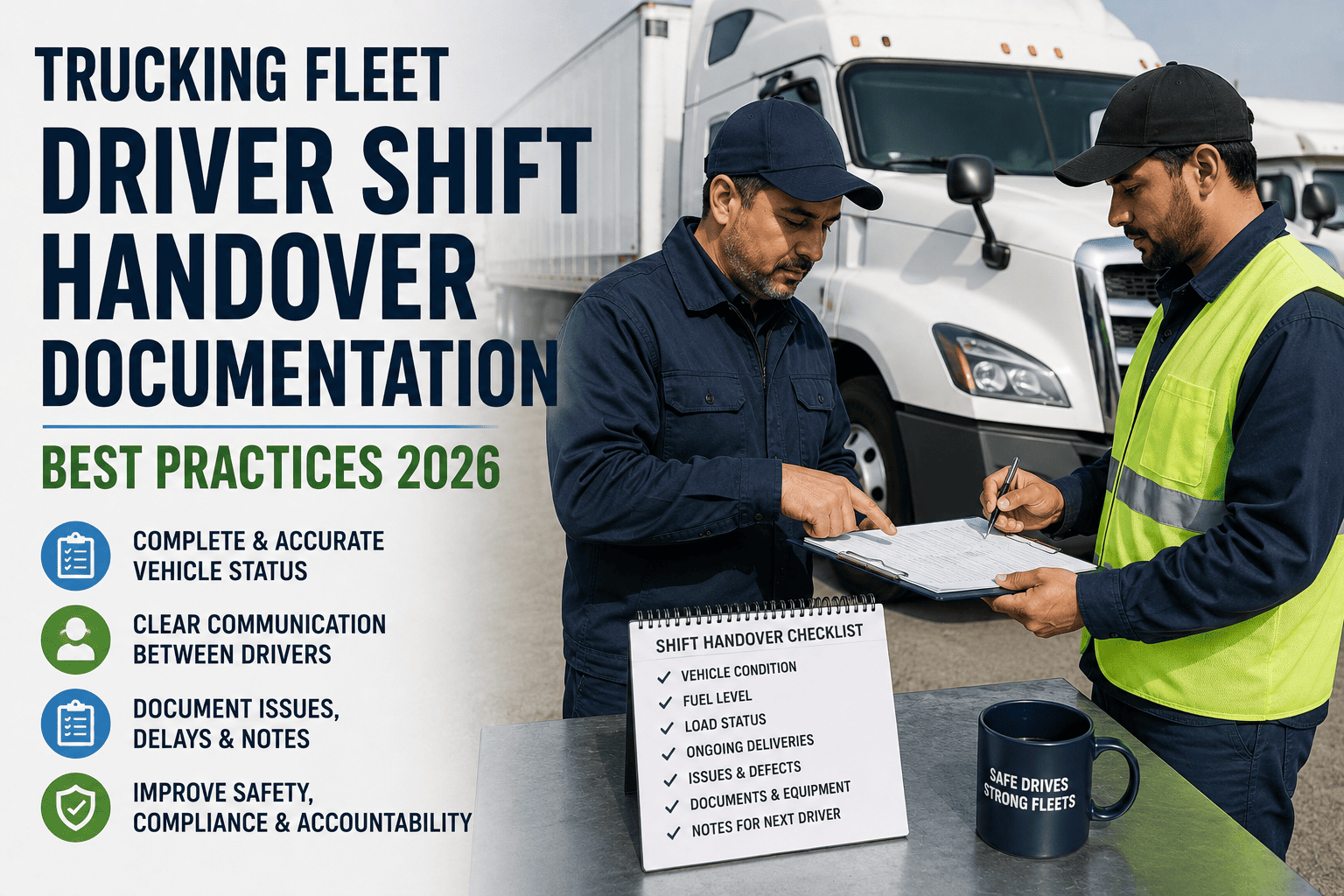
A truck doesn't know it's changing hands. Only the paperwork does, and when that paperwork is a crumpled note on the dash or a rushed verbal "it's fine, just some fuel," a lot can slip through the cracks between one driver's shift and the next. A scratch nobody logged. A warning light nobody mentioned. A fuel level that doesn't match what shows up on the card statement. Shift handover documentation isn't paperwork for paperwork's sake, it's the one moment where accountability either transfers cleanly or quietly disappears.
Driver shift handover documentation is the record created every time a commercial vehicle changes hands between drivers, covering vehicle condition, fuel or charge level, mileage, damage, and outstanding issues. Fleets moving from paper handovers to digital, photo-verified logs typically cut disputed-damage claims significantly and catch developing mechanical issues before they become breakdowns. Sign up for free to see a digital handover in action.
Why Handover Documentation Gets Skipped, And Why That's Expensive
Handovers happen at the worst possible time for careful paperwork: end of a long shift, driver tired, next driver waiting, dispatcher pushing for the truck to roll. That pressure is exactly why so many handovers turn into a quick glance and a nod instead of a documented record. The cost shows up later, when a dent nobody can date turns into a dispute, or a fuel discrepancy nobody can trace turns into a shrug. Without a timestamped, signed record, there's no way to know which driver had the truck when something happened.
The Three Places Undocumented Handovers Hurt Most
Damage disputes top the list, since without a documented condition report at handover, it's impossible to prove whether a scratch or dent happened on this shift or three shifts ago. Fuel and mileage discrepancies come next, quietly draining budget when nobody can trace where the gap appeared. Missed early warning signs are the most expensive gap of all, when a driver notices a strange sound or a dashboard light but the note never makes it to maintenance because there was no structured place to put it.
What A Complete Handover Record Should Capture
A strong handover checklist covers more ground than most paper forms manage, but it doesn't need to be complicated to be thorough. The categories below reflect what leading fleets standardize across every shift change.
Vehicle Condition And Exterior
A quick photo-documented walk-around covering each panel, glass, mirrors, and lights catches the damage disputes before they start. Photos with timestamps do more to settle a disagreement than any written description ever could.
Fuel, Mileage, And Fluid Levels
Odometer reading, fuel or charge level, and a glance at fluid levels give the incoming driver a clean baseline and give the fleet office a trail to reconcile against fuel card data.
Dashboard Warnings And Driver Observations
This is the section paper forms handle worst. A structured field for "anything unusual, sound, smell, warning light, handling" turns a driver's gut feeling into a logged, trackable note that maintenance can actually act on.
Why This Field Matters More Than It Looks
Most early mechanical warning signs are noticed by drivers long before a fault code triggers. A handover record with no place to capture that observation means the information dies at shift change instead of reaching the shop.
Equipment, Documentation, And Cab Contents
Confirming the presence of required items, registration, safety gear, load documentation, prevents the scramble of a driver discovering something missing halfway through a route.
FleetRabbit turns shift handover into a guided, photo-verified checklist on any phone, timestamped and signed by both drivers automatically. Sign up for free and run your first digital handover today.
Paper Logs Versus Digital Handover Records
The format of the record matters almost as much as its content. A checklist that lives on paper is easy to rush, easy to lose, and impossible to search later. The comparison below shows where the two approaches diverge.
| Factor | Paper Handover | Digital Handover |
|---|---|---|
| Photo Evidence | Rarely attached, easy to skip under time pressure | Required and timestamped as part of the checklist |
| Searchability | Filed in a binder, difficult to locate weeks later | Instantly searchable by vehicle, driver, or date |
| Maintenance Follow-Up | Notes often never reach the shop until a failure occurs | Flagged observations route directly into a work order |
| Dispute Resolution | He-said, she-said with no verifiable timestamp | Signed, timestamped record settles the question quickly |
| Consistency Across Shifts | Varies by driver and by how rushed the shift was | Same guided checklist every time, for every driver |
Building A Handover Process Drivers Will Actually Follow
The best checklist in the world fails if drivers see it as a hurdle instead of a habit. Here's the practical path fleets use to get real adoption.
Keep It Short Enough To Finish In Minutes
A ten-page inspection form gets skipped. A guided checklist that takes under three minutes gets completed, especially when it's built into a phone instead of a clipboard.
Require Both Signatures, Not Just One
A handover only protects both drivers when both of them confirm it. A single-signature form leaves the incoming driver with no proof of the condition they actually received.
Route Flagged Issues Automatically
An observation that stays trapped on a form helps no one. Structured digital handovers can push a flagged dashboard light or noted damage straight to the maintenance queue without anyone having to remember to forward it.
Review Patterns, Not Just Individual Records
A single handover tells you about one shift. A dashboard of handovers across weeks tells you which vehicle keeps generating the same complaint, and which driver pairs need a clearer process.
FleetRabbit routes flagged issues straight to maintenance and gives you a searchable history across every driver and vehicle. Book a free demo to see the dashboard yourself.
Frequently Asked Questions
Every undocumented handover is a gap where damage disputes, fuel discrepancies, and early warning signs quietly disappear. FleetRabbit turns shift handover into a fast, photo-verified, signed record that protects your drivers and your fleet.