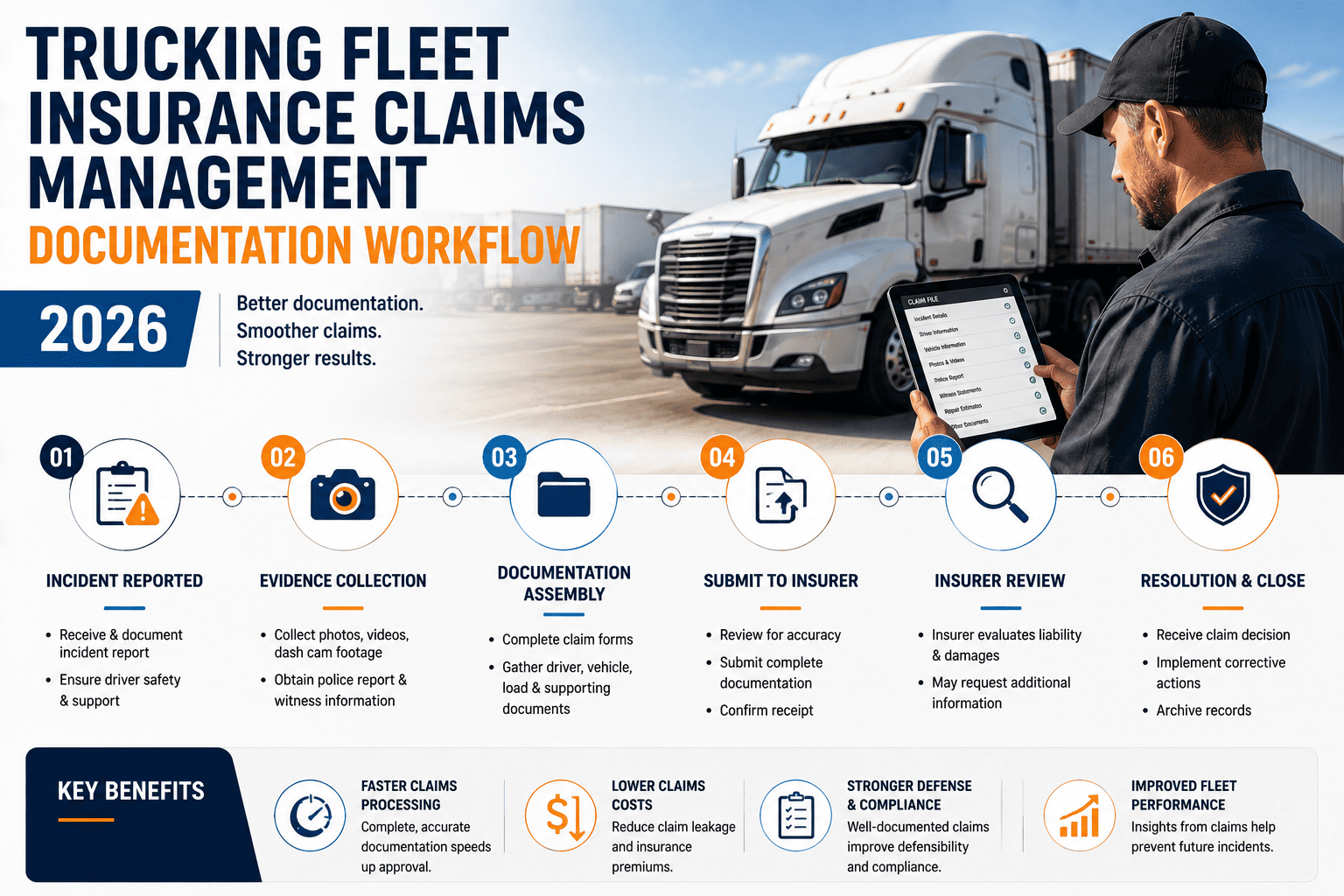
Effective insurance claims management is critical for trucking fleets to reduce disputes and accelerate claim resolution. In 2026, fleets rely on photos, telematics data, dash cam videos, and digital incident reports to create accurate and well-documented claims. Modern claims management software streamlines evidence collection, automates documentation workflows, and improves communication with insurers. By maintaining comprehensive accident records and real-time data, trucking companies can minimize claim processing delays, reduce financial risks, and improve overall fleet insurance management.
Trucking Fleet Insurance Claims Management & Documentation Workflow in 2026
Poor documentation turns minor incidents into six-figure disputes. The right claims workflow protects your fleet, speeds up settlements, and keeps your premiums under control year after year.
Effective trucking fleet insurance claims management in 2026 requires a structured documentation workflow that begins at the scene and continues through settlement. Fleets that capture telematics data, dash cam footage, scene photos, witness statements, and driver reports within the first hour of an incident resolve claims 3x faster and dispute settlements 40 percent less frequently than those relying on manual, paper-based processes.
Why Claims Documentation Is a Fleet's Most Valuable Protection
A truck involved in a minor fender-bender can become a multi-year legal battle if the documentation is incomplete. Plaintiff attorneys in commercial trucking cases are sophisticated — they know exactly what evidence to request and how to use documentation gaps against carriers. In 2026, nuclear verdicts against trucking companies continue to climb, with average jury awards in trucking cases exceeding $22 million when fleets lack strong evidence to defend their drivers.
The answer is not hoping incidents don't happen. It is building a documentation and claims workflow so thorough that any incident becomes defensible within hours. Sign up with FleetRabbit to see how integrated telematics and incident reporting transforms your claims exposure, or book a demo to walk through a real example with our team.
The 6-Stage Claims Management Workflow
Every high-performing fleet claims program follows the same logical progression — from the moment an incident occurs to the moment the file closes. Here is the complete workflow.
Immediate Incident Response
Driver activates emergency protocol within minutes of incident. Scene is secured, injuries addressed, and dispatch is notified. Digital documentation begins immediately via mobile app.
Evidence Capture at Scene
Structured photo protocol, video walkaround, witness contact collection, and police report number documented. Telematics data locked remotely by fleet manager to prevent overwrite.
Digital Evidence Assembly
Telematics data, dash cam footage, ELD records, and maintenance history are pulled together in one incident file. Driver statement is recorded and timestamped while memory is fresh.
Carrier Notification & Filing
Insurance carrier is notified within required contractual timeframe. Complete documentation package is submitted electronically. Legal counsel notified for injury or significant damage incidents.
Claims Monitoring & Coordination
Active management of the claim through adjuster coordination, repair oversight, and response to information requests. Dispute triggers identified early and escalated to legal if needed.
File Close & Loss Analysis
Claim is closed and total cost is documented. Loss run is updated. Root cause analysis triggers corrective actions. Data feeds into fleet risk scoring for future premium negotiations.
Stage 1 — Scene Documentation: What to Capture and How
The First Hour Determines the Claim's Outcome
The evidence available at a crash scene degrades by the minute. Other vehicles move, weather changes road conditions, witnesses leave, and physical marks are erased by traffic. Fleet managers who have invested in driver training for structured scene documentation consistently achieve better claim outcomes than those who leave documentation to chance. In 2026, most leading fleets equip drivers with a mobile app that guides them through a structured scene documentation checklist — ensuring nothing critical is missed even under stress.
Vehicle Damage
- All four sides of your vehicle
- Close-up of every damage point
- Undercarriage if applicable
- Cargo condition and securement
- License plate — yours and theirs
Scene Context
- Wide angle showing full scene layout
- Road surface and skid marks
- Traffic signs and signals
- Weather and lighting conditions
- Position of all vehicles before moving
Third-Party Evidence
- Other vehicle damage — all sides
- Driver license and insurance card
- Other vehicle VIN visible
- Witness names and contact info
- Police officer badge and report number
Digital Timestamps
- All photos must have GPS metadata
- Video walkaround with audio narration
- Driver selfie to confirm no injuries
- Screenshot of fleet app clock at scene
- Police report time vs incident time
Stage 2 — Digital Evidence That Wins Claims
Telematics and Dash Cam Data Change the Claims Landscape
In 2026, insurers, attorneys, and courts expect digital evidence from commercial fleets. A carrier that cannot produce telematics data or dash cam footage is often assumed to be hiding something — even if the truth is simply that they did not have the systems in place. Fleets using integrated telematics platforms like FleetRabbit can produce a complete digital evidence package within hours of any incident. Start a free trial and experience how fast evidence becomes available when everything is connected.
Stage 3 — The Incident Report: What Every Document Must Include
Incomplete Reports Are a Liability, Not a Formality
A well-structured incident report is the spine of your claims file. It ties together all the digital evidence, physical documentation, and narrative accounts into a single defensible document. Many fleets use templates that capture the basics but miss critical fields that insurance adjusters and attorneys specifically look for. The table below shows the complete required fields for a trucking incident report in 2026.
| Report Section | Required Fields | Why It Matters for Claims |
|---|---|---|
| Incident Identification | Date, time, precise GPS location, incident type classification, weather conditions, road surface | Establishes facts that are hardest to dispute later; cross-references with telematics timestamp |
| Vehicle Information | Unit number, VIN, license plate, last inspection date, odometer, any active fault codes at time of incident | Prevents claims of deferred maintenance or vehicle defect without factual basis |
| Driver Information | Driver ID, CDL number, hours on duty, hours since last rest, current HOS cycle status, any prior incidents in 12 months | Addresses fatigue and disqualification questions before they become attack vectors |
| Third-Party Information | All parties' names, license numbers, insurance carriers, vehicle descriptions, injury status, statements if provided | Creates complete record of all parties in case additional claimants emerge later |
| Narrative Account | Factual description of events in chronological order; avoid opinion, speculation, or fault admission | Provides the story framework your attorney and insurer need; must be consistent with telematics data |
| Evidence Inventory | List of all photos, videos, dash cam clips, witness names, police report number, and any physical evidence preserved | Creates a chain of custody for all evidence and prevents gaps from being exploited |
Digital Claims Documentation That Protects Your Fleet
FleetRabbit's incident management platform captures telematics data, dash cam footage, driver reports, and maintenance records in one connected system — giving your claims team everything they need within hours of any incident.
Common Claims Documentation Mistakes That Cost Fleets Thousands
These Errors Turn Defensible Claims Into Expensive Disputes
Even experienced fleet safety managers make documentation errors that undermine otherwise strong claims positions. Understanding the most common mistakes — and how to eliminate them — is one of the highest-value investments a fleet can make. Book a demo with FleetRabbit to see how automated workflows prevent these errors before they happen.
Failing to Preserve Telematics Data
Telematics systems overwrite older data on a rolling cycle — sometimes as short as 72 hours. Failing to lock incident data immediately after an event means critical evidence disappears permanently.
Delayed Carrier Notification
Most commercial trucking policies require notification within 24 to 72 hours of an incident. Late notification can give carriers grounds to deny coverage or reduce cooperation in the claim.
Inconsistent Driver Statements
When a driver's verbal account at the scene does not match their written statement taken later, plaintiff attorneys use the inconsistency to undermine the driver's credibility across the entire claim.
Incomplete Photo Documentation
Photos that only show your vehicle's damage — without scene context, road conditions, and third-party damage — leave gaps that opposing attorneys fill with unfavorable interpretations.
Admitting Fault at the Scene
Drivers who apologize or accept responsibility verbally at the scene create statements that can be used against the fleet in litigation — even when the actual liability picture is more complex.
Poor Maintenance Record Organization
When a fleet cannot produce complete maintenance records within days of a discovery request, courts draw negative inferences. Disorganized records suggest — whether or not it is true — that maintenance was neglected.
Types of Claims and Documentation Requirements by Category
Different Incidents Require Different Evidence Priorities
Not all trucking claims follow the same evidence hierarchy. A cargo damage claim requires completely different documentation than a personal injury collision. Understanding which evidence matters most for each claim type allows your team to prioritize correctly in the critical first hours after an incident.
Collision Claims
Priority evidence: dash cam footage, telematics speed data, GPS position, scene photos showing road layout, police report, and third-party statements. Telematics is often dispositive.
Personal Injury Claims
Priority evidence: ELD records proving legal HOS compliance, driver qualification file, training records, vehicle inspection history, and any pre-existing road hazard documentation.
Cargo Damage Claims
Priority evidence: bill of lading, pre-load condition photos, reefer temperature logs if applicable, shock and tilt sensor data, securement inspection records, and delivery condition photos.
Property Damage Claims
Priority evidence: scene photos showing impact point, GPS route data confirming authorized route, maintenance records for any components involved, and dimensional/weight compliance records.
Liability Disputes
Priority evidence: complete digital evidence package submitted within 24 hours, consistent driver statement, witness contact information, and any traffic camera or surveillance footage identified at scene.
Regulatory Claims
Priority evidence: ELD records, inspection reports, compliance documentation, and drug and alcohol testing records. Complete compliance history is your primary defense against FMCSA-related liability exposure.
How Claims Data Drives Premium Reduction
Your Claims History Is Your Biggest Insurance Negotiating Tool
Insurance underwriters price commercial trucking policies based primarily on three factors: loss run history, safety program quality, and compliance record. Fleets with strong documentation workflows tend to close claims faster, dispute more effectively, and demonstrate lower total loss costs — all of which translate directly to better renewal terms. A fleet that proactively shares its safety metrics, telematics data, and claims management protocols at renewal negotiation consistently outperforms peers who simply submit a renewal application.
Strong Documentation
Complete evidence packages reduce disputed claim time and cost
Lower Loss Costs
Faster settlements and successful disputes reduce total paid claims
Better Loss Run
Improved 3-year history changes your risk profile at renewal
Lower Premiums
20 to 30 percent premium reductions achievable within 2 to 3 renewal cycles
FleetRabbit Turns Every Incident Into a Defensible File
Connect telematics, dash cams, driver reports, and maintenance records in one platform. Close claims faster, win more disputes, and negotiate better premiums at renewal. Sign up free or book a demo with our fleet specialists today.
Frequently Asked Questions
Key Takeaways
Evidence captured in the first 30 minutes of an incident is the foundation of every successful claim. Structured driver protocols and mobile documentation apps are non-negotiable in 2026.
Telematics data, dash cam footage, and ELD records form the digital evidence core of every defensible claims file. Fleets without these systems are at a significant disadvantage in any disputed claim.
Different claim types require different evidence priorities. A cargo damage claim and a personal injury collision require entirely different documentation focus in the critical first hours.
Strong claims management drives premium reductions. Fleets that close claims faster, dispute effectively, and demonstrate low total loss costs earn better renewal terms and preferred underwriter positioning.
The six most common documentation mistakes — from delayed carrier notification to inconsistent driver statements — are entirely preventable with the right platform and training programs in place.
Every Claim You Lose Is a Claim You Could Have Won
FleetRabbit gives fleet safety managers the tools to document every incident thoroughly, assemble evidence instantly, and build the claims record that protects your fleet year after year. Start your free trial today — no credit card required.