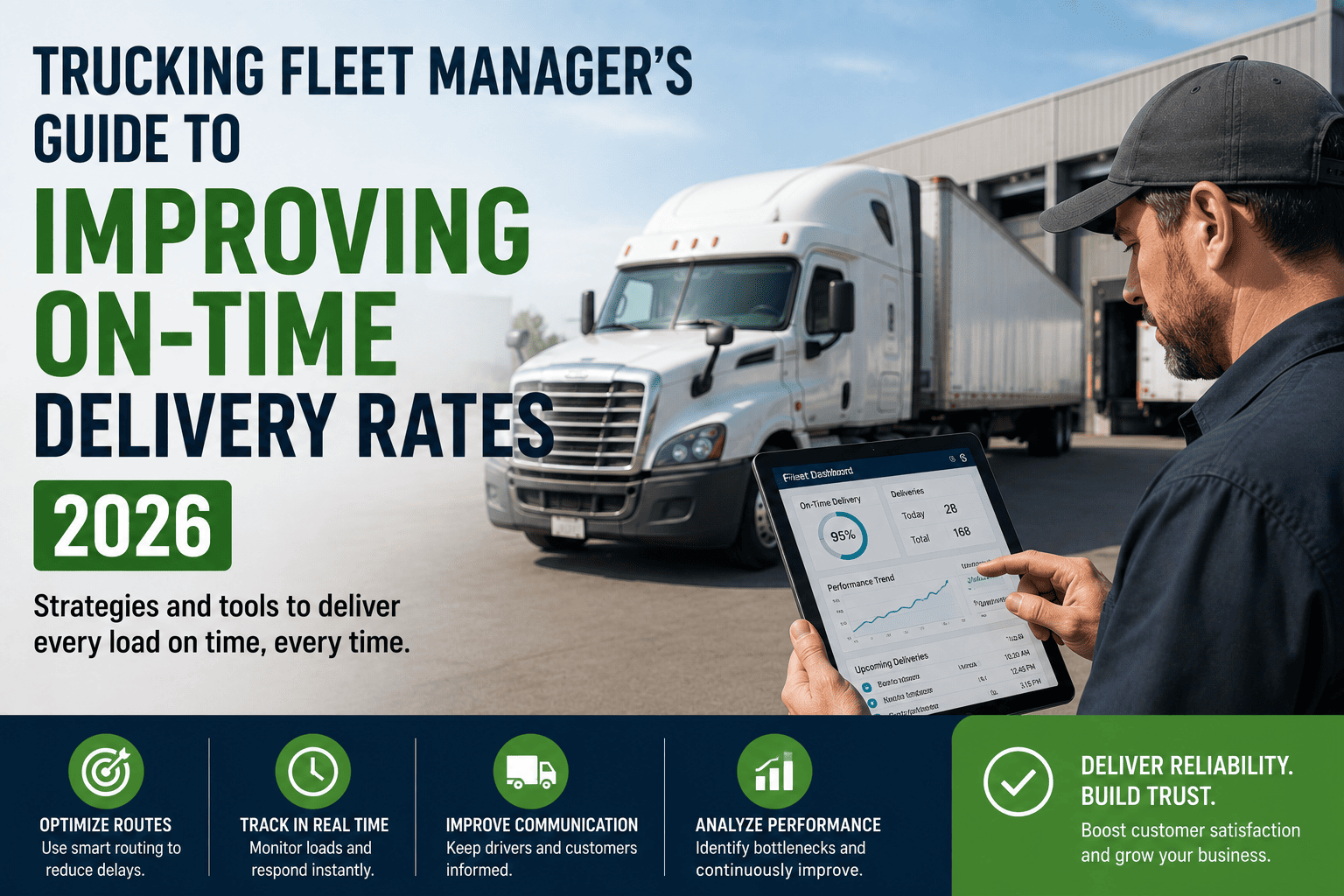
On-time delivery is no longer a nice-to-have metric buried in a monthly report, it is the number customers actually judge a fleet by. More than two-thirds of customers say they would not reorder from a brand after a missed delivery window, which means every late load is not just an operational miss, it is a retention problem. The fleets pulling ahead in 2026 are not necessarily running more trucks, they are running smarter dispatch, tighter ETA accuracy, and better visibility into every stage of the delivery. This guide breaks down exactly what drives on-time delivery performance and how fleet managers can systematically raise it.
AI-driven dispatching can lift on-time delivery rates by 10 to 15 percentage points over traditional manual dispatch methods, and fleets using optimized routing and predictive ETA systems report on-time rates as high as 98 percent. Major carriers using predictive ETA and ETD systems have improved on-time performance from roughly 87 percent to 94 percent, generating measurable operational savings along the way.
Why On-Time Delivery Determines Whether Customers Stay
Late deliveries rarely stay contained to a single missed appointment. They cascade into customer complaints, penalty clauses, and in many cases, quiet attrition where a customer simply moves their next contract to a competitor without ever filing a formal complaint. Delivery reliability has become one of the clearest signals shippers use to judge a carrier's overall operational discipline, which means on-time delivery rate is functioning as a proxy for trust, not just a scheduling statistic.
What's Actually Causing Late Deliveries
Before fixing on-time performance, it helps to know exactly where the time is being lost. Most fleets assume traffic is the primary culprit, but the real breakdown usually happens earlier in the process, well before a truck ever leaves the yard.
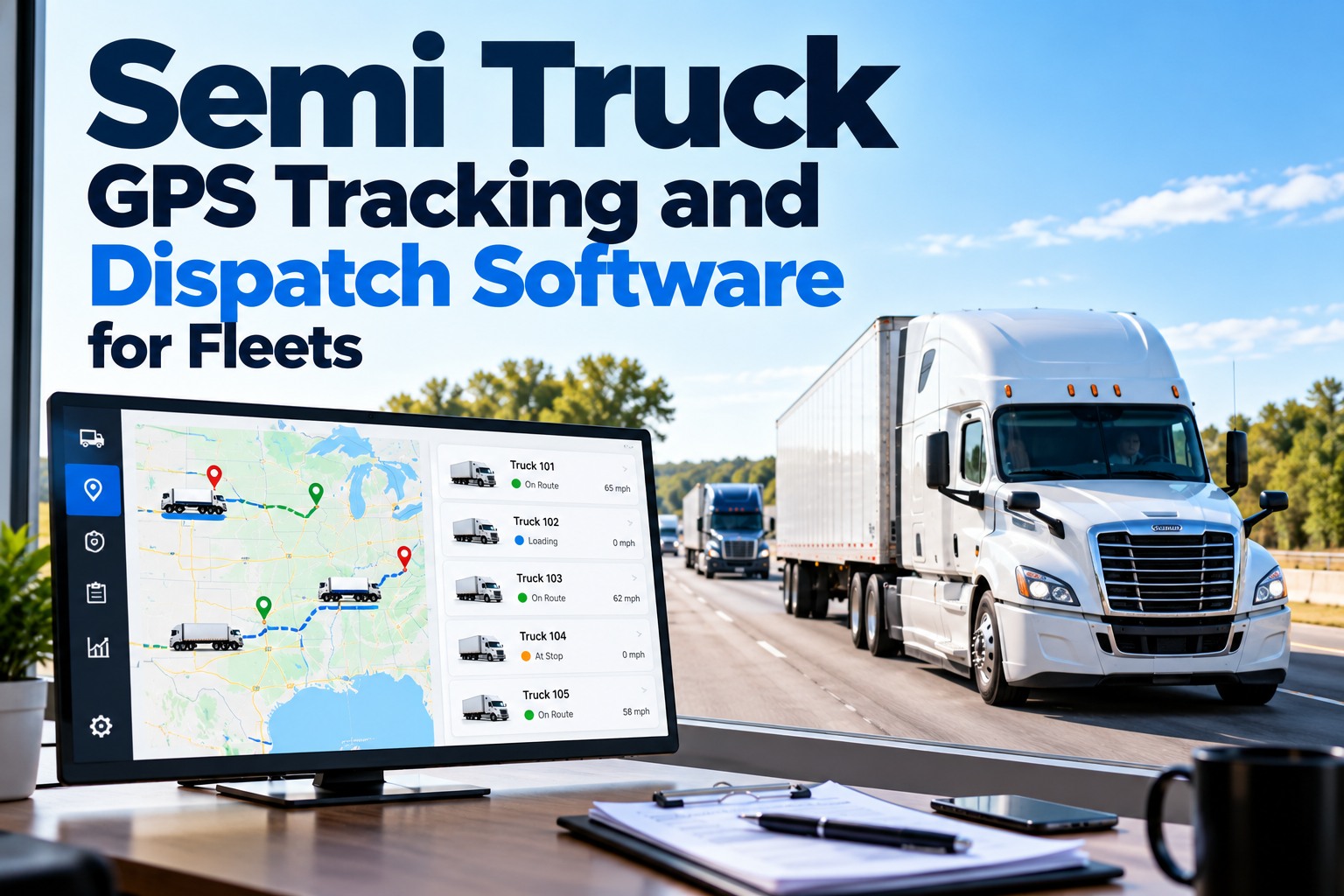
FleetRabbit gives dispatch live GPS visibility and continuously updated ETAs across every route, so delays get caught and communicated before a customer ever notices. Sign up free and see your fleet's delivery performance today.
Calculating And Benchmarking Your On-Time Delivery Rate
On-time delivery rate is calculated by dividing the number of deliveries completed within the promised window by the total number of deliveries, then multiplying by 100. A fleet that completes 1,900 deliveries on time out of 2,000 total deliveries is running at a 95 percent on-time rate. That formula is simple, but the benchmark that matters is how your number compares to what modern dispatch technology makes achievable.
| Dispatch Approach | Typical On-Time Rate | Planning Time Per Route | ETA Update Frequency |
|---|---|---|---|
| Manual, Phone-Based Dispatch | 80 to 87 percent | Hours per shift | Rarely updated after dispatch |
| Rule-Based Route Planning | 87 to 92 percent | 30 to 60 minutes | Updated a few times per shift |
| AI-Driven Dispatch Optimization | 94 to 98 percent | Minutes, largely automated | Continuous, live updates |
The Four Pillars Of A Reliable Delivery System
Fleets that consistently hit their delivery windows are not relying on one single fix. They are combining four capabilities that reinforce each other, and removing any one of them weakens the whole system.
Live GPS Tracking
Real-time vehicle location is the foundation everything else depends on. Without accurate live positioning, ETA calculations and dispatch decisions are working from stale, guessed data.
Dynamic ETA Calculation
ETAs recalculated continuously against live traffic, weather, and stop sequencing give both dispatch and customers an honest picture of arrival time instead of a static guess made hours earlier.
AI Dispatch Optimization
Automated load assignment and mid-route reoptimization process thousands of variables in seconds, reshuffling assignments the moment a delay risk appears rather than waiting for a dispatcher to notice.
Delivery Performance Analytics
Ongoing tracking of on-time rate by route, driver, and customer reveals exactly where the system is breaking down, turning delivery performance into something you manage instead of something you discover after the fact.
How These Pillars Work Together
Live GPS data feeds dynamic ETA calculation. Dynamic ETAs feed dispatch optimization, since a system cannot reroute intelligently without knowing where every truck actually is and when it will actually arrive. Dispatch optimization feeds analytics, generating the data that shows which routes, customers, or time windows need attention. Skip live tracking and your ETAs are guesses. Skip dynamic ETAs and your dispatch optimization is working from outdated information. Skip analytics and you never find out which fix actually worked.
FleetRabbit connects GPS tracking, live ETAs, dispatch optimization, and delivery analytics into a single view, so your team always knows what is on track and what needs attention. Book a 30-minute demo and see it running with your own routes.
Traditional Dispatch Versus AI-Powered Dispatch
The clearest way to see the impact of modern dispatch technology is a direct side-by-side comparison of how a delay gets handled under each approach.
- Dispatcher notices a delay only after a driver calls in
- Route re-planning done manually, taking 30 or more minutes
- Customer notified after the delivery window has already passed
- On-time performance reviewed weeks later in a spreadsheet
- System flags delay risk automatically from live GPS and traffic data
- Routes reoptimized in seconds without dispatcher intervention
- Customer receives an updated ETA before the delay becomes visible
- On-time performance tracked live, by route and by driver
Proactive Communication Changes The Customer Experience
A delivery that runs fifteen minutes late with an updated ETA sent in advance is a very different customer experience than the same fifteen-minute delay discovered only when the truck fails to show up on time. Predictive ETA systems make that proactive communication possible, and it is often the single biggest driver of customer satisfaction scores, separate from the actual on-time rate itself.
Building A Continuous Improvement Process
Improving on-time delivery is not a one-time project, it is an ongoing cycle. Start by establishing your current baseline on-time rate broken out by route, driver, and customer, since a fleet-wide average often hides which specific lanes are dragging the number down. Identify the routes or time windows with the lowest on-time performance and investigate whether the cause is planning, traffic patterns, or delivery-site delays like dock congestion. Implement live ETA tracking so delays are visible the moment they start developing, not after a customer complaint arrives. Review performance weekly rather than monthly during the first improvement phase, since early course correction compounds faster than a slow quarterly review cycle.
Setting Realistic Improvement Targets
Fleets moving from manual dispatch to AI-driven optimization typically see the biggest jump in the first 60 to 90 days, often gaining 10 to 15 percentage points in on-time rate as static planning gets replaced by continuous reoptimization. After that initial jump, further gains tend to come from analytics-driven fixes to specific problem routes rather than broad system-wide changes, which is why ongoing performance tracking matters even after the technology is fully implemented.
Key Takeaways For Fleet Managers
On-time delivery has become one of the clearest signals of operational reliability a fleet can offer its customers, and the gap between fleets running static, manual dispatch and fleets running live, AI-powered systems is measured in double-digit percentage points, not small margins. The technology to close that gap, live GPS tracking, dynamic ETA calculation, AI dispatch optimization, and delivery performance analytics, already exists and is being used today by fleets reporting on-time rates as high as 98 percent.
The path forward starts with visibility. You cannot fix what you cannot see in real time, and fleets still discovering delays only after a customer calls in are always going to be reacting instead of preventing. Establishing a baseline, identifying your weakest routes, and layering in live tracking and predictive ETAs turns on-time delivery from a lagging report into a metric you actively manage every single day.
FleetRabbit combines live GPS tracking, dynamic ETAs, AI dispatch optimization, and delivery analytics into one platform built to help fleet managers raise on-time performance and protect customer relationships. See where your fleet stands today.