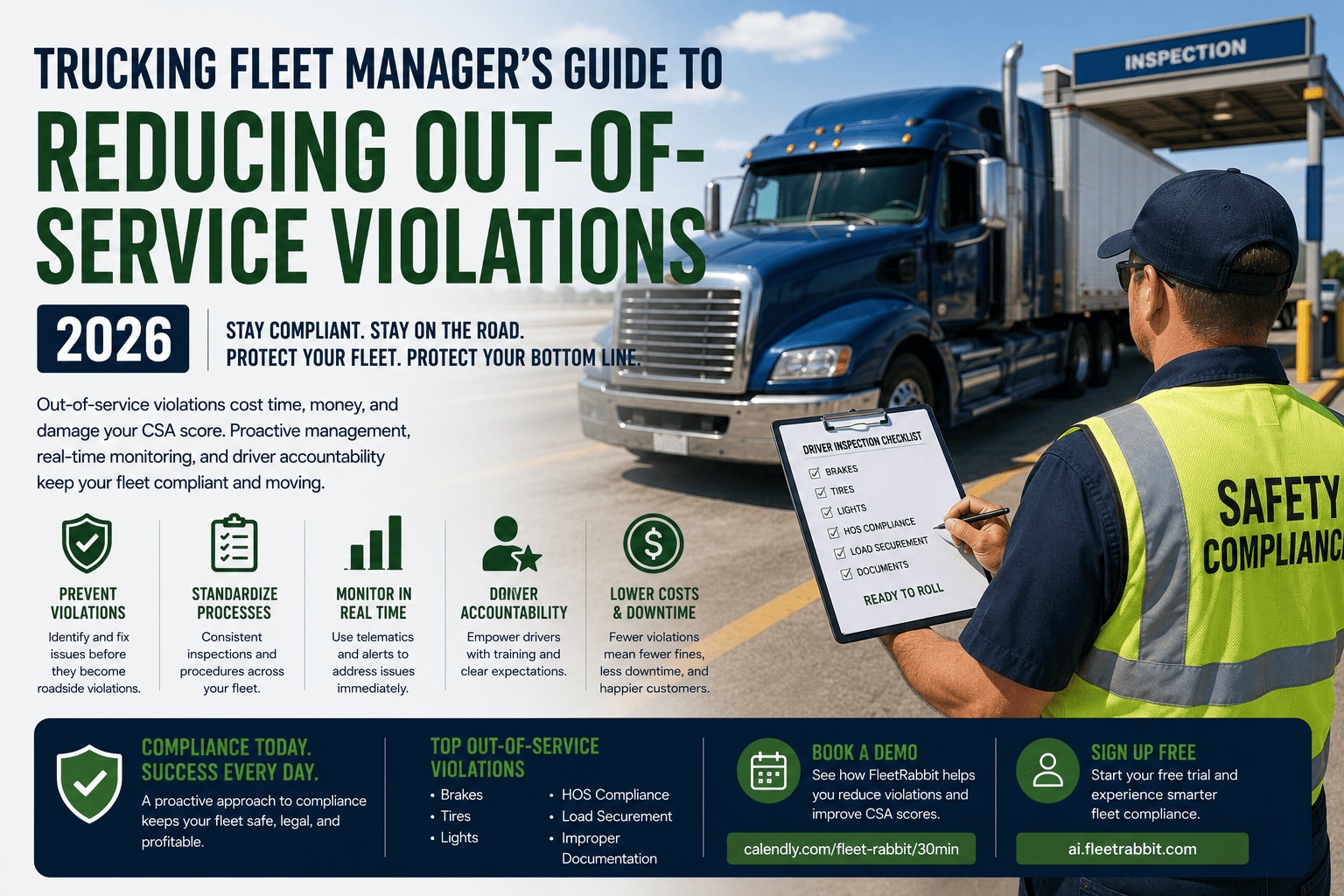
Roughly one in five trucks pulled over for a roadside inspection gets placed out of service on the spot, and the driver was not caught doing anything wrong. The truck itself failed. A worn brake shoe, a tire below the tread threshold, a cracked wheel, or a burned-out light is often enough to shut a load down for hours while the fine, the tow, and the schedule disruption stack up behind it. Sign up for FleetRabbit to catch these defects during your own pre-trip inspections instead of at the roadside, or book a demo to see how a digital DVIR process closes the gap.
The national out-of-service rate sits near 20 percent, and it has climbed steadily in recent years as vehicle defects continue outpacing driver violations at the roadside. Brakes remain the single largest category, and together brakes, tires, wheels, and lighting account for roughly 80 to 85 percent of every out-of-service order issued. Under the 2026 CSA scoring update, an out-of-service violation is weighted twice as heavily as a standard violation, so one preventable defect now hits a carrier's safety percentile harder than ever before.
Why Out-of-Service Violations Are Harder to Absorb in 2026
Out-of-service violations have always been costly, but the math changed in 2026. Regulators restructured how these events feed into a carrier's safety percentile, and the shift makes every preventable defect worth catching before it ever reaches an inspector.
What Changed Under the 2026 CSA Update
The updated scoring model gives out-of-service violations a severity weight twice as high as non-out-of-service violations, and shortens the window a violation stays on the record from 24 months to 12. In practice, this rewards fleets that maintain a steady stream of clean inspections and penalizes fleets that treat DOT inspections as an occasional event rather than a constant condition to maintain. A single preventable brake or tire violation now does more damage to a carrier's standing than it would have a year earlier.
The Four Categories Behind Most Out-of-Service Orders
The vast majority of out-of-service placements trace back to a small handful of vehicle systems. Brake system defects consistently rank as the single largest category, followed by tire condition, wheel and rim integrity, and lighting or reflector defects. Cargo securement adds a further share on top of these four. Because this pattern repeats year after year, a fleet that concentrates its inspection discipline on exactly these systems addresses the large majority of its total out-of-service risk.
FleetRabbit turns every driver-reported defect into a work order automatically, blocking dispatch until the issue is resolved or certified safe. Sign up to digitize your inspection process, or book a demo to see the defect-to-work-order flow in action.
Where Out-of-Service Orders Actually Come From
Breaking down the major categories shows exactly where inspection effort pays off fastest, and what specific threshold each one is measured against at the roadside.
| Defect Category | Approx. Share of OOS Orders | What Inspectors Check | Prevention Focus |
|---|---|---|---|
| Brake System | Roughly a quarter of all vehicle OOS orders | Brake shoe and lining thickness, stroke measurement, air system function | Replace linings before they approach the defective threshold, not at it |
| Tires | A leading share alongside brakes | Tread depth per axle position, sidewall damage, inflation pressure | Rotate or replace steer tires before tread nears the OOS threshold |
| Wheels and Rims | A significant share of total OOS events | Cracks, missing or loose lug nuts, rim damage | Photo-documented wheel inspection at every brake service interval |
| Lighting and Reflectors | Roughly 7 to 8 percent of vehicle OOS orders | Functioning headlights, brake lights, marker lights, and reflective tape condition | Full light check built into every pre-trip inspection, not just at PM intervals |
| Cargo Securement | Roughly 11 percent of vehicle OOS orders | Strap tension, tie-down count, load stability | Standardized securement checklist matched to cargo type before departure |
Building an Inspection Program That Catches Defects First
Fleets that consistently keep their out-of-service rate below the national average are not avoiding inspections. They are running their own inspection process with more discipline than the roadside inspection they might face on any given day.
Set Maintenance Thresholds Ahead of the OOS Line
Replacing brake linings or rotating tires when they approach the defective threshold, rather than waiting until they cross it, keeps a wear item from ever becoming a roadside violation in the first place.
Route Every Defect Directly to a Work Order
When a driver logs a defect on a digital DVIR, the system should automatically generate a work order and hold the vehicle from dispatch until the issue is resolved or formally certified as not affecting safe operation. Paper-based systems routinely lose this handoff between the driver, dispatch, and the shop.
Keep Documentation Complete, Not Just Maintenance Performed
A large share of violations found during compliance audits trace back to missing signatures, incomplete repair certifications, or inspection records that cannot be located, not to maintenance that was actually skipped. Digital records that auto-store timestamps and signatures close this gap.
Treat Every Day Like an Inspection Could Happen
Because roadside inspections can occur at any time, on any route, the fleets with the strongest track records run a full pre-trip DVIR every single day rather than reserving inspection discipline for known enforcement events like Brake Safety Week.
What One Out-of-Service Order Really Costs
The citation itself is only the opening cost. A truck placed out of service cannot move until the defect is repaired, whether that means an on-site fix, a tow, or a dispatched mobile mechanic, and every hour of that delay pushes back the delivery behind it. The violation then carries into the carrier's safety percentile for a full 12-month window under the 2026 weighting, influencing insurance renewal terms and audit likelihood well after the truck is back on the road. For a mid-size fleet, a single preventable out-of-service event routinely adds up to several thousand dollars in combined downtime, repair, and downstream schedule costs, on top of whatever fine was issued at the roadside.
Frequently Asked Questions
Most out-of-service orders are preventable, caught days earlier during a thorough pre-trip inspection instead of at the roadside. FleetRabbit turns every DVIR into a real safeguard, not a formality. Start your free trial with no credit card required, or book a demo to see how it fits your fleet's inspection process.