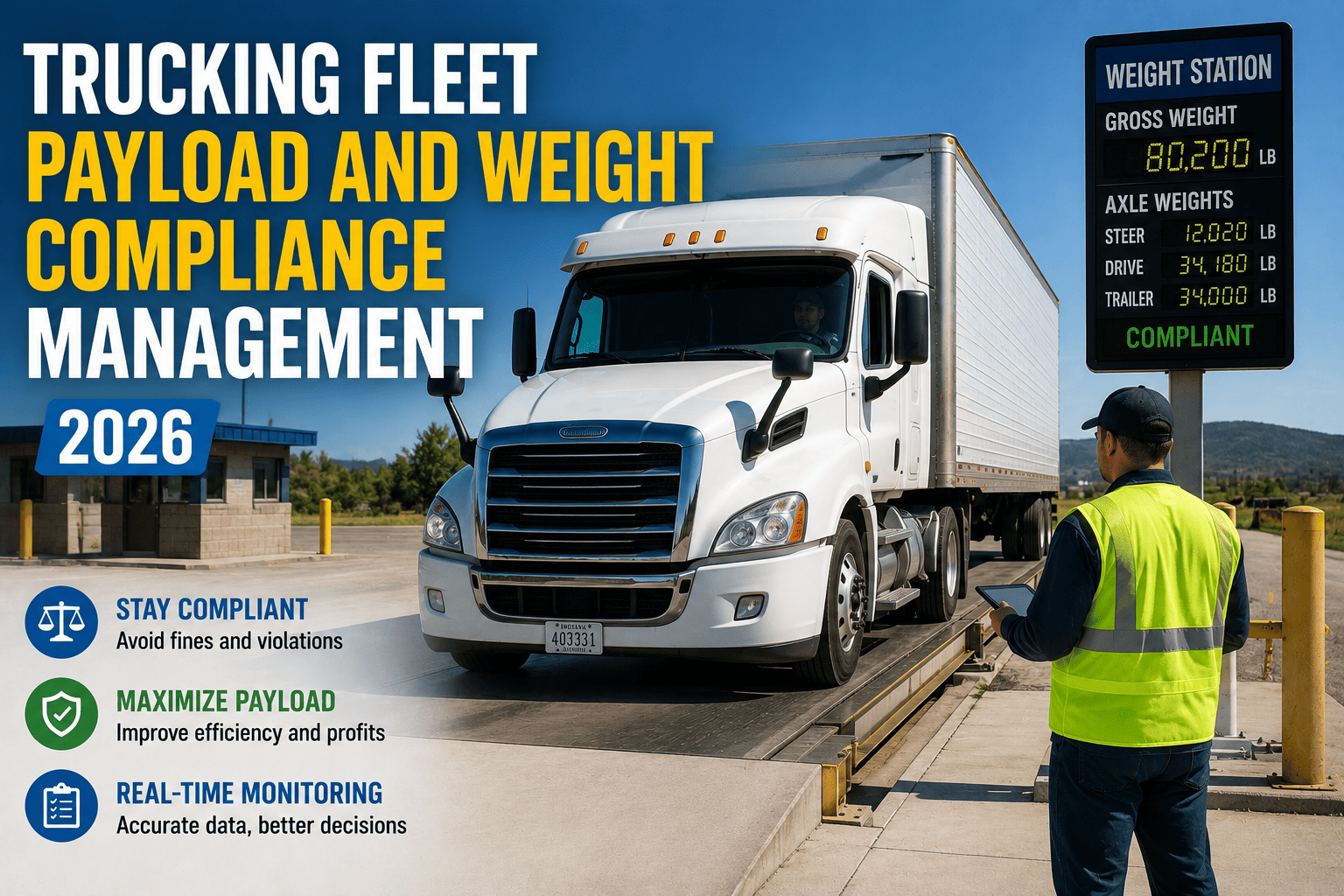
A truck doesn't have to look overloaded to be illegal. A trailer can look perfectly normal and still be thousands of pounds over on one axle simply because the load shifted, or because nobody weighed it after the last stop added freight. Weight violations are one of the few compliance failures that can shut a truck down on the spot, and they're also one of the most preventable, if a fleet actually tracks payload the way it tracks fuel or mileage.
Payload and weight compliance means keeping every truck within its Gross Vehicle Weight Rating, per-axle limits, and Federal Bridge Formula spacing rules, on every load, every route. Weight-related violations were issued in the hundreds of thousands nationally in recent years, and fines commonly run from a few hundred to several thousand dollars per incident depending on how far over the limit a truck is caught. Sign up for free to start tracking payload across your fleet.
The Three Numbers Every Load Has To Respect
Weight compliance isn't one number, it's three working together. A load can be under the total weight limit and still fail because one axle is carrying too much. Understanding how these three checks interact is the first step to avoiding a violation nobody saw coming.
What A Weight Violation Actually Costs
The citation is only the visible part of the bill. Most fleets underestimate the true cost of a single overweight stop because the fine is just the first line item.
Direct Fines Scale With How Far Over You Are
Most states use a tiered, per-pound penalty structure, so the fine grows with the violation instead of staying flat. A truck a few hundred pounds over might face a modest citation, while a truck several thousand pounds over can face a fine running into the thousands, plus the vehicle being held out of service until the load is corrected.
The Costs That Don't Show Up On The Ticket
An out-of-service order stops the truck exactly where it's weighed, often requiring on-the-spot freight redistribution or a second vehicle dispatched to take the excess. Missed delivery windows from that delay can trigger their own contract penalties. And the violation itself stays on the carrier's safety record long enough to affect insurance renewals and inspection targeting well after the fine is paid.
FleetRabbit tracks payload against GVWR and axle limits for every vehicle, flagging a load before it leaves the yard instead of at the weigh station. Sign up for free to start monitoring your fleet's loads today.
Standard Weight Limits Every Fleet Should Track
Federal limits set the baseline that most interstate routes follow, though state and seasonal rules can tighten things further depending on where a truck is running.
| Weight Category | Typical Federal Limit | Common Compliance Risk |
|---|---|---|
| Steer Axle | 12,000 to 13,000 lb | Overloaded front cargo or fuel tank placement pushing weight forward |
| Drive Tandem Axles | Up to 34,000 lb combined | Uneven load distribution shifting weight toward the drive group |
| Trailer Tandem Axles | Up to 34,000 lb combined | Freight loaded too far toward the rear of the trailer |
| Gross Vehicle Weight | Up to 80,000 lb standard configuration | Added freight mid-route without re-verifying total weight |
Payload Capacity Is Not The Same As Gross Weight
Payload is what's left after subtracting the truck and trailer's own tare weight from the gross limit. A loaded dry van commonly carries somewhere in the low-to-mid 40,000-pound range of actual freight, and that number shrinks further with heavier trailers, extra fuel, or added equipment. Treating payload as a fixed number instead of gross weight minus tare weight is one of the most common planning mistakes fleets make.
Building A Weight Compliance Process That Sticks
Avoiding violations isn't about hoping drivers eyeball the load correctly. It's a short sequence of checks that, done consistently, catches problems before the truck ever reaches a scale.
Verify Weight Before Dispatch, Not After
A pre-trip weight check, even an estimated one based on known freight weights, catches an obviously overloaded truck before it leaves the yard rather than at a weigh station three hours down the road.
Check Distribution, Not Just Total Weight
A truck can be under gross weight and still fail an axle check. Confirming how freight sits across the trailer, not just how much total weight it adds, prevents the most common type of violation.
A Simple Rule Of Thumb For Distribution
Aim for freight to sit roughly balanced across the drive and trailer tandem groups rather than concentrated at either end. Uneven loading is the single most frequent cause of an axle-specific violation on an otherwise legal load.
Re-Verify After Any Mid-Route Load Change
Adding freight at a second stop is one of the most common ways a compliant load becomes an overweight one. Any change in cargo mid-route should trigger a fresh weight check before the truck continues.
Keep Digital Records For Every Load
A logged weight record for every dispatch gives a fleet a defensible trail if a violation is ever disputed, and it turns weight compliance from a driver's guess into a documented, trackable process.
FleetRabbit logs payload, axle distribution, and route-specific limits for every truck, giving your team an audit-ready record before enforcement ever asks for one. Book a free demo to see it applied to your fleet.
Why Digital Tracking Beats The Clipboard Estimate
Most weight violations aren't the result of a fleet deliberately overloading a truck. They're the result of nobody having a clear, current number to check against before the vehicle rolled. Digital load tracking closes that gap by keeping tare weight, axle configuration, and route-specific limits attached to every vehicle automatically, so a dispatcher or driver can check a load against real limits in seconds instead of relying on memory or a rough estimate.
Route-Aware Limits Matter As Much As The Load Itself
A load that's perfectly legal on one interstate can require a permit crossing into a neighboring state, or be restricted entirely during a seasonal load period. Tracking weight without tracking the route it's traveling only solves half the problem.
Frequently Asked Questions
Every overweight violation is a preventable cost, a fine, an out-of-service delay, and months on your safety record, all traced back to a load nobody verified before dispatch. FleetRabbit keeps payload, axle distribution, and route limits visible for every vehicle, before the truck ever leaves the yard.