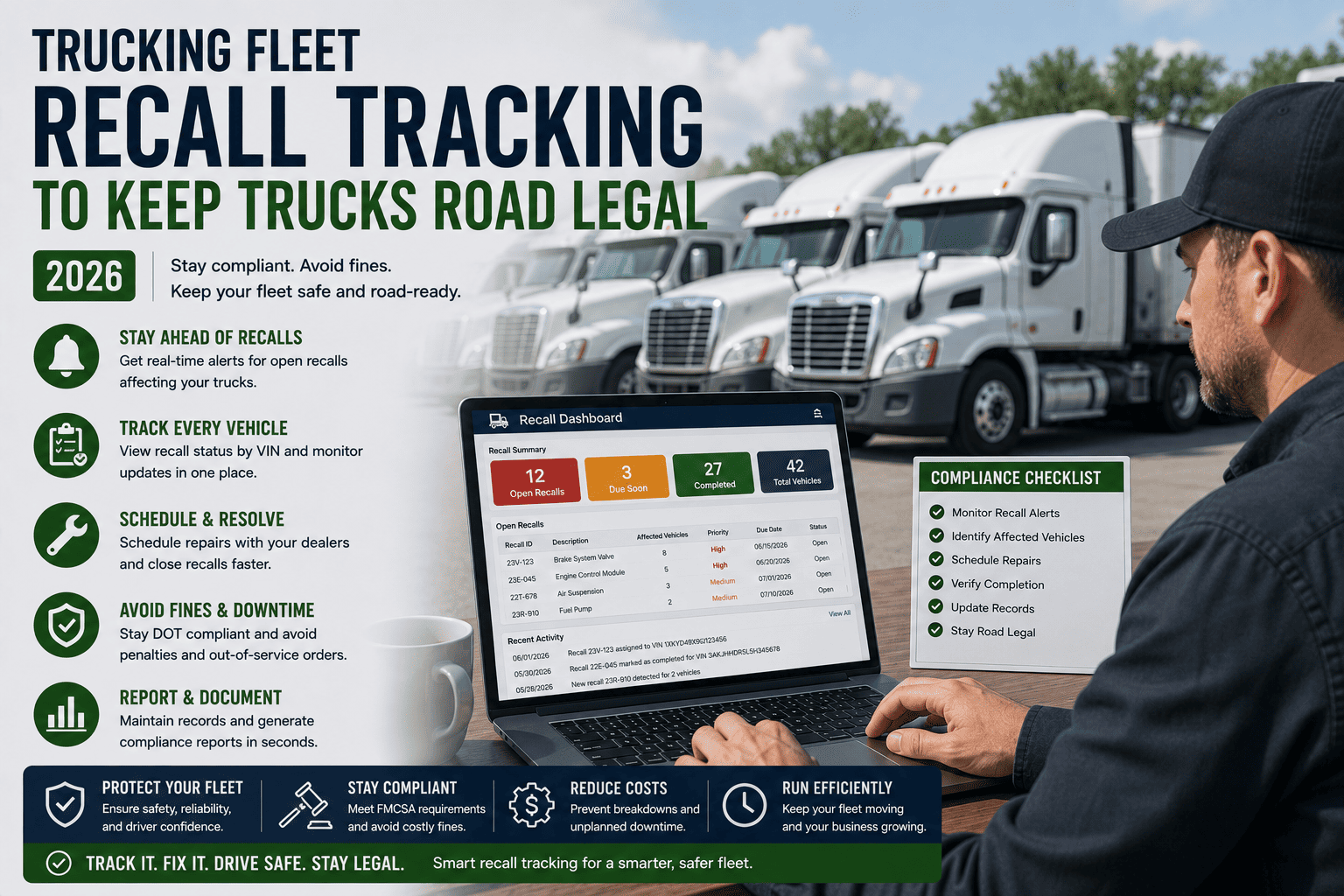
Somewhere in your fleet right now, a truck may be carrying a defect the manufacturer already knows about. NHTSA issues commercial vehicle recalls almost every week, covering everything from wheel lug nuts that can loosen on the highway to brake systems that release slower than they should. The manufacturer mails a letter. That letter sits in an office mailbox, gets misfiled, or arrives after the truck has already changed routes or drivers. The truck keeps running, road-legal on paper, unsafe in reality, until an inspector or a roadside failure forces the issue.
NHTSA issued open recall notices affecting tens of thousands of commercial trucks in 2026 alone, several carrying a Do Not Drive warning. Average recall completion rates across all manufacturers sit near 45 percent, meaning more than half of recalled vehicles may still be operating with an unresolved safety defect. Automated VIN monitoring closes that gap by checking every truck in your fleet against NHTSA data continuously instead of relying on a mailed letter.
Some 2026 recalls, including cases involving wheel lug nuts and brake components on Volvo and Mack trucks, carry an explicit Do Not Drive warning from NHTSA. That is not a suggestion. A truck under this warning that stays on the road creates direct liability exposure for the fleet operator, not just the manufacturer, if an incident occurs before the repair is made.
Why Recall Notices Slip Through the Cracks
Recall tracking fails for the same three reasons in almost every fleet, regardless of size.
FleetRabbit checks every VIN in your fleet against current NHTSA recall data automatically and alerts your team the moment a new recall applies to one of your trucks. Sign up free and run your first fleet-wide recall check today.
The Real Cost of an Unresolved Recall
An open recall is not just a compliance checkbox. It carries financial and legal weight that compounds the longer it stays unresolved.
| Risk Area | What Happens | Why It Matters |
|---|---|---|
| Roadside Inspection | Open safety recalls can be flagged during DOT roadside checks | Can result in out-of-service orders and delayed deliveries |
| Liability Exposure | A known, unresolved defect contributing to an incident | Significantly raises legal and insurance exposure for the operator |
| Insurance Review | Insurers increasingly ask for recall compliance history | Poor recall records can affect premiums and renewal terms |
| Resale Value | Open recalls must be disclosed and often resolved before resale | Unresolved recalls can delay a sale or reduce resale value |
How Automated Recall Tracking Actually Works
Modern fleet management platforms replace the mailed letter with a continuous, automated process built around the vehicle identification number.
Continuous VIN Monitoring
Every VIN in the fleet is checked against the NHTSA recall database on an ongoing basis, not once at purchase and never again. New recalls are caught the same week they are published, not months later.
Why it matters
Manufacturers file new recalls constantly across brakes, steering, wheels, and electrical systems. A one-time check at onboarding misses everything issued afterward.
Instant Recall Alerts
When a new recall matches a truck in the fleet, the maintenance manager and dispatcher get notified immediately, including whether the recall carries a Do Not Drive warning.
Why it matters
Speed determines whether a truck gets pulled for repair before or after it is dispatched on its next multi-day route.
Maintenance Scheduling Integration
Recall repairs get folded directly into the existing maintenance calendar, scheduled around the vehicle's next planned service window whenever the recall severity allows it.
Why it matters
Coordinating recall repairs with scheduled maintenance avoids pulling a truck out of service twice for what could have been handled once.
Compliance Reporting
Every recall, notice date, and completion record is logged against the VIN, creating an audit-ready history available in seconds instead of a paper search.
Why it matters
DOT audits, insurance reviews, and customer compliance questionnaires all move faster when the record is already organized and current.
FleetRabbit logs every recall notice and repair against the vehicle's VIN automatically, so audit-ready compliance history is always one click away. Book a free demo to see how your fleet's recall history would look inside the dashboard.
A Simple Recall Response Checklist
When a recall alert comes in, a consistent response process keeps the truck road-legal without unnecessary downtime.
Confirm the recall applies to the exact VIN and check for a Do Not Drive warning.
Pull the truck from active dispatch immediately if the warning applies.
Schedule the repair with an authorized dealer or service center as soon as parts are available.
Log the completed repair against the VIN with date and technician details.
Frequently Asked Questions
Staying Road-Legal Is a Daily Habit, Not a Yearly Task
Recall tracking is not a project you finish once. New notices arrive every week, and the trucks affected are not always the ones you would expect. Fleets that rely on mailed letters and manual VIN lookups are always a step behind. Fleets that automate the check are the ones that catch a Do Not Drive warning before the truck leaves the yard, not after.
FleetRabbit monitors every VIN against NHTSA recall data continuously, alerts your team the moment a match appears, and keeps an audit-ready record of every repair. Start free with three vehicles or talk through your fleet's compliance setup with our team.