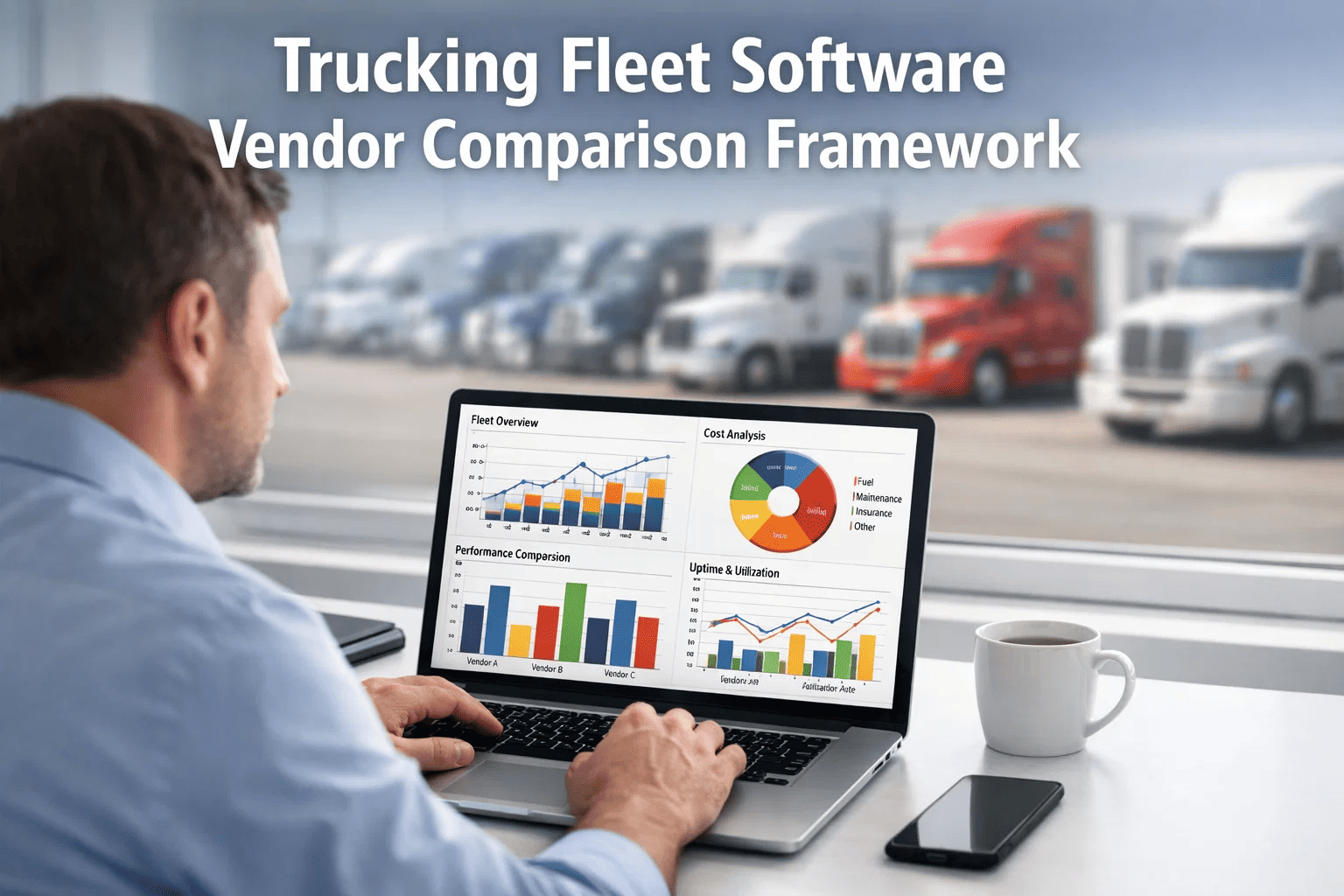
Selecting a trucking fleet management software vendor is one of the most consequential technology decisions a logistics operator makes. The market is crowded with vendors making similar claims about capability and ease of use, yet the differences between platforms — differences that will define your operational outcomes for the next five to ten years — are rarely obvious from sales presentations. This interactive checklist gives your team a structured, criterion-by-criterion framework for evaluating any vendor objectively. Work through each category, check off what each vendor satisfies, and use the completion score to drive your final decision. FleetRabbit welcomes evaluation against every criterion listed here. Our confidence in the platform's actual capabilities is not limited to the demo environment — it extends to the operational outcomes our customers achieve after deployment.
89%
Of fleet operators who switched vendors cite inadequate evaluation of scalability as the primary driver of platform dissatisfaction
$140K
Average total cost of a failed fleet software implementation including migration, lost productivity, penalties, and re-implementation
6–18 mo
Typical evaluation and implementation cycle for mid-market trucking fleets selecting and deploying new fleet management software
3.8x
Higher satisfaction rate among fleet operators who used structured evaluation frameworks versus those who chose based on sales quality alone
How to Use This Evaluation Framework
This framework is designed for use across three to five vendor finalist sessions after an initial screening has narrowed the field from a broader candidate list. Complete the checklist for each vendor independently — do not allow one vendor's demonstration to influence how you score another. Every criterion below should be verified in a live environment with your actual use cases, not in a vendor-controlled demo environment optimized to avoid your edge cases. Criteria that a vendor cannot demonstrate live, and can only document in sales materials or describe as forthcoming, should not be checked as satisfied.
Organize your evaluation team to include at minimum: a fleet operations manager who will assess functional workflow accuracy, a maintenance coordinator or shop supervisor who will validate maintenance capability, an IT or systems administrator who will assess integration and architecture claims, and a driver or dispatcher representative who will evaluate the day-to-day user experience of the mobile and dispatch interfaces. Vendors who perform well on all dimensions of this framework across all evaluator roles are the correct shortlist for reference conversations and final selection.
FleetRabbit structures its demonstration sessions around your specific evaluation framework. When you arrive with this checklist, our team works through each criterion in the order you prioritize — not in a sequence designed to emphasize our strengths and avoid your hardest questions. We provide API documentation before the session, arrange reference conversations at comparable fleet size during the evaluation period, and supply implementation project plan documentation before contract discussion begins.
Schedule Your FleetRabbit Structured Evaluation Session
Request a demonstration session built around your specific evaluation checklist. We will walk through each of the criteria that matter most to your operation, demonstrate real capability rather than representative slides, and provide the reference access and technical documentation your team needs to complete an informed, thorough evaluation against every vendor in your finalist pool.
Evaluate the depth and completeness of each vendor's core operational functionality before assessing advanced features. Platforms with gaps in core capability create operational problems that no amount of premium add-on features can compensate for. Check each criterion the vendor satisfies after live demonstration — not based on sales materials alone. Core capability gaps are the most common source of post-implementation dissatisfaction among fleet operators who did not conduct structured evaluations.
Vehicle Tracking and Fleet Visibility
Maintenance and Inspection Management
ELD and Hours-of-Service Compliance
Category 2: Compliance and Regulatory Management
Compliance failures in commercial trucking carry financial penalties, CSA score damage, out-of-service orders, and insurance premium consequences that far exceed the cost of the technology required to prevent them. Evaluate each compliance capability with documentation demonstrated in the live system — not described in sales materials. The compliance management capability of a fleet platform separates true fleet management solutions from GPS tracking tools marketed with compliance feature claims.
Safety and CSA Score Management
Tax and Permit Compliance
Category 3: Technology Architecture and Integration
Technology architecture decisions made at vendor selection determine integration cost, future scalability, and long-term platform sustainability. Demand technical specifics during evaluation — vendor architecture claims that cannot be demonstrated or supported with documentation should be treated as unverified. Architecture quality becomes the decisive differentiator among vendors who satisfy core and compliance capability requirements, because it determines whether the platform will still meet your operational needs when your fleet has grown and your integration requirements have expanded.
Platform Architecture and Performance
Integration and Data Architecture
Category 4: Analytics, Reporting, and Operational Intelligence
The operational value of a fleet management platform is determined as much by what it reveals about your fleet's performance as by what it automates in your daily workflows. Evaluate each vendor's analytics and reporting capability against the specific management decisions your executive team and operations managers make daily — not against a generic feature list. Platforms that generate reports but do not surface actionable insights at the point where dispatch, maintenance, and driver management decisions are made deliver less operational value than their feature specifications suggest.
Executive and Operational Reporting
Category 5: Implementation, Support, and Vendor Viability
The highest-capability platform delivers poor value if the implementation fails, if support is inaccessible when operational issues arise, or if the vendor organization is not financially viable for the duration of your planned platform relationship. Evaluate organizational capability with the same rigor you apply to product capability assessment. Implementation quality and support availability are the categories where the gap between vendor claims and actual customer experience is widest — making reference conversations at comparable fleet size the most important verification activity in this category.
Implementation Quality and Timeline
Support Availability and Vendor Stability
Frequently Asked Questions
How should we weight the five evaluation categories against each other?
For most trucking fleet operations, Category 1 (Core Capabilities) and Category 2 (Compliance Management) should be treated as minimum-threshold categories — vendors that do not satisfy the majority of criteria in these two categories should be eliminated before advanced feature comparisons proceed. Category 3 (Technology Architecture) becomes the primary differentiator among vendors that satisfy core and compliance requirements, as architecture determines the platform's longevity and integration capability. Category 4 (Analytics and Reporting) determines operational intelligence value over the platform lifecycle — platforms with strong analytics deliver compounding operational improvement as your data history deepens. Category 5 (Implementation and Support) is the final decisive factor between vendors with comparable product capability. Assign a weighted score with Core and Compliance at 25 percent each, Technology at 20 percent, Analytics at 15 percent, and Implementation at 15 percent as a starting framework — adjusted for your operation's specific priorities.
What is the minimum number of vendors we should evaluate before making a selection?
Evaluate a minimum of three vendors against this complete checklist framework before making a selection decision. Initial research may identify eight to twelve candidate platforms, which should be reduced to three to five finalists through preliminary screening against your minimum-threshold requirements before investing in the full structured evaluation process with live demonstrations. Evaluating fewer than three vendors against complete criteria risks selecting an adequate option when a meaningfully better alternative exists in the market. Evaluating more than five vendors through the complete structured process creates evaluation fatigue that degrades assessment quality and extends the decision timeline beyond what the operational urgency of fleet software selection typically justifies.
How do we verify vendor claims that cannot be demonstrated in a sales environment?
Customer references are the most reliable verification mechanism for vendor claims that are difficult to assess in a sales demonstration — implementation timeline accuracy, support responsiveness at 2 AM, data migration quality, and platform performance under real fleet-scale data volume. Require references at comparable fleet size and speak with them directly, not through vendor-facilitated introductions that allow the vendor to be present during the conversation. Request a proof-of-concept period of 30 to 60 days where the platform is operated with your actual fleet data before contract execution for any claim whose failure to deliver would materially affect the implementation decision. For API capability claims, have your technical team review actual API documentation — not a slide deck describing API capabilities — before accepting integration claims as satisfied.
What red flags should disqualify a vendor from further evaluation?
Immediate disqualification criteria include: ELD solution not currently listed on the FMCSA registered ELD database; refusal to provide API documentation before contract execution; inability to provide customer references at comparable fleet size; contract language that limits or conditionalizes data export rights at contract termination; and support models that do not include phone access at any hour for critical operational issues. Near-disqualification flags requiring specific explanation include: implementation timelines significantly shorter than industry norms for comparable deployment complexity; pricing substantially below market rates without a clear business model explanation; and platform features that cannot be demonstrated in a live environment and are represented only in documentation or demo videos.
How does FleetRabbit perform against this evaluation framework?
FleetRabbit satisfies every criterion in this evaluation framework in live demonstration and in documented customer reference feedback. GPS tracking updates at one-second frequency with full offline buffering. DVIR compliance is FMCSA-verified with native offline capability. ELD integration covers all required data elements with dispatch-visible HOS status in real time. IFTA reporting is GPS-derived with automated quarterly generation. The platform is built on cloud-native infrastructure with a publicly documented RESTful API and SOC 2 Type II security certification. Recall tracking monitors open FMCSA and NHTSA campaigns against your VIN inventory automatically. Analytics and reporting include cost-per-mile, maintenance cost analysis, driver performance, and scheduled report distribution. Implementation project plans are provided before contract execution at task-level detail, and support is available by phone 24 hours a day. FleetRabbit actively encourages parallel evaluation against any other platform on this checklist.
Should we include drivers and technicians in the vendor evaluation process?
Yes. Driver and technician input in vendor evaluation consistently produces better platform selection outcomes than management-only evaluation processes. Drivers and technicians interact with mobile applications under conditions — in cabs, in shop environments, under time pressure — that managers evaluating software in conference rooms never replicate. Applications that perform well in a demonstration may be unusable in actual field conditions, and drivers will identify these usability gaps immediately during hands-on evaluation. Driver and technician involvement in the selection process also dramatically increases post-implementation adoption rates. Fleets that include their drivers in platform selection report measurably higher DVIR completion rates and mobile application usage than fleets that select platforms for drivers without their input. Request a driver-facing evaluation session with your FleetRabbit demonstration — we will provide devices and facilitation.
Evaluate FleetRabbit — We Welcome the Full Checklist Comparison
Take your completed evaluation checklist into your FleetRabbit demonstration session. Our team will demonstrate the platform against each specific criterion you have marked for verification — in a live environment with representative fleet-scale data, not in a sample environment optimized for presentation quality. We provide API documentation on request before the session, facilitate customer reference conversations at comparable fleet size during the evaluation period, and supply implementation project planning documentation before contract discussion begins.
If there is a criterion on this checklist that another vendor satisfies and FleetRabbit does not, we want to know about it. Structured evaluation improves both vendor selection decisions and the products that compete to earn your selection. FleetRabbit's confidence in this evaluation framework is the same confidence we have in every FleetRabbit customer's first year of operational outcomes after deployment.
Schedule Your FleetRabbit Structured Evaluation Session
Request a demonstration session built around your specific evaluation checklist. We will walk through each of the criteria that matter most to your operation, demonstrate real capability rather than representative slides, and provide the reference access and technical documentation your team needs to complete an informed, thorough evaluation against every vendor in your finalist pool.