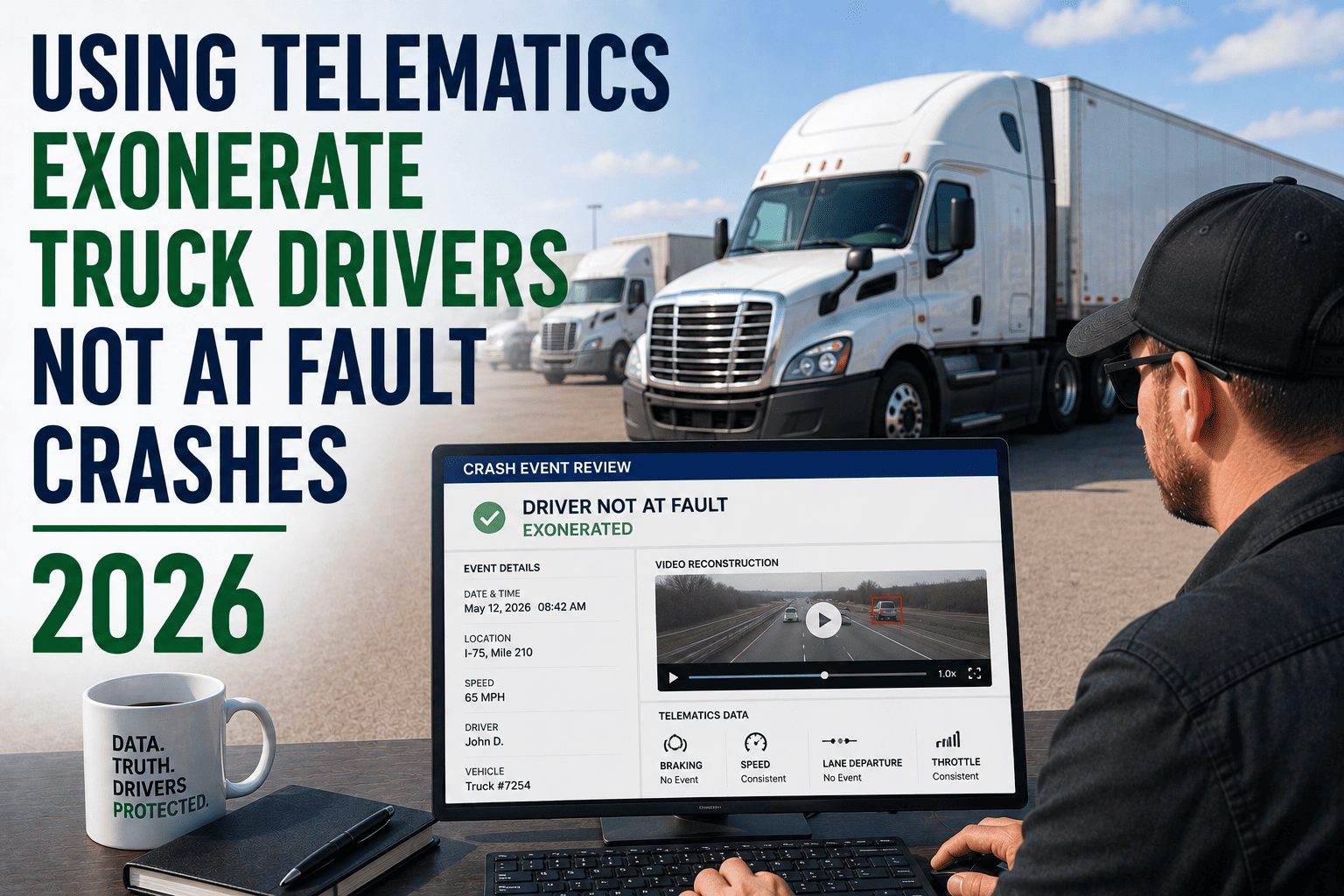
A loaded trailer is stopped at a red light. A sedan rear-ends it, the driver jumps out screaming that the truck "slammed on its brakes for no reason," and within an hour your dispatcher is fielding a call from a personal injury attorney. This is the exact moment that decides whether your fleet pays nothing or pays seven figures. In 2026, that decision increasingly comes down to one thing: whether you have the data to prove what actually happened.
Why "He Said, She Said" Is a Losing Strategy in 2026
For decades, a not-at-fault crash came down to two conflicting stories, a police report written in five rushed minutes, and whichever party seemed more sympathetic to a jury. That arrangement has always favored the smaller vehicle. Commercial trucks are large, visible, and easy to paint as the villain, even when an investigating officer finds the truck driver did nothing wrong.
The financial stakes of losing that story have exploded. Verdicts against trucking companies have been rising at roughly 51.7 percent per year, and the average truck-crash verdict between 2020 and 2023 climbed to around $27.5 million. A single "thermonuclear" jury award can outlast a carrier's entire insurance program, even in crashes where the truck driver was confirmed to be driving safely below the speed limit. Without hard evidence, your fleet is negotiating from a position of fear rather than fact, and plaintiff attorneys know it.
This is exactly why more carriers are choosing to sign up for FleetRabbit before their next incident happens rather than after, because exoneration evidence only works if it was already being captured the moment the collision occurred.
The Cost of Having No Evidence
When a fleet has nothing but a verbal account, three things tend to happen in sequence. First, the early incident report gets written under pressure and is later read back as an admission of fault, even when the crash was 100 percent the other driver's doing. Second, the claim drags into litigation because there is no objective record to settle it quickly. Third, third-party litigation funders bankroll the plaintiff's case for years, betting that a trucking company with deep pockets will eventually pay rather than fight. Each of these stages is preventable with the right data trail.
FleetRabbit records GPS position, speed, braking force, and HD video continuously, so when a not-at-fault crash happens, the proof already exists. No scrambling for witnesses. No guessing what really occurred. Start a free trial and protect your next driver today.
The Four Layers of Proof That Exonerate a Driver
Modern telematics doesn't just record a single data point. It builds a layered, time-stamped account of the seconds before, during, and after an incident. Investigators and insurers now refer to this as a full incident reconstruction, and each layer reinforces the others so the final picture can't be dismissed as one person's word against another's.
HD Video, Inside and Outside the Cab
Dual-facing dash cameras capture the road ahead and the driver's own reactions simultaneously. This footage is almost always admissible in court and turns a dispute over memory into a simple matter of watching what happened.
Precision GPS and Speed Data
Location and velocity are logged at tight intervals, confirming exactly where the truck was and how fast it was traveling in the moments leading up to contact, often down to fractions of a second.
Braking and Acceleration Profiles
Hard-braking and sudden-acceleration events show whether the driver reacted appropriately, and whether the truck's own systems engaged correctly when the other vehicle entered its path.
Engine and Vehicle Diagnostics
Fault codes and mechanical data confirm the truck itself was functioning normally, removing maintenance failure as a contributing factor and closing off a common angle plaintiff attorneys try to pursue.
Carriers that want this kind of layered protection running in the background of every trip can start a free trial with FleetRabbit in minutes, with no need to overhaul existing hardware.
A Real Incident, Reconstructed
Picture a regional delivery truck merging onto a highway on-ramp. A sedan in the driver's blind spot accelerates instead of yielding, clips the trailer, and spins out. The sedan's driver tells the responding officer the truck "cut them off." Without data, that statement alone could shift blame onto the carrier. Here is how the same incident plays out once telematics enters the picture.
That five-second window, fully documented, is often all it takes to move a claim from "open investigation" to "closed, no fault." Insurers and defense attorneys describe this synchronized record as an objective account that carries more weight than eyewitness testimony, because it can't misremember or change its story under cross-examination.
What Exoneration Data Actually Saves You
The value of this evidence isn't abstract. It shows up directly in legal fees avoided, settlements that never happen, and insurance premiums that stay flat instead of climbing after a claim that was never the driver's fault in the first place.
- Claim relies on conflicting verbal accounts
- Early incident reports risk being read as admissions of fault
- Cases drag into multi-year litigation
- Carrier often settles to avoid trial risk
- Insurance premiums rise after every claim, fault or not
- Synchronized video, GPS, and braking data tell one consistent story
- Claims professionals can assess liability within hours, not months
- Footage showing no fault is shared and claims are often dropped
- Legal costs avoided entirely in clear-cut exoneration cases
- Documented safe driving supports lower long-term premiums
One terminal manager described it plainly after dash cam footage exonerated a driver who would otherwise have been deemed automatically at fault: the recording alone saved the company close to $50,000 in damages from a single incident. That is the kind of return that turns telematics from a line-item expense into a financial safeguard.
FleetRabbit gives every truck in your fleet a synchronized record of speed, location, braking, and video, so a not-at-fault crash never turns into a guessing game. Book a demo and see exactly how a real incident gets reconstructed in minutes.
Building an Exoneration-Ready Fleet
Protecting your drivers isn't about reacting faster after a crash. It's about making sure the right data was already being captured before the crash ever happened. Three practices separate fleets that win these disputes from fleets that don't.
1. Capture Continuously, Not Selectively
A camera that only records when manually triggered is useless in the seconds that matter most. Continuous recording with automatic incident detection means the five seconds before impact, the ones that prove who reacted appropriately, are never missed.
2. Preserve the Full Data Set Immediately
GPS, speed, and braking logs need to be locked and exported the moment a collision is detected, before the incident gets lost in normal data cycling. Automated incident reporting removes the risk of a critical clip being overwritten before anyone realizes it was needed.
3. Train Drivers on What to Say, Not Just What to Do
Even with perfect data, an early verbal report written under stress can muddy the waters. Coaching drivers to describe events factually, without assigning blame to themselves, keeps the data and the paperwork telling the same story.
Fleets that put all three pieces in place are the ones that consistently turn not-at-fault crashes into closed cases instead of courtroom battles. If your current setup leaves any of these gaps, you can sign up for FleetRabbit and have continuous, automated coverage running across your fleet within days.
Frequently Asked Questions
The Bottom Line
A not-at-fault crash should never become a financial catastrophe for your fleet. The difference between a claim that closes in an afternoon and one that turns into a multi-year, multi-million-dollar legal fight almost always comes down to whether the right evidence was being captured the moment it happened. Video, GPS, braking data, and engine diagnostics working together don't just defend your drivers. They remove the guesswork, the fear, and the leverage that plaintiff attorneys rely on when a fleet has nothing but a verbal account to stand on.
FleetRabbit captures the video, location, speed, and braking data that exonerate drivers and protect your fleet from costly disputes. See how a real incident gets reconstructed in minutes, with no credit card required to get started.