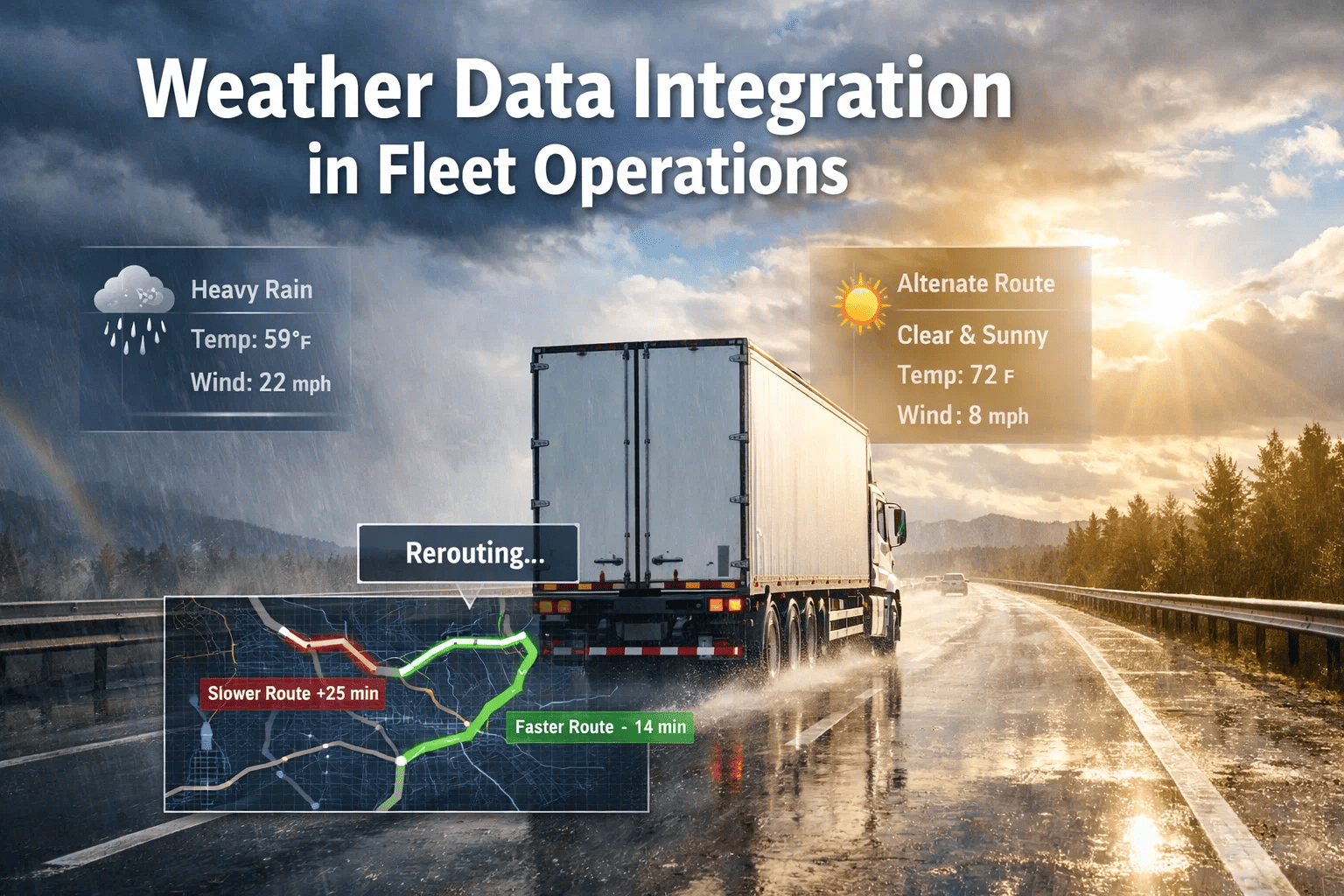
Weather is the most consistently underestimated operational variable in trucking and logistics planning. Every fleet manager knows that severe weather affects operations — but few organizations have systematically integrated real-time weather data into route planning, departure scheduling, load sequencing, and driver safety protocols in a way that measurably reduces weather-related incidents, delays, and costs. The gap between knowing that weather matters and operationally managing weather risk is where preventable weather-related incidents, missed delivery windows, and vehicle damage occur. Book a demo to see how FleetRabbit integrates operational data to help your fleet manage weather risk across every route and terminal.
Guide
Weather Data Integration With Trucking Fleet Operations: Route Optimization, Safety Protocols, and Real-Time Logistics Planning for Weather-Resilient Transportation
FLEET OPTIMIZATION & OPERATIONAL SAFETY GUIDE
Managing Weather Risk in Trucking Operations: From Reactive Response to Proactive Weather-Integrated Fleet Planning
Weather-related trucking incidents cost the U.S. transportation industry over $3.4 billion annually in vehicle damage, cargo loss, and liability claims. Organizations that integrate real-time and forecast weather data into dispatch planning, route selection, driver briefing protocols, and vehicle preparation workflows reduce weather-related incident rates by 40–60% while maintaining delivery commitments that reactive weather response consistently fails to support.
The True Cost of Weather-Reactive Fleet Operations
Most trucking operations respond to weather rather than plan around it. Dispatchers learn about severe conditions when drivers call in from the road. Route alternatives are considered after a winter storm hits rather than before departure. Drivers receive weather advisories as general safety reminders rather than route-specific, weather-integrated planning information. This reactive posture creates entirely preventable costs across multiple dimensions.
Vehicle Damage and Insurance Claims
$18,000–$45,000
Average cost per weather-related commercial vehicle incident including towing, repair, cargo damage assessment, and insurance processing. Weather accounts for 21% of all large truck crashes according to FMCSA data.
Missed Delivery Windows and Customer Penalties
$2,500–$15,000
Average cost per missed delivery commitment including customer-assessed penalties, re-delivery expenses, and relationship damage that affects contract renewal negotiations. Weather is the most cited cause of delivery window failures.
Emergency Re-Routing and Accommodation
$800–$3,500
Driver accommodation costs, re-routing fuel surcharges, and emergency dispatch coordination expenses when weather forces unplanned route changes after departure. Pre-planned weather routes add minimal cost compared to emergency re-routing.
HOS Compliance Risk From Unplanned Delays
$16,000+
Average FMCSAfine for HOS violations that result from unplanned weather delays forcing drivers to push through legal limits to meet commitments made without weather-adjusted scheduling. HOS violations triggered by weather delays are not exempt from regulatory consequence.
Weather Variables That Fleet Operations Must Monitor and Plan Around
Snow accumulation rates, freezing rain probability, bridge ice formation conditions, and road surface temperature data are essential for pre-departure route decisions. The relevant data is not whether snow is forecast — it is the accumulation rate against route clearing schedules, the bridge surface temperature against freeze thresholds, and the state DOT alert level along planned corridors. Generic weather apps provide none of this operational granularity.
Sustained winds above 35–40 mph create significant stability risk for high-profile loads — enclosed trailers, flatbeds with tarped cargo, and empty trailers. Many bridge crossings have posted wind speed restrictions that trigger closure at specific thresholds. Operations planning high-bridge crossings or operating on exposed corridors during wind event forecasts must incorporate wind speed and gust data into departure timing and route selection decisions.
Fog-related crashes are disproportionately severe in trucking due to the closing speed between large trucks and other vehicles in reduced visibility conditions. Dense fog advisories on specific route segments should trigger departure delays or routing around affected corridors. Valley fog patterns, radiation fog formation timing, and visibility forecast data by corridor hour are the relevant variables for fog risk management in trucking operations planning.
Cold weather below -15°F creates diesel gelling risk for non-winterized fuel, battery performance degradation, and tire pressure loss that can trigger TPMS alerts during warm-up cycles. Extreme heat above 100°F increases tire blowout risk, stresses cooling system components, and affects refrigerated trailer thermal performance. Temperature extremes require vehicle pre-operation protocols that go beyond standard pre-trip inspection checklists.
Flood-related road closures often develop faster than standard traffic routing systems update. Flash flood events can close primary routes with little advance warning. Fleets operating through flood-prone geography — river valley corridors, areas with significant grade changes that channel runoff — need active monitoring of precipitation intensity and stream gauge data that precede road closure by 30–90 minutes, enabling proactive re-route before affected corridors close.
Severe thunderstorm events with large hail, lightning, and damaging winds represent vehicle damage and driver safety risks that warrant route or timing adjustments for operations in affected corridors. Tornado watches and warnings require driver shelter protocols — pulling to safe locations rather than attempting to outrun severe weather. Operations planning in severe convective weather regions during peak season must incorporate storm cell tracking data into dispatch decision workflows.
How FleetRabbit Supports Weather-Integrated Fleet Operations
FleetRabbit provides the fleet management data infrastructure that enables weather-integrated operational planning. While FleetRabbit integrates with GPS and telematics providers to provide real-time vehicle location and route status, the platform's core contribution to weather operations management is the fleet data context — vehicle locations, driver HOS status, maintenance readiness, and inspection compliance — that makes weather information operationally actionable rather than just informational.
01
Real-Time Vehicle Location for Weather Impact Assessment
FleetRabbit's GPS integration with telematics providers gives operations managers the exact position of every vehicle in the fleet at any moment. When a weather event develops along a specific corridor, dispatchers can immediately identify which vehicles are in or approaching the affected area and assess re-routing, shelter, or continuation decisions based on actual vehicle positions rather than estimated run positions. Real-time location data converts weather forecasts from general advisories into vehicle-specific risk assessments.
02
HOS Status Integration for Weather-Adjusted Scheduling
Weather events that force route diversions, shelter stops, or departure delays have direct HOS implications. A driver who adds three hours of running time due to a weather diversion may reach HOS limits before reaching destination. FleetRabbit's HOS monitoring provides dispatchers with real-time available hours for every driver — enabling weather-adjusted schedule decisions that account for the HOS implications of delay and re-routing before they create compliance violations that require last-minute driver swaps or missed deliveries.
03
Vehicle Maintenance Readiness for Weather Operations
Vehicle mechanical readiness is a critical pre-condition for safe weather operations. A truck with a tire pressure anomaly noted in the DVIR should not be dispatched into a winter storm corridor where tire performance is reduced. A vehicle with a PM service overdue on brake adjustment should not be dispatched in anticipation of icy road conditions requiring extended braking distances. FleetRabbit's maintenance status tracking gives dispatchers visibility into vehicle readiness issues before weather-exposed dispatches are committed.
04
Digital Inspection Protocols for Weather-Specific Pre-Trip Checks
FleetRabbit's DVIR module supports weather-specific inspection checklists that can be activated for dispatches during adverse weather conditions. Winter weather inspection checklists add items for tire chain compliance, windshield washer fluid level, antifreeze specification verification, and light system functionality beyond standard pre-trip requirements. Weather-specific checklists ensure that vehicles dispatched into forecast adverse conditions meet the enhanced inspection standard that safe weather operations require.
05
Driver Communication for Weather Event Management
FleetRabbit's dispatch communication tools enable structured driver briefing for weather-affected runs — including route-specific weather alerts, authorized shelter locations, emergency contact protocols, and route deviation authorization procedures. Documentation of driver weather briefing is maintained in the dispatch record, providing evidence of systematic safety communication in the event of weather-related incidents that trigger regulatory or insurance investigation.
06
Incident Documentation for Weather-Related Events
When weather-related incidents occur — vehicle damage, cargo disruption, or safety events — FleetRabbit's incident documentation system captures structured records that include vehicle condition, driver HOS status at time of event, prior inspection history, and dispatch instructions. Complete incident documentation protects the fleet operator in liability investigations and supports insurance claim processing that accurately attributes causation to weather conditions versus vehicle or driver factors.
Give Your Fleet the Operational Data to Manage Weather Risk Proactively
FleetRabbit's real-time fleet visibility — vehicle locations, driver HOS status, maintenance readiness, and inspection compliance — gives your operations team the fleet data context to make weather-informed dispatch decisions before conditions create preventable incidents. Book a demo to see FleetRabbit's operational visibility platform in action.
Building a Weather Operations Protocol for Your Trucking Fleet
Effective weather operations management requires documented protocols that define decision thresholds, authority levels, and driver procedures for different weather event types. The following framework organizes weather operations protocols by severity level, providing a starting point for fleet operators developing or refining their weather management approach.
Dispatch Actions
Review all active dispatches against advisory area coverage
Confirm weather-enhanced pre-trip inspection completed for affected runs
Verify driver has current authorized shelter location list for route
Document advisory briefing in dispatch record for each affected run
Driver Protocols
Reduce speed to conditions on advisory-affected corridors
Increase following distance to minimum 8 seconds in reduced traction
Check in with dispatch when entering and exiting advisory area
Report any road condition changes not matching forecast briefing
Dispatch Actions
Hold non-critical departures until warning is downgraded or lifted
Re-route essential runs to avoid highest-risk corridor segments
Contact drivers in affected areas with current shelter locations
Review HOS status for drivers in affected area — plan early stops if needed
Driver Protocols
Seek authorized shelter if conditions exceed safe operating threshold
Do not attempt bridge crossings in restricted wind conditions
Report to dispatch every 60 minutes in warning conditions
Document any damage or safety events immediately through FleetRabbit app
Dispatch Actions
Suspend all non-essential dispatches immediately
Confirm shelter status for all drivers in affected area
Notify customers of emergency weather impact on affected shipments
Activate emergency contact protocol for any driver not responding
Driver Protocols
Immediately seek nearest authorized shelter — do not continue route
Confirm shelter location with dispatch upon arrival
Do not depart until dispatch authorization received
Document shelter event, timing, and conditions through FleetRabbit app
Common Questions About Weather Data and Fleet Operations
QCan FleetRabbit integrate directly with weather data providers?
FleetRabbit's primary value in weather operations management is providing the fleet operational data context — real-time vehicle locations, driver HOS status, maintenance readiness, and inspection compliance — that makes weather information actionable at the dispatch decision level. FleetRabbit's GPS and telematics integration provides vehicle position data that can be overlaid with weather information from dedicated weather data platforms your operations team uses. Integration between FleetRabbit and specific weather data providers can be evaluated during the platform onboarding process based on your operational technology environment.
QHow should we handle customer commitments when weather forces departure delays?
Early, proactive customer communication for weather-related delays consistently reduces penalty exposure compared to late notification. When FleetRabbit's dispatch system shows a departure hold pending weather, the fleet manager or dispatcher has real-time information to assess the likely delay duration and communicate adjusted ETA to customers before the original window expires. Customers who receive advance notification with specific updated timing are significantly less likely to assess penalties than those who discover missed windows without prior communication. Document all customer weather communications in the dispatch record.
QDoes insurance coverage differ for weather-related incidents versus other crash types?
Commercial vehicle insurance policies typically cover weather-related incidents, but coverage adequacy and claim outcomes are significantly affected by the documentation of weather protocols and the evidence of reasonable operational precautions. Fleets with documented weather operating protocols, driver briefing records, and vehicle inspection compliance are in a significantly stronger position in weather-related insurance claims than those responding to weather reactively without documented decision frameworks. FleetRabbit's inspection records, dispatch documentation, and incident reporting tools provide the evidence infrastructure that supports favorable weather claim outcomes.
QWhat fleet maintenance preparations are most important before winter weather season?
Seasonal winter preparation for trucking fleets should include: fuel system anti-gel additive or winterized fuel specifications for anticipated temperature ranges, antifreeze concentration verification in cooling systems, battery load testing and replacement of marginal batteries before cold weather arrival, complete brake system inspection with adjustment for optimal cold-weather performance, heating system and defroster functionality verification, and tire chain compliance audit for routes through chain-required corridors. FleetRabbit's seasonal maintenance checklist feature enables fleet-wide winter readiness inspection workflows with completion tracking and deficiency documentation for every vehicle in the fleet.
Weather Operations Outcomes for Transportation Fleets
40–60%
Reduction in Weather-Related Incidents
Proactive weather-integrated dispatch planning consistently reduces weather-related incident rates compared to reactive operational response to developing conditions.
Real-Time
Vehicle Position for Weather Impact Assessment
FleetRabbit's GPS integration provides exact vehicle positions enabling dispatchers to assess which assets are in or approaching weather-affected corridors for targeted intervention.
Zero
Documentation Gaps in Weather Incident Response
FleetRabbit's inspection, dispatch, and incident documentation tools create complete records of weather operational decisions, driver briefings, and incident events for regulatory and insurance purposes.
HOS-Aware
Weather-Adjusted Scheduling Decisions
Real-time HOS visibility enables dispatch teams to make weather delay and re-routing decisions with full awareness of hours-of-service implications before compliance violations occur.
Conclusion: Weather Risk Is Manageable — With the Right Fleet Data Foundation
Weather will always be an uncontrollable variable in trucking operations. What is controllable is how completely and systematically your organization incorporates weather risk into dispatch decisions, route planning, driver briefing, vehicle preparation, and incident response. The difference between a fleet that manages weather proactively and one that responds reactively is not prescience — it is the quality of the operational data infrastructure and the protocols that govern how weather information is applied to specific, real-time fleet decisions.
FleetRabbit provides the fleet management data foundation — real-time vehicle positions, driver HOS status, maintenance readiness tracking, and digital inspection compliance — that makes weather risk management operationally actionable rather than theoretically aspirational. Fleets that combine FleetRabbit's operational intelligence with systematic weather monitoring and documented response protocols achieve measurably lower weather-related incident rates, stronger customer service outcomes during adverse weather events, and better insurance and regulatory outcomes when weather incidents do occur.
Build a Weather-Resilient Fleet Operation With FleetRabbit
FleetRabbit's real-time fleet intelligence — vehicle locations, driver HOS status, maintenance readiness, and digital inspection compliance — gives your operations team the data foundation to make proactive, weather-informed dispatch and routing decisions that protect drivers, vehicles, cargo, and customer commitments during adverse weather conditions.
Weather Route Planning
Driver Safety Protocols
Real-Time Fleet Visibility
HOS Compliance
Incident Documentation
April 16, 2026
By Jason Smith
All Posts