A dispatcher assigns a driver a route that looks fine on paper. Three hours in, that driver hits the 14-hour on-duty window with two hours of delivery still ahead. Nobody noticed because nobody was watching in real time, they were reviewing logs after the fact, the same way fleets have done it for years. The violation gets flagged only once the ELD data uploads following a roadside inspection, by which point the fine is already earned and the CSA score is already dented. This is the exact failure pattern that real-time Hours of Service management is designed to eliminate, and in 2026 the gap between fleets that catch problems before dispatch and fleets that only discover them after enforcement has become far more expensive to ignore.
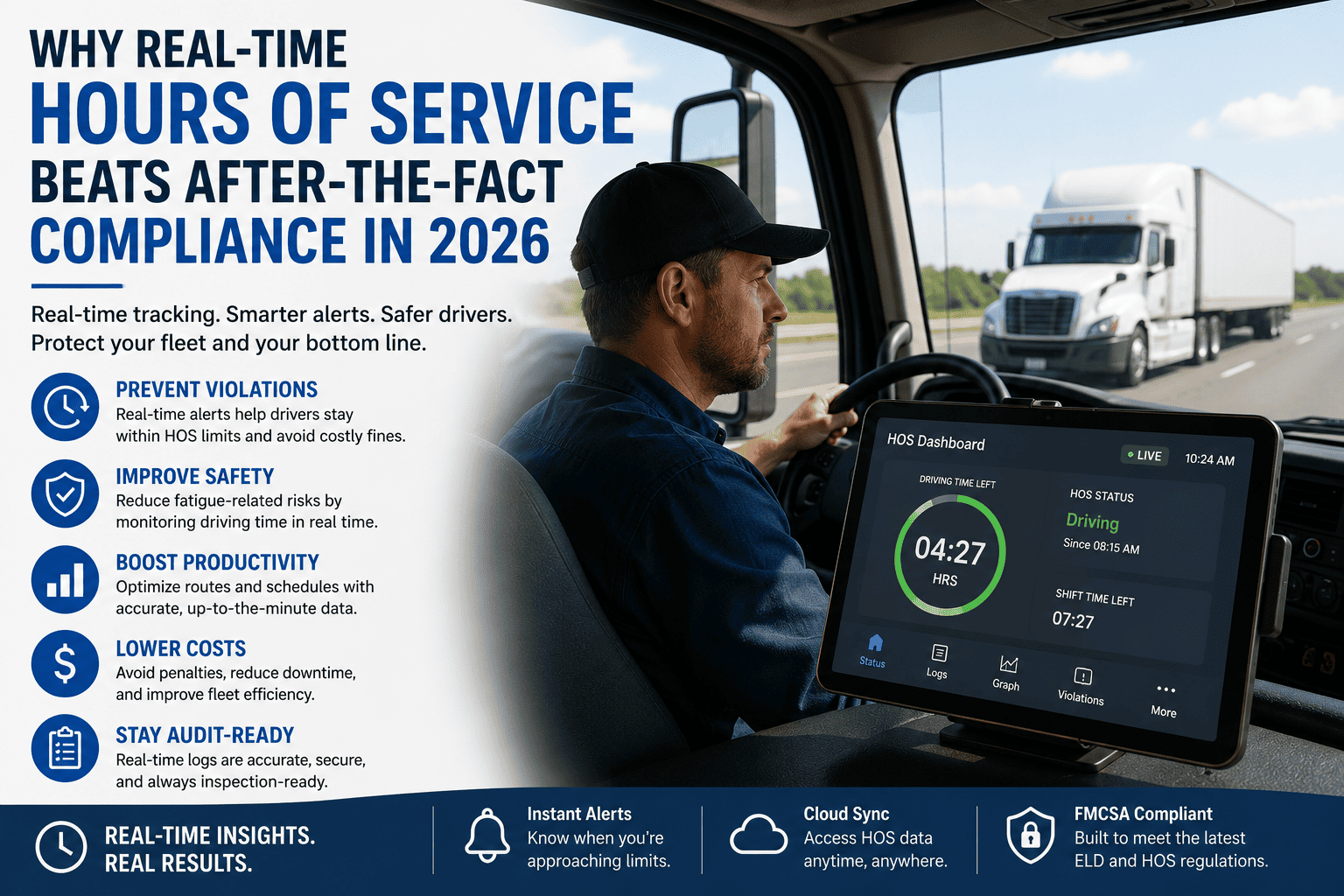
Real-time HOS management beats after-the-fact compliance because it prevents violations before a driver is ever dispatched, instead of just documenting them once they've already happened. By connecting live ELD data to dispatch decisions, fleets see exactly how many hours a driver has left on the 11-hour driving limit, the 14-hour window, and the 60/70-hour cycle before a route is assigned, not after a roadside inspection flags the problem.
The Problem With Reviewing HOS Logs After the Fact
Traditional HOS compliance treats the electronic log as a record to be checked later, during a weekly audit, a roadside inspection, or a compliance review. That approach only ever catches violations after they've occurred. By 2026, ELD data uploads directly into FMCSA's Safety Measurement System within 24 hours of every roadside inspection, and the current SMS weighting model gives extra impact to violations from the most recent six months. That means a single missed 30-minute break or an over-hours dispatch doesn't just cost a fine, it accelerates a carrier's HOS Compliance BASIC score toward the investigation threshold faster than at any point since the ELD mandate began.
An hours of service violation under the current FMCSA penalty schedule can carry a civil penalty of up to roughly $17,000 per driver per violation, and that number doesn't account for the CSA score damage, the insurance premium increases, or the far larger legal exposure a fatigue-related crash can create. Fleets still relying on after-the-fact log reviews are essentially auditing their own mistakes instead of preventing them.
- Violations discovered during weekly log audits or roadside inspections
- Dispatch decisions made without visibility into remaining driver hours
- Fines and CSA damage occur before anyone reviews the data
- Fatigue risk goes unmanaged until a driver is already over-hours
- Live alerts surface developing violations before they happen
- Dispatch integrates available hours before a route is assigned
- Violations are prevented instead of documented after the fact
- Drivers approaching fatigue thresholds are flagged proactively
FleetRabbit connects live ELD data straight into your dispatch view, so no route ever gets assigned to a driver who legally can't complete it. Sign up free and see your fleet's real-time HOS status today.
The Core HOS Limits Every Dispatch Decision Has to Respect
Real-time monitoring only works if it's tracking the right numbers. Under 49 CFR Part 395, property-carrying commercial drivers operate within four core limits that define whether a route can legally be completed. A dispatch system that isn't checking all four in real time is only solving part of the problem.
Why the 30-Minute Break Rule Trips Up So Many Fleets
The 30-minute break requirement is based on cumulative driving time, not the clock, which means it can't be scheduled the way a lunch break can. A driver who doesn't pause until reaching a destination on a long continuous route is one of the most common ways fleets rack up avoidable citations. Real-time monitoring tracks accumulated driving minutes as they happen and prompts a break before the threshold is crossed, instead of letting the ELD simply record the violation after it occurs.
How Real-Time Monitoring Changes the Dispatch Conversation
Instead of a dispatcher assigning a route and hoping the driver's hours work out, real-time HOS integration answers the question before the assignment is made. It shows exactly how many driving hours, on-duty hours, and weekly cycle hours a driver has left, so the route gets built around what's actually legal rather than adjusted after a violation already happened.
| Compliance Task | Traditional Log Review | Real-Time HOS Management |
|---|---|---|
| Checking Available Hours | Reviewed manually before or after dispatch, often outdated | Live hours remaining visible at the moment of route assignment |
| Break Compliance | Flagged as a violation once the ELD log is reviewed | Driver alerted before the 8-hour cumulative threshold is reached |
| Weekly Cycle Tracking | Calculated at the end of the week during payroll or audit review | Running 60/70-hour total visible continuously across the fleet |
| Violation Response | Corrective action taken after CSA score impact already occurred | Developing violation prevented before it can be recorded at all |
Connecting HOS Data to Maintenance and Dispatch
An hours of service violation is rarely just a driver problem. It's often a dispatch decision made without visibility into the full picture, including whether the assigned vehicle was even due for maintenance before a long haul. Fleets that connect HOS data, maintenance status, and dispatch into one view stop making the kind of assignment that creates compliance exposure in the first place.
Turning HOS Data Into a CSA Advantage
Because the 2026 SMS weighting model emphasizes the most recent six months of violation history, a fleet that shifts to real-time prevention sees its HOS Compliance BASIC score improve faster than it would have under the old weighting rules, turning a compliance fix into a measurable safety score advantage.
FleetRabbit turns ELD data into proactive alerts your dispatch team can act on before a route is assigned, keeping your CSA score clean and your drivers legally on the road.
Frequently Asked Questions
FleetRabbit connects real-time HOS data to dispatch decisions so your fleet stays ahead of violations instead of reacting to them after an audit or roadside inspection.