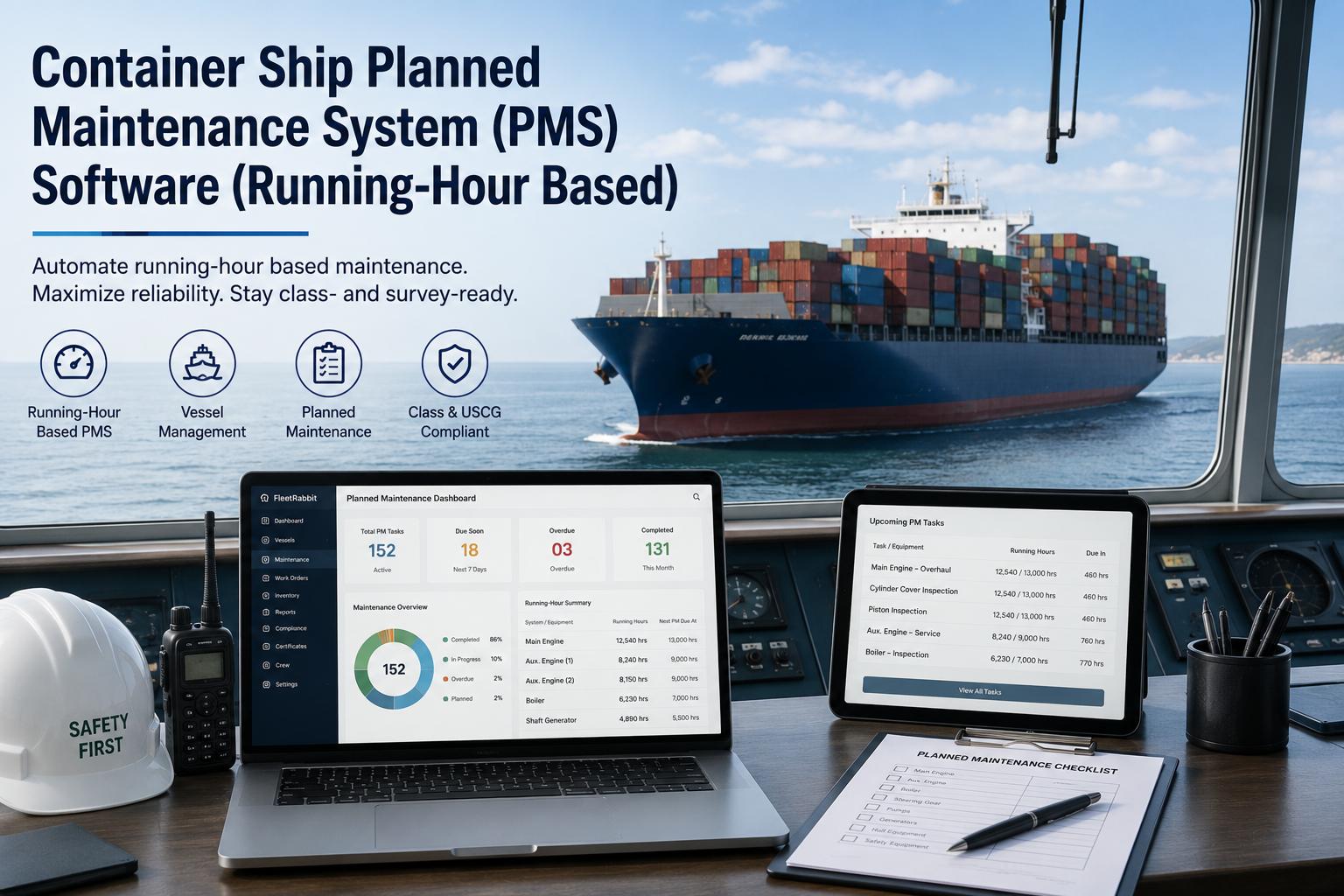
Container liner operators, boxship chief engineers, and shoreside technical superintendents manage complex machinery systems on strict schedules: running electronic 2-stroke propulsion plants, auxiliary generator banks under heavy reefer electrical loads, and bow thrusters across global port rotations. When running-hour logs, lube oil analysis records, Class Continuous Machinery Survey (CMS) items, spare parts consumption, and statutory Class certificates are tracked manually on standalone shipboard databases and paper logs, container lines risk unexpected auxiliary blackouts, costly port state detentions, and off-hire penalties during high-velocity terminal calls. Fleet Rabbit delivers specialized container ship Planned Maintenance System (PMS) software powered by automated running-hour triggers, digital Class CMS survey vaults, offline shipboard execution, and satellite-optimized ship-to-shore synchronization. Eliminate maintenance blindspots, streamline Class renewal audits, and maintain continuous seaworthiness across transoceanic container rotations with zero active satellite connectivity. Book a Demo to see Fleet Rabbit container ship PMS software in action.
MARITIME APEX HORIZON HEROContainer Ship Planned Maintenance System (PMS) Software
Automate running-hour machinery overhaul intervals, streamline IACS Continuous Machinery Surveys (CMS), centralize statutory certificates, and manage offline ship-to-shore work orders across global container fleets.
Why Legacy Software Fails Container Ship Planned Maintenance
Cumbersome enterprise ship management systems and isolated shipboard spreadsheets leave container operators exposed to missed overhaul hours, unlinked spare parts stockouts, and Class survey condition remarks.
Auxiliary Engine High-Hour Load Blindspots
Container ships run heavy auxiliary generator sets continuously in port to power hundreds of refrigerated containers; static calendar intervals miss accelerated oil shearing and valve wear, leading to blackout risks in congested channels.
Lapsed Class Continuous Machinery Survey (CMS) Deadlines
Machinery components approved under Class CMS cycles filed in paper engine room binders risk exceeding their 5-year survey windows during long transpacific rotations without automated shoreside tracking.
Disconnected Critical Spare Parts Inventory
Chief Engineer maintenance work orders disconnected from shoreside procurement databases lead to delayed overhauls when replacement exhaust valve spindles or injector nozzles are missing from shipboard stores.
Open-Ocean Satellite Latency & Heavy Sync Failures
Legacy maritime PMS platforms require heavy bandwidth database replication that fails over standard ocean VSAT links. Cloud-only tools crash, leaving engineers unable to log completed jobs or access maintenance manuals.
How Fleet Rabbit Powers Running-Hour Planned Maintenance
Fleet Rabbit synchronizes engine room running-hour meters, deck department PMS tasks, digital certificate vaults, and bi-directional ship-to-shore sync into one maritime platform. Request a 1-on-1 walkthrough.
Automated Running-Hour Machinery PMS
Automatically triggers maintenance intervals for hydraulic exhaust valves, fuel injector overhauls, turbocharger cleanings, and lube oil laboratory sampling based on true engine tachometer hours.
IACS Continuous Machinery Survey (CMS) Vault
Classify and track CMS-credited machinery items with digital chief engineer inspection reports, photo evidence, and 1-click audit ledgers for attending Class surveyors.
Linked Spare Parts & ROB Tracking
Automatically deduct spare parts from remaining-on-board (ROB) inventory as PMS jobs are signed off, triggering automated re-order alerts to shoreside technical purchasing teams.
Open-Ocean Offline Mode & Micro-Sync
Engineers record daily engine logs, complete work orders, and attach defect photos completely offline; lightweight data payloads automatically micro-sync to shoreside servers via marine VSAT.
Shoreside Superintendent Work Orders
Shipboard deficiencies immediately generate prioritized technical requisitions routed directly to shoreside port engineers and marine technical superintendents for rapid spare-part provisioning.
Critical Equipment & Standby Testing
Enforce ISM Code Section 10.3 compliance with automated test intervals for emergency steering changeovers, quick-closing fuel shutoff valves, emergency fire pumps, and generator auto-starts.
Statutory, Flag State & Class Society Compliance
Fleet Rabbit’s container ship maintenance and inspection workflows are structured to meet statutory international maritime regulations across major governing bodies.
Full alignment with IMO ISM Code Element 10 (Maintenance of the Ship and Equipment), SOLAS Chapter II-1 machinery and electrical installations, and MARPOL Annex VI energy efficiency management.
Supports IACS Continuous Machinery Survey (CMS) arrangements, Planned Maintenance System (PMS) survey credits, annual tailshaft condition monitoring, and auxiliary boiler inspection ledgers.
Supports USCG Title 46 CFR Subchapter F (Marine Engineering), Subchapter J (Electrical Engineering), Port State Control (PSC) boarding inspection readiness, and EPA Vessel General Permit (VGP) logs.
Pre-aligned with Paris MoU, Tokyo MoU, and USCG Qualship 21 inspection standards, minimizing deficiency findings and preventing vessel detention during high-speed port turnarounds.
Container Ship Planned Maintenance Software Comparison
A focused capability comparison for maritime technical directors evaluating Planned Maintenance Systems (PMS), statutory certificate vaults, and low-bandwidth marine synchronization. Competitor data sourced from public records as of 2026. Request a technical comparison.
| Capability | Fleet Rabbit | Amos / DNV ShipManager | Samsara | Generic Tools |
|---|---|---|---|---|
| Pricing (per vessel) | $5/month | $500–$2,000/mo ($$$$) | $27–60/month | Variable ($$$) |
| Running-Hour Machinery PMS Triggers | Native & automated | Native (high complexity) | Requires custom setup | Manual entry only |
| Class Continuous Machinery Survey (CMS) Crediting | Native & automated | Module upgrade required | Not available | Manual spreadsheets |
| Linked Critical Spare Parts ROB Tracking | Native & automated | Complex inventory add-on | Not available | Manual stock sheets |
| Open-Ocean Offline Mode & Micro-Sync | Full offline mode (VSAT ready) | Legacy database sync | Limited | Limited |
| Free Trial | 14 days, up to 3 assets | Demo only | Demo only | Demo only |
| Contract Terms | Monthly or annual | Multi-year enterprise lock-in | 3-year minimum | Annual / Multi-year |
5-Step Implementation Roadmap
Fleet Rabbit provides an accelerated deployment program engineered for container fleets, transitioning your technical management from legacy spreadsheets to automated PMS compliance in two weeks.
Machinery Particulars & Running-Hour Baseline Import
Import container ship particulars, IMO numbers, main engine specs, auxiliary genset tachometer baselines, and spare parts catalogs.
PMS Running-Hour & Interval Setup
Configure running-hour maintenance triggers for auxiliary generators, purifiers, air compressors, and bow thruster hydraulic systems.
Class CMS Survey Hierarchy Setup
Map machinery components to Class Continuous Machinery Survey schedules and set automated 90/60/30-day survey countdown alerts.
Shipboard & Shoreside Rollout
Equip Chief Engineers, Second Engineers, and shoreside Technical Superintendents with the intuitive offline-ready application.
Live Fleet Compliance Board Go-Live
Activate real-time Port State readiness indicators, Class survey countdown ledgers, and 1-click USCG audit compliance reports.
2-Week Fleet Deployment Plan & Results
Modernize container ship Planned Maintenance and USCG compliance tracking with zero disruption to scheduled liner service rotations. Request an onboarding plan.
Week 1: Setup & Data Migration
- Migrate legacy machinery running hours, spare parts catalogs, and active Class/Flag statutory certificates
- Set automated 90/60/30-day renewal triggers for USCG COI, DOC, SMC, and Load Line surveys
- Configure user permission roles for Master, Chief Engineer, Port Captain, and Technical Superintendent
Week 2: Shipboard Pilot & Go-Live
- Conduct quick 20-minute shipboard officer training on completing offline mobile DVIRs and PMS logs
- Validate micro-sync data transmission over shipboard VSAT and fleet satellite links
- Activate central shoreside dashboard with live Port State readiness indicators and survey ledgers
Protect Container Liner Fleets from Machinery Breakdowns and Survey Overdues
Automate machinery running-hour PMS, streamline Class CMS survey credits, and maintain verified seaworthiness across global voyages. Start today at $5/asset/month with a 14-day free trial.
Real-World Operational Results
Proven operational outcomes reported by international container ship operators and liner fleet technical managers. Request the full maritime case study.
Class Survey Overdue Elimination — 16-Boxship Fleet
A regional container liner operator suffered from repeated Class CMS survey overdue warnings and unexpected auxiliary generator turbocharger failures caused by disconnected shipboard paper logs. Fleet Rabbit deployed running-hour PMS triggers and automated CMS survey ledgers, eliminating 100% of overdue maintenance items and reducing auxiliary engine downtime by 48% across scheduled liner voyages.
Faster Defect Resolution — 20-Vessel Container Fleet
A container feeder line suffered from communication lag between Chief Engineers logging bow thruster hydraulic seal weepage in paper logbooks and shoreside superintendents ordering replacement parts. Fleet Rabbit converted shipboard defects into instant photo-verified technical requisitions, cutting spare part procurement and defect turnaround time from 14 days to under 48 hours.
On a fast-turnaround container service, every minute at berth counts. Coast Guard inspectors verify everything from auxiliary generator load-sharing to emergency steering gear changeovers. Fleet Rabbit gave our Chief Engineers an intuitive offline app for daily PMS tasks and gave our shoreside technical team real-time visibility into every certificate and maintenance record across the fleet.
Frequently Asked Questions
Upgrade Your Container Ship Planned Maintenance in Less Than 2 Weeks
Automate running-hour PMS tasks, streamline Class CMS survey credits, and ensure complete Port State survey readiness at $5/asset/month with a 14-day free trial.