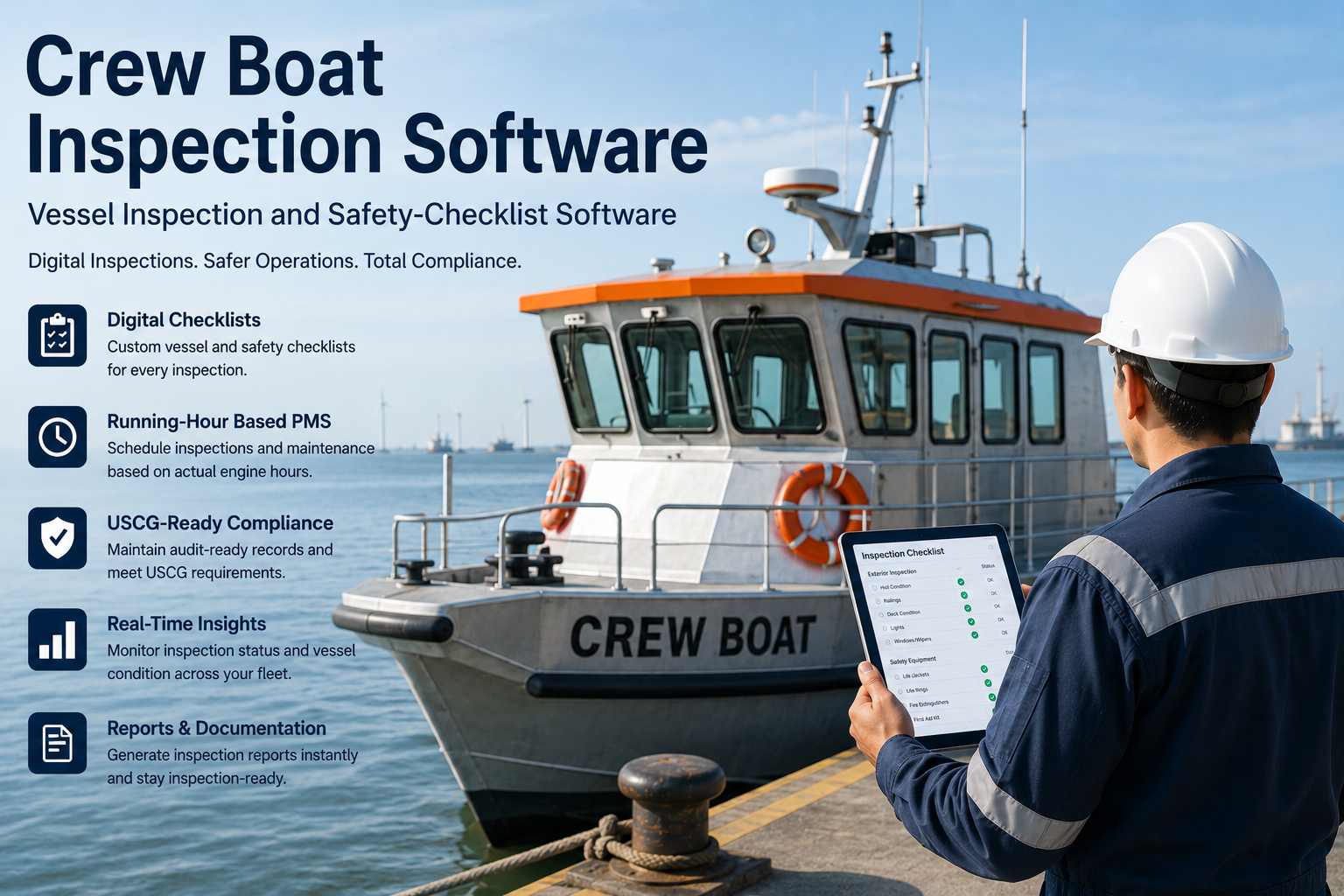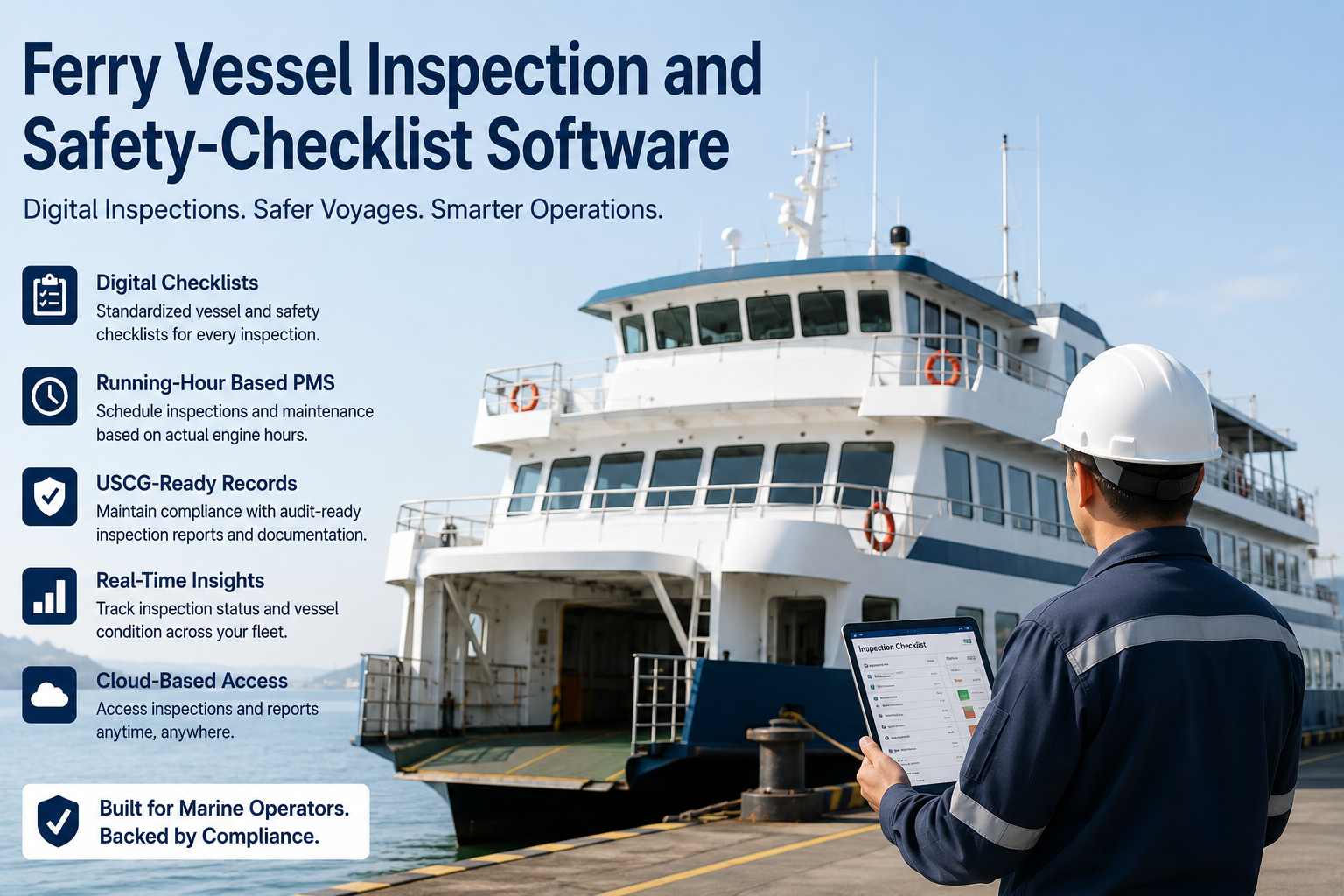
Municipal ferry systems, fast catamaran commuter lines, and private passenger vessel operators work under rigorous port inspection regimes: completing pre-departure wheelhouse walkarounds, verifying Marine Evacuation System (MES) slide readiness, testing bilge high-water alarms, and ensuring USCG Subchapter K/T life-saving compliance before each crossing. When deck walkarounds, watertight door dogging checks, emergency steering drill entries, and propulsion health notes live in paper logbooks or isolated wheelhouse files, marine operators risk sudden port captain "no-sail" orders, expensive USCG Form 835 deficiency citations, and unexpected mid-harbor breakdowns. Fleet Rabbit delivers dedicated passenger ferry vessel inspection and safety-checklist software designed for high-frequency passenger routes, unifying digital pre-departure DVIR walkarounds, running-hour planned maintenance systems (PMS), Class survey certificate vaults, and low-bandwidth ship-to-shore data synchronization into one clean marine console. Eliminate departure bottlenecks, demonstrate continuous seaworthiness to attending USCG marine inspectors, and record full deck and engine audit trails completely offline across remote island slips and steel engine rooms with zero cellular link. Book a Demo to see Fleet Rabbit passenger ferry inspection software in action.
VESSEL BRIDGE TELEMETRY HEROFerry Vessel Inspection & Safety-Checklist Software for Marine Operators
Automate pre-departure safety checklists, track watertight bulkhead door integrity, streamline USCG life-saving drill logs, and synchronize offline deck and engine room records across passenger ferry fleets.
Why Paper Inspection Sheets Compromise Passenger Ferry Schedules
Passenger ferries operate with turnaround intervals measured in minutes; traditional physical clipboards and standalone bridge spreadsheets cannot maintain the rapid audit accountability demanded by USCG inspectors and high-frequency transit timetables.
Unrecorded Pre-Departure Steering & Fire Pump Checks
USCG inspectors conduct unannounced dockside boarding to audit steering emergency switchovers and emergency fire pump pressures; paper sheets lacking photo verification or exact time stamps invite immediate Form 835 deficiency citations.
Watertight Bulkhead Door Gasket & Dogging Failures
Constant passenger foot traffic and vehicle deck vibration cause rubber gasket deterioration and loose dogging mechanisms; unmonitored watertight doors compromise compartment subdivision, introducing severe flooding risks in heavy chop.
Life-Saving Appliance Inspection Expiration Gaps
Passenger count limits dictate precise lifejacket, child PFD, and raft capacities under Subchapter K and T; physical logs in wheelhouse drawers fail to trigger advance alerts when annual hydrostatic releases or MES packings near expiration.
Sub-Deck Steel Void & Slipway Network Dropouts
Bilges, void spaces, and aluminum catamaran hulls act as complete cellular dead zones. Cloud-only tools freeze, preventing crew members from logging structural hull inspections, bilge alarm checks, or urgent maintenance requisitions.
How Fleet Rabbit Delivers Passenger Ferry Inspection Control
Fleet Rabbit synchronizes wheelhouse pre-departure checks, passenger deck life-saving audits, engine room survey logs, and shore engineering triage into one unified system. Request a 1-on-1 walkthrough.
Pre-Departure Safety Checklists
Digital walkaround forms for navigation electronics, dual radar interlocks, whistle tests, emergency steering changeovers, and bridge communication trunks.
Life-Saving & Firefighting Audits
Mobile verification routines for passenger PFD lockers, hydrostatic release dates, MES slide inspections, fixed CO2 engine room releases, and fire dampers.
Watertight Bulkhead & Door Inspections
Standardized checks for hydraulic sliding doors, manual dogging handles, chalk tests, door status bridge indicators, and bilge high-water float sensors.
Full Offline Mode & Local Cache
Deckhands and engineers inspect lower voids, record running hours, and attach high-res defect photos completely offline; data auto-syncs when within harbor signal.
Direct Defect-to-Shop Work Orders
Deficiencies logged during routine crossing walkarounds immediately convert into prioritized technical work orders routed to port engineers for night-shift servicing.
USCG COI & Class Survey Vault
Centralize Certificate of Inspection (COI) documents, stability letters, drydock survey reports, and Class hull credits with 90/60/30-day renewal countdown triggers.
Statutory, Flag State & Class Society Alignment
Fleet Rabbit’s passenger ferry inspection workflows are structured to satisfy domestic and international passenger safety standards across primary maritime authorities.
Full alignment with USCG Subchapter T (Small Passenger Vessels under 100 GT), Subchapter K (Passenger Vessels carrying more than 150 passengers), and Subchapter H safety inspection rules.
Meets IMO International Code of Safety for High-Speed Craft (HSC Code 2000), SOLAS Chapter III (Life-Saving Appliances), and ISM Code Element 10 shipboard inspection rules.
Pre-aligned for IACS Continuous Machinery Survey (CMS) walkarounds, aluminum high-speed catamaran hull bottom inspections, propeller shaft audits, and electrical distribution tests.
Supports Transport Canada Marine Safety and Security (TCMSS) passenger vessel regulations, Domestic Vessel Regulatory compliance, and UK Maritime and Coastguard Agency (MCA) passenger surveys.
Passenger Ferry Inspection Software Comparison
A capability comparison focused on passenger vessel inspection workflows, USCG Subchapter K/T life-saving audits, and offline maritime execution. Competitor data sourced from public records as of 2026. Request a technical comparison.
| Capability | Fleet Rabbit | Amos / DNV ShipManager | Samsara | Generic Spreadsheets |
|---|---|---|---|---|
| Pricing (per vessel) | $5/month | $500–$2,000/mo ($$$$) | $27–60/month | Manual overhead |
| Pre-Built USCG Subchapter K/T Inspection Forms | Pre-built & specialized | Custom configuration required | Generic vehicle only | Not available |
| USCG COI & Survey Vault with Expiration Alerts | Native & automated (90/60/30) | Module upgrade required | Not available | Manual file folders |
| Running-Hour Machinery PMS Triggers | Native & automated | Native (high complexity) | Requires custom setup | Manual entry only |
| Harbor & Steel Engine Room Offline Sync | Full offline mode | Legacy database sync | Limited | Paper only |
| Free Trial | 14 days, up to 3 assets | Demo only | Demo only | None |
| Contract Terms | Monthly or annual | Multi-year enterprise lock-in | 3-year minimum | None |
5-Step Implementation Roadmap
Fleet Rabbit provides an accelerated deployment program engineered for passenger ferry operators, taking your vessels from paper clipboards to digital inspection readiness in two weeks.
Vessel Particulars & Lifesaving Asset Setup
Import vessel HIN/VIN numbers, passenger capacities, liferaft serials, MES models, and active USCG Certificate of Inspection (COI) records.
Pre-Departure Checklist & Drill Activation
Activate pre-built digital forms for wheelhouse instruments, steering pump switchovers, fire pump flow checks, and watertight bulkhead inspections.
Safety & Seaworthiness Lockout Rules
Set automated dispatch alerts and vessel status flags for open critical safety defects (e.g., inoperable emergency fire pumps or expired life raft tests).
Master, Crew & Port Engineer Mobile Rollout
Equip Masters, Chief Engineers, and deckhands with the intuitive offline-first mobile inspection and maintenance application.
Live Operations Dashboard Go-Live
Activate real-time fleet seaworthiness dashboards, USCG audit countdown ledgers, and 1-click inspection reporting for attending marine inspectors.
2-Week Deployment Plan & Results
Modernize passenger ferry pre-departure inspections and USCG compliance records with zero disruption to scheduled commuter crossings. Request an onboarding plan.
Week 1: Setup & Configuration
- Digitize paper logbooks, life-saving appliance inventories, and active USCG COI documents
- Set up 90/60/30-day renewal warnings for annual drydock surveys, life raft recertifications, and boiler checks
- Assign user permission roles for Master, Chief Engineer, Port Captain, and Safety Director
Week 2: Shipboard Pilot & Go-Live
- Conduct quick 20-minute crew training on completing offline mobile pre-departure checks and drill logs
- Validate micro-sync data transmission across harbor Wi-Fi and terminal cellular connections
- Activate central shoreside dashboard with live USCG audit readiness indicators and work order queues
Protect Passenger Ferry Operations from Costly Deficiencies and Schedule Halts
Standardize pre-departure walkarounds, automate USCG life-safety audits, and maintain audit-ready compliance across every crossing. Start today at $5/asset/month with a 14-day free trial.
Real-World Operational Results
Proven operational outcomes reported by municipal transit operators and private passenger ferry companies. Request the full maritime case study.
Pre-Departure Compliance Rollout — 10-Vessel Catamaran Fleet
A regional ferry operator faced recurring passenger delays and USCG citations due to incomplete paper steering drill logs and unverified bilge float switches. Fleet Rabbit deployed structured mobile pre-departure checklists with photo verification, ensuring complete safety compliance before every harbor crossing, eliminating 100% of USCG inspection delays, and saving 18 admin hours weekly.
Faster Defect Triage — 16-Vessel Ferry Fleet
A private passenger vessel company struggled with communication lag between deck officers reporting damaged lifejacket lockers on paper slips and shoreside maintenance teams ordering hardware. Fleet Rabbit converted failed walkaround items into instant photo-verified technical requisitions, cutting defect resolution turnaround time from 7 days to under 12 hours.
When carrying hundreds of passengers on tight commuter headways, there is zero margin for safety oversights. The Coast Guard expects immediate proof of every steering drill, life raft certification, and bilge alarm check. Fleet Rabbit gave our Masters and Chief Engineers a fast, reliable mobile app that works seamlessly in our engine rooms and gives shoreside management total confidence that every vessel is fully compliant and safe to depart.
Frequently Asked Questions
Upgrade Your Passenger Ferry Vessel Inspections in Less Than 2 Weeks
Standardize pre-departure walkarounds, automate USCG Subchapter K/T audits, and maintain complete audit-ready records at $5/asset/month with a 14-day free trial.