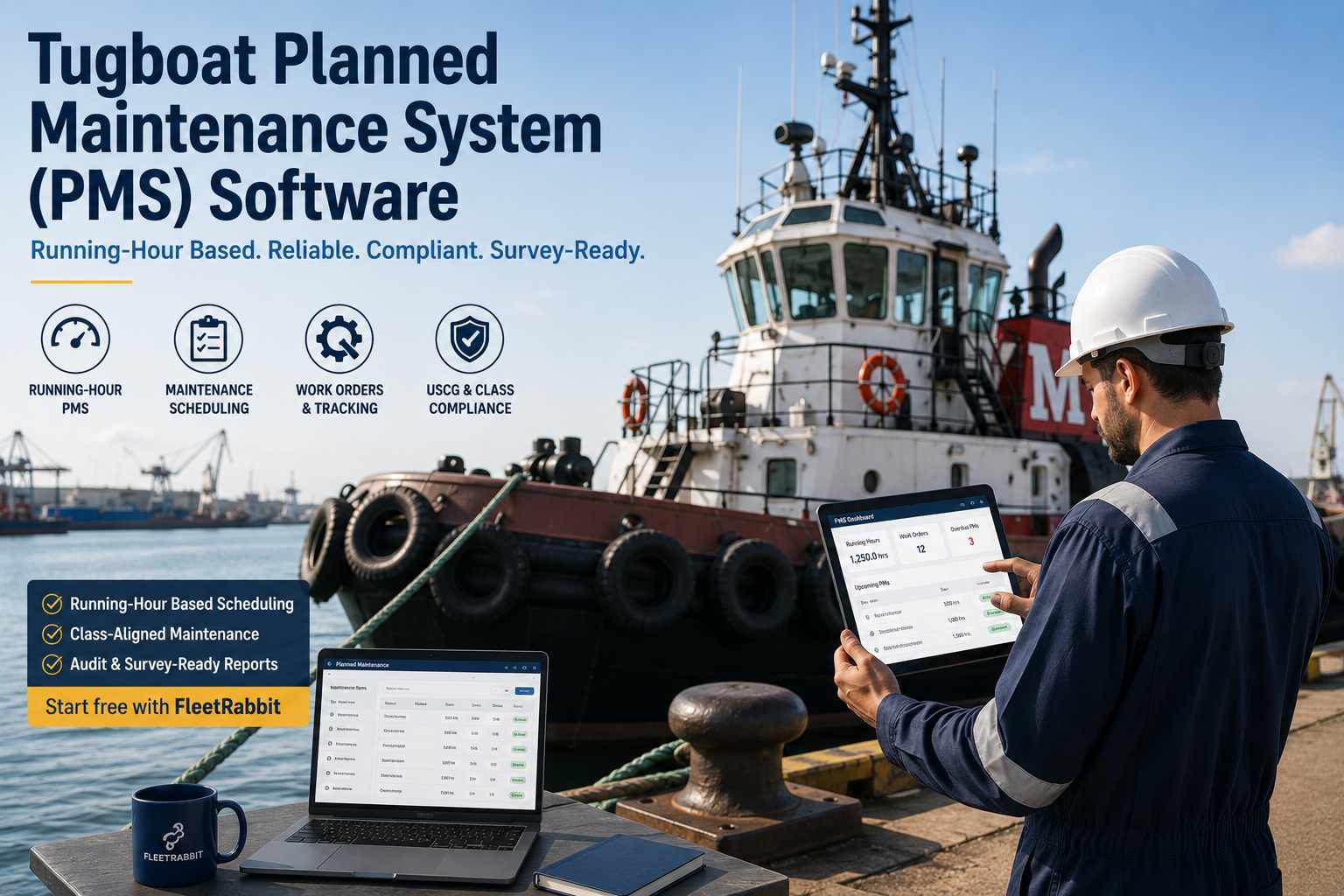
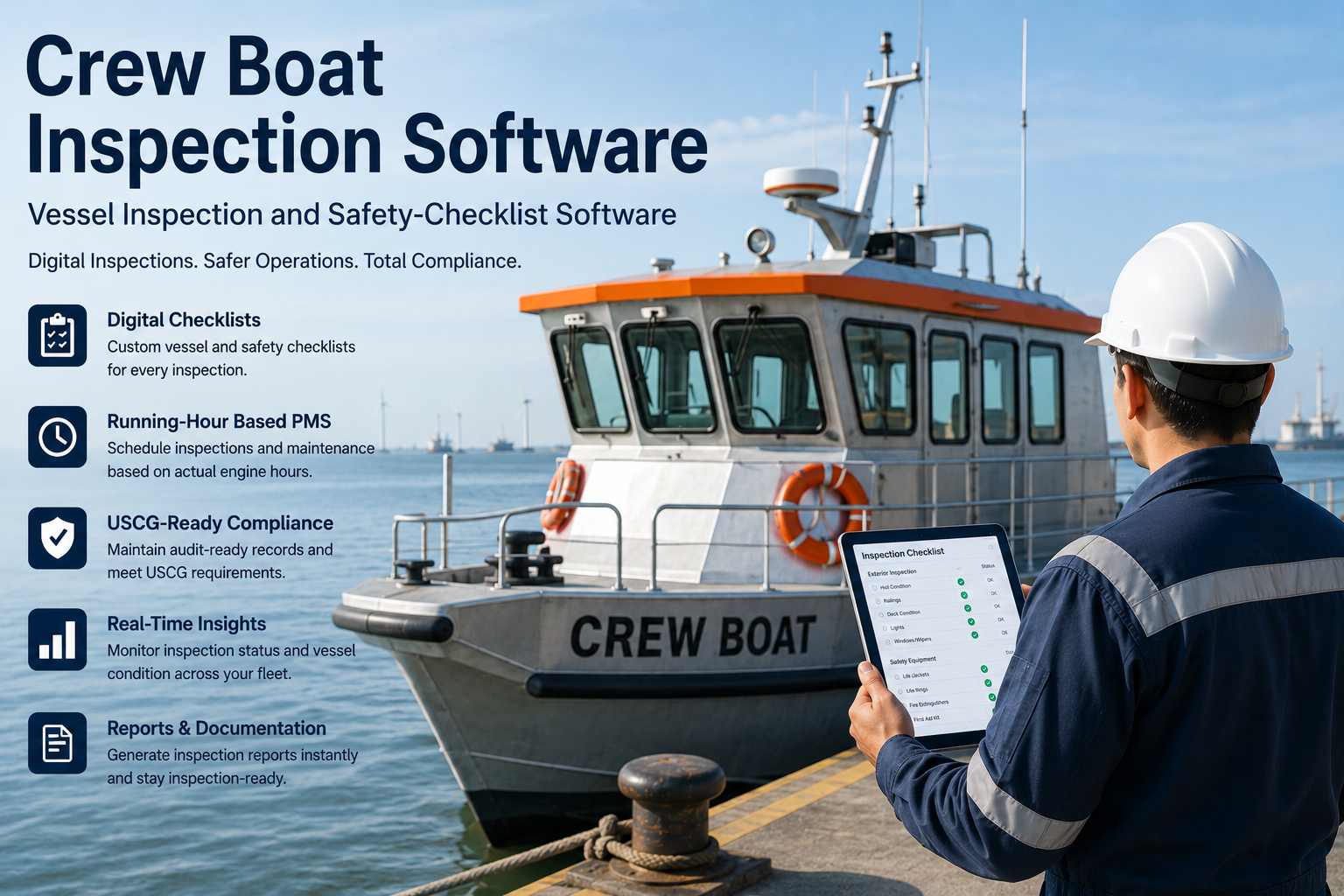
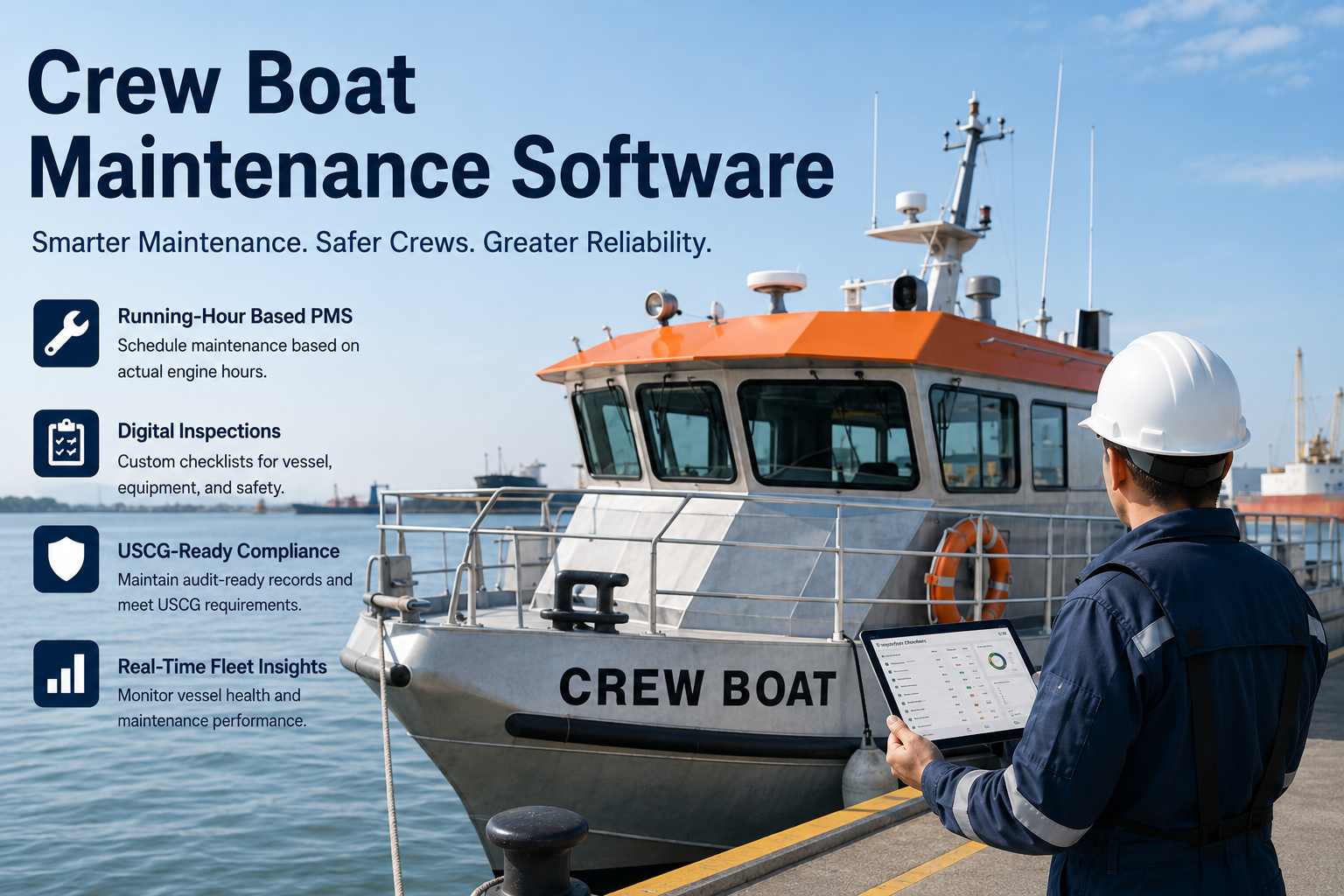
Tugboat operators, port engineers, and chief engineers operate under demanding maritime realities: keeping high-bollard-pull main propulsion engines, auxiliary diesel generator sets, and azimuth thrusters operating reliably while staying compliant with USCG Subchapter M and Class society Continuous Machinery Surveys (CMS). When engine room bell books, running-hour counters, and overhaul records sit in physical binders and disconnected spreadsheets, shoreside teams lose visibility and tugs face sudden mechanical breakdowns or costly Port State Control detentions. Fleet Rabbit delivers dedicated tugboat planned maintenance system (PMS) software that automates running-hour scheduling, digital seaworthiness inspections, and Class/USCG audit workflows on a single unified marine platform. Eliminate unexpected mechanical downtime, streamline drydock work orders, and maintain complete offline maintenance logs during long-range coastal towing voyages with zero shore connectivity. Book a Demo to see Fleet Rabbit tugboat PMS in action.
99%
Tugboat fleet operational availability across active harbor and coastal towing routes
45%
Reduction in unscheduled main engine, Z-drive, and tow winch breakdowns
100%
USCG Subchapter M (TSMS) and Class survey compliance completion rate
6.5 hrs
Weekly scheduling and reporting time saved per chief engineer and port captain
Align Tugboat Planned Maintenance with True Machinery Stress, Not Static Calendar Dates.
Fleet Rabbit automates running-hour PMS alerts, auxiliary genset service logs, and Class survey readiness into one centralized marine dashboard. Pre-built templates for marine diesels, Z-drives, tow winches, and steering gear require zero custom configuration.
Why Static Calendar Maintenance Fails Commercial Tugboat Fleets
Standard fleet management software tracks basic road mileage and monthly service dates, but harbor assist and escort tugs endure severe-duty continuous bollard load that calendar systems completely miss.
High-Load Maneuvering Blindspots
A harbor tug may log few nautical miles while running main engines and auxiliary gensets under heavy load, resulting in severe unlogged machinery wear.
Overlooked Running-Hour Overhauls
Z-drives, turbochargers, and fuel injectors demand strict 500, 2,500, and 5,000-hour service intervals; calendar scheduling causes premature wear or expensive over-maintenance.
Disconnected Class & USCG TSMS Logs
Machinery history records stored across physical engine room binders create severe compliance risks during ABS, DNV, Lloyd's Register, and USCG annual surveys.
Offshore Communication Blackouts
Cloud-only software freezes when tugs transit out of cellular range, leaving chief engineers unable to log daily soundings, PMS work orders, or machinery defects at sea.
How Fleet Rabbit Powers Running-Hour Tugboat Planned Maintenance
Fleet Rabbit integrates main propulsion telemetry, auxiliary generator meters, and daily soundings into automated PMS workflows built for commercial towing operations. See a running-hour PMS live demo.
01
Automated Running-Hour Triggers
Dynamic PMS alerts trigger off actual operating hours pulled directly from main engines, auxiliary diesel gensets, Z-drives, and tow winches.
02
Pre-Built Tugboat PMS Templates
Standardized digital job cards covering 250-hr lube filter changes, 1,000-hr injector tests, 5,000-hr top-end overhauls, and annual Class survey items.
03
Class Survey Readiness Boards
Shoreside port engineers and chief engineers see real-time compliance badges for critical Continuous Machinery Survey (CMS) items and statutory certificates.
04
Deep-Water Offline Mode & Sync
Engineers complete daily rounds, record fuel soundings, and log PMS job cards without internet connection; data automatically syncs upon port or satellite link.
05
Closed-Loop Defect-to-Work-Order
Failed inspection checks instantly create categorized maintenance tickets with attached defect photos, routing priority tasks directly to port engineers and shipyard vendors.
06
Critical Spares & Lube Tracking
Track minimum safety inventory for critical engine spares, filter kits, and lube oil stock directly tied to recurring planned maintenance work orders.
Built for Class Societies & Global Maritime Regulatory Standards
Fleet Rabbit’s planned maintenance workflows comply with international maritime safety codes and statutory classification requirements across major maritime regions.
United States & USCG
Aligns machinery maintenance records with USCG Subchapter M Towing Safety Management Systems (TSMS), Certificate of Inspection (COI) rules, and EPA marine diesel tier standards.
IMO & ISM Code
Supports planned maintenance procedures aligned with International Safety Management (ISM) Code Section 10 for maintenance of the ship and equipment.
Classification Societies
Maintains machinery history ledgers and overhaul records aligned with ABS, DNV, Lloyd's Register, and Bureau Veritas Continuous Machinery Survey (CMS) requirements.
Canada & MCA (UK)
Structures machinery records to satisfy Transport Canada Marine Safety Management Systems and UK Maritime and Coastguard Agency (MCA) Workboat Codes.
Fleet Rabbit vs. Competitors: Tugboat Planned Maintenance Software
A feature-level comparison focused on running-hour marine PMS, Class survey compliance, and offline vessel functionality. Competitor pricing and feature data sourced from publicly available documentation as of 2026. Request a 1-on-1 technical evaluation.
Tugboat PMS Deployment Roadmap
Fleet Rabbit delivers a structured, rapid deployment process designed for commercial towing operators, bringing your tugs from initial machinery tagging to automated running-hour PMS in two weeks.
01
Machinery Hierarchy Import
Import main propulsion units, gensets, Z-drives, tow winches, and Class survey schedules
02
Running-Hour PMS Intervals
Configure running-hour trigger thresholds for oil sampling, filter changes, and major overhauls
03
Job Card & Checklist Setup
Set up digital job cards for Subchapter M, bilge alarms, tow winches, and steering gear
04
Shipboard Mobile Rollout
Equip chief engineers and vessel masters with the 1-tap offline mobile PMS application
05
Shoreside PMS Go-Live
Activate real-time seaworthiness tracking, critical spares alerts, and Class audit reports
2-Week Tugboat PMS Deployment Timeline
Transition your tug fleet from reactive engine repairs to automated running-hour maintenance with zero interruption to active sailing schedules. Request a rollout scope tailored to your fleet.
Week 1
Machinery Hierarchy & Service Interval Setup
Audit historical vessel logbooks, engine hour meters, drydock history, and active Class surveys
Set automated PMS intervals for 250-hr lube changes, 1,000-hr top-end checks, and 5,000-hr overhauls
Configure user permission levels for chief engineers, vessel masters, and shoreside port captains
Week 2
Shipboard Validation & shoreside Go-Live
Conduct brief 15-minute shipboard training for crew members on offline job card completion
Test automated work order generation on simulated cooling pressure and fuel leak defect logs
Enable shoreside dashboard with live seaworthiness indicators and exportable Class audit reports
TUG FLEET GAINS WITHIN 14 DAYS
Commercial towing operators deploying Fleet Rabbit achieve complete oversight of machinery running hours, eliminate unlogged offshore defects, and pass Class surveys without paperwork delays.
45%
Less machinery downtime
99%
Fleet availability rate
6.5 hrs
Saved weekly per engineer
Protect Your Tug Fleet with Precision Running-Hour PMS Scheduling.
Eliminate missed engine overhauls, simplify Class society surveys, and keep your commercial tugs operating safely on water. Deploy across your entire fleet at $5/vessel/month with a 14-day free trial.
Real-World Outcomes from Tugboat PMS Deployments
Proven operational outcomes reported by harbor assist towing companies, barge lines, and coastal escort operators. Request the full marine case study.
A coastal towing operator suffered repeated auxiliary generator turbocharger burnouts due to static calendar servicing that failed to track heavy harbor ship-assist loads. Fleet Rabbit introduced automated running-hour PMS triggers, cutting premature overhaul costs and saving over $135,000 in repair expenses in the first year.
100%
PMS running-hour adherence
$135k+
Annual overhaul savings
99%
Tug availability rate
A municipal harbor service struggled with scattered paper binders and delayed defect tracking between onboard crews and shoreside maintenance. Fleet Rabbit implemented mobile Subchapter M pre-voyage checklists and Class CMS tracking, resulting in zero survey deficiencies during annual USCG inspections and cutting audit prep time by 85%.
0
Class survey deficiencies
85%
Faster audit preparation
100%
Digital log compliance
What Marine Port Engineers & Chief Engineers Say About Fleet Rabbit
Managing planned maintenance and Class survey records across our tug fleet used to involve endlessly chasing paper logbooks and Excel sheets. Fleet Rabbit gave our port engineers real-time visibility into engine running hours and defect work orders even when our vessels are far offshore, cutting unscheduled downtime and making audit preparation effortless.
Director of Marine Maintenance & Port Engineering
Commercial Towing & Harbor Services, Gulf Coast
Frequently Asked Questions
How does Fleet Rabbit calculate tugboat planned maintenance intervals using running hours?
Fleet Rabbit captures real-time operating hours and daily engine room soundings directly from main propulsion engines, auxiliary diesel generators, Z-drive thrusters, and tow winches. Instead of relying on static calendar dates, the platform automatically triggers maintenance work orders when specific running-hour thresholds (such as 250-hour lube changes, 1,000-hour injector testing, or 5,000-hour top-end overhauls) are reached, ensuring maintenance reflects true machinery stress.
Book a demo to view the marine PMS configuration board.
Can shipboard engineers and vessel captains log PMS tasks and daily rounds when deep offshore without cellular signal?
Yes, the Fleet Rabbit mobile application features an offline-first architecture engineered specifically for deep-water voyages and isolated waterways without internet connectivity. Shipboard engineers and masters can log daily engine room rounds, complete PMS job cards, record meter readings, and attach defect photos completely offline. All data is cached securely on the mobile device and automatically synchronizes with shoreside servers the moment the vessel re-establishes cellular, Wi-Fi, or satellite connectivity.
Start a free trial to test offline vessel sync.
Does the platform support USCG Subchapter M, ISM Code, and Class Society Continuous Machinery Surveys (CMS)?
Yes, Fleet Rabbit comes pre-configured with standardized maritime safety management and Class maintenance templates covering USCG Subchapter M (TSMS), ISM Code Section 10, and Class Society survey rules (ABS, DNV, Lloyd's Register). These include pre-voyage seaworthiness checks, steering gear tests, bilge and fire alarm tests, emergency drill logs, and statutory vessel certificate tracking with automated renewal warnings.
Book a demo to explore our maritime compliance workflows.
What happens when a shipboard crew flags a critical machinery defect or safety failure during an inspection?
When an engineer or captain records a critical defect—such as a fuel line leak, steering hydraulic pressure drop, or inoperable bilge high-level alarm—Fleet Rabbit immediately marks the vessel as 'Not Dispatch Ready' on shoreside operations boards. This prevents dispatchers from clearing the vessel for transit while instantly generating a prioritized work order with attached photos and defect notes for the port engineer and maintenance crew.
Book a demo to review the defect triage workflow.
What is the pricing and contract structure for Fleet Rabbit tugboat planned maintenance software?
Fleet Rabbit is priced at a transparent rate of $5 per vessel per month billed annually, offering full access to running-hour marine PMS tracking, digital Subchapter M logs, offline syncing, and real-time seaworthiness dashboards with no hidden onboarding fees. We also provide monthly billing options and a 14-day free trial on up to 3 assets so marine operations teams can validate the platform directly on working vessels.
Sign up for your free trial.
Modernize Your Tugboat Planned Maintenance in Less Than 2 Weeks.
Fleet Rabbit provides marine operations with automated running-hour PMS alerts, Class survey tracking, and real-time seaworthiness status at $5/vessel/month with a 14-day free trial.
Running-hour PMS tracking for main engines, gensets, and thrusters
USCG Subchapter M, ISM Code, and Class-aligned digital job cards
Offline shipboard logging with automated shoreside cloud sync
Real-time seaworthiness status and automated defect work orders
August 21, 2026
By Edward
All Posts