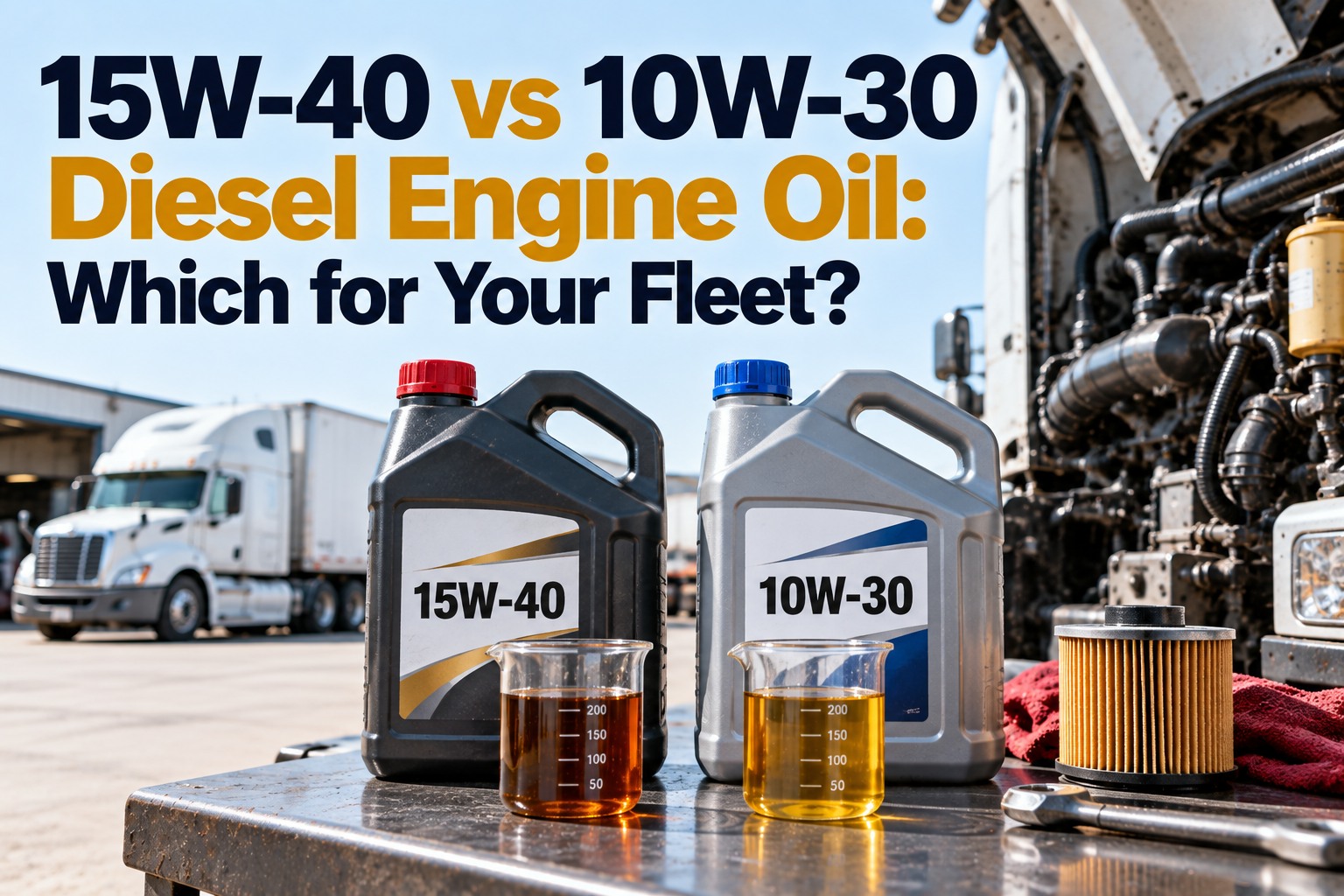
The 15W-40 against 10W-30 question is usually argued as a preference and settled by whichever drum is closest to the door. It is actually two separate engineering questions with published numbers behind both. At the cold end, SAE J300 rates 10W down to −25°C for cranking and −30°C for pumping, and 15W down to −20°C and −25°C — the same numeric ceilings, 7,000 mPa·s and 60,000 mPa·s, just measured 5°C further down. At the hot end the two grades do not overlap at all: SAE 30 covers 9.3 to under 12.5 mm²/s at 100°C and SAE 40 picks up at 12.5 and runs to under 16.3, and the minimum high-temperature high-shear viscosity is 2.9 mPa·s for a 30-grade against 3.7 for a 15W-40. That gap in film strength at 150°C is the whole argument, and it is also why the API service category matters as much as the viscosity: FA-4 oils are built around a lower HTHS target and are not a universal substitute for CK-4. This guide covers the cold-start numbers, the viscosity bands, which grade wins under which conditions, the CK-4 and FA-4 trap, and the mistakes that cost engines. Book a 30-minute demo to see grade filled recorded per unit, or start free with 3 vehicles.
The Difference Between These Two Grades Is 5°C at One End and 0.8 mPa·s at the Other.
For fleet maintenance managers, shop leads and owner-operators: what the published specifications actually say, when the lighter grade is the right call, when it absolutely is not, and why the API category can override the viscosity decision entirely.
No credit card required. Slots into the oil change records you already keep.
Head to Head on the Published Numbers
Before any argument about fuel economy or engine life, here is what the two grades are actually required to do. Everything else in this guide follows from these eight rows. Record which grade each unit takes, free on 3 vehicles. Swipe the table on mobile.
| Property | 15W-40 | 10W-30 | Advantage |
|---|---|---|---|
| Low-temperature cranking limit | 7,000 mPa·s at −20°C | 7,000 mPa·s at −25°C | 10W-30 |
| Low-temperature pumping limit | 60,000 mPa·s at −25°C | 60,000 mPa·s at −30°C | 10W-30 |
| Kinematic viscosity at 100°C | 12.5 to under 16.3 mm²/s | 9.3 to under 12.5 mm²/s | — |
| Minimum HTHS at 150°C | 3.7 mPa·s | 2.9 mPa·s | 15W-40 |
| Film thickness at operating temperature | Thicker | Thinner | 15W-40 |
| Internal drag and pumping losses | Higher | Lower | 10W-30 |
| Cold-start cranking effort | Higher | Lower | 10W-30 |
| Availability across the parts network | Near universal | Widely stocked | 15W-40 |
Viscosity limits, cranking and pumping requirements and HTHS minima are per the SAE J300 engine oil viscosity classification. Film thickness, drag and cold-start rows follow directly from those figures rather than from any manufacturer's claim.
The Cold End: a 5°C Margin, Not a Different Oil
This is the part most often overstated in both directions. 10W is not dramatically thinner when cold — it has to meet the same ceiling, just 5°C further down the scale. Whether those 5°C matter depends entirely on where the trucks sleep. We'll check your grades against your climate in a demo.
Limits per SAE J300: 10W must not exceed 7,000 mPa·s cranking viscosity at −25°C and 60,000 mPa·s pumping viscosity at −30°C; 15W must meet the same figures at −20°C and −25°C respectively. Below its rated temperature a grade is outside specification regardless of how the engine sounds on the day, and cold-start is where a disproportionate share of engine wear occurs.
The Hot End: Two Bands That Do Not Overlap
At operating temperature these are genuinely different oils, and the boundary is a single number. An oil at 12.4 mm²/s is a 30-grade and an oil at 12.6 is a 40-grade, and the high-shear requirement steps up with it. Log viscosity results per unit free.
Kinematic viscosity windows and HTHS minima per SAE J300. SAE 40 carries more than one HTHS minimum depending on the winter grade it is paired with — 3.7 mPa·s applies to 15W-40, while lighter winter grades paired with a 40 are held to a lower figure. The practical reading: a 15W-40 is required to hold roughly a quarter more film strength at 150°C than any 30-grade.
Do Your Records Show Which Grade Went Into Which Truck?
Mixed fleets end up with mixed sumps, and the first place it shows is an oil analysis result nobody can interpret. In 30 minutes we'll set up grade and API category as fields on the oil change record, so the next sample is read against what was actually filled.
Which One Belongs in Your Trucks
The manual decides, and these lists are for reading the manual against your own operation. Where the engine maker permits either, this is the trade-off in plain terms.
- The engine maker specifies a 40-grade, or specifies CK-4 without approving FA-4
- Ambient temperatures rarely go below −20°C, which covers most of the continental United States
- High-load, high-temperature duty — heavy haul, grades, sustained high power
- Older or high-mileage engines with wider bearing clearances
- Mixed fleets where one drum on the shelf prevents the wrong-grade mistake
- You would rather have film thickness in hand than a fractional fuel gain
- The engine maker specifies or permits a 30-grade for your duty cycle
- Winter ambient regularly drops below −20°C, where the 5°C margin is real
- Line-haul work where pumping losses run for hours at a time
- Newer engines designed and approved around the lighter grade
- Fuel economy is being measured, and the difference is worth chasing
- You have the discipline to keep two grades from getting mixed up in the shop
CK-4 and FA-4 are different categories, and FA-4 is not a universal substitute
The API service category sits alongside the SAE grade, and it can override the grade decision completely. CK-4 oils are formulated to the conventional high-temperature high-shear targets for their grade; FA-4 oils are built around a lower HTHS target to reduce pumping losses, which means they are not broadly backward compatible and must only be used in engines the maker specifically approves for them. Two drums can both say 10W-30 and belong in different engines. Read the category as carefully as the grade, and record both on the service line — because an FA-4 fill in an engine approved only for CK-4 is not a preference, it is an out-of-specification fill. Confirm your engine's position with the engine maker before standardising on either.
Seven Ways Fleets Get the Grade Decision Wrong
None of these are exotic. Every one of them is something that happens in busy shops on ordinary days. We'll audit your grade practice with you. Swipe the table on mobile.
| The mistake | Why it matters |
|---|---|
| Choosing the grade from the shelf instead of the manual | Every engine maker publishes a grade recommendation by ambient temperature. The manual is the answer; the drum nearest the door is not |
| Treating FA-4 as a drop-in for CK-4 | FA-4 oils are built around a lower high-temperature high-shear viscosity and are not universally backward compatible. Use them only where the engine maker specifically approves them |
| Running 15W-40 through a hard winter | Below the −20°C cranking limit you are outside the grade's rating, and cold-start wear is where a large share of engine life goes |
| Running 10W-30 in heavy, hot, high-load duty without approval | The thinner film is only safe where the engine was designed and approved for it. Load and heat are exactly the conditions that expose the difference |
| Mixing grades to top up | A top-up with the other grade lands the sump somewhere between two specifications and matches neither. Record which grade went in |
| Reading a low viscosity result as "the oil is fine, it's just thin" | Low viscosity on an analysis report may indicate improperly functioning injectors or fuel dilution. Confirm which grade was actually filled before diagnosing anything else |
| Assuming a fuel-economy claim transfers to your duty cycle | Pumping-loss savings are real but duty-dependent. A line-haul gain is not a refuse-route gain |
Putting the Grade Decision on Record
The grade choice only holds if the record survives a shift change. Put it on the inspection report and into preventive maintenance so the specification travels with the truck rather than living in someone's head.
"Oil changed" is not a record. 15W-40 CK-4 is. The category is what tells the next technician whether a substitution is allowed.
Mixed fleets have mixed requirements. A single fleet-wide grade is only correct if every engine in it permits that grade.
A grade that suits a southern lane is not automatically right for the same model running a northern one through February.
A viscosity result means nothing without knowing the target. This is the single most common reason oil analysis gets dismissed as unhelpful.
What the Wrong Grade Costs
The grade decision is cheap; the consequences are not evenly priced. Industry benchmarking puts unplanned downtime at roughly $448 to $760 per truck per day before the repair, and ATRI puts 2025 repair and maintenance cost at $0.215 per mile, up 8.6%. Work through your own numbers with our team.
Relative exposure by outcome, illustrative — not prices. Downtime benchmark: FleetNet America and ATA's Technology & Maintenance Council via industry reporting; per-mile cost: ATRI.
15W-40 and 10W-30 Questions Fleets Ask
Is 10W-30 thinner than 15W-40?
At operating temperature, yes, and measurably so — SAE 30 spans 9.3 to under 12.5 mm²/s at 100°C while SAE 40 runs from 12.5 to under 16.3, and the high-shear minimum at 150°C is 2.9 mPa·s against 3.7 for a 15W-40. When cold, the difference is smaller than people assume: both winter grades meet the same 7,000 mPa·s cranking ceiling, 10W simply meets it 5°C lower. Check your spec with our team.
Can I use 10W-30 instead of 15W-40 in my truck?
Only where the engine maker permits it for your duty cycle, and only in the API category the engine is approved for. Many modern heavy-duty engines are specified for a 30-grade; many older ones are not, and high-load high-temperature work is exactly where the thinner film shows up. Check the manual before the drum. Record the approved spec per unit free.
Which grade is better for cold weather?
10W-30, by a 5°C margin on both the cranking and pumping limits — rated to −25°C and −30°C against −20°C and −25°C for a 15W. If your winter ambient regularly sits below −20°C that margin is worth having; if it rarely does, it is not the deciding factor. Match grades to your lanes in a demo.
What is the difference between CK-4 and FA-4?
They are separate API service categories, not grades. CK-4 oils meet the conventional high-temperature high-shear targets for their viscosity grade; FA-4 oils are formulated to a lower HTHS target for reduced pumping losses, which is why they are not broadly backward compatible and are restricted to engines specifically approved for them. Two 10W-30 drums can carry different categories and belong in different engines. Log the category, not just the grade, free.
Does 10W-30 really save fuel?
Lower viscosity means lower pumping and churning losses, so there is a real mechanism behind the claim — but the size of the gain depends heavily on duty cycle, and a line-haul result does not transfer to stop-start or refuse work. Treat published figures as an upper bound for your own operation and measure it if it matters. Discuss measuring it with our team.
Can I mix 15W-40 and 10W-30?
A top-up leaves the sump somewhere between two specifications and matching neither, which also makes the next oil analysis result difficult to read. If it happens, record what went in so the sample can be interpreted rather than discarded. Record top-ups per unit free.
My oil analysis says viscosity is low. Is the grade wrong?
Possibly, but fuel dilution is the more common cause, and low viscosity may indicate improperly functioning injectors. The first step is confirming which grade was actually filled, because a 30-grade read against a 40-grade target will look like a problem that is not there. See grade-aware analysis records in a demo.
Put the Grade and the Category on the Service Line
FleetRabbit holds the approved specification against each unit and the grade and category actually filled against each service, so a substitution is a decision rather than an accident — and every oil analysis result arrives on a work order that already knows what it should be compared against.
No credit card required. Start with your next oil change.