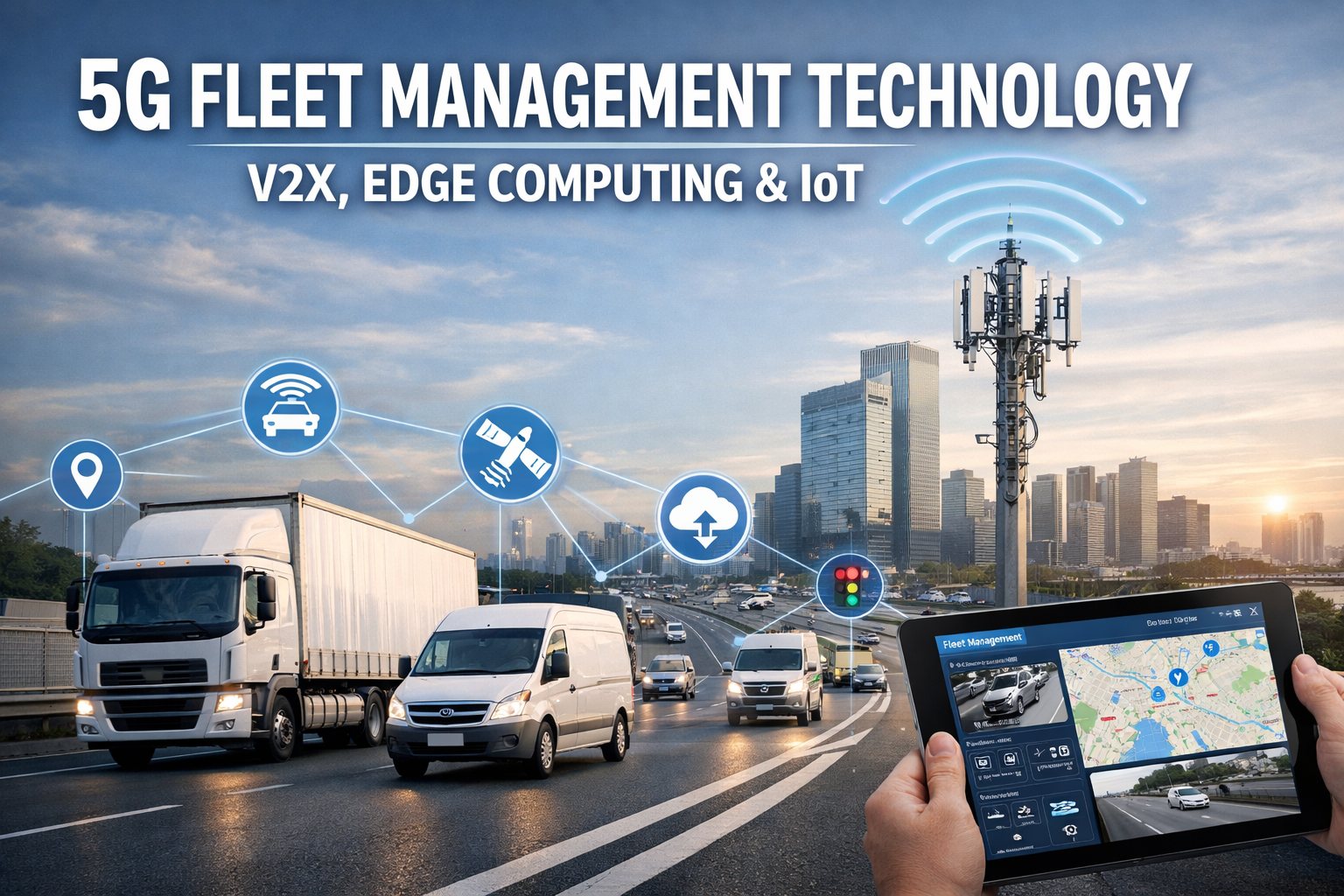
The 5G revolution in fleet management isn't comingit's deploying now across major freight corridors in 2026. With latency dropping from 50-100 milliseconds to under 10 milliseconds, bandwidth increasing 100x, and network capacity supporting millions of simultaneous device connections, 5G unlocks fleet management capabilities that transform how commercial transportation operates. Vehicle-to-everything (V2X) communication enables trucks to "see" around corners. Edge computing processes telematics data locally for instant decisions. Real-time digital twins mirror every vehicle with sub-second accuracy. This guide covers everything fleet managers need to know about 5G fleet management technologyfrom V2X fundamentals to practical implementation strategies. Start your 5G-ready fleet transformation, or schedule a connected fleet consultation.
What is 5G Fleet Management?
5G fleet management leverages fifth-generation cellular technology to connect commercial vehicles with unprecedented speed, reliability, and capacity. Unlike previous generations focused primarily on faster data transfer, 5G introduces three distinct capability pillars that transform fleet operations—each enabling applications impossible with 4G LTE. Explore 5G-ready fleet management features.
Enhanced Mobile Broadband
Massive bandwidth up to 10 Gbps for HD video streaming, large data transfers, and rich media applications. Stream real-time dashcam footage from entire fleets without compression artifacts.
Ultra-Reliable Low Latency
Sub-10ms response times enabling real-time vehicle control, instant safety alerts, and V2X communication. Critical for autonomous driving support and collision avoidance systems.
Massive Machine Type
Support for 1 million+ IoT sensors and devices per square kilometer. Every tire pressure sensor, temperature monitor, and cargo tracker connected simultaneously without network congestion.
5G vs 4G LTE: What Actually Changes for Fleets
Understanding the technical differences between 5G and 4G LTE helps fleet managers appreciate why 5G telematics enables fundamentally new capabilities rather than just faster versions of existing features. Discuss 5G upgrade timing with our experts.
| Capability | 4G LTE | 5G | Fleet Impact |
|---|---|---|---|
| Network Latency | 30-50ms | <10ms | Real-time V2X, instant safety alerts |
| Peak Data Speed | 1 Gbps | 10 Gbps | HD video from every vehicle simultaneously |
| Device Density | 100K/km² | 1M+/km² | All IoT sensors connected without congestion |
| Network Reliability | 99.9% | 99.999% | Safety-critical applications become viable |
| Bandwidth Per User | 10 Mbps | 100 Mbps | Multiple simultaneous data streams |
| Energy Efficiency | Baseline | 90% better | Longer telematics device battery life |
The most significant difference isn't raw speed—it's the combination of low latency and ultra-high reliability that enables safety-critical applications. A collision warning system that takes 50ms to transmit might arrive too late; one that takes 5ms can actually prevent accidents. This is why 5G fleet tracking represents a fundamental shift in what's possible for commercial vehicle safety.
V2X Fleet Technology: Vehicle-to-Everything Communication
V2X (Vehicle-to-Everything) communication is perhaps the most transformative 5G fleet capability, enabling vehicles to exchange real-time data with other vehicles, infrastructure, pedestrians, and cloud systems. This creates a mesh of situational awareness extending far beyond what cameras and sensors alone provide. Prepare your fleet for V2X integration, or book a V2X technology consultation.
V2V (Vehicle-to-Vehicle)
Trucks communicate directly with surrounding vehicles, sharing position, speed, braking status, and hazard detection in real-time.
- Platooning: Following distances under 50 feet at highway speeds—10-15% fuel savings
- Collision Avoidance: Know when vehicles 3 cars ahead brake hard—before you see lights
- Hazard Sharing: One truck encounters ice, every connected vehicle knows instantly
V2I (Vehicle-to-Infrastructure)
Vehicles connect with traffic signals, toll systems, weigh stations, and roadside units for seamless corridor operations.
- Signal Timing: Adjust speed to hit green lights—reduce fuel-wasting stops
- Toll Automation: Credentials transmitted automatically—bypass physical inspections
- Road Conditions: Construction zones and hazards broadcast directly to vehicles
V2P (Vehicle-to-Pedestrian)
Detect pedestrians and cyclists carrying connected devices, even when not visible to cameras or sensors.
- Urban Delivery: Alerts when pedestrians approach from blind spots
- Loading Zones: Detect workers around the vehicle during deliveries
- Crosswalks: Know when pedestrians are crossing—even around corners
V2N (Vehicle-to-Network)
Connect to cloud platforms for traffic optimization, fleet coordination, and predictive routing based on network-wide data.
- Real-Time Traffic: Route updates based on what's happening now—not 15 minutes ago
- Fleet Coordination: Optimize multiple vehicle movements across the network
- Predictive Routing: AI-powered route suggestions using all connected vehicle data
Edge Computing: Processing Data Where It Matters
Fleet edge computing processes data at the network edge—in roadside units, cell towers, or vehicle onboard computers—rather than sending everything to distant cloud servers. Combined with 5G connectivity, edge computing enables real-time analysis impossible with cloud-only architectures. Learn how edge computing benefits your fleet, or start your free trial today.
Reduced Latency
Process critical data locally in 1-5ms instead of 50-100ms cloud round-trips. Essential for collision avoidance and real-time alerts.
Lower Data Costs
Filter and process data locally, sending only relevant information to cloud—60-80% reduction in cellular data consumption.
Offline Resilience
Continue critical operations during connectivity gaps. Edge devices cache and process data until connection restores.
Real-Time AI
Run ML models at the edge for instant driver fatigue detection, hazard identification, and route optimization without cloud delays.
5G-Enabled Fleet Applications
5G connected vehicles unlock applications that fundamentally change fleet operations. These aren't theoretical possibilities—they're deploying in commercial fleets today. See which 5G applications fit your fleet, or schedule a personalized demo.
Real-Time HD Video
Requires: eMBBStream continuous HD video from multiple cameras per vehicle without buffering. Enable live coaching, instant incident review, and remote vehicle inspection.
Real-Time Digital Twins
Requires: URLLC + eMBBMirror every vehicle parameter—location, speed, engine data, cargo condition—in a synchronized digital model updated multiple times per second.
Platooning Support
Requires: URLLCV2V coordination enables following distances under 50 feet at highway speeds with synchronized braking—fuel savings of 10-15% through reduced aerodynamic drag.
Massive IoT Networks
Requires: mMTCConnect every sensor on every vehicle: tire pressure, temperature probes, door sensors, fuel gauges, cargo weight. Thousands of data points per vehicle continuously.
Predictive Routing
Requires: V2N + EdgeAccess real-time traffic data aggregated from all connected vehicles. Route updates based on conditions happening now, not 15 minutes ago.
Safety Interventions
Requires: URLLC + EdgeDetect dangerous situations and alert drivers within milliseconds. Forward collision warnings, lane departure alerts, drowsiness detection with zero perceptible delay.
5G Fleet Implementation Roadmap
Transitioning to 5G fleet management requires strategic planning as network coverage expands and device ecosystems mature. Here's a practical phased approach: Get a customized 5G implementation plan, or try FleetRabbit free for 30 days.
Phase 1: Foundation
2024-2025- Deploy 5G-capable telematics devices in new vehicles (work on 4G now, 5G-ready for future)
- Implement cloud infrastructure that supports edge computing architectures
- Begin HD video telematics pilots on high-priority routes with good 5G coverage
- Evaluate V2X-ready vehicle options for next procurement cycle
Phase 2: Expansion
2025-2026- Roll out 5G across fleet as corridor coverage expands on major freight routes
- Activate V2I integrations on equipped highways (toll automation, weigh station bypass)
- Deploy edge computing for real-time analytics and safety applications
- Pilot digital twin applications for fleet simulation and optimization
Phase 3: Optimization
2026-2028- Full V2X deployment across fleet with V2V communication between company vehicles
- Implement platooning on eligible corridors for fuel savings
- Advanced predictive maintenance using comprehensive 5G IoT fleet sensor networks
- Autonomous vehicle integration readiness as regulations mature
Challenges and Considerations
While 5G fleet technology offers transformative potential, fleet managers should understand current limitations and plan accordingly.
Coverage Gaps
5G coverage remains concentrated in urban areas and major corridors. Rural routes may rely on 4G LTE fallback for several more years.
Hardware Costs
5G telematics devices currently cost 20-40% more than LTE equivalents ($200-400 vs $150-250). V2X equipment adds additional expense.
Data Security
More connected devices create larger attack surfaces. V2X communication requires robust security to prevent spoofing and interference.
Integration Complexity
5G capabilities require software platforms designed for real-time data processing. Legacy systems may need significant updates.
Benefits of Connected Fleet 5G Technology
Enhanced Safety
Sub-10ms alerts enable collision avoidance systems that actually prevent accidents. V2V and V2I communication creates 360° awareness beyond sensor range.
Operational Efficiency
Real-time traffic routing, platooning fuel savings, and predictive maintenance reduce operating costs. Every optimization happens with current data.
Complete Visibility
Every sensor, every camera, every vehicle parameter available in real-time. No more waiting for end-of-day uploads or dealing with connectivity gaps.
Future-Ready
5G infrastructure supports autonomous vehicles, advanced ADAS, and capabilities not yet invented. Investment provides 10+ year technology runway.
Frequently Asked Questions
What is 5G fleet management?
5G fleet management uses fifth-generation cellular technology to connect commercial vehicles with ultra-low latency (under 10ms), massive bandwidth (up to 10 Gbps), and support for millions of IoT devices per square kilometer. This enables capabilities impossible with 4G LTE: real-time HD video streaming from every vehicle, V2X (vehicle-to-everything) communication, synchronized digital twins, and edge computing that processes data locally for instant decision-making.
What is V2X technology for fleets?
V2X (Vehicle-to-Everything) is a communication system enabling vehicles to exchange real-time data with other vehicles (V2V), infrastructure like traffic signals (V2I), pedestrians (V2P), and network systems (V2N). For fleets, V2X enables truck platooning with synchronized braking, cooperative collision avoidance, automated toll and weigh station interactions, and real-time traffic optimization. 5G provides the low-latency, high-reliability connection V2X requires.
How does edge computing benefit fleet operations?
Edge computing processes data at or near the vehicle rather than sending everything to distant cloud servers. Benefits include: reduced latency (1-5ms vs 50-100ms for cloud round-trips), lower cellular data costs (60-80% reduction), offline resilience during connectivity gaps, and real-time AI/ML inference for instant hazard detection. Edge computing is essential for safety-critical applications where milliseconds matter.
When will 5G coverage be available for fleet routes?
5G coverage is expanding rapidly. As of 2026, most major freight corridors (I-10, I-40, I-80, I-95) have substantial 5G coverage. Rural areas lag behind but are improving. Most 5G fleet devices support 4G LTE fallback, ensuring connectivity even without 5G coverage. Get route-specific coverage analysis.
What does 5G fleet management cost?
5G telematics hardware costs 20-40% more than 4G LTE equivalents ($200-400 vs $150-250 per device). Monthly data plans may cost $5-15 more per vehicle. V2X-capable vehicle equipment adds $500-2,000 depending on capabilities. Costs are declining as adoption scales—early investment positions fleets for competitive advantages.
Should I upgrade my fleet to 5G now or wait?
A phased approach works best. Start by deploying 5G-capable devices in new vehicles and on high-priority routes with good coverage. Don't wait for "perfect" coverage—5G devices work on 4G networks today while being ready for 5G features when available. The technology foundation you build now enables V2X, autonomous support, and future applications.