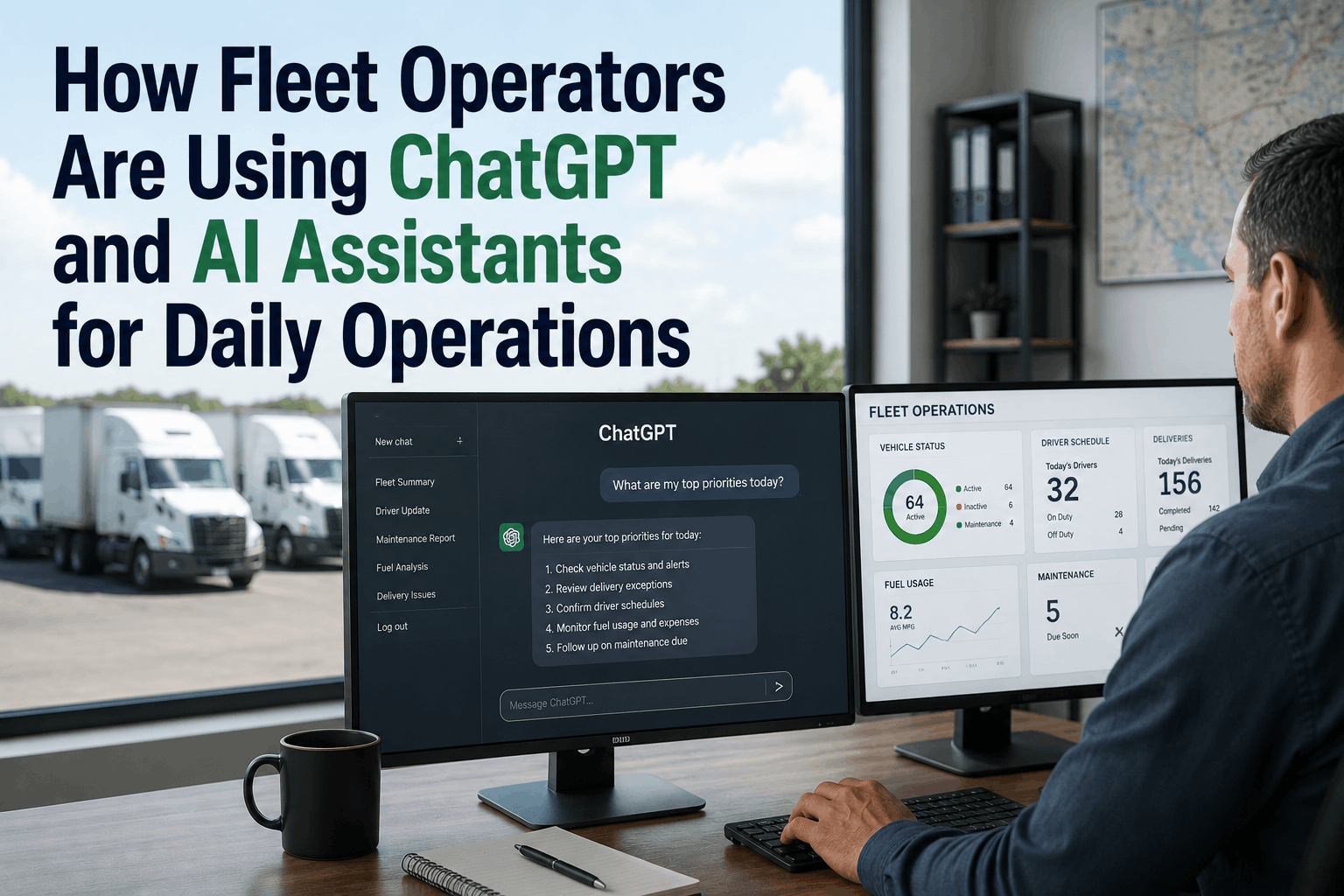
For decades, fleet management has been defined by manual processes, fragmented systems, and reactive decision-making. Dispatchers spent hours on the phone. Fleet managers dug through spreadsheets. Drivers juggled multiple apps while trying to stay focused on the road. That era is ending. AI assistants—powered by large language models like ChatGPT, Claude, and Gemini—are transforming fleet operations from the back office to the driver's seat. This isn't about replacing people. It's about giving them superpowers .
How Fleet Operators Are Using ChatGPT and AI Assistants for Daily Operations
Major telematics providers—Motive, Geotab, Frotcom—are now connecting their platforms directly to AI assistants. Fleet managers can ask questions in plain language and get instant answers based on live operational data, without logging into multiple systems.
From Data Fragmentation to Conversational Insights
The biggest challenge facing fleet managers isn't a lack of data—it's too much data spread across too many systems. Motive, after visiting more than 4,000 customer sites and traveling 8 million miles, identified two common pain points: fragmentation and manual work. Fleet managers were jumping between systems, copying and pasting data, and spending hours pulling reports before they could make decisions.
AI assistants are solving this problem by acting as a unified interface across all these systems. With Motive's integration with ChatGPT, Claude, Copilot, and Gemini, fleet managers can now ask questions in conversational language and receive answers grounded in live operational data. For example, when preparing for insurance renewal, the AI can pull safety data from Motive, industry benchmarks from the web, and contract history from email—all into one comprehensive report.
Geotab's MCP Connector takes a similar approach, allowing fleet managers to ask questions like "Which trucks are due for preventive maintenance in the next 30 days?" or "Which drivers had the most speeding events last week?" and get instant answers based on live MyGeotab data. Central Transport, an early user, reported that the technology replaced weeks of manual analysis with near-instant reporting and insights.
To experience this level of efficiency in your own fleet, book a demo with FleetRabbit and see how AI-powered insights can transform your operations.
The Prompt Engineering Advantage
AI assistants are powerful tools, but they're only as effective as the prompts you give them. FreightWaves' Masterclass on Prompt Engineering for Trucking Companies identified a critical insight: the biggest mistake fleet operators make is treating AI like a mind reader. Vague prompts produce vague results.
The solution is a simple three-part formula: Role + Task + Format. Tell the AI who it is, what it's doing, and how to deliver the answer. For example: "You are a fleet manager for a 6-truck reefer operation running Midwest lanes. Create a monthly safety checklist covering reefer unit maintenance, tire wear, brake inspections, and DOT paperwork. Return it as a bullet-point list with categories for Daily, Weekly, and Monthly."
Fleet operators can also train AI to understand their specific business context. By creating a "Company Profile Prompt" that defines fleet size, preferred lanes, brokers, driver policies, and communication tone, the AI becomes a virtual assistant that knows your operation inside out. This one prompt can guide hundreds of decisions across safety, dispatch, compliance, maintenance, and customer communication.
To learn how prompt engineering can save your team hours of manual work, sign up with FleetRabbit and access our AI readiness toolkit.
Define who the AI is and what context it's operating in. Example: "You are a safety manager for a 50-truck fleet."
Explain exactly what you want done with specific details and constraints. Example: "Create a driver orientation plan covering compliance, safety, and culture."
Specify how the AI should deliver the output. Example: "Provide it as a bulleted checklist organized by daily activities for the first week."
AI in the Cab: Voice Assistants for Drivers
AI assistants aren't just for the back office. Motive's Atlas AI assistant, available in late 2026, brings voice-driven AI into the cab. Drivers can say "Hey Atlas" or "Hey Motive" to complete tasks without taking their hands off the wheel—saving critical footage, checking remaining drive time, or finding nearby fuel stops. The assistant also enables instant connection with dispatch or teammates through voice, and provides real-time support with weather updates, nearby locations, and roadside details.
This hands-free capability addresses a critical safety concern: driver distraction. By allowing drivers to access information and communicate without touching a screen or phone, AI assistants reduce the cognitive load on drivers and keep their attention focused on the road. For fleet operators, this means safer drivers, better compliance, and more efficient operations.
The same technology that powers in-cab assistants also supports driver coaching and feedback. AI can analyze ELD data and generate clear coaching points for drivers—without the fleet manager having to live inside the telematics portal. This turns coaching from a reactive process into a proactive one, improving driver performance and reducing accident risk.
Automating Dispatching and Load Management
AI is also transforming the dispatch desk. DispatchMVP, an AI-powered dispatching platform launched in late 2024, uses ChatGPT and AWS Textract to parse transport requests from emails, texts, or PDFs and automatically populate the database. The platform then computes the best-suited truck, trailer, and driver based on certifications and availability—saving about 20 minutes per dispatch.
The system can also reassign loads if exceptions occur, like a truck breakdown, ensuring minimal disruption to operations. It tracks the location and maintenance schedules of all trucks, integrates with load boards and ELDs, and eliminates the potential for double booking by notifying dispatchers of conflicts. For Young Guns Transportation, an eight-truck power-only carrier, the platform replaced hours of manual work with automated, error-free dispatching.
For fleet managers looking to reduce admin burden and improve dispatch efficiency, book a demo with FleetRabbit and explore how AI can streamline your operations.
Real-World Impact: Central Transport
"By integrating the Geotab MCP connector with Claude, we transformed complex fleet data into real-time, actionable intelligence, replacing weeks of manual analysis with instant, high-depth reporting. This partnership has evolved Geotab from a system we query into a system we 'think with' – giving us a competitive advantage that empowers our managers to make faster, more confident decisions at scale." — Jon Hanvey, Director of Tractor Maintenance, Central Transport.
Maintenance Management and Downtime Reduction
One of the most immediate opportunities for AI in fleet operations is maintenance management. According to Mike Branch, vice president of data and analytics at Geotab, fleet managers today spend hours pulling information from different systems before they can even begin making maintenance decisions. AI connected directly to fleet data can automate much of that manual work.
Instead of reviewing dozens of reports, a fleet manager can simply ask, or have AI automatically determine, which vehicles are at the highest risk of unplanned downtime in the next 30 days, why they're at risk, and what actions should be taken. AI can identify patterns, prioritize recommendations, and even initiate workflows such as scheduling maintenance or creating service alerts across multiple systems.
This shift from reactive to proactive maintenance is particularly valuable for fleets operating hundreds or thousands of vehicles across multiple locations. By automating the data-gathering and prioritization process, AI helps fleet managers spend less time collecting information and more time making strategic decisions. To learn how FleetRabbit can help you implement AI-driven maintenance management, sign up with FleetRabbit and start optimizing your maintenance workflows.
The Open Standard Advantage
One of the key trends in fleet AI is the move toward open standards. Rather than forcing customers to use proprietary AI systems, companies like Geotab and Motive are building connectors that work with multiple AI platforms—ChatGPT, Claude, Copilot, Gemini, and others. This approach allows fleets to continue using the AI tools their organizations have already approved while maintaining their existing security and data governance policies.
Geotab's MCP Connector, built on the open Model Context Protocol standard, enables secure access to live fleet data within approved AI platforms. This flexibility means fleet managers aren't locked into a single ecosystem and can choose the AI tools that best fit their workflows. It also means that as AI technology continues to evolve, fleets can adopt new capabilities without disrupting their existing systems.
FleetRabbit's AI-powered platform helps you automate reporting, optimize maintenance, and make data-driven decisions—all in one place.
Common AI Mistakes and How to Avoid Them
Even with powerful AI tools, fleet operators can fall into common traps. The FreightWaves Masterclass identified several frequent mistakes:
Being too vague is the most common error. "Write a policy" produces generic results. "Write a driver handbook for a 10-truck reefer fleet operating in the Midwest, emphasizing winter driving safety" produces something useful. Forgetting to specify output format is another—asking for "a checklist" without saying how it should be grouped leads to a jumbled list rather than a usable tool. Asking too many things at once confuses the AI; it's better to break requests into steps and let the AI build piece by piece.
Finally, treating AI's first draft as final is a missed opportunity. The best prompts are refined iteratively—ask for revisions, add more context, and adjust the output until it matches your operational reality. This is prompt engineering, and it's the skill that separates fleets that get value from AI from those that are still struggling to make it work.
The Future: AI as a Strategic Partner
AI assistants are evolving from tools that answer questions into systems that think with you. The goal isn't to replace fleet managers, but to help them spend less time collecting information and more time making strategic decisions. As one fleet executive put it, the technology transforms the telematics system from "a system we query into a system we think with."
For fleet operators, the message is clear: AI is not coming—it's here. And those who learn to leverage it effectively will have a significant competitive advantage. By reducing admin burden, automating repetitive tasks, and providing instant access to insights, AI assistants are becoming as essential to fleet operations as the trucks themselves. To position your fleet for this AI-driven future, book a demo with FleetRabbit and start your AI transformation today.
Frequently Asked Questions
How do AI assistants integrate with existing fleet telematics?
Major telematics providers like Motive and Geotab now offer connectors that link their platforms directly to AI assistants like ChatGPT, Claude, and Copilot. These connectors enable fleet managers to access live operational data and automate tasks using conversational language, without logging into multiple systems.
What is prompt engineering and why does it matter for fleets?
Prompt engineering is the skill of crafting clear, specific instructions for AI assistants. In trucking, it's essential because vague prompts produce generic results. The three-part formula—Role + Task + Format—turns a random question into a professional-grade instruction that produces actionable outputs for dispatch, safety, compliance, and maintenance.
Can AI assistants help with driver coaching and safety?
Yes. AI can analyze ELD data and generate clear coaching points for drivers based on specific behaviors like hard braking, speeding, or idling. This turns coaching from a reactive process into a proactive one, improving driver performance and reducing accident risk.
What are the common mistakes fleets make with AI?
Common mistakes include being too vague with prompts, forgetting to specify output format, leaving out critical business context, asking too many things at once, and treating AI's first draft as final. The solution is prompt engineering—giving AI clear, structured, and specific instructions.
How much time can AI save in daily fleet operations?
Fleet operators report significant time savings—Central Transport replaced weeks of manual analysis with near-instant reporting. DispatchMVP saves about 20 minutes per dispatch by automating data entry. AI-powered maintenance management can dramatically reduce the hours spent gathering information across multiple systems.
FleetRabbit helps you leverage AI to automate reporting, optimize maintenance, and make faster, more confident decisions—all from a single platform.