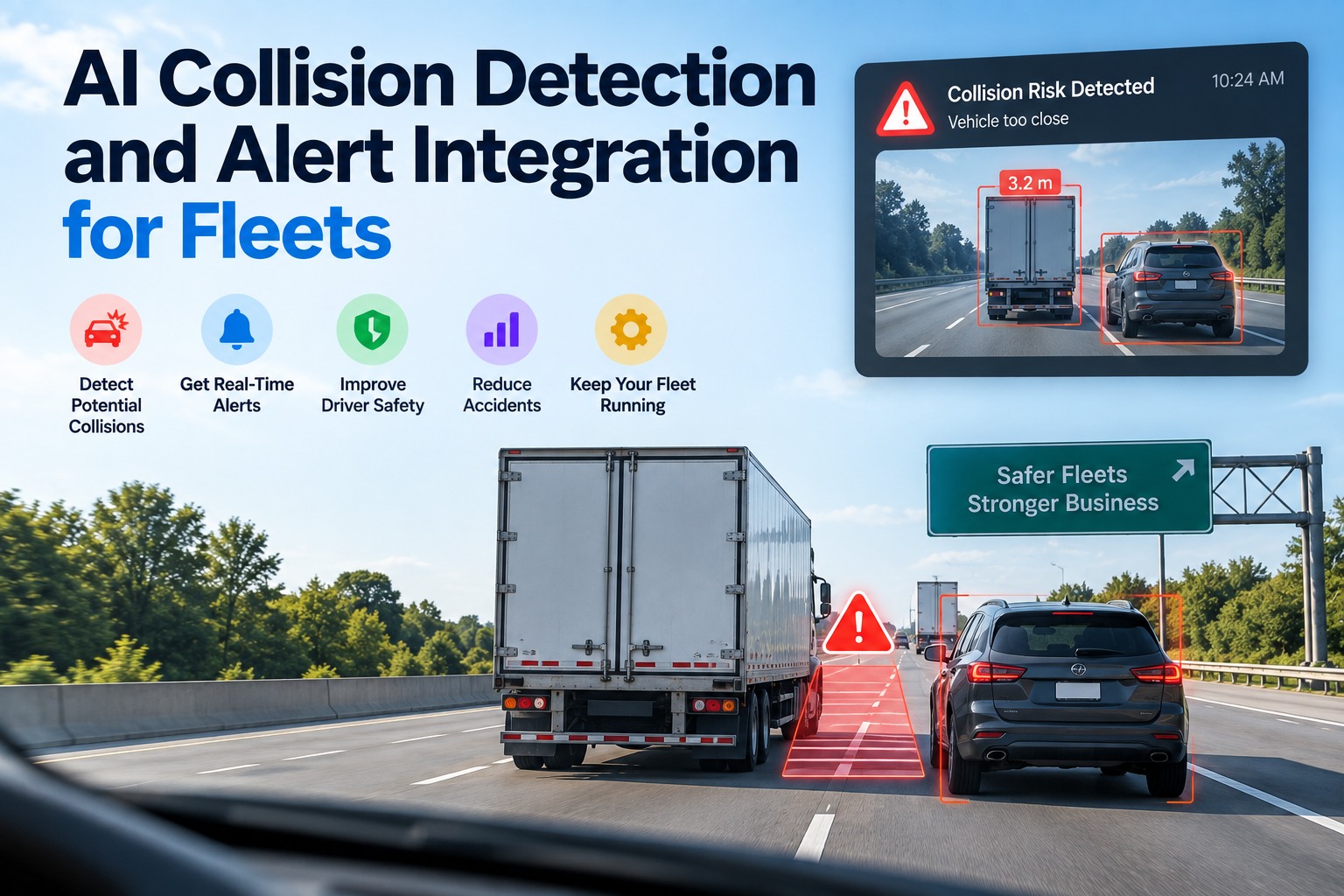
AI collision detection is only as useful as what happens in the hours after it fires: a near-miss should become a coaching conversation, a minor contact should become an inspection and a work order, and a recordable crash should start the federal post-accident clocks before they run out. When the camera alert, the unit's DVIR history, the repair and the compliance steps live in one place, the safety lead makes those calls in minutes instead of reconstructing them days later. This guide gives you a three-tier triage rule, the post-accident testing decision table from 49 CFR 382.303, a timeline of the clocks that start at impact, and the vehicle checks that should happen before the truck goes back out. Book a demo to see collision alerts next to your inspection and maintenance records, or start free with 3 vehicles.
AI collision detection · After the alert
AI Collision Detection and Alert Integration for Fleets
For safety managers, fleet managers and maintenance leads: how to turn every AI collision alert into the right response — coaching, repair or the full post-accident process — without switching between systems.
Deadlines apply when a crash meets the post-accident testing criteria in 49 CFR 382.303.
Not Every Collision Alert Is a Crash
An AI collision alert covers everything from a hard-brake near-miss to a serious crash, so the first decision is which tier it belongs to. FMCSA's definition of an "accident" in 49 CFR 390.5 — a fatality, an injury treated away from the scene, or a vehicle towed away with disabling damage — draws the line for the top tier. You can set these three tiers up on a free account and route each one to a different owner.
Near-miss, no contact
Forward-collision warning, harsh braking or a close following event where nothing was struck.
Contact, not recordable
A low-speed strike, mirror hit or dock bump with no injury treated away and no tow-away.
Recordable crash
A fatality, an injury treated away from the scene, or a vehicle towed away with disabling damage.
Does This Crash Require a Post-Accident Test?
The testing decision depends on two facts the alert alone cannot tell you: what kind of crash it was and whether the driver received a citation. Under 49 CFR 382.303, a fatality always requires testing, while injury and tow-away crashes require it only when the driver is cited for a moving violation. We can walk through this decision on your own incident history in a demo.
Why speed matters here
If a required alcohol test isn't given within 2 hours, the carrier must record why; after 8 hours it must stop trying and record that too. A required drug test must happen within 32 hours. The driver also has to stay available for testing, or it can be treated as a refusal. An alert that reaches the safety lead in minutes protects every one of those deadlines.
After Any Contact, Check the Truck Before It Leaves
A collision can damage the parts that keep a truck legal and the sensors that detect the next one, even when the damage looks cosmetic. Treat any Tier 2 or Tier 3 event as a hold until these checks are done and recorded on the unit's inspection and work order history.
Lights and reflectors
Lamps, reflective tape and lenses are often the first things broken in a low-speed strike.
Tires, wheels and axle
A curb or dock impact can cut a sidewall or shift wheel alignment.
Brake and air lines
Check for pinched lines and leaks near any point of impact.
Radar and camera mounts
A knocked bumper or replaced windshield can misalign collision sensors, which keep working on a wrong reference.
Coupling and body
Fifth wheel, landing gear, doors and mirrors on the struck side.
Footage and data saved
Lock the event clip and telematics data with the work order before the camera overwrites continuous video.
See one collision alert become a checked, repaired truck
In 30 minutes we'll follow an alert through triage, inspection and repair in FleetRabbit, with the clip and records attached at each step.
Who Gets Hurt in Large-Truck Crashes
Most of the harm in large-truck crashes falls on people outside the truck, which is why a single missed pattern in collision alerts can carry so much liability. The National Safety Council reports 5,340 deaths in large-truck crashes in 2024, down 2.5% from 2023, while injuries rose 5% to 161,201. Start tracking near-miss patterns free before they become Tier 3 events.
- Occupants of other vehicles 70%
- Truck occupants 17%
- Pedestrians, cyclists, others 13%
The rule to watch: automatic emergency braking
NHTSA and FMCSA's 2023 proposal would require AEB on new heavy vehicles and was estimated to prevent 19,118 crashes, save 155 lives and prevent 8,814 injuries a year. DOT's 2026 regulatory agenda lists a revised proposal that would also cover motor carrier maintenance requirements for trucks equipped with the technology.
Sources: National Safety Council Injury Facts (2024 data); NHTSA heavy-vehicle AEB proposed rule (2023); DOT 2026 Unified Agenda via Safety+Health.
What Changes When Alerts Share a Record With Maintenance and Compliance
Most fleets already have a camera or telematics provider that detects collisions; the gap is that the alert, the inspection, the repair and the compliance steps sit in different places. FleetRabbit works with those providers through its telematics integrations and keeps everything on the unit's record, and a demo shows it with your own providers. Swipe the table on mobile.
| After a collision alert | Separate systems | One record in FleetRabbit |
|---|---|---|
| Is the truck safe to move? | Call the driver, then the shop | Latest DVIR and open defects shown with the alert |
| Who owns the response? | Whoever sees the email first | Tier-based routing to a named person |
| Is the footage kept? | Depends on someone downloading it | Clip linked to the damage work order |
| Was the unit checked before release? | Hard to prove later | Inspection and repair signed off on the unit |
| Are near-misses turning into a pattern? | Reviewed only after a crash | Repeat alerts per driver and unit visible over time |
Frequently Asked Questions
What is AI collision detection integration?
It connects the collision alerts from your camera or telematics provider to the unit's inspection, maintenance and compliance records, so each alert is triaged, routed and closed in one place. See it with your own alerts.
Does every collision alert need a post-accident drug and alcohol test?
No. Under 49 CFR 382.303, testing is required after a fatality, or after an injury treated away from the scene or a disabling tow-away when the driver is cited. Near-misses and minor contact without those outcomes don't trigger it. Set up tier routing free on 3 vehicles.
How fast must post-accident tests happen?
Alcohol tests should happen within 2 hours; if not, the reason must be recorded, and attempts stop at 8 hours. Drug tests must happen within 32 hours. Walk through the timeline with our team.
Should a truck be inspected after a minor collision?
Yes. Even low-speed contact can damage lights, tires, air lines or the mounts for collision sensors, so inspect and record the checks before the unit is dispatched again. Track post-collision inspections free.
Do we need new cameras or hardware?
Usually not. FleetRabbit works with the camera and telematics providers fleets already use and brings their collision alerts into the same view as DVIR, maintenance and compliance records. Check your provider with us.
Does AI decide whether an event was a crash?
No. AI flags the event and can suggest a tier, but the safety manager confirms the tier, the testing decision and whether the unit goes back into service. The carrier remains responsible for compliance. Start free and keep people in control.
Choose How You Want to Start
Every collision alert should end with the right person, the right checks and a complete record.