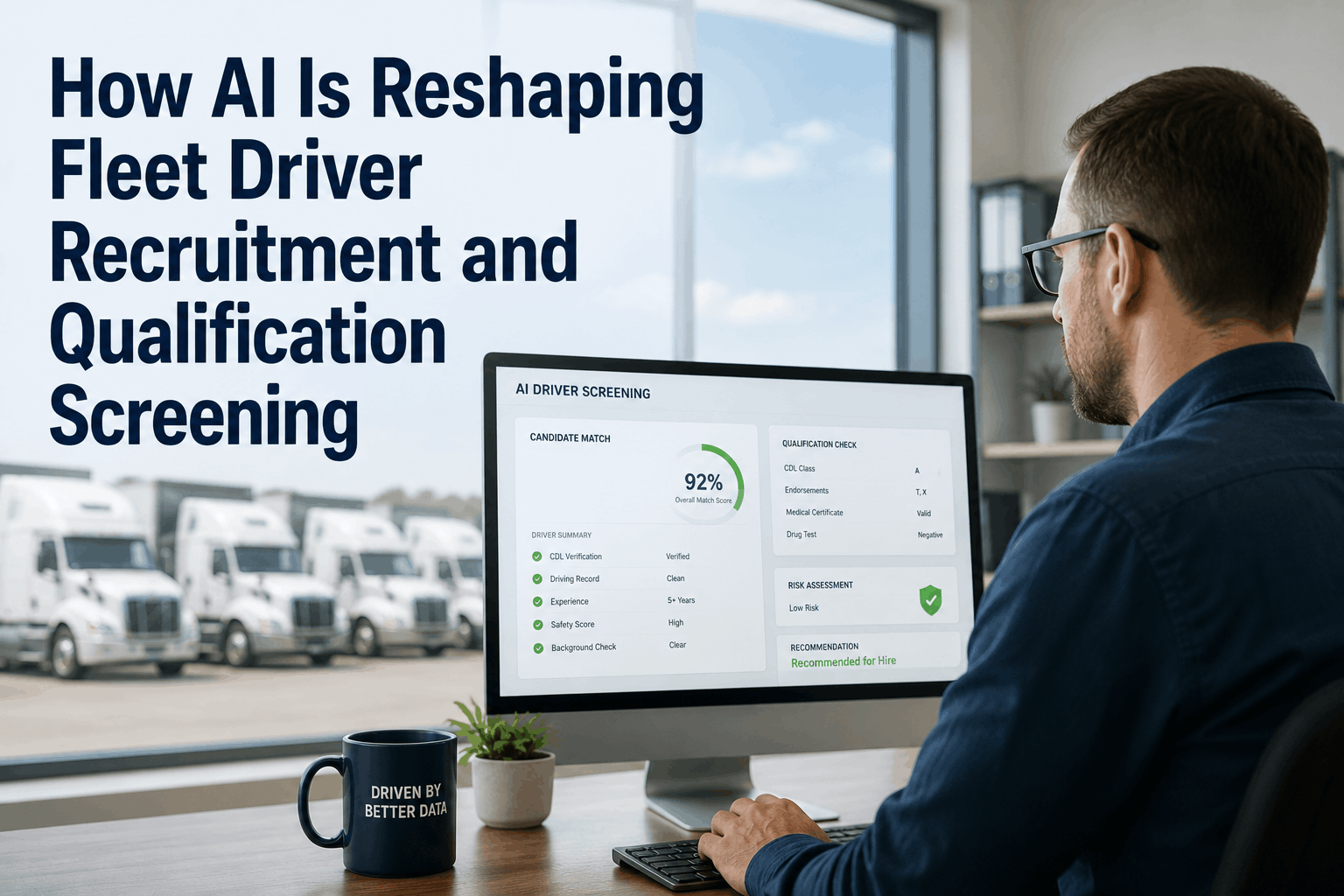
The commercial trucking industry is facing a hiring crisis that no amount of job board spend alone can fix. With a shortage of 60,000 to 82,000 qualified CDL drivers in 2024, annual turnover rates above 90% at large long-haul fleets, and more than 180,000 drivers sidelined by the FMCSA Drug and Alcohol Clearinghouse since 2020, fleet recruiters are being asked to find compliant, experienced drivers from a pool that is shrinking by the day. Artificial intelligence is not a silver bullet — but for fleets that deploy it intelligently, it is fundamentally changing the speed, accuracy, and cost of driver qualification screening in ways that manual processes simply cannot match.
How AI Is Reshaping Fleet Driver Recruitment and Qualification Screening
AI is compressing weeks of driver qualification work into hours — and fleets that adopt it are filling seats faster, reducing bad hires, and lowering their cost-per-hire by up to 30%.
Why Traditional Driver Recruitment Is Breaking Down
Fleet recruiting has historically been a paper-heavy, manually intensive process. A recruiter receives a CDL application, manually pulls the MVR, cross-checks PSP records, verifies employment history, confirms medical certificate status, and checks Clearinghouse compliance — all before a single phone screen takes place. For a high-volume fleet processing hundreds of applications monthly, this workflow creates a bottleneck that costs both time and qualified candidates. According to industry data, only about 25% of available truck driving jobs are posted online — the rest are filled through personal connections and staffing agencies — meaning recruiters must work harder than ever to source from an already narrow pool.
The problem compounds with speed. In a tight driver market, the best qualified candidates receive multiple offers within days of applying. Fleets with slow qualification pipelines — those taking 7 to 14 days to complete screening — routinely lose their top applicants to competitors who can make offers within 48 hours. This is precisely where AI-powered qualification workflows deliver their most measurable value. Sign up with FleetRabbit to see how AI-driven driver qualification fits into your hiring workflow.
High-volume fleets receive hundreds of applications monthly. Manual qualification screening of each applicant creates multi-day backlogs that push top candidates toward faster-moving competitors.
Missing a Clearinghouse flag, an expired medical certificate, or a disqualifying MVR violation during manual review can result in a non-compliant hire — exposing the fleet to DOT audit risk and liability.
Recruiters spend an estimated 40% of their time on repetitive administrative screening tasks rather than relationship-building and closing qualified candidates. AI reclaims that time.
Traditional hiring focuses on whether a driver can start — not whether they will stay. AI predictive models assess retention risk at the application stage, improving 90-day retention rates.
What AI Actually Does in Driver Qualification Screening
The term "AI in recruiting" is often applied loosely to tools that are simply automated — resume parsers, form auto-fill, or basic keyword matching. In the context of fleet driver qualification, genuine AI goes significantly further. It applies machine learning to make judgment-level decisions: distinguishing between a minor moving violation and a disqualifying pattern of unsafe behavior, flagging inconsistencies in employment history that warrant follow-up, and scoring applicants against retention models built from thousands of prior driver records.
Here is what modern AI-powered CDL screening actually does in practice across a typical fleet hiring pipeline. Book a FleetRabbit demo to walk through how each stage applies to your specific fleet type and driver volume.
AI parses CDL class, endorsements, years of experience, and previous employers from unstructured application data — eliminating manual data entry errors and normalizing submissions from multiple channels.
Automated MVR pulls are scored against fleet-specific qualification standards — not just DOT minimums. Violations are weighted by recency, severity, and pattern, surfacing risk profiles that a basic pass-fail threshold would miss.
AI integrates with FMCSA Drug and Alcohol Clearinghouse queries and flags prohibited drivers in real time — preventing non-compliant hires that expose fleets to serious regulatory and liability risk.
NLP-powered document analysis detects gaps, inconsistencies, and patterns in prior employment that correlate with elevated termination or safety risk — flagging records for human review rather than passing them silently.
Machine learning models score each applicant against retention and safety performance data from similar driver profiles — giving recruiters a ranked queue based on both compliance and predicted job fit, not just availability.
FleetRabbit's AI-powered driver qualification platform compresses your screening workflow from days to hours — without sacrificing compliance accuracy.
The Numbers Behind AI-Driven Driver Hiring
The business case for AI in fleet driver recruitment is supported by a growing body of data across both general recruitment research and transportation-specific case studies. Organizations using AI for recruitment report 89.6% greater hiring efficiency, 85.3% time savings, and 77.9% cost savings compared to fully manual processes. For fleet-specific applications, the compounding effect of faster screening, better compliance filtering, and improved retention predictions produces cost-per-hire reductions of up to 30%. Sign up with FleetRabbit and model what that reduction means for your fleet's annual recruiting budget.
For fleets specifically, the retention impact is arguably more significant than the speed gains. With large carrier turnover consistently above 90% annually — meaning roughly 7 out of 10 new hires leave before their first anniversary — even a modest improvement in retention prediction accuracy at the hiring stage translates to enormous downstream savings. The industry-standard cost of replacing a commercial truck driver is estimated at $8,000 to $12,000 per driver when factoring in recruiting spend, onboarding, training, and lost productivity. A fleet of 200 drivers running 90% annual turnover spends $1.4 to $2.1 million per year just replacing the drivers it loses. Narrowing that turnover by even 15 percentage points through better hiring decisions saves $200,000 to $300,000 annually.
CDL Compliance Screening: Where AI Eliminates Human Error
Driver qualification files (DQFs) are among the most compliance-sensitive documents in fleet operations. FMCSA regulations require fleets to maintain specific documentation for every driver — CDL verification, medical examiner certificate, annual MVR review, previous employer safety performance history, and Clearinghouse enrollment confirmation. Missing or expired documentation during a DOT audit triggers violations that directly affect a fleet's Safety Measurement System scores and can result in fines, increased insurance premiums, or — in serious cases — out-of-service orders.
Manual DQF management across a fleet of 50 or more drivers is an error-prone administrative burden. AI platforms automate expiration tracking, send proactive renewal alerts for medical certificates and licenses, and generate audit-ready compliance reports that remove the risk of human oversight gaps. During a DOT audit, fleets running AI-managed qualification systems can produce complete, timestamped documentation for every driver in seconds rather than hours. Book a demo with FleetRabbit to see how automated DQF management works in practice.
Predictive Retention: Hiring Drivers Who Will Actually Stay
The most transformative — and least widely deployed — application of AI in fleet driver recruitment is predictive retention modeling. Rather than evaluating an applicant solely on whether they meet current qualification thresholds, AI systems trained on historical driver performance data can score how likely a candidate is to remain with the fleet for six months, one year, or longer based on their profile characteristics.
These models analyze factors including regional home-base distance relative to typical run lengths, prior tenure patterns across previous employers, CDL class and endorsement history relative to the specific routes being hired for, and dozens of other variables that experienced recruiters intuitively consider but rarely document or scale. Sign up with FleetRabbit to access predictive hiring tools built specifically for commercial fleet operations.
The Freight Market Is Recovering — and Fleets Need to Be Ready
The 2020–2021 freight boom exposed how unprepared most fleets were to scale hiring quickly. With freight market optimism building in 2025 and rate increases expected to drive renewed capacity demand, the same pressure is returning. Fleets that enter the next upturn with an AI-powered recruitment infrastructure will be able to scale driver headcount at a pace that manual-process competitors simply cannot match. As one industry analysis noted, during the last boom, driver recruiting became a costly reactive process — with high turnover, inflated advertising costs, and overwhelmed recruiting teams scrambling to hire in fierce competition.
The fleets that build AI qualification pipelines before demand peaks will have a structural advantage: faster time-to-offer, lower cost-per-hire, better compliance documentation, and drivers who are more likely to stay. For fleets still running primarily manual screening workflows, the window to build that infrastructure is now — not when the freight market tightens and every competitor is hiring simultaneously. Book a FleetRabbit demo and get your driver qualification workflow ready for the next demand cycle.
FleetRabbit gives fleet recruiters an AI-powered qualification engine that screens, scores, and ranks CDL applicants against your specific hiring standards — automatically.