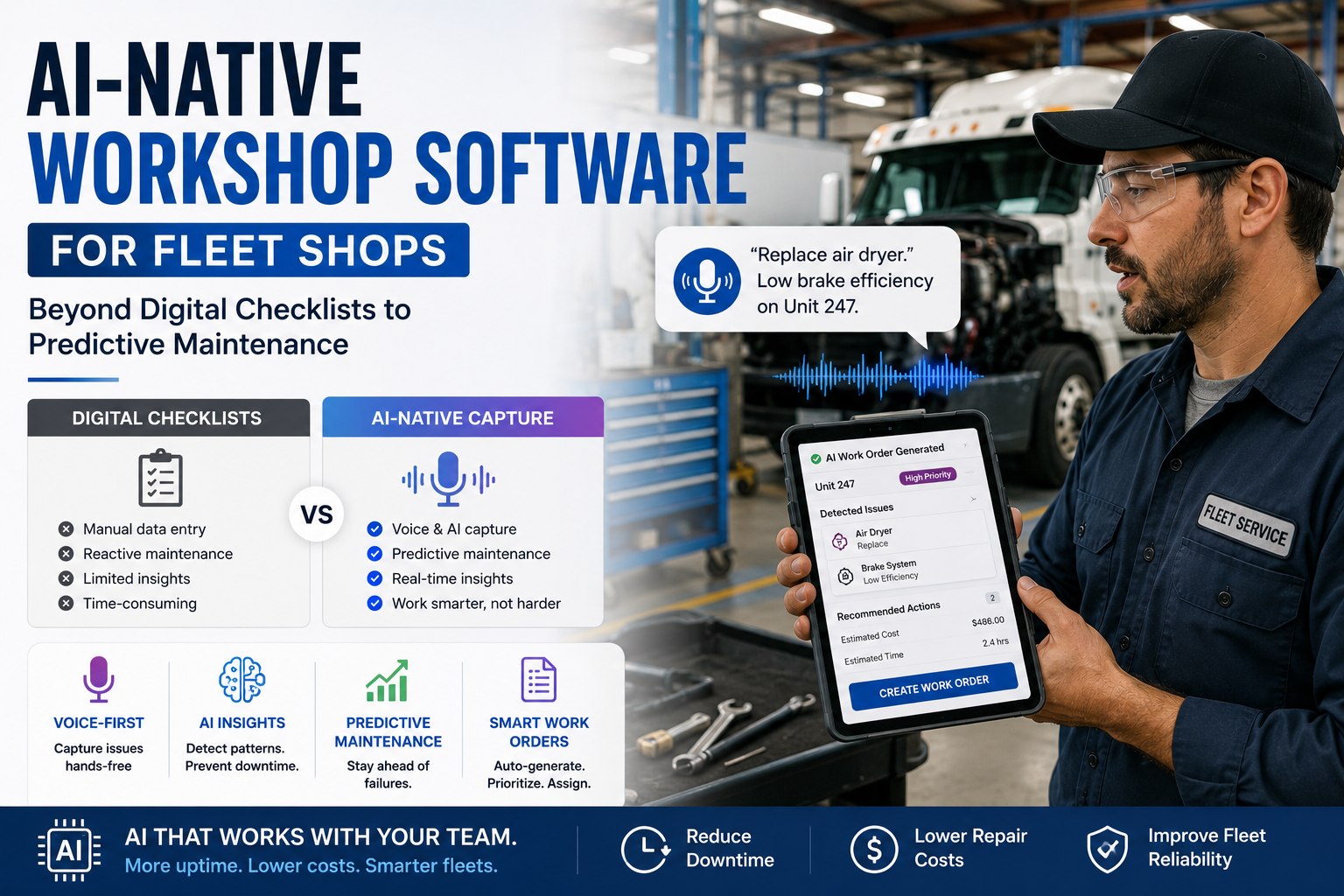
Most fleet shops that call themselves "digital" are running digital checklists — a paper form moved onto a tablet. It's a real improvement over paper, but it hides a stubborn limitation: a digital checklist still depends on a human to stop, tap, and type every field, and the data it produces often ends its life as a PDF nobody queries again. AI-native workshop software is a different architecture entirely. Instead of a human keying data into a form, the technician speaks or writes naturally and AI turns that input into structured records automatically — categorizing, summarizing, and routing it without manual entry. Voice-activated work orders are now a named 2026 field-service pattern, not a novelty. And the structured data this creates is the fuel for the real destination: predictive maintenance, where the software forecasts a failure weeks out and generates the work order before the truck ever breaks down. This guide contrasts digital checklists against AI-native capture, walks the maturity ladder from reactive to predictive, and shows what "beyond checklists" actually looks like on the shop floor. Start a free trial or book a demo to see AI-native fleet workshop software in action.
FLEET WORKSHOP SOFTWARE · AI-NATIVE PLATFORM
Beyond Digital Checklists: AI-Native Workshop Software for Fleet Shops
A digital checklist is still manual data entry with a nicer screen. AI-native software structures the data itself — voice and natural-language capture in, predictive maintenance out — so your shop moves from recording what already happened to preventing what's about to.
73%
of fleets still run reactive maintenance — fixing trucks after they break
27%
using AI predictive maintenance are cutting unplanned downtime by up to 45%
The Limitation Hiding Inside "Digital"
Moving a checklist from paper to a screen removes the clipboard, but it keeps the fundamental bottleneck: a person still has to translate what they observe into structured fields by hand. That gap is where data gets thin, late, or lost — and thin data can't power anything intelligent downstream.
Digital Checklist
A form on a tablet
Human stops work to tap and type every field
Captures only what fits the preset boxes
Detail gets skipped when the shop is busy
Output often ends as a static PDF
Data rarely queried or reused
Records what already happened
AI-Native Capture
Structure builds itself
Technician speaks or writes naturally, hands free
NLP extracts and categorizes every detail
Effortless capture means fuller records
Output is structured, searchable data
Data feeds analytics and prediction
Forecasts what's about to happen
i
Why this distinction decides everything downstream: AI needs structured, per-asset data to find patterns — component, defect, severity, date, all machine-readable. A digital checklist that produces a PDF gives AI nothing to learn from; AI-native capture produces exactly the indexed data that failure prediction requires. In other words, the choice between a checklist and AI-native capture isn't a UI preference — it decides whether your shop can ever reach predictive maintenance at all.
See what AI-native capture produces versus a checklist.
The Maintenance Maturity Ladder
Every fleet sits somewhere on a ladder that runs from chaos to foresight. AI-native software is what lets a shop climb past the middle rungs, because each level depends on the quality of data the level below produces.
01
Reactive
Fix it when it breaks. No planning, highest costs, maximum downtime — and still where 73% of fleets operate.
02
Preventive
Service on a fixed calendar or mileage schedule. Better than reactive, but replaces good parts early and still misses failures between intervals.
03
Predictive
Service based on actual condition. AI forecasts failures 20–45 days out at 80–97% accuracy and schedules the repair before the breakdown.
04
Autonomous / Prescriptive
The software detects the fault, orders the part, schedules the technician, and notifies the manager — moving from pilot to production in 2026.
You can't skip rungs — but AI-native capture is what lets you climb them.
Fleet Rabbit supports reactive, preventive, and predictive workflows in one platform, so your shop advances up the ladder on the data it's already generating instead of starting a separate project.
What "AI-Native" Actually Means on the Shop Floor
The label gets overused, so here's the concrete difference. An AI-native platform doesn't bolt AI onto a form — AI is how the data is captured, understood, and acted on from the start.
Voice & Natural-Language Capture
Technicians speak or write the way they talk, and NLP turns it into structured work orders and inspections — voice-activated work orders are a named 2026 field-service pattern.
Structured, Indexed Data
Every record is machine-readable and indexed by vehicle, component, and date — the exact form the analytics and prediction layers need to find patterns.
Predictive Failure Modeling
Machine learning correlates current readings against the failure signatures of every similar component across the fleet, flagging risk weeks before a breakdown.
Automated Work-Order Generation
When risk crosses a threshold, the platform creates and schedules the work order automatically — the truck gets fixed during planned downtime, not on the roadside.
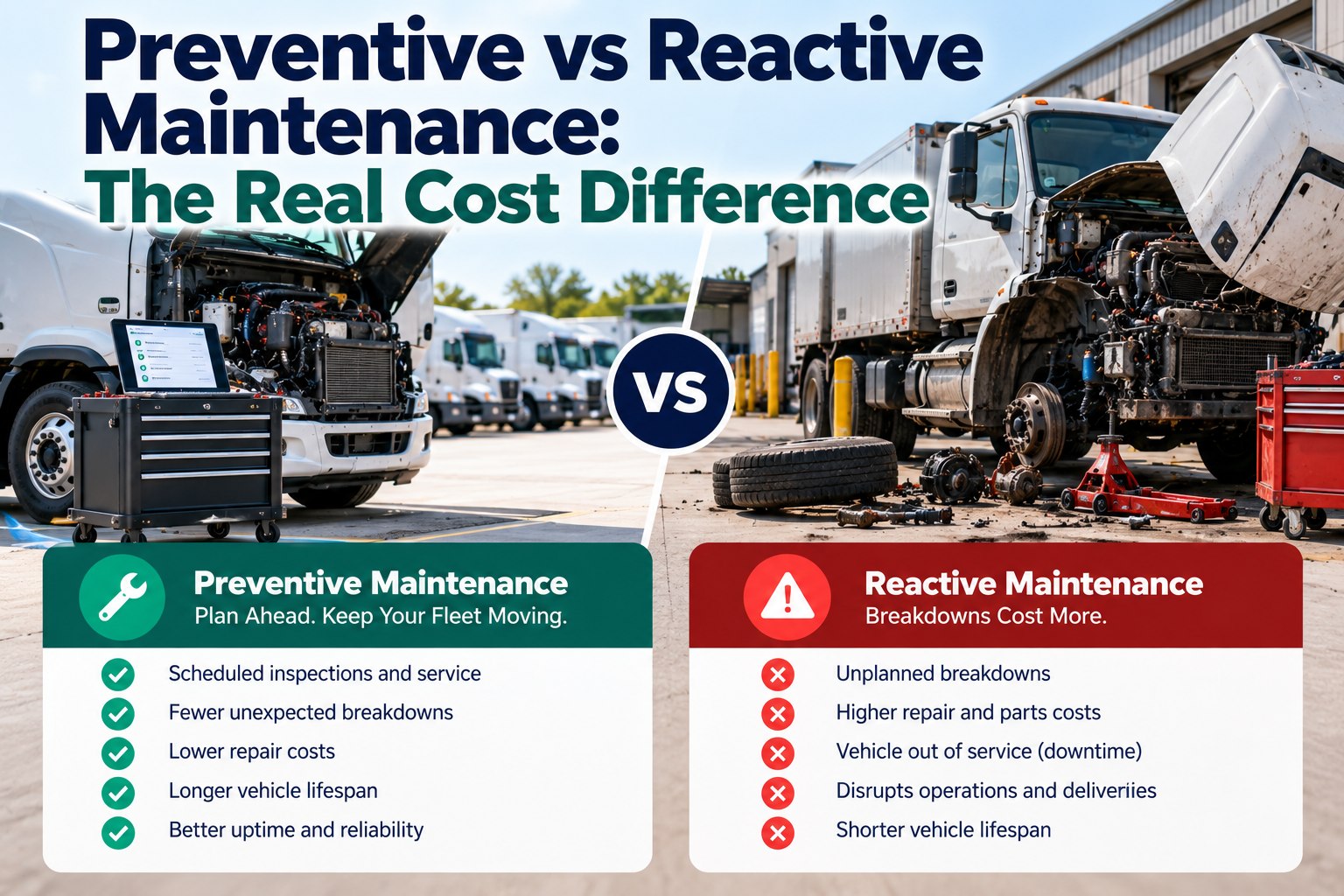
What Reactive Actually Costs
The case for climbing the ladder is financial, and the numbers are well-documented. Swipe the table horizontally on mobile.
← Swipe to see all columns →
Capture Data Like It's 2026, Not 2016
Fleet Rabbit is AI-native fleet workshop software — voice and natural-language capture that structures your data automatically, analytics that turn it into insight, and predictive maintenance that forecasts failures 20–45 days out and generates the work order before the breakdown. Reactive, preventive, and predictive workflows in one platform, at $5/vehicle/month, no hardware, live within 72 hours.
Voice & NLP capture
Structured fleet data
Predictive alerts
Auto work orders
Choosing an AI-Native Platform
Plenty of vendors have added the word "AI" to a checklist app. These are the criteria that separate genuinely AI-native software from a form with a chatbot bolted on. Swipe the table horizontally on mobile.
← Swipe to see all columns →
Frequently Asked Questions
What does "AI-native" workshop software actually mean?
It means AI is how the software captures, understands, and acts on data from the start, rather than a feature bolted onto a digital form. In practice, a technician speaks or writes naturally and natural language processing turns that input into structured records automatically, that structured data feeds analytics and failure prediction, and work orders can be generated from risk without manual creation. A digital checklist with a chatbot added is not AI-native, because the underlying data capture is still manual, and seeing the difference on real records is exactly what you can
book a demo to compare.
Isn't a digital checklist already good enough?
It's a real improvement over paper, but it keeps the core bottleneck: a person still has to translate observations into structured fields by hand, so detail gets skipped when the shop is busy and the output often ends life as a static PDF nobody queries. More importantly, that thin data can't power anything intelligent downstream — AI needs structured, indexed, per-asset records to find failure patterns. The checklist records what already happened; AI-native capture produces the data that lets you forecast what's about to. Seeing what that richer data unlocks is something you can
book a demo to explore.
How does AI-native capture lead to predictive maintenance?
Prediction is only as good as the data underneath it. When voice and natural-language capture produce structured records indexed by vehicle, component, and date, machine learning can correlate current readings against the failure signatures of every similar component across the fleet and forecast a breakdown 20 to 45 days in advance at 80 to 97% accuracy. A checklist that outputs PDFs gives those models nothing to learn from, which is why the capture layer determines whether predictive maintenance is even reachable, and walking that path from capture to prediction is something you can
book a demo to see end to end.
What is the maintenance maturity ladder?
It's the realistic progression every fleet follows: reactive (fix it when it breaks), preventive (service on a fixed schedule), predictive (service based on actual condition using AI forecasting), and autonomous or prescriptive (the software orders the part and schedules the repair itself). Around 73% of fleets are still on the reactive rung, and most cannot jump straight to predictive — each level depends on the data quality of the one below. AI-native capture is what lets a shop climb the ladder on the data it already generates, and mapping your current rung and next step is something you can
book a demo to work through.
How accurate is AI failure prediction for fleets?
The documented figures are strong: machine learning models analyzing vehicle sensor data, telematics, and maintenance history predict component failures 20 to 45 days in advance with 80 to 97% accuracy, and roughly 85 to 95% of breakdowns are now considered predictable. That advance warning is what lets a fleet address an emerging fault during planned downtime instead of on the roadside, cutting unplanned downtime by up to 45%. Testing that prediction against your own fleet's history is exactly what you can
book a demo to do.
Do we have to replace our whole system to go AI-native?
No. The strongest AI-native platforms support reactive, preventive, and predictive workflows in a single system, so you don't rip out what works or start a separate data-science project — you advance up the maturity ladder on the data your shop already generates. Fleet Rabbit runs on devices your team already carries with no hardware to install and deploys live within 72 hours, so adoption is incremental rather than a rip-and-replace. Planning that gradual transition for your operation is something you can
book a demo to map out.
Is predictive maintenance worth it for a smaller fleet?
Increasingly, yes, because the cost of a single breakdown lands harder on a small fleet. An unplanned truck breakdown runs about $760 in direct repairs and past $1,900 all-in once towing and lost productivity are counted, and reactive repairs cost 3 to 5 times their planned equivalent — so preventing even a few failures a year pays for the platform. The 2026 standard is a hybrid approach, used by around 66% of leading operators: preventive for routine assets, predictive for the critical ones. Sizing that up for your fleet is something you can
book a demo to do.
Are fully autonomous work orders real yet?
They're moving from pilot to production in 2026. In an autonomous workflow the software detects a developing fault, orders the part, schedules the technician, and notifies the manager of the planned downtime window with minimal human intervention — the top rung of the maturity ladder. Most AI today is still assistive rather than fully autonomous, with humans making the final call, but the trajectory is clear and the data foundation is the same AI-native capture that powers prediction. Seeing where that automation stands today is something you can
book a demo to explore.
Stop Recording the Past. Start Predicting the Breakdown.
Fleet Rabbit is AI-native fleet workshop software — voice and natural-language capture that structures your data automatically, and predictive maintenance that forecasts failures weeks out and generates the work order before the truck ever breaks down. Climb from reactive to predictive on the data you already generate, integrated in 5–7 working days, at $5/vehicle/month, with no hardware required.
Free tier for up to 3 vehicles · No credit card required · No hardware installation
July 29, 2026
By Derek Goes
All Articles