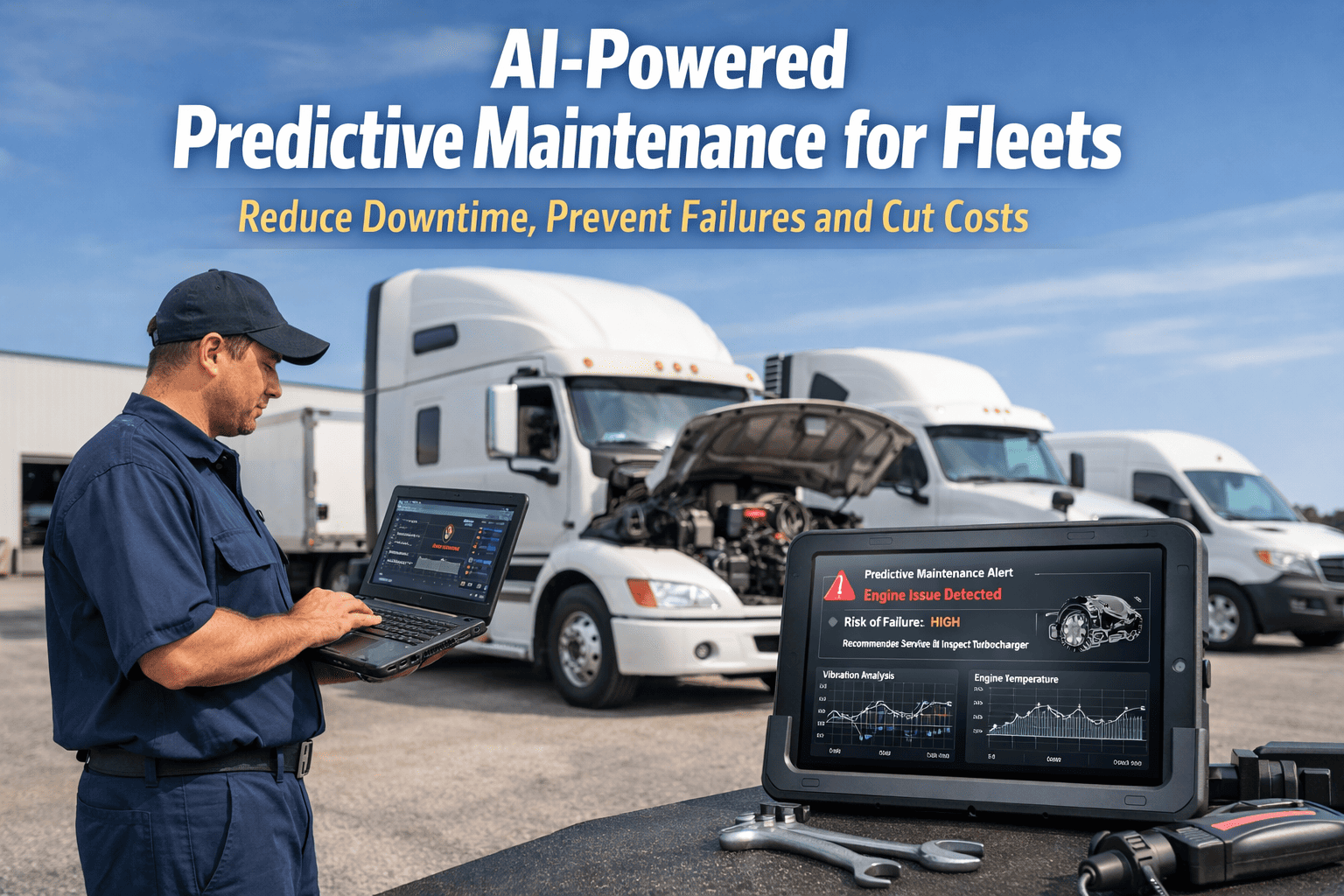
Fleet maintenance is no longer reactive—in 2026 it's predictive, data-driven, and powered by AI. The days of waiting for breakdowns to force repairs are ending as smart maintenance systems fleet operators deploy transform how vehicles are monitored, serviced, and optimized. While traditional maintenance relied on fixed schedules or responding to failures, predictive maintenance fleet management uses real-time data and machine learning to anticipate problems before they occur.
The stakes have never been higher. Rising downtime costs fleet operators $500-$1,500 per vehicle per incident. Unexpected failures strand drivers mid-route, destroy delivery schedules, and erode customer trust. Annual maintenance costs consume 15-40% of total fleet operating expenses—much of it preventable with the right technology. Fleets that embrace AI fleet maintenance software are reducing downtime by 25-30%, cutting maintenance costs by 20-25%, and extending vehicle lifespan by years. This comprehensive guide explains how predictive analytics fleet maintenance works, the technologies driving it, and how to implement these systems in your operation.
Still relying on reactive maintenance?
Discover how predictive systems are transforming fleets — explore it in a quick demo.
Book Your Free DemoWhat is Predictive Maintenance in Fleet Management?
Predictive maintenance is a data-driven approach that uses sensors, analytics, and machine learning to monitor vehicle health continuously and predict when components will fail—before they actually do. Instead of servicing vehicles on fixed schedules (preventive) or waiting for breakdowns (reactive), vehicle predictive maintenance systems analyze real-time data to determine the optimal moment for intervention.
Think of it as giving every vehicle in your fleet a continuous health checkup. Sensors monitor engine temperature, oil quality, brake wear, battery voltage, tire pressure, and dozens of other parameters. AI algorithms analyze this data stream, comparing current readings against historical patterns and known failure signatures. When the system detects early warning signs—a slight vibration indicating bearing wear, a temperature trend suggesting cooling system stress, or an electrical pattern preceding alternator failure—it alerts maintenance teams days or weeks before catastrophic breakdown.
How Predictive Maintenance Differs from Preventive Maintenance:
- Preventive Maintenance: Service vehicles on fixed schedules (every 10,000 miles, every 90 days) regardless of actual condition. Simple but often wasteful—replacing parts with remaining useful life or missing problems that develop between intervals.
- Predictive Maintenance: Service vehicles based on actual condition data and failure predictions. More efficient—parts are replaced when needed, not before, and problems are caught as they develop, not after they cause failures.
How AI Powers Predictive Maintenance
Artificial intelligence transforms raw vehicle data into actionable maintenance intelligence. Without AI, sensor data is just numbers—overwhelming volumes of readings that no human team could analyze in real time. Machine learning fleet analytics processes this data continuously, identifying patterns invisible to human observation and predicting failures with increasing accuracy over time. See how AI analytics work in a live demo.
Machine Learning Models
AI algorithms learn from historical maintenance data, identifying which sensor patterns preceded past failures. Over time, models become more accurate at predicting specific failure modes for your fleet's exact vehicle types and operating conditions.
IoT Sensors
Connected sensors throughout vehicles capture continuous data streams—engine diagnostics, vibration analysis, fluid quality, temperature readings, and electrical system monitoring. This real-time data feeds AI models with the inputs needed for accurate predictions.
Real-Time Data Collection
Telematics systems transmit vehicle data continuously to cloud platforms. Every trip generates thousands of data points that AI systems analyze for anomalies, trends, and early warning indicators.
Predictive Analytics
Advanced analytics platforms process data streams, run predictions, and generate maintenance recommendations. Dashboards visualize fleet health, highlight at-risk vehicles, and prioritize maintenance actions by urgency and impact.
Key Technologies Behind Predictive Maintenance
Building effective predictive maintenance capabilities requires integrating multiple technologies into a cohesive system. Understanding these components helps fleet operators evaluate solutions and plan implementations effectively. The iot fleet monitoring system architecture connects physical sensors to cloud analytics platforms through reliable data pipelines.
IoT Sensors and Edge Devices
Modern vehicles contain dozens of sensors, and predictive maintenance adds more. Vibration sensors detect bearing wear. Oil quality sensors measure contamination levels. Temperature sensors track thermal stress. Edge computing devices on vehicles pre-process data, reducing transmission costs and enabling real-time local alerts for critical conditions.
Telematics and Connectivity Systems
Cellular and satellite connections transmit vehicle data to cloud platforms continuously. Modern telematics capture GPS location, fuel consumption, driver behavior, engine diagnostics, and custom sensor inputs. This connectivity transforms isolated vehicles into nodes in an intelligent fleet network.
AI and Machine Learning Platforms
Cloud-based AI platforms ingest data streams, train predictive models, and generate maintenance recommendations. These systems improve over time as they learn from your fleet's specific patterns. Some platforms offer pre-trained models for common failure modes; others customize entirely to your operation.
Cloud Infrastructure and Integration
Scalable cloud platforms store historical data, run analytics workloads, and integrate with existing fleet management systems. APIs connect predictive maintenance insights to work order systems, parts inventory, and scheduling tools—automating the response to predictions, not just generating them.
Want to see how these technologies work in real fleet operations?
Take a closer look with a live walkthrough.
Benefits of Predictive Maintenance for Fleets
The ROI of predictive maintenance benefits fleet operators across multiple dimensions. While implementation requires investment, the returns typically justify costs within 6-12 months for mid-size and larger fleets. Here's what maintenance optimization fleet programs deliver:
Catching problems early means fixing them before they cause breakdowns. Scheduled repairs during off-hours replace emergency roadside service calls. Fleet reliability improvement translates directly to better customer service and higher revenue.
AI predictions identify developing problems weeks before failure. Emergency repairs become rare exceptions rather than weekly disruptions. Planning replaces panic in maintenance operations. See how FleetRabbit predicts failures in advance.
Optimized maintenance schedules reduce parts waste from premature replacement. Catching issues early prevents cascading damage. Labor efficiency improves when repairs are planned rather than reactive.
Precision maintenance extends useful life of expensive components. Instead of replacing parts on arbitrary schedules, you replace them when data indicates actual need—often significantly later than traditional intervals suggest.
Real-World Results: Predictive Maintenance in Action
Theory matters less than results. Here's what fleets actually achieve when implementing AI-powered predictive maintenance systems—a mini case insight from real fleet operations.
Regional Distribution Fleet: 85 Vehicles
Before Predictive Maintenance
- 12-15 roadside breakdowns monthly
- $47,000 monthly emergency repair costs
- Fleet availability: 87%
- Reactive maintenance: 65% of work orders
- Average repair cost: $1,850
After 6 Months with AI System
- 2-3 roadside breakdowns monthly
- $28,000 monthly maintenance costs
- Fleet availability: 96%
- Planned maintenance: 85% of work orders
- Average repair cost: $680
FleetRabbit: AI-Driven Predictive Maintenance
FleetRabbit brings enterprise-grade predictive maintenance capabilities to fleets of all sizes. Our AI fleet maintenance software combines real-time monitoring, intelligent alerts, and maintenance automation into a platform designed for practical results rather than theoretical capabilities.
AI-Driven Alerts
Machine learning models analyze vehicle data continuously, generating alerts when patterns indicate developing problems. Alerts include severity ratings, recommended actions, and time-to-failure estimates so you can prioritize effectively.
Real-Time Monitoring
Dashboard visibility into every vehicle's health status. Track maintenance metrics across your entire fleet. Identify at-risk vehicles before problems become emergencies. Access insights from anywhere on any device.
Maintenance Automation
Predictions automatically trigger work orders, parts orders, and scheduling. Integration with existing systems eliminates manual data entry. Maintenance teams focus on fixing vehicles, not managing paperwork.
Curious how much downtime you can eliminate?
Get a personalized FleetRabbit walkthrough.
Predictive vs Preventive Maintenance: Complete Comparison
Understanding the differences between predictive and preventive maintenance helps fleet operators choose the right approach—or combination of approaches—for their operation. Both have roles in comprehensive maintenance strategies.
| Factor | Preventive Maintenance | Predictive Maintenance |
|---|---|---|
| Approach | Fixed schedules (time/mileage) | Data-driven, condition-based |
| Data Requirements | Minimal—basic mileage tracking | Extensive—sensors, telematics, analytics |
| Upfront Investment | Low | Moderate to high |
| Operating Costs | Higher (premature replacements) | Lower (optimized timing) |
| Downtime | Moderate (scheduled service) | Minimal (precise intervention) |
| Failure Prevention | Good (catches some issues) | Excellent (catches most issues) |
| Parts Utilization | Lower (early replacement) | Higher (full useful life) |
| Best For | Simple fleets, limited budgets | Complex fleets, reliability-critical ops |
Most successful fleets combine both approaches: preventive maintenance for routine items (oil changes, filter replacements) and predictive maintenance for expensive, failure-prone components (engines, transmissions, brakes). This hybrid strategy balances simplicity with sophistication.
Implementation Strategy: Getting Started
Implementing predictive maintenance requires systematic planning. Rushing deployment without proper foundation leads to disappointing results. Follow this framework for successful implementation of digital maintenance systems fleet-wide.
Data Foundation
Start by assessing your current data collection capabilities. What sensors exist on your vehicles? What telematics data are you already capturing? Identify gaps between available data and predictive requirements. Many fleets have more data than they realize—it's just not being analyzed effectively.
Tool Selection
Evaluate fleet maintenance automation tools based on your specific needs. Consider integration capabilities with existing systems, scalability for fleet growth, and vendor support quality. Request demos with your actual data to assess relevance to your operation. Schedule a FleetRabbit demo to see how it fits your fleet.
Pilot Program
Begin with a subset of your fleet—typically 10-20% of vehicles. Choose vehicles with known maintenance challenges to demonstrate value quickly. Refine processes and prove ROI before expanding fleet-wide. Most successful implementations take 3-6 months from pilot to full deployment.
Integration and Scaling
Connect predictive insights to maintenance workflows. Automate work order creation, parts ordering, and scheduling. Train maintenance teams on interpreting predictions and acting on recommendations. Expand to full fleet once processes are proven and teams are confident.
Future Trends: Fleet Technology 2026 and Beyond
Predictive maintenance technology continues advancing rapidly. Understanding emerging trends helps fleet operators make forward-compatible technology decisions and prepare for capabilities that will define competitive advantage in coming years.
Advanced AI Models
Next-generation machine learning models will predict failures with higher accuracy and longer lead times. Generative AI will suggest optimal repair procedures. Natural language interfaces will make systems accessible to non-technical users.
Expanded IoT Networks
5G connectivity will enable richer data streams with lower latency. New sensor types will monitor additional parameters. Edge computing will bring more intelligence directly to vehicles for faster response to critical conditions.
Autonomous Maintenance
Integration with autonomous vehicle systems will enable self-diagnosis and, eventually, self-repair for certain conditions. Vehicles will coordinate directly with service facilities, scheduling their own maintenance during optimal windows.
Predict Problems Before They Happen
Take control of your fleet's performance with smarter maintenance systems. AI-powered predictive maintenance isn't future technology—it's available now, delivering measurable ROI for fleets ready to move beyond reactive and preventive approaches. The fleets that embrace these capabilities today will define the efficiency standards others struggle to match tomorrow.