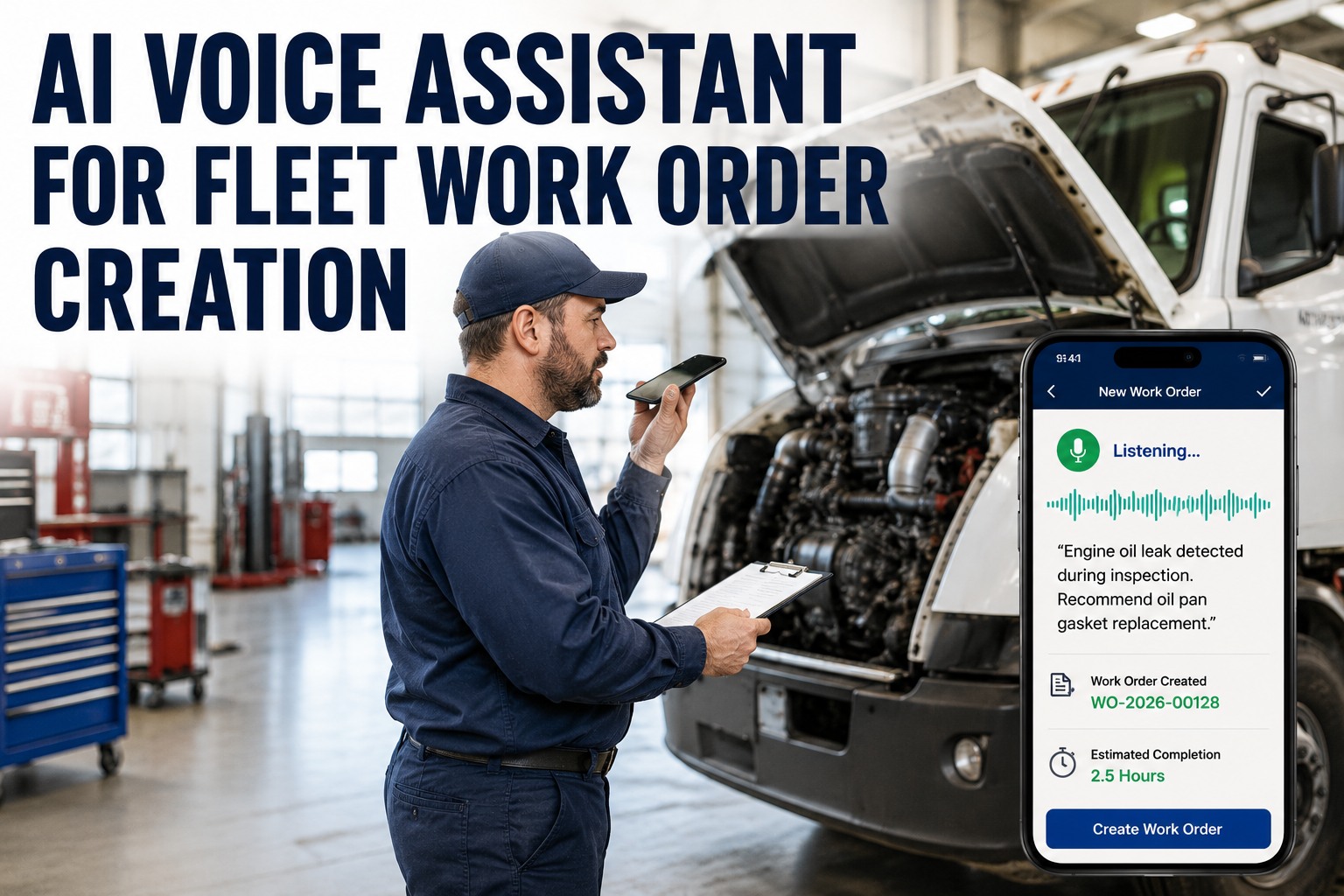
An AI voice assistant for work order creation does something a dictation app can't: it listens to a technician describe a repair in plain speech and hands back a finished, structured repair ticket — complaint, cause, correction, parts, labor time, and the labor code — ready to assign and invoice. The technician says, "Unit 214, customer says it's down on power on grades, found a split charge pipe at the intercooler, replaced the pipe and both clamps, hour and a half," and the assistant produces a repair order with each element in its right field and a VMRS job code attached. That matters because documentation is the part of the job technicians resent most, and with 44% of diesel techs considering leaving the trade, removing the friction they hate is a real lever on keeping them. This guide explains how a voice assistant turns a spoken repair into a structured, coded work order, why the labor code is what separates a real assistant from a transcriber, and how a fleet can put it to work fast. Start a free trial or book a demo to see AI-generated work orders on your fleet.
WORK ORDER CREATION · AI VOICE ASSISTANT
AI Voice Assistant for Fleet Work Order Creation
Speak the repair the way you'd tell a coworker, and the assistant hands back a structured repair ticket — complaint, cause, correction, parts, labor time, and the labor code — ready to assign and invoice. Not a transcript. A finished work order.
The paperwork is the part techs hate — and it's costing you the techs
Writing up work orders is consistently among the tasks technicians resent most, and with 44% of diesel technicians considering leaving the trade, every source of daily friction matters. A voice assistant that writes the ticket for them removes one of the frustrations that pushes good people out — and hands back the time they'd rather spend turning wrenches.
44%
of diesel technicians are considering leaving the trade — ATRI
Spoken Repair In, Structured Ticket Out
The assistant's job is to hear one continuous, natural sentence and resolve it into the discrete fields a repair order needs. Here's the same spoken input broken into the structured ticket it produces.
The Labor Code Is What Makes It an Assistant
Anything can transcribe speech. What separates a true work-order assistant is that it structures the repair the way the maintenance industry actually codes it — using the 3 C's and a VMRS labor code — so the ticket is billable, benchmarkable, and searchable, not just readable.
The 3 C's
How every repair order is structured
Complaint The problem in the driver's own words — the symptom that opened the ticket.
Cause The diagnosed reason the technician found behind the symptom.
Correction The work actually performed to fix it, with parts and labor.
The VMRS Labor Code
The industry's universal repair language
Standardized Vehicle Maintenance Reporting Standards, maintained by the ATA's Technology & Maintenance Council since 1970.
Structured A numeric job code identifying the system, assembly, and component the work touched.
Benchmarkable Estimated hours per code compared against actual, so you can track efficiency and spot cost trends.
i
Why coding at the point of speech matters: when the labor code is assigned as the ticket is created, every repair automatically feeds fleet-wide analytics — which components fail most, which repairs run long, where cost concentrates. When coding is a separate back-office chore, it gets skipped or guessed, and the data underneath your maintenance decisions quietly rots. A voice assistant that codes as it captures keeps that data clean without adding a step.
See coded work orders generated live.
What the Assistant Assembles
From one spoken description, the assistant populates every field a complete, billable repair order needs. Swipe the table horizontally on mobile.
← Swipe to see all columns →
Give your technicians back the hour they lose to writing tickets.
Fleet Rabbit's voice assistant turns a spoken repair into a coded, billable work order in seconds — so techs do the work they signed up for, not the paperwork they'd quit over.
What a Coded Voice Work Order Unlocks
Generating the ticket by voice is the visible win. The structured, coded data underneath is where the compounding value lives.
01
Seconds, Not Minutes
A repair that took several minutes to write up becomes a spoken sentence, freeing wrench time on every single job across the shop.
02
Billable and Accurate
Labor time and parts land in the right fields the first time, so tickets are invoice-ready and less revenue leaks through unbilled work.
03
Consistent Across Techs
A green tech's work order comes out as structured and coded as a veteran's, because the assistant enforces the format, not the person.
04
Clean Fleet Analytics
Because every job is coded at creation, failure trends, cost drivers, and efficiency benchmarks build themselves from real, complete data.
05
Searchable History
Coded, structured tickets make a vehicle's repair history searchable in seconds for warranty, diagnosis, and audit instead of buried in free text.
06
A Reason to Stay
Removing the paperwork techs resent is a small, real signal that the shop values their time — one lever on the retention you control.
Turn Spoken Repairs Into Coded Work Orders
Fleet Rabbit's AI voice assistant listens to a technician describe a repair and builds a structured, billable work order — complaint, cause, correction, parts, labor time, and VMRS labor code — ready to assign and invoice, with the data feeding clean fleet analytics. At $5/vehicle/month, no hardware, live within 72 hours, free for up to three vehicles.
Spoken-to-structured tickets
3 C's + VMRS coding
Invoice-ready
Clean analytics
Voice Assistant vs. Dictation vs. Manual Entry
Three ways to create a work order, and only one of them hands back a coded, billable ticket. Swipe the table horizontally on mobile.
← Swipe to see all columns →
Frequently Asked Questions
What does an AI voice assistant for work order creation actually do?
It listens to a technician describe a repair in natural speech and produces a finished, structured work order — separating the complaint, cause, and correction, capturing parts and labor time, and assigning a labor code — rather than just transcribing the words. The technician talks the way they'd explain the job to a coworker, and the assistant does the structuring and coding. Seeing that spoken-to-coded-ticket transformation on a real repair is exactly what you can
book a demo to watch, so you can judge the output against your own work orders.
How is this different from voice dictation?
Dictation converts speech to a block of text and stops there, leaving someone to read it, split it into fields, and code it. A voice assistant goes the whole way: it identifies which words are the complaint, which are the cause, which are the correction, which name parts and labor, and it assigns the labor code — producing a billable work order, not a paragraph. The difference is structure and coding, and comparing the two on the same spoken repair is something you can
book a demo to see side by side.
What are the 3 C's, and why do they matter?
The 3 C's — Complaint, Cause, and Correction — are how the repair industry structures every work order: the complaint is the problem in the driver's words, the cause is the diagnosed reason, and the correction is the work performed to fix it. Documenting all three creates a complete, defensible service record for warranty and audit, and a voice assistant separates them automatically from one spoken description. Seeing how cleanly your technicians' natural speech maps to the 3 C's is something you can
book a demo to explore.
What is a VMRS labor code and why assign one?
VMRS — Vehicle Maintenance Reporting Standards — is a universal coding system the ATA's Technology & Maintenance Council has maintained since 1970, using numeric job codes to identify the system, assembly, and component a repair touched. Assigning one turns a repair into standardized, benchmarkable data: you can compare estimated versus actual hours, track which components fail most, and spot cost trends across the fleet. Because the assistant codes at the point of creation, that data stays clean without a back-office step, and seeing coded tickets generated live is something you can
book a demo to review.
How does it help with technician retention?
Writing up work orders is one of the tasks technicians resent most, and with 44% of diesel techs considering leaving the trade, the daily frictions that push people out matter. A voice assistant that writes the ticket for them removes one of those frustrations and hands back time they'd rather spend on actual repairs — a small but real signal that the shop respects their time. It won't fix pay or the labor market, but it's a lever within your control, and understanding that impact is something you can
book a demo to think through for your crew.
Is it accurate with maintenance terminology?
Yes, because it's trained on maintenance language rather than general speech. It recognizes component names, part terms, and the way technicians actually describe repairs, and it works over shop noise thanks to noise-cancelling recognition tuned for the environment. That's what lets it map a spoken repair to the right fields and the right labor code instead of guessing, and testing that accuracy on your own techs' phrasing is something you can
book a demo to do firsthand before rolling it out.
Do we need special hardware or a long setup?
No. The assistant runs on the smartphones your technicians already carry, so there's nothing to buy or install, and it deploys live within 72 hours rather than the quarters a hardware project takes. Because there's no equipment to distribute, rolling it out across the shop is straightforward, and mapping that rollout is something you can
book a demo to plan. The no-hardware design also keeps it a low-risk addition rather than a capital commitment.
What does it cost, and can we trial it?
It's free for up to three vehicles with no credit card, then $5 per vehicle per month with no hardware and no setup fee, so you can prove the time savings and coding quality with your own technicians before committing. The low barrier is intentional — a work-order assistant should earn its place in the shop rather than in a sales pitch — and setting up that trial for your fleet size is exactly what you can
book a demo to do.
Let Your Technicians Talk, Not Type
Fleet Rabbit's AI voice assistant turns a spoken repair into a structured, coded, billable work order — the 3 C's separated, parts and labor captured, a VMRS labor code assigned, and clean data feeding your fleet analytics. Give techs back the time they'd rather spend on wrenches, integrated in 5–7 working days, at $5/vehicle/month, free for up to three vehicles, with no hardware required.
Free tier for up to 3 vehicles · No credit card required · No hardware installation
July 30, 2026
By Emily Parker
All Articles