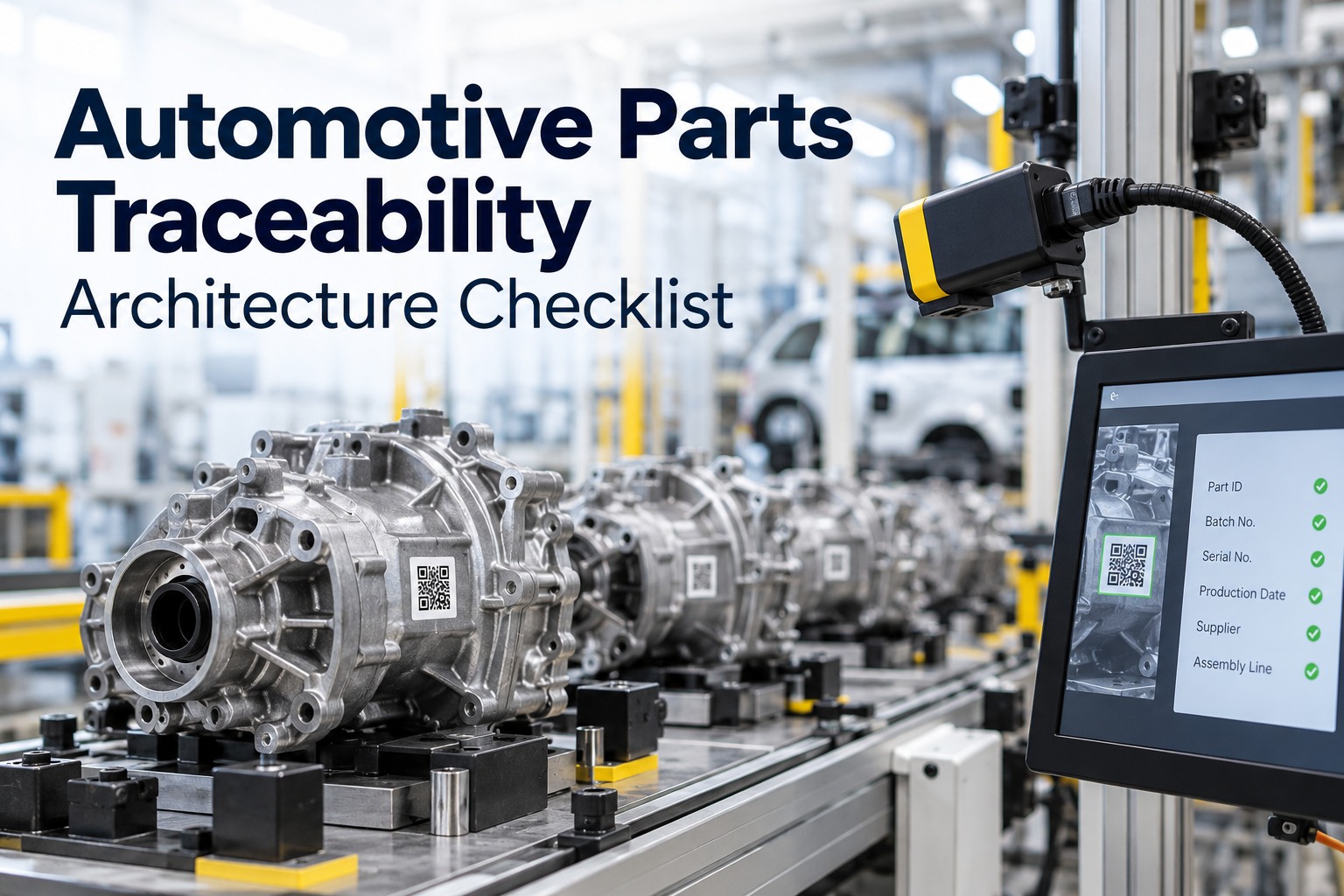
Traceability architecture comes down to four decisions, and most suppliers make three of them carefully and discover the fourth during a recall. What you identify and at what granularity. Where you capture events. How you link a component to the assembly it went into. And whether you can actually query all of that under time pressure. The fourth is the one that bites, because a genealogy that is complete but takes three days to interrogate is functionally the same as not having one — the containment perimeter gets drawn from a date range instead, and a date range always covers more vehicles than the fault did. That matters in both directions: an over-scoped recall costs more than it needed to and still leaves defective units on the road, because the effort was spread across units that were never affected. See it on your own data and we'll time a scoping query against your records.
Manufacturing · Traceability Architecture
Automotive Parts Traceability for Suppliers
Choosing identifier granularity part by part, deciding what gets captured at each station, linking components to assemblies so genealogy survives the boundary, and testing whether the query returns in minutes or in days.
One genealogy chain
Raw materialHeat or batch number, supplier, certificate
ComponentSerial or lot, machine, station, operator, process parameters
AssemblyWhich components went in, with test and inspection results attached
ShipmentContainer, despatch reference, destination — where the chain leaves you
Granularity Is a Per-Part Decision
Serialising everything is expensive and serialising nothing is indefensible. The standard practice splits by consequence of failure.
Swipe to see all columns
The principle worth writing into your own standard: identify at the level your worst realistic containment scenario would require. If a plausible defect would force you to recall a whole month's production because you cannot distinguish within it, that part needs finer granularity — and the cost of the marking is small against the cost of the scope you would otherwise carry.
What the Standard Actually Requires
Three obligations, and the third is where customer-specific requirements pile on top.
Status throughout the lifecycle
The identification and traceability clause requires product status to be identified throughout production, service provision and post-delivery, with traceability maintained across all of it — including storing the supporting evidence, not merely the identifiers.
Retention measured in decades
Documented retention periods commonly run ten to fifteen years and sometimes longer, set by customer and regulatory requirements. That is an architecture constraint, not a storage detail — whatever you build has to remain queryable long after the systems that created it have been replaced.
Plus every customer's own additions
Each manufacturer publishes requirements extending the base standard, and they differ. Assume the strictest customer sets your architecture, because building to the average means rebuilding for the one that asks for more.
On marking specifically, two references are worth having on the desk: the direct parts marking guideline covering DataMatrix and QR symbols applied by laser, dot peen or inkjet, and the readability standard for direct part marks. The second is the one people skip, and it matters — a mark that satisfies the format and fails the quality grade is a mark that will not scan reliably at a customer's plant two years from now.
Capture Points and What Each One Unlocks
Every capture decision is really a decision about a question you will want to ask later.
Swipe to see all columns
The third row is the underrated one. Capturing a pass or fail flag satisfies the audit; capturing the measured value lets you find the parts that passed marginally when a defect pattern later emerges. That population is invisible to any system storing outcomes rather than readings, and it is frequently where the real affected scope sits.
Minutes
or
Days
Same data. Different architecture.
How long does a scoping query take against your records today?
Almost nobody has measured it, because the question only gets asked when it is already urgent. Pick a material batch at random, and time how long it takes to list every part made from it, every assembly containing those parts and every shipment that carried them. Bring the result to a 30-minute session and we'll show you where the chain breaks.
Aggregation Is Where Chains Break
Genealogy describes the relationship between a finished product and everything that went into it. Four events create or destroy those relationships.
01Component into assemblyThe parent-child link that makes forward tracing possible. Captured at the station, or reconstructed later from timing — and reconstruction is inference, not traceability.
02Parts into containerWhich identifiers sit inside which container reference. This is what allows remote containment at a customer's site, because it turns a request to search into an instruction to isolate.
03Rework and disaggregationThe event that quietly destroys chains. A part removed from an assembly, reworked and refitted elsewhere breaks the original link and creates a new one — and if the system only records additions, the genealogy now describes something that is no longer true.
04Container transfer at the boundaryWhere your chain hands over to your customer's. Internal traceability covers receiving through despatch inside one plant; external traceability extends across organisational boundaries. Most recall investigations need both, which makes the handover record the joint that has to hold.
Query Performance Is a Design Requirement
Not an operational nicety. Four dimensions your records need to answer on, and a system that handles three of them is a system that will fail on the fourth.
By material
Start from a supplier batch or heat numberThe most common recall entry point, since defects frequently trace to an input rather than to your process. Requires goods receipt data to be linked to production, which is the join most often missing.
By process
Start from a machine, tool, station or time windowQuery by date range, tool identifier or specification to isolate affected units. This is what tool wear, calibration drift and a mis-set parameter all look like when they surface months later.
By measurement
Start from a value range rather than a resultFind everything that passed within a defined margin of the limit. The hardest query to support and the one that most often produces a genuinely accurate scope, because it identifies the population a pass-fail record renders invisible.
By unit
Start from a returned part and work backwardsReconstruct what went into a specific failed unit — material, machine, station, parameters, test values. This is root cause work, and it also tells you whether the perimeter you drew was wide enough.
Precision cuts both ways, and that is the argument
Over one thousand new recalls are processed annually, with completion rates across most component categories landing between 60 and 75 per cent. A recall covering more vehicles than it needed to costs more and still leaves defective units on the road — because the outreach, the parts and the service capacity all get spread across units that were never affected. Precise scoping is not only cheaper. It is the version more likely to reach the vehicles that actually carry the defect.
Capture Without Operator Overhead
The practical constraint that decides whether an architecture survives contact with a production line.
Manual capture degrades predictably
A traceability step depending on someone scanning during a busy shift will be skipped on the shifts that matter most. The gaps then appear in exactly the periods you will later want to investigate, because those are the periods when the line was under pressure.
Automatic capture is the design goal
Reading technologies that capture identity without operator action are described as the dominant approach precisely because they remove the overhead. Where automation is not viable, design the manual step so that the process cannot continue without it rather than relying on compliance.
Mark quality is a capture problem
A direct part mark that fails its readability grade will scan inconsistently, which produces intermittent gaps that look like process problems rather than marking problems. Verifying mark quality at application is cheaper than diagnosing it downstream.
Designing It in Seven Decisions
In order. Each one constrains the next, which is why taking them out of sequence causes rework.
1Set granularity per part classSerialised for safety-critical and high-value, serial or tight lot for functional assemblies, batch for fasteners and bulk. Decide against your worst realistic containment scenario rather than against marking cost.
2Choose marking method and verify qualityLaser, dot peen or inkjet according to material and application, following the direct parts marking guideline — and grade the result against the readability standard rather than assuming it passes.
3Define capture points against future queriesWork backwards from the questions you will need to answer. Every capture point is a query you are enabling, and every one you skip is a question you will not be able to ask when it matters.
4Record measured values, not just verdictsTest and inspection readings linked to individual identifiers. This costs almost nothing at capture and is the difference between finding the marginal population and missing it entirely.
5Handle aggregation and disaggregation explicitlyEspecially rework. A system that records only what went in will eventually describe a genealogy that no longer matches the physical product.
6Link the shipment to the identifiersThe join that makes containment beyond your walls possible. Without it, notifying a customer means asking them to search rather than telling them what to isolate.
7Test the query, then test it again after a yearTime a scoping exercise on real data, then repeat it once the dataset has grown. Systems that answer in seconds at pilot scale routinely answer in hours at production volume, and the retention period is measured in decades.
Frequently Asked Questions
Which parts should we serialise and which can be batch tracked?It depends on the part. Safety-critical and high-value components such as airbags, brakes and battery packs are usually serialised individually, because individual failure can cause harm and liability requires unit-specific documentation. Fasteners, adhesives and bulk materials are commonly tracked at batch or lot level, where individual identification is impractical and the failure mode is material-wide anyway. Decide by asking what your worst realistic containment scenario would require.
What does the automotive standard actually require?The identification and traceability clause requires identifying product status throughout production, service provision and post-delivery, with traceability maintained throughout including storage of the supporting evidence. Scope and retention are set by customer and regulatory requirements, with documented retention commonly running ten to fifteen years or longer. Each manufacturer also publishes its own requirements extending the base standard, and they differ — assume your strictest customer sets the architecture.
What should be captured at each station?Work order, station, operator, tool and the process parameters applied, linked to the part identifier, so a complete genealogy record travels with the product through every downstream station. Add measured test and inspection values rather than pass-fail flags — that is what later allows you to find parts that passed marginally, a population that is invisible to any system storing outcomes rather than readings.
Why does query performance matter so much?Because a complete genealogy that takes three days to interrogate produces the same outcome as no genealogy — the perimeter gets drawn from a date range instead. Systems designed for it can isolate affected units in minutes rather than days, with claimed scope reductions of up to ninety per cent. Test yours on real data, then retest once the dataset has grown, since pilot-scale performance rarely survives production volume across a fifteen-year retention window.
Is over-scoping a recall the safe option?No, and this is the point worth internalising. A recall covering more vehicles than it needed to costs more and still leaves defective units on the road, because outreach, parts and service capacity get spread across units that were never affected. With completion rates across most component categories landing between 60 and 75 per cent, a wider scope means a smaller share of the genuinely affected population actually gets fixed. Precision is both the cheaper and the safer choice.
Where do genealogy chains usually break?At rework and at the organisational boundary. A part removed from an assembly, reworked and refitted elsewhere breaks the original parent-child link — and if the system only records additions, the genealogy now describes something untrue. At the boundary, internal traceability covers receiving through despatch inside one plant while external traceability extends to suppliers and subcontractors, and most recall investigations need both. The container-to-identifier link is the joint that has to hold.
How do we stop capture being skipped on busy shifts?By removing the operator dependency where you can. Automatic identification is the dominant approach precisely because it captures without overhead, and manual steps get skipped on exactly the shifts you will later want to investigate. Where automation is not viable, design the step so the process cannot continue without it. And verify direct part mark quality against the readability standard at application, since a marginal mark produces intermittent gaps that look like process faults. Start free with three assets and test the capture before you scale it.
Design for the Query You Will Have to Run
Set granularity against your worst containment scenario rather than your marking budget, define capture points by working backwards from the questions you will need to ask, store measured values instead of verdicts, handle rework as explicitly as assembly, link shipments to identifiers so containment works beyond your walls — and then time the query, because an architecture nobody has tested under pressure is a hypothesis.
Serial
Lot
Batch
Chosen per part class
Standards, retention periods and marking requirements vary by customer, region and product. Work from the applicable quality standard, the marking guidelines and each customer's own specific requirements rather than from general descriptions.