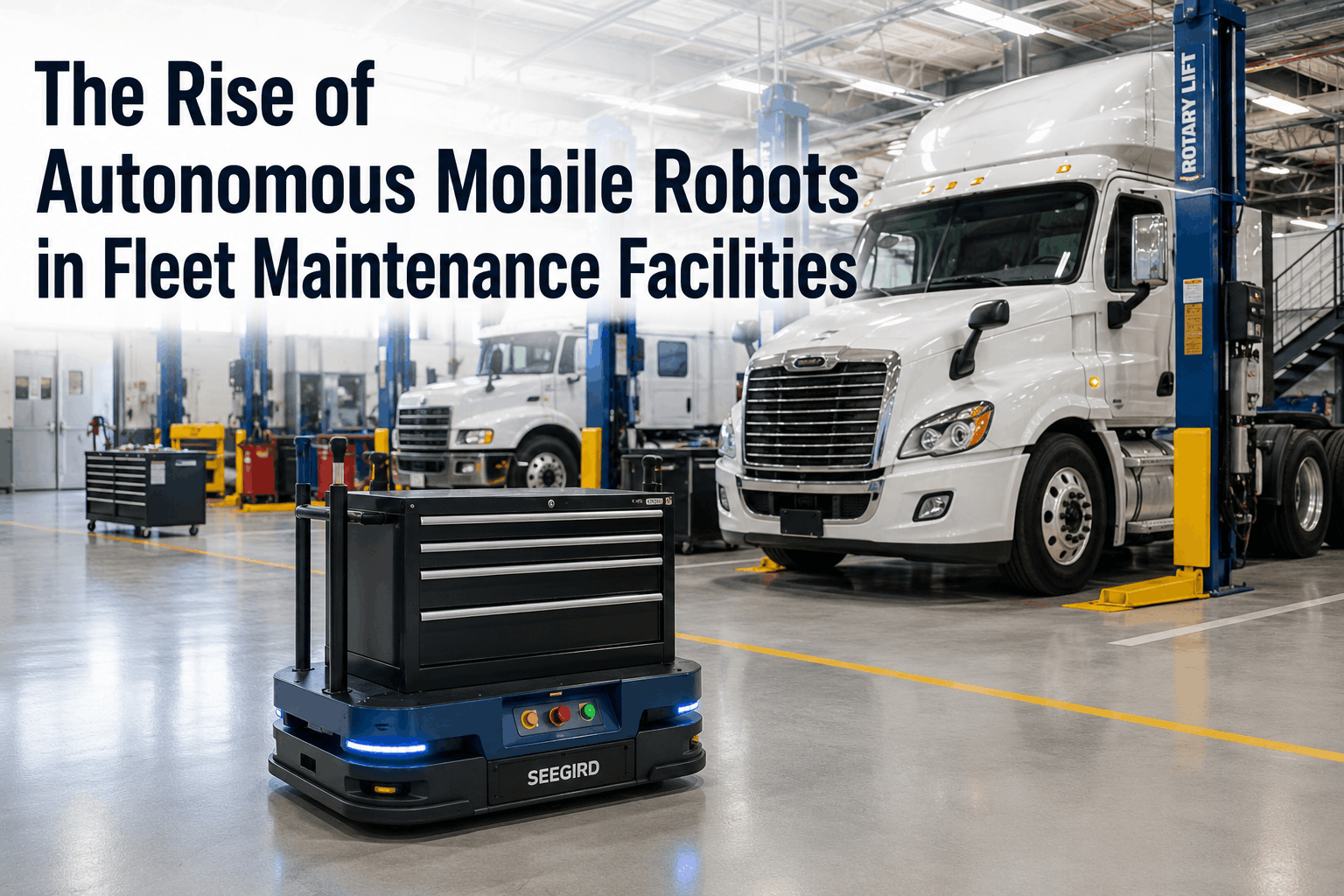
Walk into any modern fleet maintenance facility and you'll notice something different. The familiar sounds of mechanics rushing between bays, hunting for tools, and manually transporting heavy parts are being replaced by the quiet hum of autonomous mobile robots (AMRs). These intelligent machines are not science fiction — they're transforming how fleet workshops operate, delivering parts, handling tires, managing inventory, and even assisting with complex repairs. With the global AMR market in logistics and maintenance projected to grow at 17% CAGR through 2030, fleet facilities that adopt this technology are gaining a significant competitive advantage in efficiency, safety, and cost control.
The Rise of Autonomous Mobile Robots in Fleet Maintenance Facilities
Autonomous mobile robots are self-navigating machines equipped with sensors, cameras, and AI navigation systems. Unlike automated guided vehicles (AGVs) that follow fixed paths, AMRs use real-time mapping to navigate dynamic workshop environments, avoiding obstacles and rerouting around people and equipment without requiring physical infrastructure changes.
Transforming the Workshop Floor
AMRs are reimagining every aspect of fleet maintenance operations. Their impact begins with logistics: instead of mechanics spending 20-30% of their day walking to parts storage, retrieving tools, and delivering components, AMRs handle these tasks autonomously. A mechanic working on a brake job can request parts through a tablet interface, and within minutes, an AMR delivers the exact components to their bay. This seems simple, but the cumulative effect is transformative — shops using AMRs report up to 40% faster repair turnaround times and significantly higher mechanic productivity.
Beyond parts delivery, specialized AMRs are now performing tasks that traditionally required significant manual labor. Robotic tire handlers can lift, position, and torque wheels with precision, reducing the physical strain on mechanics and virtually eliminating mounting-related injuries. Parts kitting robots prepare complete repair kits — all the parts, consumables, and specialty tools needed for a specific job — and deliver them to the bay, eliminating the dreaded "I forgot a part" delay that kills shop efficiency. To integrate AMR technology into your fleet facility, sign up with FleetRabbit and access our automation readiness assessment tools.
Autonomous transport of parts, fluids, and consumables to service bays
Robotic systems for lifting, positioning, and torqueing wheels safely
Pre-assembled repair kits delivered ready for the specific job
Real-time stock tracking and automated reorder alerts
The Economics of Automation
The business case for AMRs in fleet maintenance is compelling and increasingly well-documented. Industry data shows that AMR deployment typically reduces material handling costs by 30-40% while improving labor productivity by 25-35%. For a mid-sized fleet workshop with 15 mechanics, the annual savings from reduced walking time, faster parts retrieval, and fewer repair delays can exceed $150,000. With AMR systems now available at under $30,000 per unit, the payback period often falls within 12-18 months — one of the fastest ROI profiles in fleet technology.
But the benefits extend beyond direct cost savings. AMRs reduce workplace injuries by eliminating heavy lifting, repetitive motions, and the constant walking that contributes to mechanic fatigue. They also improve quality: when parts are delivered accurately and on time, repairs are completed correctly the first time, reducing rework and warranty claims. And as the technology matures, integration with fleet management systems becomes seamless, with AMRs communicating directly with maintenance scheduling platforms to anticipate parts needs before a vehicle even arrives. To model the financial impact of AMR adoption for your facility, book a demo with FleetRabbit and access our automation ROI calculator.
AMR Adoption: What Fleet Managers Need to Know
$25,000-$50,000 per unit
12-18 months
25-35% improvement
3x within 3-5 years
Integration With Fleet Management Systems
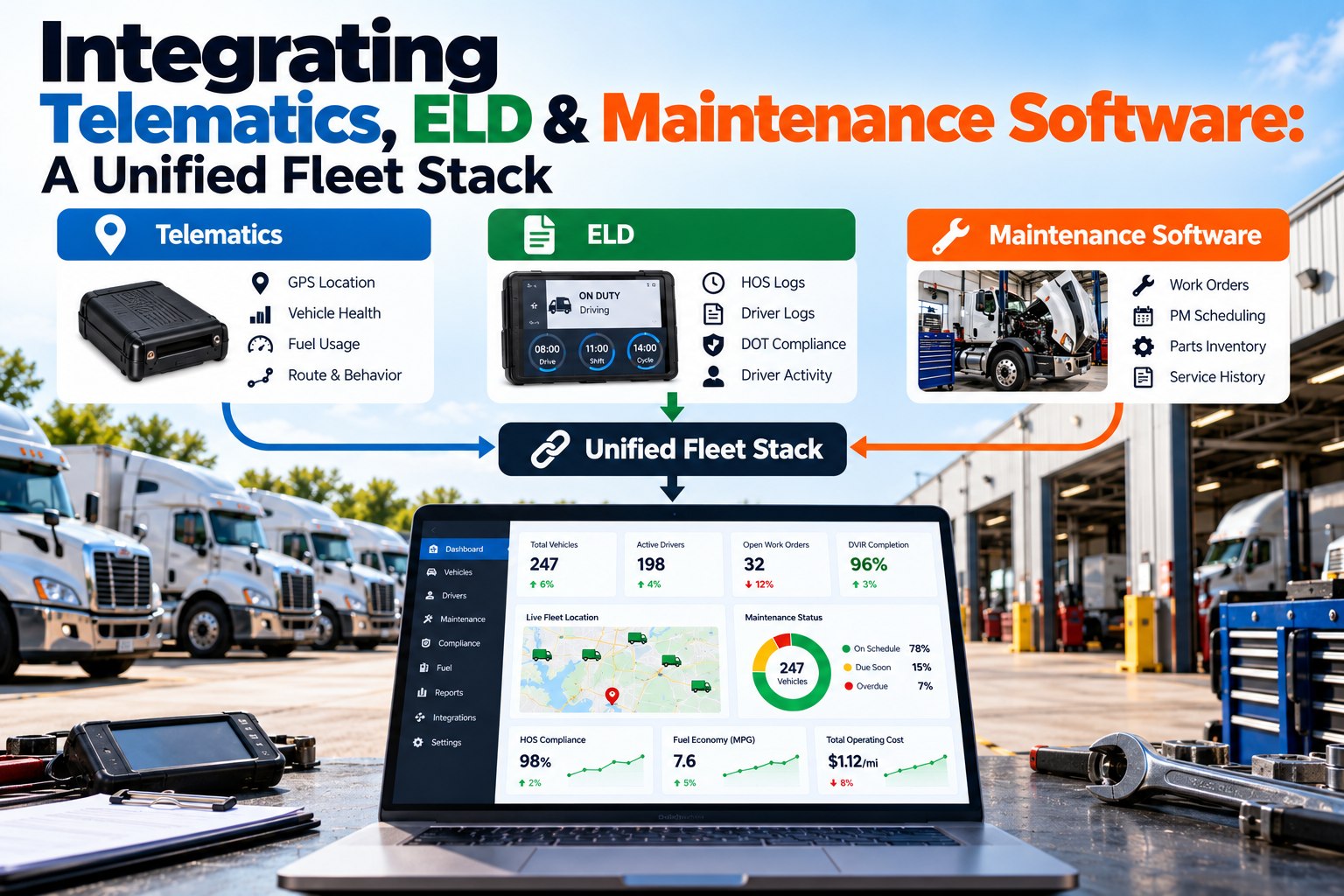
The true power of AMRs emerges when they're integrated with broader fleet management platforms. When an AMR is connected to your maintenance scheduling system, it can anticipate parts needs based on upcoming service appointments. When a vehicle arrives with a specific repair requirement, the AMR can prepare the necessary components before the technician even pulls the vehicle into the bay. This integration turns a parts delivery robot into a proactive efficiency engine that drives continuous improvement across the entire workshop.
FleetRabbit's platform supports this integration by providing a unified interface that connects maintenance scheduling, parts inventory, and AMR task management. This means every repair order automatically generates the required parts requests, and every AMR movement is logged and tracked within the system. Facility managers gain visibility into robot utilization, delivery times, and parts consumption patterns, enabling data-driven decisions about inventory levels and workshop layout. To experience this integrated approach, sign up with FleetRabbit and connect your maintenance operations to the future of workshop automation.
Overcoming Implementation Challenges
While AMR technology offers enormous benefits, successful implementation requires careful planning. Facility layout is a key consideration: AMRs need clear pathways and sufficient operating space. Most facilities find that a phased approach works best — starting with one or two robots in a defined area, learning the operational patterns, and then scaling to additional zones. Workforce training is equally important; mechanics need to understand how to interact with the robots, request deliveries, and trust the system to support their work.
Data shows that facilities with strong change management practices achieve faster adoption and better results. Involving mechanics in the planning process, demonstrating the robots' value early, and celebrating early wins all contribute to successful implementation. With the right approach, AMRs become welcome team members rather than unwelcome automation. To learn more about implementation strategies and best practices, book a demo with FleetRabbit and speak with our automation specialists who have guided dozens of fleet facilities through successful AMR deployments.
Evaluate workshop layout, parts flow, and high-walk areas
Deploy 1-2 robots in a specific zone, measure baseline performance
Connect AMR data with maintenance scheduling and inventory systems
Expand robot fleet and coverage based on measured ROI and feedback
The Road Ahead for Autonomous Maintenance
The current generation of AMRs is just the beginning. Next-generation systems are incorporating advanced computer vision, AI-powered decision making, and even collaborative capabilities that allow robots to work alongside mechanics in shared spaces. We're seeing prototypes of robots that can perform visual inspections, identify worn components, and assist with diagnostic procedures — transforming the workshop from a manual environment into a hybrid human-robot ecosystem.
For fleet managers, the message is clear: AMR technology is mature, proven, and economically justified. Early adopters are already realizing significant efficiency gains, and as the technology continues to advance, those who wait may find themselves at a competitive disadvantage. The infrastructure investments needed are modest compared to the operational returns, and the integration with existing fleet management tools is increasingly seamless. To position your facility for this automated future, sign up with FleetRabbit and start your automation journey with a comprehensive readiness assessment.
FleetRabbit's platform integrates with AMR systems to create a connected maintenance ecosystem that boosts productivity, safety, and profitability.
Frequently Asked Questions
What types of tasks can AMRs perform in fleet maintenance?
AMRs in fleet workshops handle parts delivery, tire handling, parts kitting, inventory management, tool retrieval, and waste disposal. Advanced systems can also assist with visual inspections, component retrieval, and diagnostic support.
How do AMRs navigate safely around mechanics and vehicles?
AMRs use a combination of LiDAR, cameras, ultrasonic sensors, and AI-based navigation to detect obstacles and dynamically reroute. They can distinguish between fixed obstacles (walls, equipment) and moving objects (people, vehicles) and adjust their paths accordingly.
What is the typical payback period for AMR investment?
Most fleet facilities see payback within 12-18 months through reduced labor costs, faster repair turnaround, and fewer injuries. Facilities with high parts volume and long mechanic walking distances see the fastest returns.
Do AMRs require facility modifications to operate?
Unlike AGVs that require fixed guide paths, AMRs navigate autonomously using onboard sensors and mapping. While some facilities may benefit from minor layout adjustments to optimize robot pathways, major infrastructure changes are rarely needed.
How does AMR integration work with existing fleet management software?
Modern AMR systems offer API-based integration with fleet management platforms like FleetRabbit. This enables automatic task generation from maintenance orders, real-time inventory updates, and comprehensive data logging for performance analysis.
What is the cost range for a basic AMR deployment?
Entry-level AMRs for parts delivery and inventory management typically range from $25,000 to $40,000 per unit. More advanced systems with robotic arms for tire handling or multi-functional capabilities range from $50,000 to $80,000. Volume discounts and leasing options are increasingly available.
FleetRabbit helps you evaluate, deploy, and measure the impact of automation in your maintenance facility.