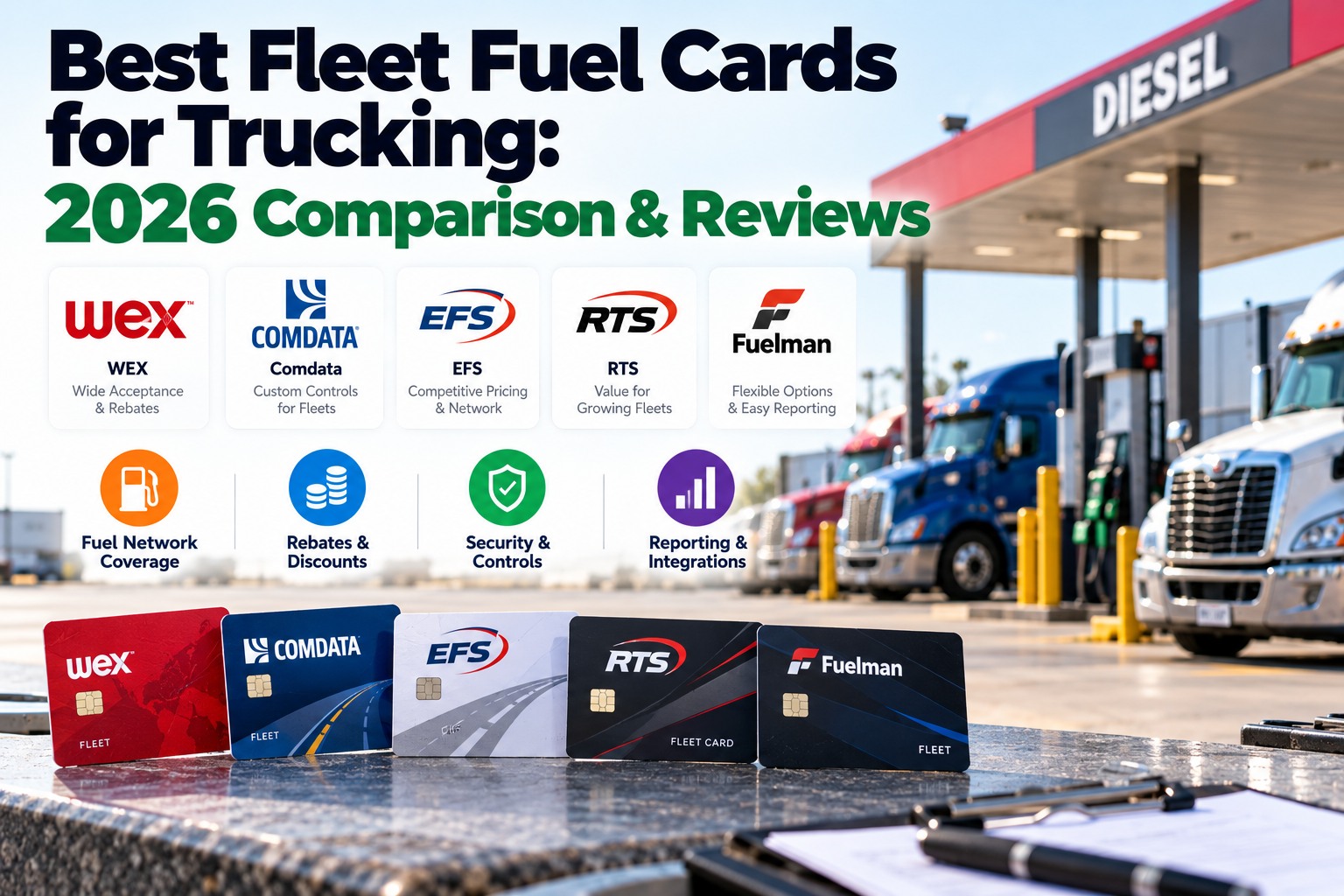
Most fuel card comparisons start with the discount per gallon, which is the number that changes most and matters least if your trucks rarely fuel where the discount applies. A better way to choose is to start with how your fleet actually fuels, then compare the controls that stop fraud and the reports that feed IFTA filing and maintenance records. This guide compares five of the most widely used cards in trucking, WEX, EFS, Comdata, Fuelman and RTS, by network fit, security and reporting, then matches them to owner-operators, small fleets and enterprise fleets. Discounts and fees are included as reported by independent reviewers, because they change often and vary by contract. To see how fuel card data can flow into maintenance and cost reporting, schedule a short demo with our team.
Fleet fuel cards · 2026 decision guide
Choose a fuel card by where your trucks fuel, then by the controls and reports you need
The same card can be the best choice for one fleet and the worst for another. Start with your lane, not the advertised discount.
Owner-operator
Discount at the stops I already use, low or no fees, simple credit
RTS
Fleet One EDGE
Comdata Connect
Small fleet
Driver controls, fraud alerts and IFTA reports without enterprise contracts
Enterprise fleet
National acceptance, granular controls and data feeds into other systems
The first question isn't the discount, it's where your trucks actually fuel
Fuel cards work on three kinds of network, and the right one depends on your routes. A card with the deepest truck-stop discount is no use to a fleet of box trucks fuelling at retail stations, and a universal card leaves money behind for a long-haul fleet that stops at the same chains every day.
Truck-stop networks
Closed-loop cards accepted at partner truck stops, usually with negotiated diesel discounts. Best for long-haul and regional tractors on known corridors.
Examples: EFS Fleet Card, Comdata, RTS
Retail fleet networks
Accepted at most retail fuel stations, with rebates rather than pump discounts. Best for mixed fleets of vans, pickups and straight trucks.
Examples: WEX, Fuelman
Open-loop Mastercard
Accepted almost anywhere Mastercard is, including shops and parts stores, with smaller savings. Best when coverage matters more than discount.
Examples: EFS Fleet Mastercard, Comdata Mastercard, Fuelman Mastercard
Pull three months of fuel card or receipt data before comparing cards. Group gallons by brand of station. If more than half your diesel goes through one chain, the card with the best terms at that chain usually wins, whatever the headline rate.
Five fuel cards at a glance: owner, network, savings and published fees
Figures below are as reported by independent reviewers in 2026 and vary by contract, location and volume. Confirm current terms with each provider in writing before signing.
| Card | Owner | Network, as reported | Reported savings | Published fees | Best fit |
|---|
| WEX Fleet | WEX | Accepted at about 95% of U.S. fuel stations | Rebate of roughly 3–5¢/gal | No setup fee; other fees by contract | Mixed and national fleets |
| EFS | WEX | 12,000+ truck stops; Mastercard and CrossRoads add retail | Fleet One EDGE averages about 12–15¢/gal in network | EDGE: $0 setup; Fleet Card by contract | Small to enterprise truck fleets |
| Comdata | Corpay | 8,000+ in-network truck stops | Typically 8–25¢/gal, more at select sites | $50 setup per account, $8/month per card | OTR and regional fleets |
| Fuelman | Corpay | 60,000+ stations; 40,000+ discount sites | Rebates around 8¢ (mixed) to 12¢ (diesel) per gallon | $39–$99/month per account by plan | Regional and mixed fleets |
| RTS | RTS Financial (Shamrock) | Strongest at Pilot Flying J; about 2,400+ core stations | Advertised average about 25¢/gal at Pilot Flying J | No annual or monthly fee for active accounts | Owner-operators on Pilot-heavy routes |
Where each card is strong, and what to watch for
Strong at
Near-universal retail acceptance, customizable spending reports and purchase alerts.
Watch for
Rebates are smaller than truck-stop discounts, and some fees are only disclosed in the contract.
Fits
Fleets of vans, pickups and straight trucks that fuel wherever they are.
Strong at
Truck-stop focus with CarrierControl limits and prompts, IFTA-ready reports and TMS, ELD and accounting integrations.
Watch for
Fleet Card fees and discounts are set by contract, and some merchants need EFS approval before a discount applies.
Fits
Truck fleets from a few units with Fleet One EDGE to large OTR fleets on the Fleet Card.
Strong at
Strong fraud controls: GPS proximity checks, OneClick unlock and limits by product, time and amount.
Watch for
Late fees are the greater of $150 or 13.99% of the past-due amount, and discounts vary by site.
Fits
OTR and regional fleets fuelling at major truck stop chains, and fleets wanting driver pay on the same card.
Strong at
Large network, driver and odometer prompts, and a fraud waiver on Pro and Enterprise plans.
Watch for
Monthly plan fees mean low-volume accounts may not break even, and rebates depend on paying in full on time.
Fits
Regional and mixed fleets with steady in-network fuelling.
RTS Fuel Card
RTS Financial
Strong at
Some of the deepest reported discounts at Pilot Flying J, no monthly fee, and a prepaid option for new authorities.
Watch for
No Love’s or TA/Petro partnership, no geolocation locking, and factoring bundles with 12-month auto-renewal terms.
Fits
Owner-operators and small fleets running Pilot Flying J corridors.
Your fuel card data is also maintenance data
Every fill-up carries an odometer reading, gallons and a location. Schedule a demo to see how FleetRabbit uses fuel card data, including from EFS, alongside inspections and work orders to track fuel economy and cost per unit.
Security controls compared: what each card says it can stop
Fuel card fraud usually looks ordinary: a second vehicle filled on the same card, a fill larger than the tank, or fuel bought far from where the truck is. The controls below are the ones reviewers documented for each card. "Not stated" doesn't mean a card lacks the control, only that the source didn't confirm it, so ask.
Control
Comdata
EFS
Fuelman
RTS
WEX
Spending limits by product, time or amount
Yes
Yes
Yes
Daily gallon or dollar limits, product rules
Spending controls
Location or GPS proximity check
Proximity check vs GPS and tank size
Not stated
Not stated
No geolocation lock
Not stated
Unlock card before each use
OneClick unlock
Not stated
Instant lock and unlock
Card lock
Not stated
Driver ID and odometer prompts
Not stated
Card-by-card prompts
Yes
PIN entry
Not stated
Fraud loss waiver
Not stated
Not stated
Pro and Enterprise plans
Not stated
Not stated
Real-time alerts
Exception alerts
Transaction monitoring
Yes
Not stated
Purchase alerts
Based on FreightWaves Checkpoint and TruckingWay reviews, 2026. Controls vary by card product and plan.
Reporting and IFTA: the card gives you gallons by state, not miles
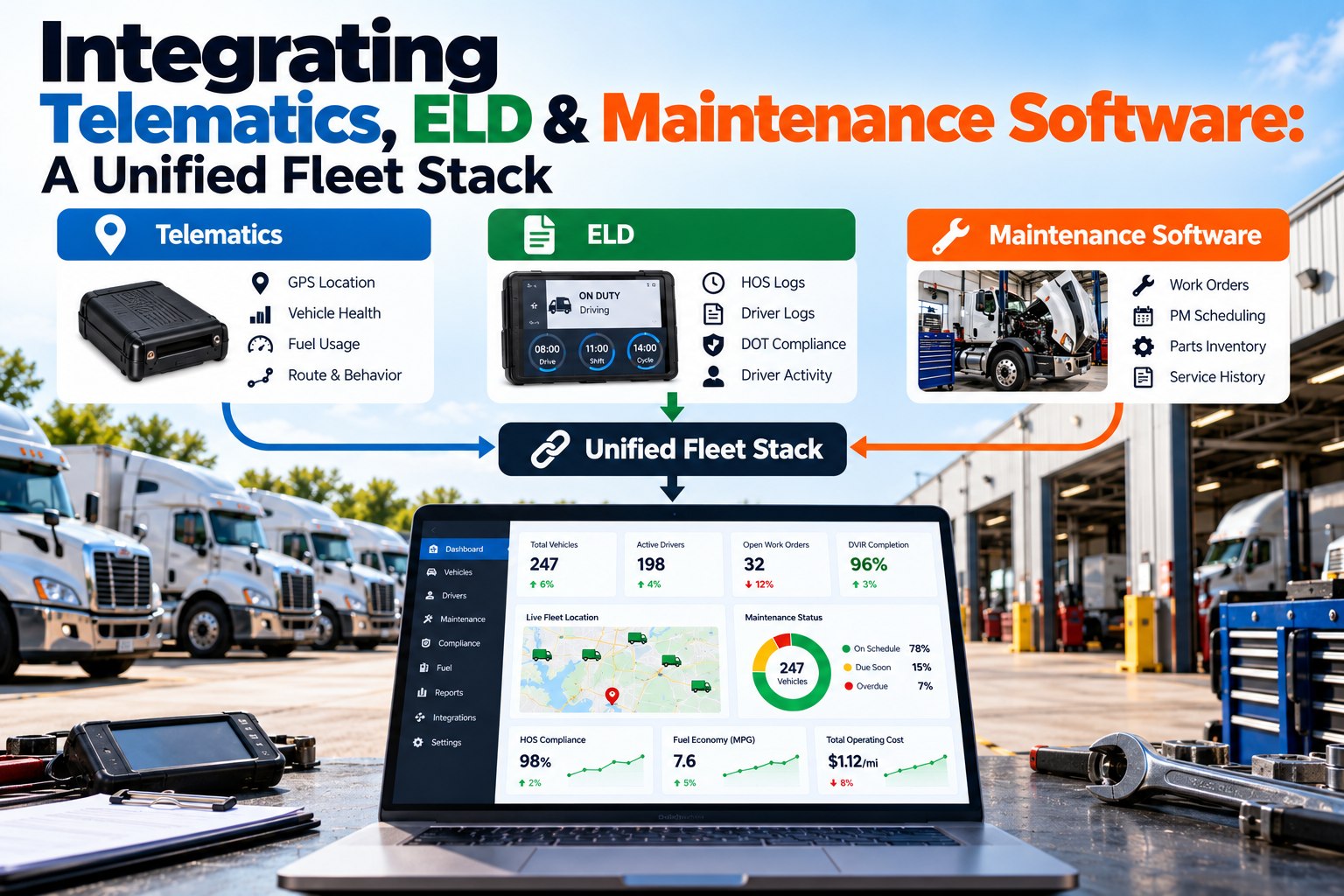
Every card here reports fuel purchases by state, which covers half of an IFTA return. The other half is miles driven in each state, which comes from your ELD or GPS, not the fuel card. Fleets that keep the two in separate systems end up reconciling them by hand every quarter. The better setups bring fuel transactions, odometer readings and mileage together on the same unit record, which also makes fuel economy visible truck by truck. A sudden drop in miles per gallon on one unit is often an early sign of dragging brakes, low tire pressure or an injector problem that belongs in a preventive maintenance check.
From the fuel card
Gallons, price, location, state, time, driver and odometer prompt
+
From the ELD or GPS
Miles by state, engine hours, idle time
=
Unit record
IFTA inputs, MPG per truck, fuel fraud flags, cost per mile
Do the fee math: when a monthly plan pays for itself
Cards with monthly plan fees only make sense above a certain volume. FreightWaves Checkpoint worked out the monthly gallons needed for Fuelman's rebates to cover its plan fees. The same method applies to any card with a fixed fee: divide the monthly fee by the rebate per gallon.
Monthly gallons to break even on Fuelman plan fees
Per FreightWaves Checkpoint's calculation from published Fuelman fees and rebates. Scale 0–1,240 gallons per month.
A single long-haul tractor burns well above these volumes, so plan fees rarely matter for trucking fleets. They matter more for small mixed fleets, and for owner-operators comparing a fee-based card with a no-fee card like RTS.
Fee traps that cost more than the discount saves
Late payment terms
Comdata's credit accounts charge the greater of $150 or 13.99% on past-due amounts; Fuelman the greater of $99 or 17.99% of the new balance.
Rebates you can lose
Statement rebates often depend on paying in full and on time, and can change after the first year.
Out-of-network fees
Some cards add transaction fees at non-preferred sites, such as $3 per transaction on Fuelman.
Bundled factoring
Cards tied to factoring can carry long auto-renewing contracts with early termination fees. Read the factoring agreement, not just the card terms.
Mixed and electric fleets: check what the card covers beyond diesel
As fleets add electric vans and trucks, the fuel card has to cover more than the pump. Some open-loop products now handle charging as well as fuel, for example the Comdata Mastercard, which reviewers note can be used for fuel, EV charging, maintenance and other fleet purchases. Closed-loop truck-stop cards usually can't. If your fleet is moving to mixed energy, ask each provider how charging sessions are recorded, whether they appear on the same statement and report as diesel, and whether per-vehicle energy cost can be tracked the same way as fuel. Otherwise your cost per mile for electric units ends up in a separate spreadsheet.
Switching cards without losing your fuel history
Changing fuel card providers is common, especially as fleets grow from an owner-operator card to a fleet program. The risk is losing the history that makes fuel data useful: twelve months of fill-ups, MPG trends by unit and the IFTA records for open quarters. Before switching, export all transactions from the old provider, keep them with your IFTA working papers, and run both cards in parallel for a short period so no truck is stranded. Keep the history in a system you control rather than only in the card provider's portal, so a provider change never resets your view of what each truck really costs to fuel.
Five questions to ask before you sign
1
Where did our fuel go last quarter, by station brand, and what are your terms at those exact chains?
2
What is every fee in writing: setup, monthly, per card, per transaction, out-of-network and late?
3
Which fraud controls come on our plan: limits, prompts, unlock, location checks and alerts?
4
How do we get transaction data out: report exports, an API or a direct integration?
5
What are the contract length, renewal and exit terms, especially if factoring is bundled?
FleetRabbit fleet management software
FleetRabbit puts fuel card data next to the maintenance record, so fuel spend explains itself
Fuel by unit
Fill-ups matched to the truck, so MPG and fuel cost per mile show up per unit.
Odometer from the pump
Readings captured at fuelling help keep PM schedules accurate.
Spot the outliers
A falling MPG on one truck is flagged before it becomes a breakdown.
One cost picture
Fuel, parts and labour on the same unit history for every cost review.
What the 20-minute demo covers
- Bringing your fuel card transactions in
- MPG and fuel cost per mile by unit
- Using fuel-stop odometer readings for PM
- Flagging units whose fuel economy drops
- Fuel, inspections and repairs in one record
Fuel is the largest variable cost a fleet controls, and it is closely tied to maintenance. FleetRabbit's fleet maintenance tools and DVIR and DOT inspection workflow put the repairs that affect fuel economy on the same record as the fuel itself.
Fleet fuel card questions
Which fuel card is best for owner-operators?
It depends on where you fuel. RTS is often cited for Pilot Flying J routes with no monthly fees, while Fleet One EDGE from EFS and Comdata's prepaid Connect card are common alternatives on other networks.
Are EFS and WEX the same company?
EFS is owned by WEX, but the products differ. EFS cards focus on truck stops and trucking controls, while the WEX Fleet Card is built for broad retail acceptance.
Who owns Comdata and Fuelman?
Both are Corpay brands. Comdata is aimed mainly at trucking fleets at truck stops, Fuelman at regional and mixed fleets across a wide station network.
Do fuel cards handle IFTA?
They report fuel purchased by state. Miles by state still come from your ELD or GPS, so IFTA needs both data sources combined.
How do fuel cards prevent fraud?
Through spending limits by product and time, driver and odometer prompts, card locks, real-time alerts and, on some cards, location checks against the truck's GPS. Controls vary by card and plan.
Are the discounts on this page guaranteed?
No. They are reported figures from independent reviews and vary by location, volume and contract. Ask each provider for current terms in writing.
Make every fill-up count toward lower cost per mile
Whichever card you choose, bring its data together with inspections and maintenance to see what fuel really costs each truck.
Network fit
Controls
Reporting
Fees
Right card
October 14, 2026
By Alex Rowan
All Articles