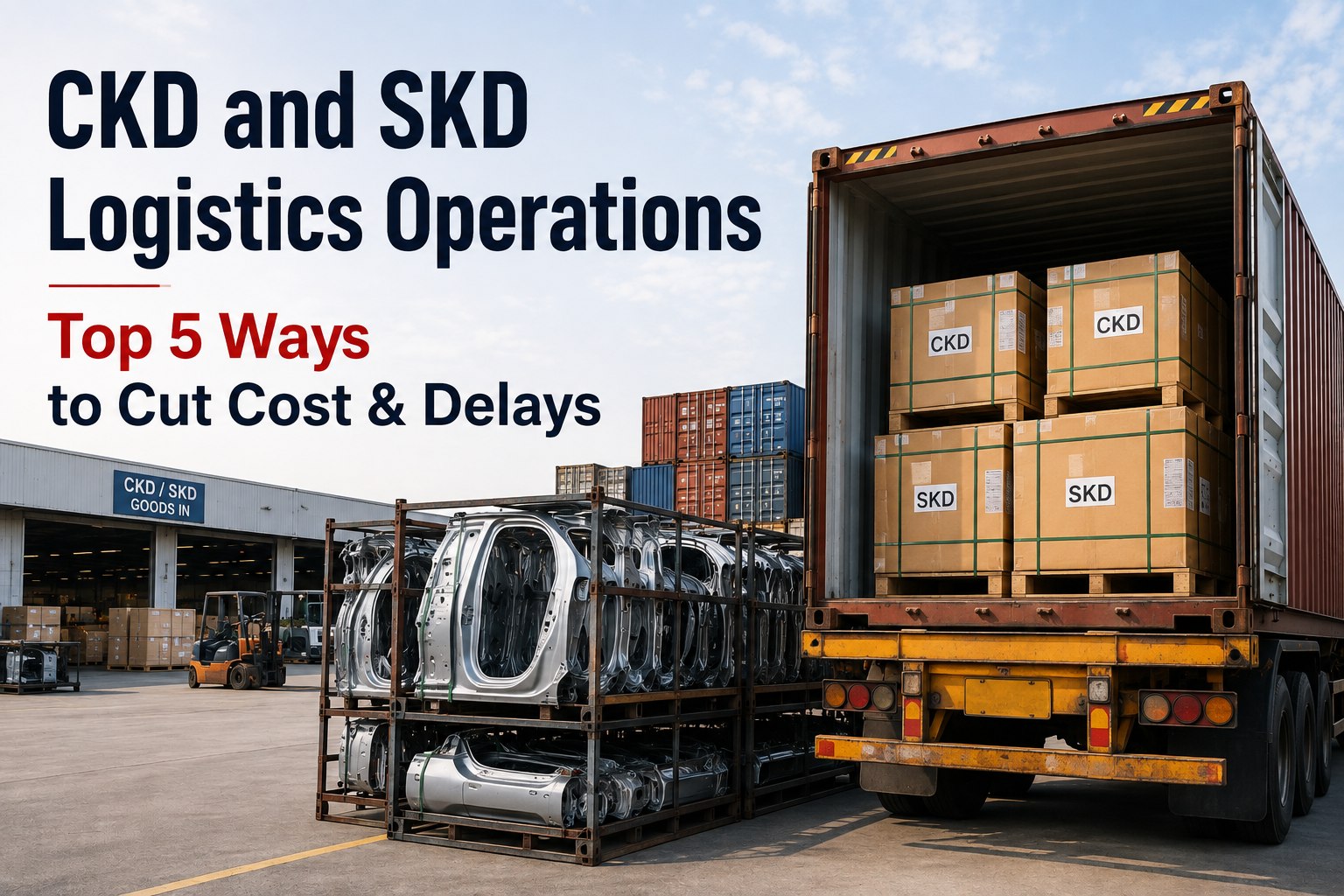
The first thing to fix in a knock-down operation is the vocabulary, because the words are actively misleading. "Kit" implies a boxed set matched to one vehicle; in practice shipments are frequently not kits at all but bulk-packed by type of part into shipping containers, and the completeness question is answered weeks later at the destination plant. "Knock-down" implies something was built and taken apart; nothing was. Those two misnomers between them explain most of the cost in a CKD or SKD programme — a missing bracket does not stop a truck, it stops an assembly line six weeks and one ocean away, at which point the recovery options are air freight or a stopped plant. Everything worth doing in knock-down logistics is therefore about proving completeness before the container is sealed rather than discovering it after. Below are five ways to do that, plus the documentation discipline and the recovery ladder for when it fails anyway. Request an enterprise demo to run it against your own kit structures.
TOP 5 · KNOCK-DOWN OPERATIONS
CKD and SKD Logistics Operations
Kit completeness proven before the seal, packing evidence that survives a dispute across an ocean, documentation that cross-references cleanly, and a recovery ladder built for six-week lead times rather than six-hour ones.
SKD — semi-knocked-down
Larger sub-assemblies, welded and often painted body. Fewer parts to control, more volume per unit.
Higher freight per unit · Lower assembly complexity
CKD — completely knocked-down
Broken to the smallest practical components, maximising packing density and units per container.
Lower freight per unit · Far higher completeness risk
Why the Cost Sits Where It Does
Knock-down programmes are usually justified on freight and tariffs — breaking a vehicle into its smallest components maximises packing density and units per container, and kits are sold to foreign affiliates or licensees to avoid import taxes, gain tax preferences for creating local manufacturing jobs, or simply to qualify as a bidder under local-content rules. Those savings are real and they are also the easy part. The cost that erodes them is entirely operational, and it concentrates in four places.
Incompleteness discovered at destinationThe dominant cost. A missing part halts local assembly with no local source, and the recovery is air freight at a multiple of the savings the programme was built on.
Transit damage and lossComponent loss in transit is a live cost line and highly sensitive to packaging method — the difference between adequate and specialised protective packing is measured in whole percentage points of kit content.
Documentation errorManual filing across commercial invoice, packing list, bill of lading and certificate of origin carries error rates far above automated cross-referenced systems, and every error is a customs hold.
Re-packing and consolidation labourParts arrive from many suppliers in reusable containers and must be re-packed to export specification, inspected and combined into a kit — a value-adding step that is also a place errors enter.
Five Ways to Cut Cost and Delay
Ordered by effect on the dominant cost line. The first two change what you can prove; the rest change what you have to prove.
01
Verify at pack, not at receipt
Attacks: incompleteness
Completeness confirmed at the destination plant is not verification — it is discovery, several weeks too late to act on. The check has to happen where the container is filled, item by item against the kit structure, with the result recorded before the doors close. This is the single change that moves the most cost, because it converts a six-week problem into a six-minute one.
Scan every item against the kit bill of material as it is packedBlock the seal event until the structure reads completeRecord shortages as exceptions at origin, never as notes on a list
02
Make the packing evidence photographic
Attacks: damage disputes
When a shortage or damage claim arises after an ocean transit and a customs inspection, the argument is about what was in the container at seal. Without dated images tied to container and kit identity, that argument is unwinnable — and it will be had repeatedly, because knock-down programmes run for years across the same lanes.
Photograph each layer as it is built, tagged to container and kit IDCapture the seal number in the same frame as the loaded doorRetain against the transit duration plus the claim window, not the shipment
03
Design packaging for the loss rate, not the pallet
Attacks: transit loss
Packaging in knock-down is a cost lever, not a cost. Specialised protective packing for hardware kits can reduce component loss in transit by more than an order of magnitude against standard practice, and carton optimisation software calculates the smallest safe packing volume — fewer cartons, less empty space, lower freight. Rigid guidelines on part orientation, stacking and tolerances are what protect against transit damage.
Set orientation, stacking and tolerance rules per part family in writingMeasure loss rate by packing method, not as a programme averageTreat reusable versus one-way as a per-lane calculation, not a policy
04
Cross-reference the document set to one identity
Attacks: customs delay
A standard export filing needs the commercial invoice, a detailed packing list, the bill of lading and a certificate of origin, with technical specification and emissions certificates attached where the destination requires them. Those documents must cross-reference to the same identifiers — VIN, engine number, kit and container — with complete alignment across every customs declaration. Manual filing carries an error rate several times that of automated linked documentation.
Generate the set from one source of truth, never assembled by handValidate identifier alignment programmatically before submissionTrack document error rate as a standing KPI, per destination market
05
Plan the recovery ladder before you need it
Attacks: expedite spend
With a multi-week transit, recovery is a supply chain decision rather than a logistics one, and the options narrow fast. Deciding the ladder in advance — and pre-agreeing who authorises each rung — is what stops every shortage defaulting to air freight because it is the only option anyone can execute quickly.
Hold a defined buffer of high-risk small parts at destinationPre-qualify local sourcing for fasteners and commodity itemsName the authoriser and the spend threshold for each recovery rung
Tips one and two are a process change, not a system purchase — and they move most of the cost.
An enterprise demo runs your kit structures, packing stations and document flow through the completeness and evidence model, and shows where a shortage would currently first become visible.
Levels of Completeness Evidence
Four levels, and the level you operate at determines what you can say when a destination plant reports a shortage. Most programmes believe they are at level three and are actually at level two.
L1
Packing list assertionA document states what should be inside. No evidence anything was checked. Every dispute becomes a negotiation, and the destination plant's word is as good as yours.
L2
Manual tick-off at packA person confirmed against a list. Better, and it degrades predictably across a shift. Cannot distinguish a genuine miss from a mis-tick, which is the distinction claims turn on.
L3
Scan-verified against kit structureEvery item scanned as packed, the structure completing programmatically, and the seal blocked until it does. The shortage becomes impossible to ship rather than expensive to discover.
L4
Scan plus layer imagery plus seal captureLevel three with photographic evidence tied to container and kit identity. Settles damage and shortage claims from the record rather than by seniority or goodwill.
Why bulk packing makes this harder than it looks
Shipments are frequently not kits in the literal sense — parts are bulk-packed by type into containers, so "kit complete" is a logical state spanning several containers rather than a physical box you can look into. Completeness therefore has to be tracked at the kit level across the whole shipment set, not per container. Programmes that verify per container regularly ship a complete-looking container into an incomplete kit.
The Document Set
What is required, what it must align to, and where it fails. Requirements vary by destination market, so treat this as the common core rather than a complete list. Our integrations overview covers the data surface these are generated from.
← Swipe to see all columns →
The row people underestimate is the last one. A knock-down programme runs against a specific bill of material version, and an engineering change made at the source plant reaches the destination weeks after the containers already in transit were packed to the old structure. Version the kit structure explicitly, and ship the version reference with the kit.
The Long-Lead Recovery Ladder
Cheapest first. The whole purpose of verification at pack is to keep you off the bottom two rungs, where the cost of a single missing component can exceed the freight saving on the container that carried the rest of it.
Destination bufferPre-positioned stock of small, high-risk, low-value items. Covers the majority of shortages at almost no carrying cost.
Local sourcingPre-qualified local supply for fasteners, commodity hardware and non-critical items. Requires approval work done before it is needed, not during.
Cannibalise a later kitBorrow from a kit not yet scheduled, and record the debt explicitly. Effective once; a habit that quietly destroys kit integrity across a whole programme.
Consolidated catch-up shipmentBatch the shortfalls onto the next scheduled container. Only works if the destination can resequence its build around the gap.
Air freightFast, and priced against a component that was shipped by sea precisely because it was not worth flying. The default when nothing above was prepared.
Destination line stopAssembly halts with no local alternative. The outcome the entire verification chain exists to prevent.
What to Measure
Six figures. The first two determine everything else. Our analytics and reporting module carries them across origin and destination.
Kit completeness at sealShare of kits verified complete at origin by scan, not by list. This is the number that predicts destination disruption weeks in advance.
Shortages discovered at destinationThe failure count. Every one of these is a verification escape, and each should be traceable to a specific pack station and shift.
Component loss rate in transitSplit by packing method and lane. Averaging across the programme hides which packing specification is actually working.
Document error rate per marketErrors per filing, by destination. Different markets fail differently, and a programme figure conceals which one needs attention.
Recovery spend by ladder rungHow much sits in air freight versus buffer and local sourcing. A high air share means the upper rungs were never actually built.
Kit structure version mismatchesKits packed to a superseded bill of material. Rarely tracked, and the cause of the shortages nobody can explain.
Prove Completeness Before the Seal
An enterprise demo takes your kit structures, packing stations, container plan and document flow, and shows where a shortage would first become visible today, what level of completeness evidence you are actually operating at, and what it would take to block the seal on an incomplete kit.
Scan-verified kit completion
Layer and seal imagery
Cross-referenced documents
Recovery ladder design
Frequently Asked Questions
What actually distinguishes CKD from SKD?
The degree of disassembly, and it varies by the receiving organisation's technical ability and by import regulations rather than by a fixed standard. CKD breaks the vehicle into the smallest practical components, maximising packing density and units per container; SKD ships larger sub-assemblies — typically including a complete welded body, often already coated or painted — which is less space-efficient but far simpler to reassemble. Both are collectively referred to as knocked-down export, as against built-up export where complete vehicles ship whole.
Why do knock-down programmes exist if the logistics are harder?
Tariffs and market access, mostly. Kits are sold to foreign affiliates or licensees to avoid import taxes, to receive tax preferences for providing local manufacturing jobs, or to qualify as a bidder at all where buy-national rules apply. Trade barriers on finished vehicles remain a primary driver, and knock-down assembly plants are cheaper to establish because they need no modern robotic equipment and can be effective at low volumes. The logistics complexity is the price of the market, not a design flaw.
Should completeness be tracked per container or per kit?
Per kit, and this trips up more programmes than any other single decision. Parts are commonly bulk-packed by type into containers rather than boxed as literal kits, so a kit's contents can span several containers on the same or even different sailings. Verifying that each container matches its own loading plan tells you nothing about whether the kit is complete — you can ship perfectly correct containers into an incomplete build. Track the logical kit as the unit and let container assignment be a packing decision beneath it.
How much difference does packaging specification make?
More than most programmes assume, because loss is usually reported as a programme average that conceals the variation. Specialised protective packing for hardware kits can cut component loss in transit dramatically against standard practice, and carton optimisation reduces packing volume without compromising protection — fewer cartons, less void space, lower freight. Rigid written guidelines on part orientation, stacking and tolerances are what actually deliver it. Measure loss by packing method rather than overall and the business case usually writes itself.
What causes most customs delays?
Identifier misalignment across the document set. The commercial invoice, packing list, bill of lading and certificate of origin — plus technical specification and emissions certificates where required — all have to cross-reference the same identifiers with complete alignment across every declaration. Manual filing carries an error rate several times that of automated systems generating from linked data. The practical fix is generating the whole set from one source rather than assembling it, then validating alignment programmatically before submission.
How should we handle engineering changes mid-programme?
Version the kit structure and ship the version reference with the kit. A change applied at the source plant does not reach containers already at sea, so for several weeks the destination is assembling to a structure that no longer exists at origin — and the resulting shortages look like packing errors. Explicit versioning turns that into a known, scheduled transition with a defined cutover kit, which is a planning conversation rather than a series of unexplained incidents.
What is the realistic first step?
Establish which completeness evidence level you are actually at, honestly. Most programmes believe they scan-verify and in practice operate a manual tick-off against a list, which cannot distinguish a genuine miss from a mis-tick — and that distinction is exactly what every claim turns on. Moving from level two to level three is a process and configuration change at the pack station rather than a capital project, and it is the change that most directly reduces destination disruption.
Find the Missing Part at the Pack Station
Kit completeness verified by scan against a versioned structure, packing evidence captured as the container is built, documents generated from one identity, and a recovery ladder whose upper rungs actually exist before anyone needs them.
Works alongside existing ERP and customs filing · Origin and destination visibility · Site-level configuration