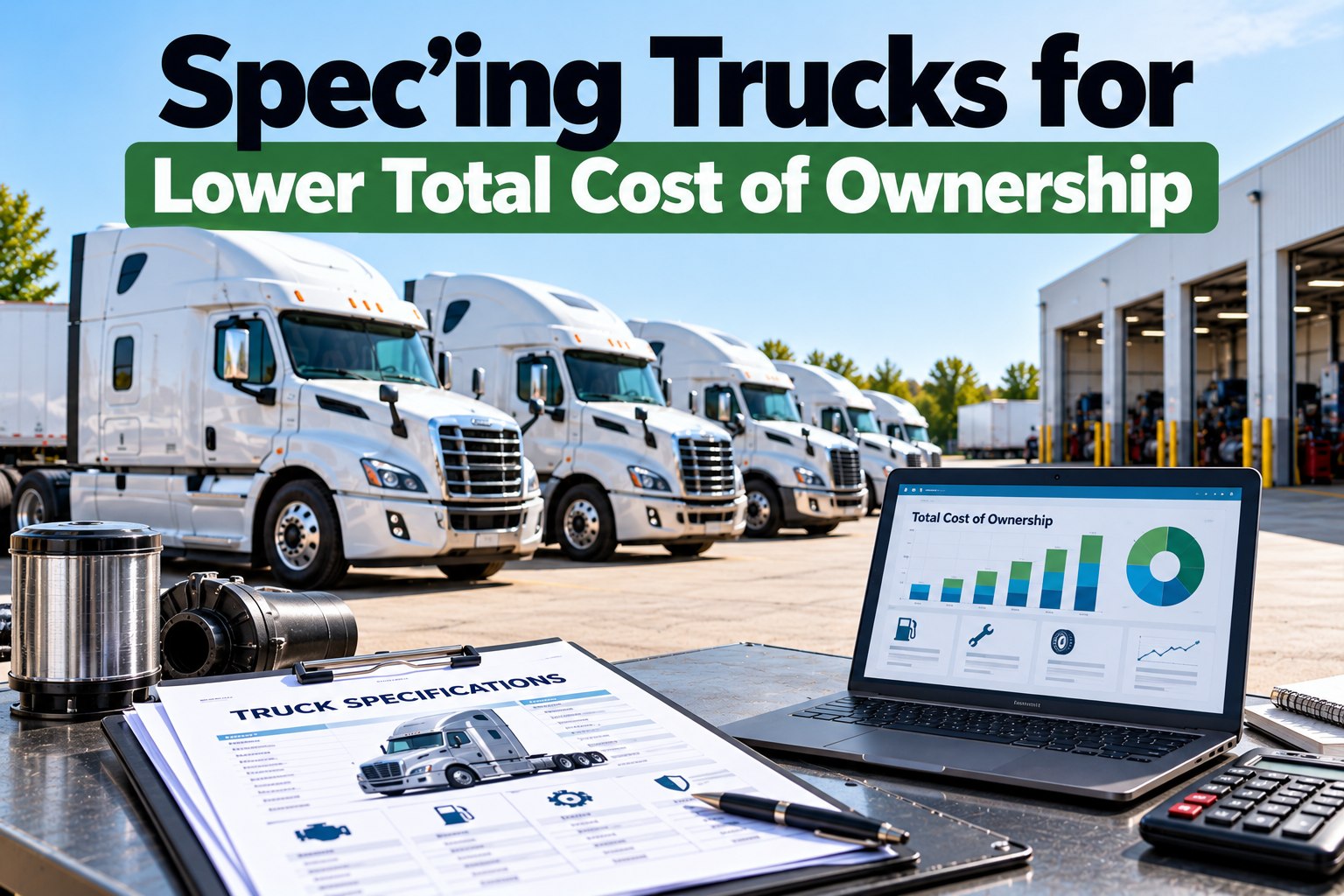
For fleet managers, the decision to purchase a Class 8 truck is one of the most consequential investments you'll make. In 2026, that decision is more complex than ever. Tariffs have added thousands to new truck prices. EPA 2027 regulations loom, creating uncertainty about future equipment values. Meanwhile, the used truck market is robust, offering proven value for those who know what to look for. This guide cuts through the noise, providing a practical, OEM-by-OEM comparison to help you make the right choice for your fleet's unique needs.
2026 Class 8 Truck Buyer's Guide: OEM by OEM Comparison for Fleet Managers
New Class 8 prices are approaching unprecedented levels. Section 232 tariffs add $9,500+ per truck, the 12% FET adds nearly $20,000, and EPA 2027 technology could add another $8,000-$15,000. Smart buyers are weighing these costs against quality used equipment with proven reliability.
Understanding Class 8: What You're Buying
Class 8 trucks are defined by a gross vehicle weight rating (GVWR) of over 33,000 pounds. This category includes most full-size semi-tractors used for long-haul, regional, port, and vocational applications. It does not describe one type of job — it describes a level of capability. The right configuration matters more than the badge on the grille.
Before diving into OEM comparisons, clarify your operation's needs. Long-haul operations require sleeper cabs with driver comfort features and fuel capacity. Regional fleets may prefer day cabs for maneuverability and lower cost. Port and intermodal operations demand durability for stop-and-go abuse. Vocational work — dump trucks, heavy haulers, construction — requires specialized configurations for extreme loads and conditions.
The used truck market in 2026 is one of the healthiest segments for fleet buyers. Well-maintained used trucks offer predictable costs, proven reliability, lower depreciation, and immediate availability — advantages that are particularly compelling when new truck prices are at historic highs.
Freightliner: The Market Leader
Freightliner's Cascadia remains the best-selling Class 8 tractor in North America, and for good reason. The fifth-generation Cascadia, refreshed in late 2025, focuses on fleet business tools, advanced safety technology, and improved aerodynamics.
Engine Options: Detroit DD13 and DD15 engines are the primary offerings, with the Cummins X15N natural gas engine now available — the industry's first 15L natural gas option for heavy-duty on-highway applications, delivering 400-605 hp and 1,450-2,050 lb-ft of torque.
Fuel Efficiency: Freightliner engineers report 1.9% greater fuel efficiency compared to the previous model, achieved through aerodynamic enhancements including a redesigned hood, A-pillar deflector, three-piece front wheel well closeouts, and new bumper air ducts that direct airflow around the underbody and tires.
Technology & Safety: The Cascadia features DTNA's Detroit Connect telematics platform and a wide range of ADAS offerings, including the latest Bendix Fusion safety systems.
Fleet Manager Verdict: The Cascadia is the safest, most conventional choice. It's deeply established in the linehaul market, easy to finance, and offers flexible spec options. For first-time buyers or fleets looking for the path of least resistance, the Cascadia is the default answer.
Key Spec: Fifth-generation Cascadia offers 1.9% better fuel efficiency than predecessor. Available with Detroit DD13, DD15, or Cummins X15N natural gas engine. Book a demo to compare real-world fuel data across OEMs.
Kenworth & Peterbilt: The PACCAR Premium
PACCAR's Kenworth and Peterbilt brands occupy the premium segment of the Class 8 market, with strong owner-operator loyalty and a reputation for quality and resale value.
Kenworth T680
The T680 is Kenworth's flagship over-the-road tractor, updated with three new ADAS packages for 2026. Engine options include the PACCAR MX-13 (405-510 hp, 1,550-1,850 lb-ft) and the MX-11 (355-445 hp, 1,250-1,700 lb-ft). The T680 can now be paired with the PACCAR TX-12 Pro automated transmission, enhancing both on- and off-highway applications.
Safety Upgrades: New ADAS packages (ADAS, ADAS Pro, ADAS Premier) feature Bendix Fusion with a new forward-looking camera enabling adaptive cruise control with Stop and Auto-Go, pedestrian-sensing autonomous emergency braking, and high-beam assist. Optional features include tire pressure monitoring, lane-keeping assist, and Kenworth's DigitalVision Mirrors with HD cameras and in-cab displays.
Peterbilt 579
The 579, Peterbilt's flagship over-the-road tractor, now features the PACCAR TX-12 Pro transmission paired with the MX-13 engine. For 2026, Peterbilt added Bendix Fusion's Stop and Auto-Go technology, including automatic emergency braking, pedestrian detection, and active cruise control.
Fleet Manager Verdict: The T680 and 579 are excellent choices for owner-operators and fleets willing to pay a premium for driver comfort and brand appeal. However, avoid "ego builds" that add unnecessary cost. A well-specced T680 or 579 can be a rational, linehaul-friendly asset — but overbuilding erodes the value proposition.
Volvo: Redefining the Flagship
Volvo Trucks North America has completely redesigned its flagship VNL line, aiming to capture significant market share with a focus on aerodynamics, safety, and driver environment. The new VNL, launched in 2024, is now complemented by a redesigned VNR for regional applications.
Volvo VNL: Built for long-haul, the VNL emphasizes fuel efficiency and driver comfort. Engine options include the Volvo D13TC at 405-455 hp and the Cummins X15 at 400-565 hp. The Volvo I-Shift transmission family and I-See system optimize performance with Volvo powertrains.
Volvo VNR: The all-new VNR is a Class 8 regional haul tractor built on the same platform as the VNL. It offers a tighter turning radius, improved visibility, and is 7.5% more fuel efficient than its predecessor thanks to a redesigned cab and new-generation D13 VGT engine. Features include Volvo Active Driver Assist, mirrorless camera monitor system, and a short-stop parking heater for day cab models.
Fleet Manager Verdict: Volvo has made a significant investment in product refresh. The VNL is now a compelling competitor, particularly for fleets prioritizing driver comfort and integrated powertrain efficiency. The VNR addresses a critical gap in the regional segment with improved maneuverability and city-driving visibility.
International: The Integrated Powertrain Play
International Motors (formerly Navistar) is pursuing a differentiated strategy with its proprietary S13 Integrated Powertrain, available in the LT, RH, HX, and HV series trucks. The S13 powertrain combines engine, T14 transmission, and aftertreatment system designed to work in tandem, delivering up to 515 hp and 1,850 lb-ft of torque.
Fuel Flexibility: The S13 Integrated Powertrain is certified for renewable diesels, including R100, R99, and hydrotreated vegetable oil (HVO). Unlike biodiesel, R100 is a paraffinic fuel with better cold-flow properties and a cleaner burn.
Safety: Bendix Fusion collision mitigation technology provides advanced safety inside and outside the truck.
Fleet Manager Verdict: International's integrated powertrain strategy is ambitious. If executed well, it could improve margins and provide a differentiated value proposition. Fleet managers should evaluate the S13's real-world performance against established competitors. The LT's five cab configurations also make it suitable for mixed applications.
Mack: Regional Focus with a New Flagship
Mack Trucks has refined its Class 8 offerings with a new line of long-haul tractors and renewed focus on regional operations. The new flagship Mack Pioneer (long haul) and redesigned Mack Anthem (regional) aim to capture distinct market segments.
Mack Anthem: Designed for regional haul, the Anthem offers enhanced maneuverability with a shorter bumper-to-back-of-cab length of 113.5 inches — 12 inches shorter than the Pioneer. This makes it ideal for tight spaces and urban environments. Available in day cab, 44-inch sleeper, and 64-inch sleeper configurations.
Mack Pioneer: Focuses on aerodynamics, fuel efficiency, safety, and driver comfort. Powered by the Mack MP13 engine, offering up to 455 hp and 1,900 lb-ft of torque. Features Mack Connect telematics standard, described as Mack's most connected truck in history.
Fleet Manager Verdict: Mack's differentiation between regional (Anthem) and long-haul (Pioneer) applications provides clarity for fleet spec'ing. The Anthem's maneuverability advantage is a genuine differentiator for urban and regional operations.
Iveco S-WAY: The European Contender
While more common in European markets, the Iveco S-WAY is gaining traction and offers a compelling value proposition. It represents a significant step up from the Stralis, with updated interiors, mirror camera technology, and spacious cab options.
Engines: Two engines available — Cursor 9 (8.7L, 360-400 hp) and XCursor 13 (12.9L, 460-580 hp). A compressed natural gas (CNG) version is also available. The 500hp engine with 2,600Nm of torque is considered the best balance of performance and efficiency. The new XCursor 13 is 10% lighter and offers up to 10% fuel efficiency improvement.
Safety: First for Iveco, the S-WAY comes with mirror cameras instead of traditional mirrors, featuring an integrated blind spot information system. It complies with new EU truck safety regulations including moving off information system, driver drowsiness warning, intelligent speed assist, and lane departure warning.
Fleet Manager Verdict: The S-WAY offers great value for money, positioned as one of the cheaper options in its class. It's proving popular with fleets and drivers alike. For operators covering extreme mileage, competitors like the Volvo FH Aero deliver better fuel efficiency but at a higher price.
New vs. Used: The 2026 Decision
In 2026, the new vs. used decision is more consequential than ever. The cost of new Class 8 trucks has been driven to unprecedented levels by a "perfect storm" of tariffs, emissions regulations, and the federal excise tax.
New Truck Costs:
- → Section 232 tariffs: $9,500+ line-item charge
- → EPA 2027 emissions technology: $8,000-$15,000 additional
- → Federal Excise Tax (12%): Nearly $20,000 on a typical tractor
- → Total new Class 8 cost: $238,000 or higher
Used Truck Advantages:
- → Predictable costs with complete service records
- → Proven reliability from established platforms
- → Lower depreciation — value retention is stronger
- → Immediate availability in a constrained market
For fleet managers, the key is evaluating total cost of ownership over 3-5 years, not just the purchase price. New trucks offer the latest technology and warranty coverage. Used trucks offer proven value and immediate availability. The right choice depends on your fleet's specific needs, financial position, and risk tolerance.
FleetRabbit's fleet intelligence platform helps you track TCO, compare OEM performance, and make data-driven equipment decisions.
Frequently Asked Questions
What is the best Class 8 truck for long-haul operations?
The Freightliner Cascadia remains the safest mainstream choice due to its established market position, easy financing, and flexible specs. The Volvo VNL offers superior driver comfort and integrated powertrain efficiency. The Kenworth T680 and Peterbilt 579 are premium options with strong owner-operator appeal.
What are the key cost factors in new Class 8 truck prices for 2026?
Three factors are driving new truck prices higher: Section 232 tariffs adding $9,500+, EPA 2027 emissions technology adding $8,000-$15,000, and the 12% federal excise tax adding nearly $20,000. Total new Class 8 costs can exceed $238,000.
Is buying a used Class 8 truck a good investment in 2026?
Yes. The used Class 8 market is one of the healthiest segments in 2026. Quality used trucks offer predictable costs, proven reliability, lower depreciation, and immediate availability. For fleets focused on cost-effective operations, the value proposition is stronger than ever.
How is the EPA 2027 regulation affecting truck buying decisions?
EPA 2027 is driving a significant pre-buy in 2026, with orders expected to exceed 400,000 units. This is followed by a projected 40% sales decline in 2027. Fleets are buying now to avoid the cost and uncertainty of new emissions technology.
What should I consider when comparing OEMs for my fleet?
Evaluate total cost of ownership, not just purchase price. Consider service network coverage, parts availability, resale value, and driver comfort. Match the truck to your actual duty cycle — long-haul, regional, port, or vocational. Avoid over-spec'ing for work you don't do.
FleetRabbit provides real-world fleet performance data to help you compare OEMs, track TCO, and make informed purchasing decisions.