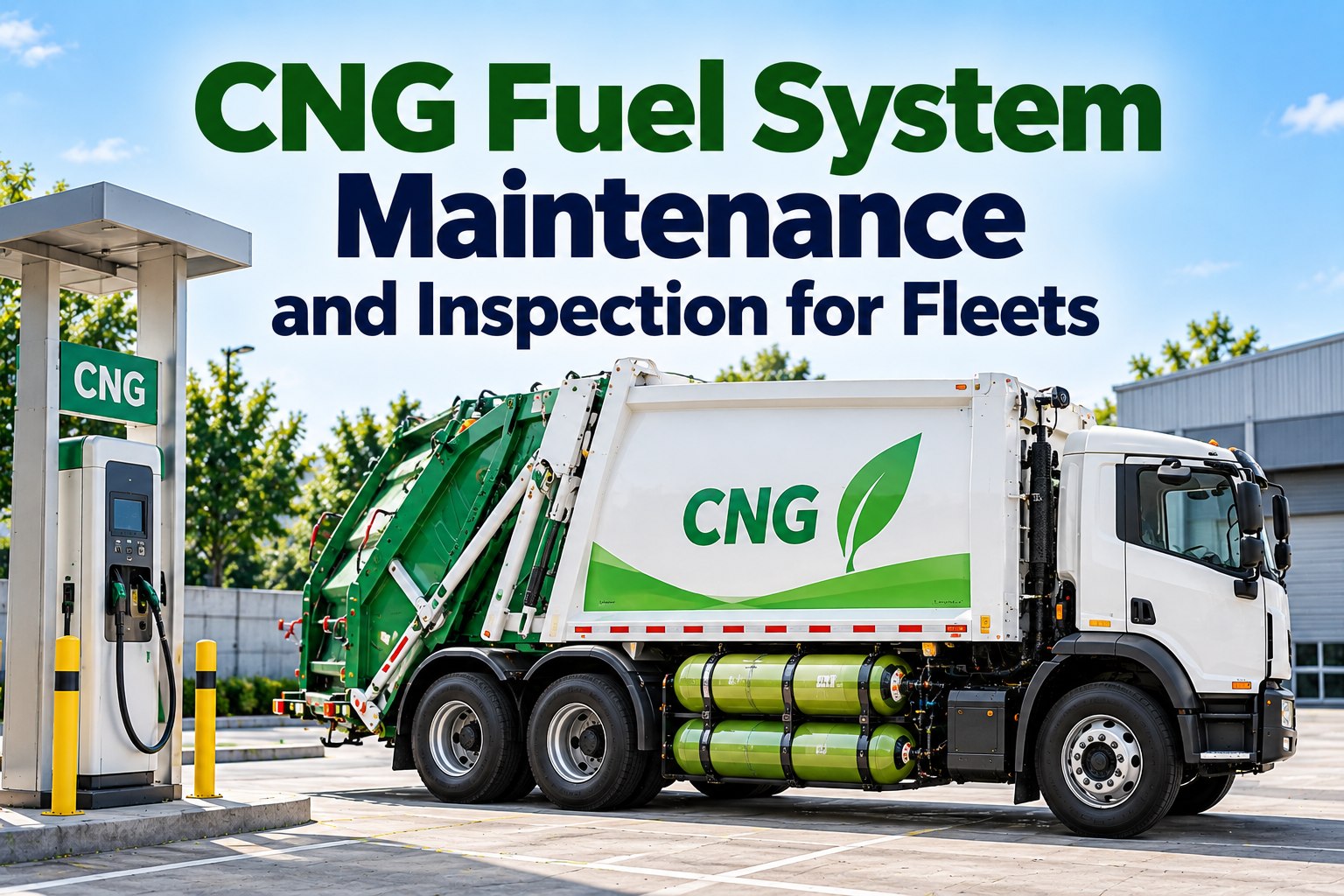
Almost everything written about CNG maintenance is about the inspection regime — the intervals, the qualifications, what a certified inspector looks at. That is a separate discipline and we cover it separately. This page is the other half: the fuel system as a set of components that wear, foul and need servicing on their own schedule, quite apart from anyone signing an inspection off. It runs at 3,600 psi service pressure against a 4,500 psi design ceiling, steps that down to roughly 125 psi at the engine, and the single most informative maintenance item on the whole system is a filter that most fleets replace and throw away without ever looking at what it caught. See a CNG service schedule running per truck.
The Filter You Bin Every 30,000 Miles Is a Test Result
For fleet technicians, workshop supervisors and maintenance managers: the real service intervals, the pressures behind the procedures, how to depressurise safely, and why sending filter residue for analysis tells you more about your fuel supplier than about your truck.
The Pressures Behind the Procedures
Understanding the cascade explains why CNG work has rules that diesel work does not. Everything upstream of the regulator is a very high pressure joint.
Cummins specifies a system service pressure of 3,600 psi (25 MPa) against a maximum allowable working pressure of 4,500 psi (31 MPa), with a normal high-pressure gauge range of 400 to 3,600 psi running from empty to full. Downstream of the regulator, nominal low-pressure output is around 125 psi (861 kPa) on most engines, though Cummins-Westport units run lower at 85 to 87 psi. Check the figures for the system actually fitted to your vehicles — these are one manufacturer's for one family of installations.
The practical consequence is that a fitting which would weep harmlessly on a diesel line is a different proposition here, and that the tooling, the torque figures and the order of operations all matter more than experience with low-pressure systems would suggest. That is also why leaks are specified as work for a qualified technician rather than for whoever is free.
What Is Actually In the System
Eight component groups, running from the cylinders down to the engine. Knowing which side of the regulator each sits on tells you most of what you need to know about handling it. Swipe on mobile.
| Component | What it does and what to watch | Governed by |
|---|---|---|
| Cylinders and shields | Store the gas at 3,600 psi. Governed by the inspection regime rather than the service schedule, but physically the most exposed part of the system on a chassis. | Inspection regime |
| Cylinder valves | Isolate each container. Closing them is step one of every depressurising procedure, which makes their condition a safety item rather than a convenience. | Inspected; operated at every service |
| Pressure relief device | Vents the cylinder in a fire rather than letting it rupture. Its vent line routing matters as much as the device — a blocked or misdirected vent defeats the purpose. | Inspected, with its vent line |
| Fill receptacle | Handled at every fuelling and exposed to whatever is on the forecourt. Check the seal, the dust cap and the check valve; it is a high-pressure component people treat like a fuel cap. | Visually, frequently |
| High-pressure lines and fittings | Everything upstream of the regulator. Inspected for abrasion, corrosion, secure support and leaks, and repaired only by a qualified technician. | Every service |
| High-pressure filter | Catches oil and particulate before they reach the regulator. Replaced on interval, and worth analysing before it goes in the bin. | 30,000 mi / 1,000 hr / 9 mo |
| Regulator | Steps 3,600 psi down to engine supply. The component most often replaced as a consequence of a problem that started at the fill station. | Per manufacturer |
| Low-pressure side and engine | Downstream of the regulator at around 125 psi. Its own filter, its own drain requirement, and the spark ignition components a diesel technician has not touched in years. | Per OEM |
A detailed inspection covers fifteen major system categories, so this is a grouping rather than a checklist — use the manufacturer's inspection sheet for the actual work. What the table is for is orientation: the first five items live at full cylinder pressure, and the last two do not, and almost every difference in how they are handled follows from that.
What Actually Gets Serviced, and How Often
Six items, and only one of them is the container inspection everybody talks about. Swipe on mobile.
| Item | Interval | Notes |
|---|---|---|
| High-pressure filter element | Every 30,000 miles, 1,000 hours or 9 months — whichever comes first | And Cummins is explicit that the interval varies with the quality of the fuel your station supplies, so it is a floor rather than a guarantee |
| Low-pressure filter | Drain fluid per the OEM recommendation | Sits under the hood at the engine rather than in the high-pressure system, and is often the one forgotten because it belongs to a different assembly |
| Leak check | At service, and any time a leak is suspected | With an electronic detector or a certified leak detection solution — never soapy water improvised on the spot |
| Container inspection | At least every 12 months on a heavy vehicle | Covered in detail in our CNG inspection guide; it is a separate regime from the service schedule above |
| Mounting and fastener torque | To the manufacturer's figures, at scheduled intervals | Published per fastener type — as an example, BTC flat isolators are specified at 120 to 135 ft-lbs |
| Station fuel quality | Whenever the filter comes out | See below. This is the check almost nobody runs and the one that explains repeat failures |
Note that the high-pressure filter runs on three clocks at once — miles, hours and months — which is the same structure as the container inspection and catches fleets out for the same reason. A truck that does low mileage still hits nine months, and a truck that idles heavily still hits a thousand hours.
The Filter Is Telling You About Your Fuel Station
This is the part worth changing your practice over, and it comes straight from the manufacturer's own manual.
Cummins recommends "oil analysis of high-pressure (HP) fuel filter residue to assess station fuel quality," and warns that "failure to meet fuel requirements may result in poor engine performance and damage." The manual also notes that the filter's replacement interval itself varies based on fuel station quality.
— Cummins CNG Fuel System Operation, Maintenance and Inspection Manual
Read together, those three statements describe a feedback loop most fleets never close. Natural gas is compressed to get it into the cylinder, and compression involves machinery with lubricant in it. When a station's own maintenance slips, oil carries over into the gas, and it ends up in your high-pressure filter. That filter is doing its job by catching it — and then it gets binned, and the evidence goes with it.
So a fleet experiencing repeated regulator problems, shortened filter life or unexplained performance complaints replaces parts on the truck, because that is where the symptom appears. The cause sits at the fill point, and the test that would prove it is already in your hand every 30,000 miles.
Filter element comes out on schedule
Residue sent for oil analysis rather than discarded
Result recorded against the fill station, not the vehicle
A pattern across trucks becomes a supplier conversation
Are your filter failures a truck problem or a station problem?
If filter results are recorded against vehicles, you will never find out — the pattern only appears when the data is grouped by where the gas came from. In thirty minutes we will set up the three interval clocks on one truck and show you where an analysis result should live.
How FleetRabbit Handles This
Four things, and the second is the one that turns scattered filter failures into a single answer.
30,000 miles, 1,000 hours and 9 months in parallel per vehicle, so whichever arrives first raises the job — and low-mileage units stop being invisible.
Fuel quality is a supplier attribute, not a vehicle one. Holding results by fill point is what turns scattered failures into a pattern you can act on.
Depressurising has five steps and a stop condition. A job card that carries them is the difference between a procedure and a memory.
Leaks are to be repaired by a qualified technician. Knowing who that is, and until when, belongs in the record rather than in somebody's head.
Depressurising, Step by Step
Five steps, in order, with one hard stop in the middle. This is the procedure that has to exist on the job card rather than in somebody's recollection.
- Turn the vehicle off and close all cylinder valvesNothing else begins until the supply is isolated at source.
- Start the engine and let it run until it stallsThis consumes the gas left downstream of the valves rather than venting it, and it is how you know the lines are empty rather than assuming.
- Confirm every gauge reads zeroCummins states it plainly: gauges must read zero. A gauge that does not is telling you the isolation has not worked, and that is where the procedure stops.
- Open the defuel and bleed valves slowlySlowly is doing real work in that sentence. Rapid release of high-pressure gas is both a safety hazard and hard on components.
- Close the manual shutoff as a secondary precautionRedundancy on a 3,600 psi system is not excessive caution, it is the design intent.
Leak checking has its own rule worth stating separately: Cummins specifies searching for leaks "using only certified leak detecting solutions and equipment" and names Swagelok Snoop as an example. Improvised detergent solutions can contain chlorides or ammonia that attack fittings over time, so the specified product is a component-protection measure as much as a detection one. Follow the procedure in the manual for your own system rather than this summary.
Fuel Quality Is an Operational Variable, Not a Constant
Diesel fleets treat fuel as broadly uniform and worry about it only when something obvious goes wrong. CNG does not work that way, because the gas arrives through machinery that belongs to somebody else.
Compression is what puts gas into a cylinder at 3,600 psi, and compressors have lubricant in them. When a station's own maintenance slips — seals wearing, separators not drained, filtration overdue — more oil carries over into the product. Your trucks then present the symptoms: filters loading early, regulators failing, performance complaints that resist diagnosis on the vehicle. Moisture behaves the same way. Water that is not removed at the station travels with the gas and can freeze in the pressure drop across a regulator, which is why cold-weather complaints often turn out to be a supply problem rather than a vehicle one.
None of this is visible from the cab, and none of it shows up in a fuel receipt. The only instrument you have is the filter, which is why treating it as disposable throws away the one measurement that could settle the question. If your fleet uses more than one fill point, comparing results across them is the fastest way to find out whether you have a station problem, a truck problem or neither.
This also changes how you read a warranty conversation. A manufacturer stating that failure to meet fuel requirements may result in poor engine performance and damage is describing a real exclusion, and the fleet with analysis results on file is in a materially different position from the fleet relying on an assumption about supply quality.
Questions Workshops Ask
How often does the CNG fuel filter need changing?
Cummins specifies the high-pressure filter element every 30,000 miles, 1,000 hours or 9 months, whichever comes first — and explicitly notes the interval varies with fuel station quality, so treat it as a floor. The low-pressure filter at the engine has its own drain requirement per the OEM. Track all three clocks free.
Why do our regulators keep failing?
Very often because oil is carrying over from the fill station and reaching them. Rather than replacing the regulator again, send the next high-pressure filter residue for oil analysis — Cummins recommends exactly that to assess station fuel quality. If the result implicates the station, no amount of work on the truck will fix it. Talk through the analysis.
What pressure does a CNG system run at?
3,600 psi service pressure with a 4,500 psi maximum allowable working pressure on the systems covered in the Cummins manual, dropping to roughly 125 psi nominal at the engine after the regulator — or 85 to 87 psi on Cummins-Westport engines. A full-to-empty gauge sweep runs 3,600 down to about 400 psi. Record your system specs.
How do we safely depressurise before working on it?
Close the cylinder valves, run the engine until it stalls to consume what is downstream, confirm every gauge reads zero, then open the defuel and bleed valves slowly and close the manual shutoff as a secondary precaution. The gauges reading zero is a stop condition, not a formality — if they do not, the isolation has not worked. Follow your own system's manual. Get it onto your job cards.
Can we use soapy water to find leaks?
Use a certified leak detection solution or an electronic detector instead. The manufacturer specifies certified products for a reason beyond detection quality: improvised solutions can carry chlorides or ammonia that attack fittings over time, so you would be trading a diagnostic shortcut for corrosion on a 3,600 psi joint. Add it to the procedure.
Is this the same as the annual container inspection?
No, and keeping them separate matters. The container inspection is a regulated regime with its own interval and qualification requirements — at least every 12 months on a heavy vehicle — and our CNG inspection guide covers it in full. Everything on this page is the component service schedule that runs alongside it. Ask us about both.
Does CNG change the rest of our maintenance?
The engine wants a gas-specific oil and brings spark ignition components back onto the sheet, and the aftertreatment burden largely goes away. Brakes, tires, suspension, body and every inspection obligation are unchanged, which means most of your maintenance programme carries across untouched and only the fuel-specific part is new. Start free on three units.
Stop Throwing Away the Evidence
FleetRabbit runs the 30,000-mile, 1,000-hour and 9-month filter clocks in parallel per vehicle, stores oil analysis results against the fill station rather than the truck, and carries the depressurising procedure on the job card where the technician actually reads it.
Free for 3 vehicles · no credit card required