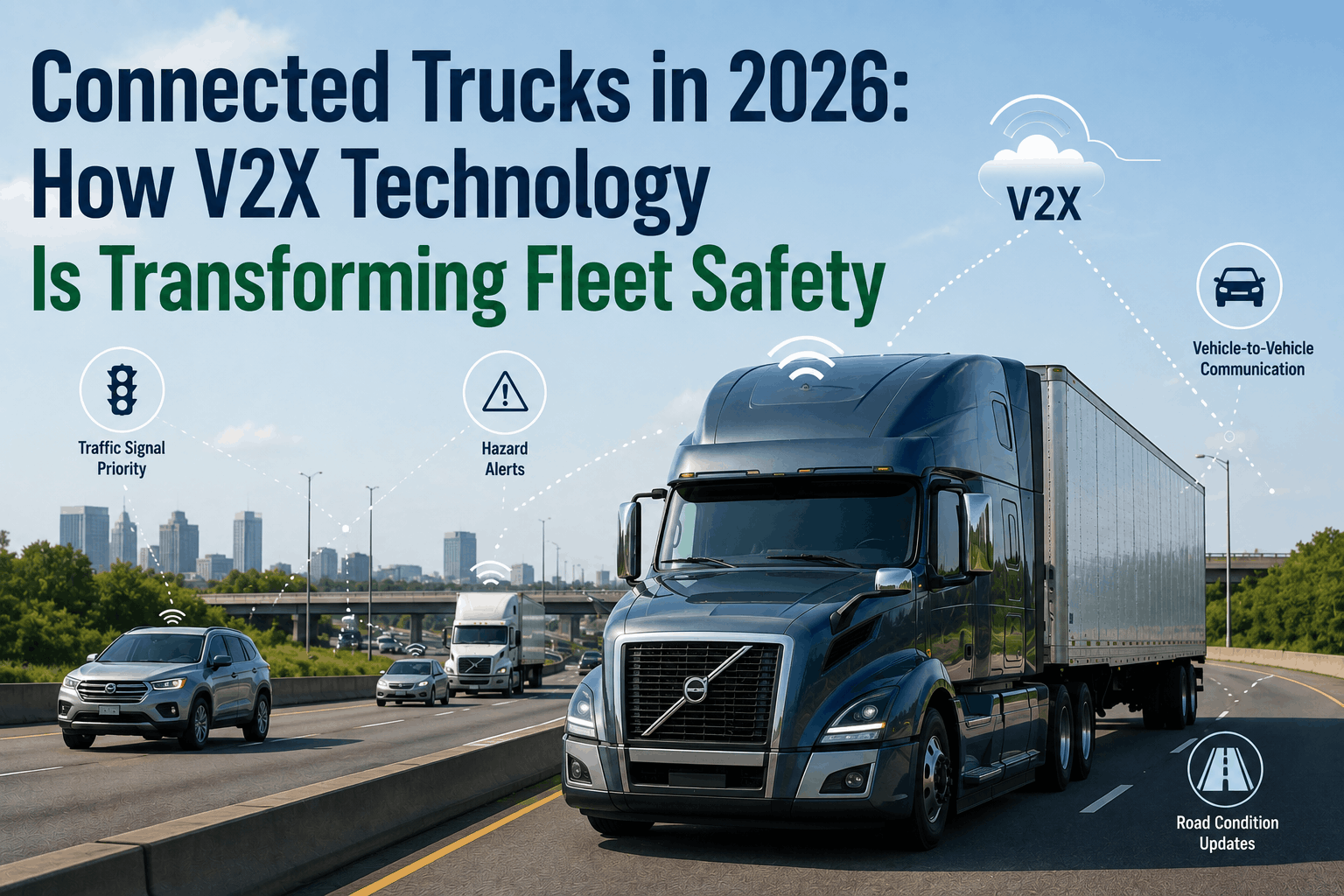
The connected truck is no longer a futuristic concept—it is the new operational reality for commercial fleets. By 2026, Vehicle-to-Everything (V2X) technology has moved from pilot programs to active deployment across highways, mining sites, and urban delivery routes. V2X enables trucks to communicate with other vehicles (V2V), infrastructure (V2I), pedestrians (V2P), and networks, creating a cooperative ecosystem that dramatically enhances safety, efficiency, and situational awareness. For fleet managers, understanding this technology is no longer optional—it is essential for staying competitive and protecting drivers on the road.
Connected Trucks in 2026: How V2X Technology Is Transforming Fleet Safety
The Safety Case: Why V2X Matters for Fleets
Single-vehicle autonomous technology has inherent limitations. Sensors can be obstructed by weather, have limited range, and cannot predict the actions of vehicles or pedestrians around corners. V2X solves these problems through cooperative awareness—what the industry calls "seeing the unseen." By sharing data between vehicles and infrastructure, V2X creates a "God's eye view" of the road environment, eliminating blind spots and enabling proactive rather than reactive safety decisions.
The safety benefits are substantial. In Connecticut, a V2X alert system deployed to protect roadside workers reduced the risk of collision by 90% and hard-braking by roadside incidents by 80%. In California, cooperative adaptive cruise control V2X deployments for freight showed that trucks could reduce fuel consumption by 5-6% and increase average speeds by 19%. In Wyoming, over 50% of drivers given V2V work zone or winter weather alerts through their human-machine interface reduced their speed. For commercial fleets, these numbers translate into fewer accidents, lower insurance costs, and improved driver retention.
To see how V2X integration can enhance your fleet's safety metrics, book a demo with FleetRabbit and explore our connected vehicle analytics platform.
C-V2X: The Cellular Backbone
Cellular Vehicle-to-Everything (C-V2X) technology is the foundation of most connected truck deployments. It provides low-latency, high-reliability direct communication between vehicles (V2V) and vehicles to infrastructure (V2I). According to industry experts, C-V2X is becoming the "standard" for commercial vehicle safety, particularly in challenging environments like mining and long-haul logistics.
In mining operations, C-V2X enables mixed fleets of manned and autonomous vehicles to operate safely alongside each other. In Xinjiang, China, a deployment of autonomous mining trucks using C-V2X achieved 21-hour continuous daily operation, outperforming human-driven fleets in efficiency and safety. For long-haul trucking, C-V2X supports advanced platooning—where trucks follow each other closely to reduce drag and save fuel—with following distances as tight as 10-12 meters.
The technology also enables cooperative perception: vehicles share sensor data to extend their collective "vision" far beyond what any single truck can see. A following truck can receive data from the lead truck's cameras and radar, effectively seeing around corners and through obstacles. This increases situational awareness by 20x compared to standalone autonomy.
Platooning: The Killer App for V2X
Truck platooning is emerging as the most commercially significant application of V2X technology. In a platoon, multiple trucks travel closely together, with the lead vehicle setting the pace and following vehicles responding to its actions within milliseconds via V2X communication. The benefits are compelling: reduced fuel consumption, improved traffic flow, and enhanced safety through coordinated braking and acceleration.
The market reflects this momentum. The Global Truck Platooning Market was valued at $169.5 million in 2025 and is projected to grow at a 21.5% CAGR to reach $1.16 billion by 2035. The V2X communication technology segment within this market is expected to grow at 23.1% CAGR through 2035, driven by demand for real-time coordination within platoons.
Driver-assistive platooning, where a human driver leads the convoy, currently dominates the market with a 95.1% share. This approach provides a practical transition path as fully autonomous platooning continues to mature.
Real-World Deployments
Across the industry, V2X technology is moving from testing to commercial operation. Kodiak AI, a leading autonomous trucking provider, has integrated HAAS Alert's Safety Cloud into its driverless trucks. The system sends digital alerts to approaching vehicles when a Kodiak truck is stopped on the shoulder—information that is critical for avoiding rear-end collisions. Studies show that drivers receiving such alerts reduce their speed by an average of 17%.
IVECO, in collaboration with Accenture, has developed an innovative V2X software solution that enhances road safety for both drivers and pedestrians. The system uses onboard sensors and vulnerable road user recognition algorithms to create Collective Perception Messages shared among connected vehicles and infrastructure. This enables the system to "see beyond the limits of a single vehicle's sensors," creating a comprehensive view of the road environment.
In India, the National Highways for Electric Vehicles (NHEV) initiative is deploying Connected Commercial Vehicle (CCV) Protocol that enables V2X communication, allowing vehicles to interact with other vehicles, infrastructure, and the power grid. The protocol is designed as the digital backbone of India's connected logistics revolution, transforming every vehicle into a smarter, safer, and more sustainable asset.
To stay ahead of these industry developments and prepare your fleet for V2X integration, sign up with FleetRabbit and access our fleet intelligence platform.
Equip Your Fleet for the Connected Future
FleetRabbit's platform helps you track connected vehicle data, monitor driver behavior, and optimize fleet safety—all from a single dashboard.
Overcoming Barriers: Cost, Complexity, and Coverage
Despite its promise, V2X adoption faces real challenges. Fleet operators express concerns over costs, complexity, and operational disruptions, revealing a tension between OEM innovation and customer acceptance. Many fleets remain cautious about fully adopting new technology, weighing return on investment and total cost of ownership as critical factors.
Infrastructure coverage is another barrier. V2X requires both vehicle-side hardware (onboard units or OBUs) and roadside infrastructure (roadside units or RSUs). Without sufficient RSU coverage, the benefits of V2X are limited to V2V communication only. Industry experts advocate a "vehicle-first" strategy: prioritizing OEM V2X installation to build penetration, then scaling roadside infrastructure based on demand.
Interoperability and standardization are also critical. As C-V2X deployments grow, ensuring that trucks from different manufacturers can communicate seamlessly is essential for realizing the full safety and efficiency benefits of the technology.
To help your fleet navigate these challenges, book a demo with FleetRabbit and explore our V2X readiness assessment tools.
The Role of 5G and URLLC
5G networks are accelerating V2X adoption by providing the ultra-reliable low-latency communications (URLLC) that safety-critical applications require. URLLC enables V2X use cases that demand millisecond-level response times—such as emergency braking coordination and intersection collision avoidance.
5G also introduces network slicing, which allows fleet operators to prioritize safety-critical traffic over less time-sensitive data, ensuring that V2X communications remain reliable even in congested network conditions.
For fleets operating in challenging environments—long-haul routes with patchy coverage, dense urban areas with interference, or remote mining sites—the combination of 5G and V2X provides the connectivity foundation needed for safe, reliable autonomous operations.
Future Outlook: From Safety to Full Autonomy
V2X technology is the bridge from today's safety-focused connected trucks to tomorrow's fully autonomous fleets. By enabling cooperative perception, coordinated decision-making, and real-time infrastructure integration, V2X addresses the limitations of standalone autonomy and accelerates the path to higher levels of automation.
As V2X matures, it will integrate with advanced technologies such as digital twin simulations, AI-powered virtual drivers, and autonomous vehicle controls, further enhancing the performance and scalability of commercial vehicle automation.
For fleet managers, the time to engage with V2X is now. The technology is proven, the safety benefits are documented, and the competitive advantages are clear. Fleets that adopt V2X early will be positioned to lead in safety, efficiency, and driver retention as the industry continues its transformation.
Frequently Asked Questions
Get Ahead of the V2X Curve with FleetRabbit
FleetRabbit provides real-time fleet intelligence to help you track connected vehicle data, monitor driver behavior, and optimize safety across your operation. Sign up with FleetRabbit and start your connected fleet journey today.