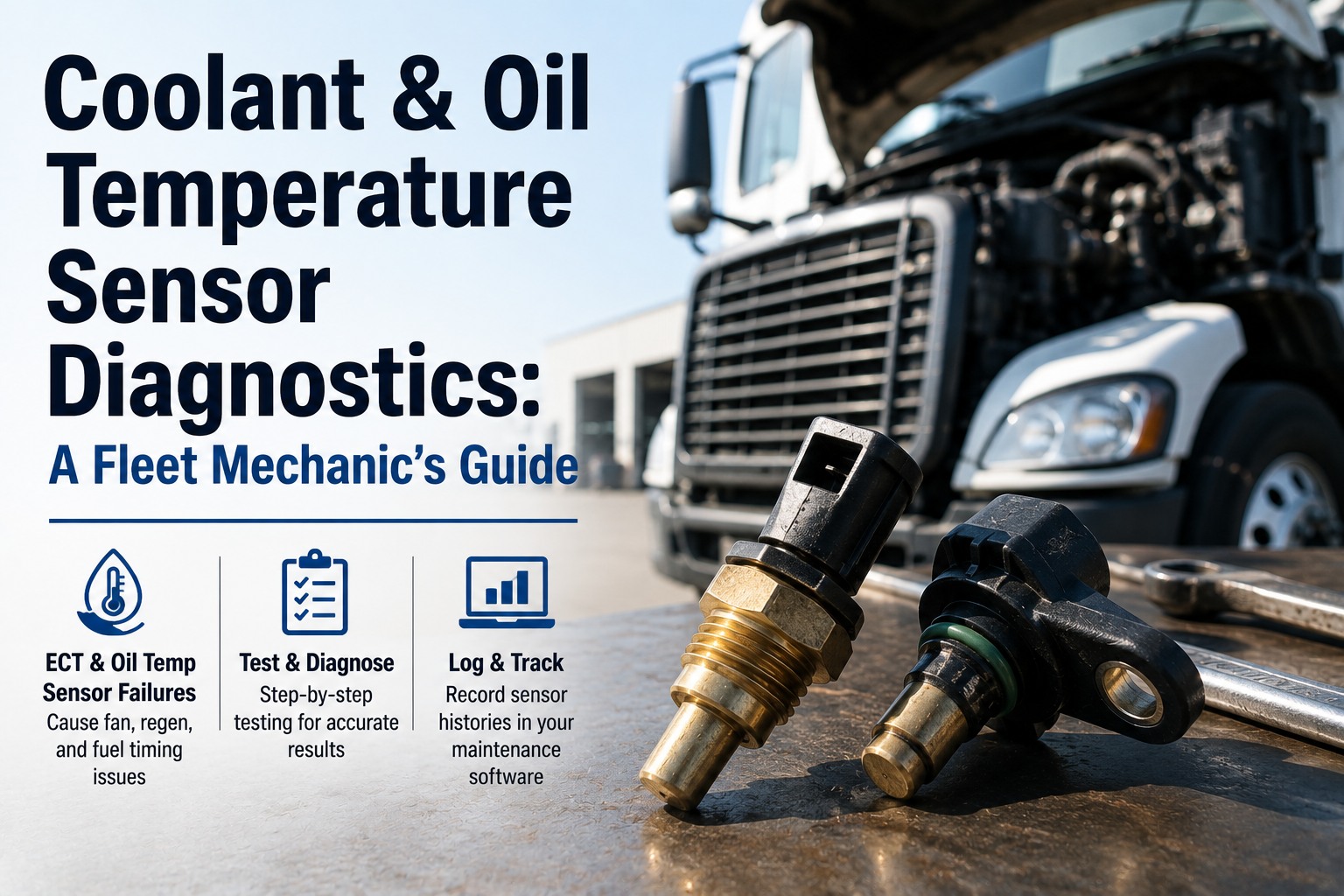
A temperature sensor is the cheapest part on the truck that can cause the most expensive problems. The engine coolant temperature sensor and the oil temperature sensor are simple thermistors — resistors whose value changes with heat — but the ECM uses their readings to decide fuel mixture, injection timing, cooling fan operation, cold-start enrichment, and on a diesel, when to run a DPF regeneration. When one of these sensors lies, the ECM acts on the lie: it over-fuels a warm engine it thinks is cold, skips a regen the truck needed, or leaves the fan off while coolant climbs. The frustrating part for fleet techs is that a bad reading and a bad wire produce identical codes, so replacing the sensor often doesn't fix it — the code comes right back. This guide covers how both sensors work, the disconnect test that separates a shorted sensor from a shorted wire in about a minute, the codes and what each one is really telling you, the downstream fan and regen and fuel-timing effects, and how logging both sensors' histories in maintenance software catches the corrosion pattern before it strands a truck. Start free trial or book a demo to log sensor histories across the whole fleet.
DIAGNOSTICS & REPAIR · TEMPERATURE SENSORS
A $30 Sensor That Decides Fueling, Timing, the Fan, and Regen
The ECM can't feel heat — it reads a thermistor's resistance and trusts it completely. When the coolant or oil temp sensor reports the wrong number, every decision built on it goes wrong too: rich fueling, a fan that won't engage, a regen that never runs. Diagnosing it right starts with knowing whether the sensor or the wire is lying.
How a Thermistor Reports Temperature
Both sensors are the same kind of device: resistance falls as temperature rises. The ECM sends a 5-volt reference and reads the voltage that comes back to calculate the temperature.
−10°C / 14°F
~10,000 Ω
Cold — high resistance
20°C / 68°F
~2,500 Ω
Warming up
80°C / 176°F
~300 Ω
Hot — low resistance
Those are typical values — always check the resistance chart for the specific engine. A reading that doesn't move with temperature, or sits pegged at an extreme, is the sensor or its wiring telling you something.
5V
Reference the ECM sends to the two-wire sensor
180–210°F
Normal operating range the ECM expects to reach
2–5%
Warm-up fuel-economy loss from a stuck-cool engine
~1 min
What the disconnect test takes to split sensor from wire
Two Sensors, One Thermal Picture
The coolant and oil temperature sensors do the same job in different fluids, and the ECM cross-checks them against each other. Understanding each one — and why they're linked — is what makes the codes readable.
ECT
Engine Coolant Temperature
A two-wire thermistor in the coolant passage. Its reading drives fuel mixture, injection timing, cooling fan operation, idle speed, cold-start enrichment, closed-loop fuel control, and DPF regeneration decisions on diesels.
P0115P0117P0118P0128
EOT
Engine Oil Temperature
The same thermistor principle measuring oil temperature. It informs cold-start fueling and thermal protection, and its reading is cross-checked against the coolant sensor for plausibility.
P0195P0197P0198
i
Why the two sensors are linked in diagnosis: the ECM compares the coolant and oil temperature readings for plausibility, so a fault in one can trigger a rationality code against the other. At a cold start, both sensors — and the intake air temperature sensor — should read nearly the same ambient temperature; if one is wildly off, the ECM knows something is wrong even before the engine warms. That cross-check is powerful, but it means a single corroded connector can throw codes that appear to point at a different, healthy sensor. Checking shared grounds and wiring before condemning either sensor saves a lot of wasted parts.
See how logging both sensor histories exposes the shared-wiring culprit.
The Disconnect Test: Sensor or Wire?
This is the single most useful thing a tech can do with a scan tool and a screwdriver, because it answers the question that determines the whole repair: is the sensor bad, or is the wiring? It takes about a minute and it stops the reflexive sensor swap that leaves the code still set.
Scan shows an implausibly HIGH temp — around 280°F when the engine is cool
Disconnect the sensor connector and watch the reading
Reading drops to ~−40°F
Sensor internally shorted → replace it
Reading stays high
Short to ground in the signal wiring → repair the wire
Scan shows an implausibly LOW temp — around −40°F on a warm engine
Check for the 5-volt reference at the connector, ignition on, engine off
5V reference present
Open sensor or ground fault → test and replace sensor
5V reference absent
Circuit fault back to the PCM → trace the reference wire
The same ECT code coming back after a new sensor isn't a bad part. It's the wiring.
Fleet Rabbit logs every temp-sensor code and the repair that followed, so a repeat P0115 after a replacement immediately points the next tech at the connector and harness instead of a second sensor.
The Codes and What They're Really Telling You
Temperature codes are precise about the type of fault — circuit low means the sensor reads hot, circuit high means it reads cold, and the thermostat codes are about warm-up rate, not the sensor at all. Swipe the table horizontally on mobile.
← Swipe to see all columns →
When the Reading Is Wrong, Here's What Breaks
A temperature sensor rarely fails quietly. Because so many engine functions depend on its reading, a wrong number cascades into problems that look unrelated until you trace them back to the sensor.
If it reads COLDER than reality
ECM over-fuels — rich running, black smoke, flooding when warm
Fuel economy drops as enrichment stays on
Raw fuel in the exhaust risks catalyst and DPF damage
Cooling fan may not engage when it should
If it reads HOTTER than reality
Cooling fan may run constantly, wasting power and fuel
ECM may lean the mixture, risking hesitation
False overheat warnings send trucks in unnecessarily
Timing pulled back, dulling power and response
If the engine stays too COOL (P0128)
Never enters closed-loop fuel control — economy suffers
DPF regeneration may not trigger properly on diesels
Excess fuel washes cylinders and dilutes oil over time
Emissions climb and the catalyst is at risk
Quick Resistance Reference and What It Signals
Keep this handy at the bench. Measured resistance well off the expected value for the current temperature points at the sensor; a value on the curve with a code still set points at the wiring. Swipe the table horizontally on mobile.
← Swipe to see all columns →
Catch the Corrosion Pattern Before It Strands a Truck
Fleet Rabbit logs every coolant and oil temp code against the specific truck with the repair that followed, flags sensors replaced more than once, and surfaces the same code spreading across units — so you find the winter road-salt corrosion or the shared ground fault instead of swapping sensors that were never bad. Deploy at $5/vehicle/month, no hardware, live within 72 hours.
Per-truck sensor histories
Repeat-replacement flags
Seasonal corrosion patterns
Regen & overheat alerts
The Diagnostic Sequence
Work these in order. The sequence is built to catch the cheap and common causes — a corroded connector, low coolant, a stuck thermostat — before anyone condemns a sensor that tests fine.
1
Read the Code and Live Temperature
Identify the exact code and read the temperature the ECM currently sees. A value pegged at an extreme, or one that contradicts a cold engine, tells you immediately whether you're chasing high or low voltage.
2
Inspect the Connector and Wiring
The most common real cause. Look for corrosion, moisture, road-salt damage, and loose or spread pins at the sensor connector — winter conditions attack these connections and produce codes identical to a dead sensor.
3
Check Coolant Level and Condition
Low coolant can leave the sensor un-immersed and misreading. Confirm the level and look for leaks before assuming the sensor is at fault — and note that low-coolant codes often accompany temp faults.
4
Run the Disconnect Test
With an implausible reading, disconnect the sensor and watch the value, or check for the 5-volt reference. This single step separates a shorted sensor from a shorted wire and an open sensor from a missing reference.
5
Measure Resistance Against Spec
Compare the sensor's resistance to the engine's temperature-resistance chart at a known temperature. A reading far off the curve confirms the sensor; a reading on the curve exonerates it and sends you to the wiring.
6
Test the Thermostat for P0125/P0128
If the code is about warm-up rate rather than circuit voltage, feel the upper radiator hose after a cold start — warm too soon means a stuck-open thermostat. Compare ECT against IAT at start-up; they should be nearly equal.
7
Check Shared Grounds and Related Codes
Because the ECM cross-checks coolant, oil, and intake temps, a rationality code may point at a healthy sensor. Inspect shared grounds and address the actual faulty circuit rather than the sensor the code names.
8
Replace — With the Fault Confirmed
Replace the sensor, repair the wiring, or change the thermostat once testing has identified the actual failure, and log what the readings showed so a recurrence starts from evidence instead of another guess.
How Fleet Software Turns These Into a Pattern
A single temperature code is a quick repair. The same code returning, or spreading across trucks each winter, is a pattern that changes what you actually fix. Here's how Fleet Rabbit surfaces it.
01
Per-Truck Sensor History
Every coolant and oil temp code is logged against the VIN with the repair that followed, so a technician sees at a glance whether this sensor was already replaced and the code came back.
02
Repeat-Replacement Flags
When the same temp code returns after a sensor swap, the system flags it — the clearest signal that the real fault is a corroded connector, a shared ground, or the wiring, not the sensor.
03
Seasonal Corrosion Patterns
Temp-sensor codes clustering across the fleet every winter point straight at road salt and moisture attacking connectors — a fleet-level cause you address with sealing and inspection, not sensors.
04
Regen & Overheat Alerts
Codes that affect DPF regeneration or risk overheating get flagged as priority, so a stuck-cool engine or a fan that won't engage is scheduled before it becomes a catalyst or head-gasket bill.
05
Driver Symptom Capture
Rough cold starts, a temp gauge behaving oddly, and poor warm-up economy get logged the day they appear — early context that points a technician at the right sensor before the code even sets.
06
Linked Cross-Check Records
Because coolant, oil, and intake temps are cross-checked, keeping all three sensors' histories together helps a technician spot the shared-wiring fault that a single code alone would hide.
Frequently Asked Questions
How do I test a coolant temperature sensor?
Two ways, and both are quick. With a scan tool, read the temperature the ECM sees and compare it to reality — a value pegged hot or cold, or one that doesn't move as the engine warms, indicts the sensor or its wiring. With a multimeter, measure the sensor's resistance and compare it to the engine's temperature-resistance chart; a typical thermistor reads roughly 10,000 ohms cold, around 2,500 ohms at room temperature, and about 300 ohms hot. A reading far off the curve confirms a bad sensor, while a reading on the curve sends you to the wiring, and keeping that test result on the truck's record is something you can
book a demo to see save the next diagnosis.
Why does my coolant temp code keep coming back after a new sensor?
Because the sensor probably wasn't the fault. A very common experience is replacing the coolant temperature sensor and having the code return, because the real problem is a corroded or damaged connector, a shared ground fault, or wiring that produces the same voltage as a dead sensor. The disconnect test — watching the reading change when you unplug the sensor, or checking for the 5-volt reference — separates the two before you buy a part. A repeat code after a replacement is strong evidence the fault is in the harness, and flagging that repeat automatically is exactly what you can
book a demo to see redirect the next technician.
What's the difference between P0128 and a sensor code like P0115?
They point at different components. P0115 and its siblings are about the sensor circuit — the voltage is out of range, so the fault is the sensor, connector, or wiring. P0128 is about warm-up rate: the engine isn't reaching normal operating temperature, usually because the thermostat is stuck open, not because the sensor is bad. The ECM sets P0128 by comparing the coolant and intake air temperatures at start-up and monitoring how fast the engine warms toward 180 to 210 degrees. Feeling whether the upper radiator hose gets warm too soon tells you about the thermostat, and keeping those two failure types distinct in the record is something you can
book a demo to see done cleanly per truck.
Can a bad coolant temp sensor affect DPF regeneration?
Yes. The ECM relies on coolant temperature to decide whether conditions are right for a DPF regeneration, so a sensor that reports the engine as cooler than it is — or a stuck-open thermostat keeping it genuinely cool — can prevent a regen from triggering when the filter needs it. That leads to soot loading, more frequent forced regens, and eventually a plugged filter and a derate. It's one of the clearest examples of how a cheap sensor drives an expensive aftertreatment problem, and catching the stuck-cool condition early is something you can
book a demo to see flagged before the DPF suffers.
Is it safe to keep driving with a coolant temp sensor code?
Short distances, usually — but not indefinitely. With a temperature code the ECM may over-fuel the engine, which hurts economy, raises emissions, and over time risks catalyst and DPF damage from raw fuel, and if the cooling fan isn't commanded on when it should be, the engine can overheat. On a diesel fleet the bigger risks are the missed regens and the oil dilution from chronic over-fueling. It's generally drivable to get the truck in, but it shouldn't run for weeks in that state, and scheduling it promptly off a logged code is something you can
book a demo to see built into the workflow.
Why do these sensors fail more in winter?
Because moisture and road salt are the main enemies of the electrical connector. Humid conditions, deep water, and winter road salt work into the sensor's connector and cause rapid pin corrosion, which raises electrical resistance and triggers the circuit codes — often on a sensor that is otherwise fine. Extreme cold adds its own problems, with moisture freezing in ventilation systems and causing erratic behavior. That's why temp-sensor codes tend to cluster seasonally across a fleet, and seeing that pattern rather than treating each truck in isolation is exactly what you can
book a demo to see surface fleet-wide.
Test Before You Swap. Log Both Sensors. Catch the Corrosion Early.
Fleet Rabbit records every coolant and oil temp code with its repair against the truck, flags repeat replacements, surfaces the seasonal corrosion pattern across the fleet, and prioritizes codes that threaten regen or risk overheating — so temperature faults get fixed at the wire or thermostat that's actually the problem, not the sensor that tested fine. Integrated with your existing systems in 5–7 working days, at $5/vehicle/month, with no new hardware required.
Free tier for up to 3 vehicles · No credit card required · No hardware installation
July 28, 2026
By Derek Goes
All Articles