A consolidation centre is a deliberate decision to add a handling step, and that framing matters because it sets the bar the design has to clear. Every hop adds touches, adds a custody boundary, adds a place for a load to sit, and adds a schedule that has to synchronise with two others. It is worth doing because the alternative — a plant receiving dozens of partial loads directly from distant suppliers — is worse on freight cost, on dock slots and on gate throughput. But the justification is conditional on the hop being fast. Where inbound and outbound are properly synchronised, goods essentially never stop moving; where they are not, you have built a warehouse that nobody planned, budgeted or staffed, and a single delayed inbound truck sets off a chain reaction of missed outbound appointments. This covers the design, the matching mechanics, the dwell discipline and the damage attribution problem that the extra boundary creates. Request an enterprise demo to model the hop against your own supplier map.
ENTERPRISE GUIDE · CONSOLIDATION CENTRES
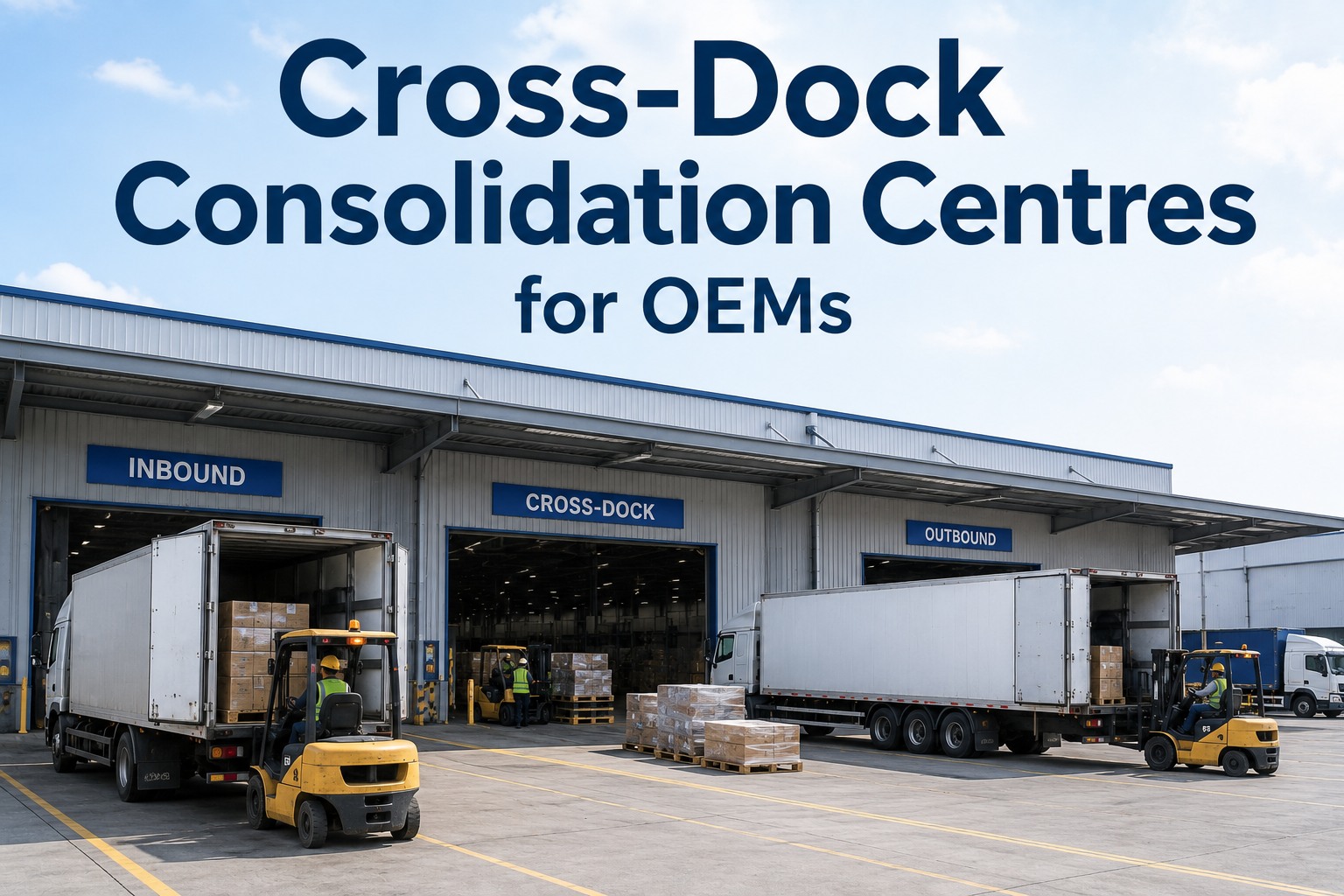
Cross-Dock Consolidation Centres for OEMs
Consolidation point design that minimises travel across the floor, inbound-to-outbound matching that survives a late truck, dwell held to hours rather than days, and damage attributable across the extra boundary.
Strip doors · inbound
Staging lanes · one per outbound door
Stack doors · outbound
Cross-Dock or Consolidation? They Are Not the Same Thing
The words get used interchangeably and the two models have opposite objectives. Deciding which one you are actually building determines every design choice that follows.
Cross-dock
Keep materials in motion. Inbound trailers are unloaded, sorted by destination or production sequence, and reloaded for immediate dispatch. Inventory barely exists as a concept.
SuitsJust-in-time and just-in-sequence flows, where an hour of delay can stop a line
Consolidation
Introduce a deliberate pause. Shipments are held briefly until there is enough volume to justify a full load, converting expensive partial shipments into economical full truckloads.
SuitsFlows that can absorb extra transit days in exchange for lower per-unit freight
The trade, stated plainly
Consolidation buys lower per-unit transport cost with added dwell, and that dwell adds to overall lead time. In a plant feeding a sequenced line, lead time is the constraint you cannot spend — which is why most OEM inbound platforms need to behave like cross-docks even when they are called consolidation centres. Where a lane genuinely can absorb the days, consolidate; where it feeds a frozen window, do not.
Designing the Point
Six design decisions, taken in this order. The first two determine the floor travel every unit will make for the life of the facility, which is why they are worth more analysis than they usually get.
01
Strip doors and stack doors
Inbound flow is assigned to strip doors, consolidated inside, and outbound flow assigned to stack doors. How many of each, and the nominal capacity of the facility, is the core design problem — and it has to be decided under uncertainty about future volumes.
02
Door adjacency
Allocate inbound and outbound doors adjacently to minimise horizontal travel, using pairing or face-to-face arrangements that allow direct transfer. Floor travel is the dominant labour cost in a cross-dock, and it is fixed at design time.
03
Staging lanes by outbound door
Each lane corresponds to an outbound door or route, so a scanned unit has one obvious destination on the floor. Lanes organised by supplier or by part instead force a second sort before loading.
04
Repack capability, or deliberately none
Some platforms receive inland deliveries, sort, repack where needed and load into containers for onward transport. Repack adds capability and touches — decide whether it is in scope rather than letting it arrive by default.
05
Yard and appointment discipline
Without disciplined yard management the facility becomes a bottleneck rather than an accelerator. The appointment schedule is what aligns arrivals with departures, and it is the mechanism the whole model rests on.
06
Labour shape, not just headcount
Cross-trained operators who can receive, sort and load interchangeably, with staffing aligned to peak inbound windows and surge capacity held for volume spikes. Underestimating labour at peak is a documented cause of missed load cut-offs.
Door count and adjacency are decided once and paid for daily.
An enterprise demo models your inbound supplier set, outbound plant routes and volume profile against strip and stack door requirements, staging lane structure and the dwell the design would actually produce.
Inbound-to-Outbound Matching
The mechanical sequence is short and each step has a failure mode. What makes a cross-dock work is that every unit knows its outbound door before it is unloaded — not after.
1
Advance notice arrivesThe despatch advice tells the platform what is coming and when. A load arriving without one cannot be pre-assigned to a lane and has to be sorted after unload.
2
Scanned on receiptEach handling unit is identified as it comes off the trailer, establishing what arrived and in what condition at the moment custody transfers.
3
Directed to a staging laneThe lane corresponds to an outbound door or route. This is the decision that has to be automatic; where an operator decides, the sort happens twice.
4
Loaded onto the next departing truckSequenced by delivery route and stop order where the outbound leg has multiple drops, so unloading at the far end follows consumption order.
Risk
One late inbound, many missed outboundsInbound and outbound must be synchronised, so a single delayed inbound truck can cause a chain reaction of missed outbound appointments. The cut-off rule for that case has to exist before it happens.
Decide the cut-off policy explicitly: does the outbound leave on time short, or wait for the late inbound and miss its own slot? For a sequenced plant lane the answer is usually to depart and expedite the remainder; for a general supply lane it is usually to hold. What must not happen is that the decision gets made by whoever is on shift, differently each time.
Dwell Control
Dwell is the metric that separates a cross-dock from an unplanned warehouse, and it is the one that drifts first. Some operations target a maximum dwell under four hours; others run continuous flow where inbound and outbound are synchronised so goods essentially never stop.
← Swipe to see all columns →
What the improvement looks like
A documented transformation introducing dedicated cross-dock lanes and integrating the warehouse system with transport management and supplier advance notices — piloted with two suppliers — cut average dwell from 18 hours to under 6, lifted consolidation to 72% of volume, and reduced handling costs by 21% within six months. Note the sequence: lanes and integration first, dwell as the result.
Damage Attribution Across the Hop
The consolidation centre adds a custody boundary, which means damage found at the plant now has three possible origins instead of two. Without evidence at each boundary, every dispute resolves by argument.
Supplier to centre
Condition at load on the supplier side, condition on the trailer at the centre before removal. Establishes whether the unit arrived at the hop intact.
Without itEvery damage found downstream is attributable to the centre by default
Inside the centre
Receipt scan, staging lane assignment, load scan. Each touch is an opportunity, and cross-docking's reduced handling is precisely what lowers damage rates relative to storage.
Without itHandling damage at the hop is indistinguishable from transit damage either side
Centre to plant
Condition at outbound load, condition on the trailer at the plant before removal. The pair that closes the chain.
Without itThe plant cannot exclude its own unload, and the claim fails on that alone
The practical consequence of adding a hop is that the number of condition captures doubles. Four boundaries instead of two, each needing timestamped evidence before removal from the trailer. That is a real operating cost, and it belongs in the business case for the centre rather than being discovered when the first significant claim arrives.
Preconditions Worth Auditing
Cross-docking requires tight coordination, and where that coordination breaks down the model creates more problems than it solves. Five conditions decide whether it will hold.
1Predictable volumesForecastable accurately enough to coordinate inbound and outbound flows. Erratic volume produces either empty outbounds or overflowing lanes.
2Reliable upstream partnersCarriers and suppliers meeting appointment windows and labelling requirements consistently. Both, not one — a punctual load without a scannable label still gets sorted twice.
3Enough volume to consolidateThe economics improve when partial loads combine into full truckloads. Below that threshold the hop adds cost without recovering it.
4Connected systemsReal-time exchange between warehouse, transport and carrier platforms. Insufficient integration produces mismatched inbound and outbound schedules, which is the failure this model cannot survive.
5Yard discipline at the centreWithout it the facility becomes a bottleneck rather than an accelerator — and a congested hub degrades every lane feeding through it simultaneously.
The hybrid answer
Many operations find a mixed approach works best: cross-dock the fast-moving, predictable flows and handle less predictable items conventionally. Applied to plant inbound, that usually means sequenced and high-frequency parts move through the hop while long-tail low-volume supply ships direct — because the hop only pays where volume and predictability are both present.
The Case for the Hop
Worth stating quantitatively, because the extra handling step needs a defence and "it consolidates freight" is not one.
Partial loads become full loadsConsolidation converts expensive less-than-truckload shipments into more economical full truckloads, with consolidation programmes reporting average savings around 30% on consolidated lanes.
Total cost, not just freightAdding storage, labour, inventory, transport and damage reduction together, cross-docking can reduce total supply chain costs by 15 to 25% for suitable product categories.
Fewer touches, less damageEvery handling event carries risk. Cross-docking reduces handling to the minimum, which lowers damage rates and the costs attached to them.
Plant-side reliefFewer, fuller arrivals mean fewer gate transactions, fewer dock slots and less yard congestion at the plant — capacity that is frequently scarcer than the freight saving is large.
Model the hop before you commit to it
We take your supplier locations and volumes, plant receiving windows and current direct-shipment cost, and model door requirements, expected dwell, consolidation ratio and the damage-evidence overhead the extra boundary adds.
What to Measure
Six figures, with live indicators for the operational three so supervisors and transport planners see them during the shift rather than after it. Our analytics and reporting module carries them.
Dwell timeElapsed time from receipt to outbound shipment. Lower dwell indicates smoother transfers and reduced handling, and it is the headline health measure of the facility.
On-time departure rateShare of outbound loads leaving as scheduled. Critical for carrier performance and for the plant slot at the far end.
Load consolidation ratioShare of inbound volume consolidated into full truckloads. Higher ratios generally lower per-unit freight cost, and this is the number the hop exists to move.
Touch count per unitAverage handling events per pallet or case. Rising touch count means the lane structure is producing a second sort somewhere.
Lane occupancy, liveStaging lane fullness in real time, alongside outbound readiness. The early warning that dwell is about to rise.
Damage by boundaryAttributed to inbound leg, the centre, or the outbound leg. Unattributed damage on a four-boundary chain is a governance failure, not bad luck.
Frequently Asked Questions
Is a consolidation centre the same as a cross-dock?
No, and conflating them causes most of the disappointment. A cross-dock keeps materials in motion — unloaded, sorted by destination or production sequence, and reloaded for immediate dispatch, with inventory barely existing. Consolidation deliberately introduces a pause, holding shipments until there is enough volume to justify a full load, trading added dwell for lower per-unit transport cost. That trade is fine on lanes that can absorb extra days and unacceptable on lanes feeding a sequenced line.
What dwell should we target?
Some operations set a maximum under four hours; others run continuous flow, synchronising inbound and outbound so goods essentially never stop moving. For plant inbound feeding a frozen window, the continuous-flow end is the right ambition and four hours is a reasonable ceiling. What matters more than the number is that it is set, measured live and treated as a breach when exceeded — dwell drifts quietly, and a facility at eighteen hours is a warehouse nobody budgeted for.
How should the floor be laid out?
Inbound flow to strip doors, outbound to stack doors, with the two allocated adjacently to minimise horizontal travel — pairing or face-to-face arrangements enable direct transfer. Staging lanes should correspond to outbound doors or routes rather than to suppliers or parts, so a scanned unit has exactly one destination on the floor. Deciding door counts and nominal capacity is genuinely difficult because it has to be done under volume uncertainty, and it is fixed for the life of the site.
What happens when an inbound truck is late?
Decide in advance, because inbound and outbound must be synchronised and one delayed inbound can trigger a chain reaction of missed outbound appointments. Write the cut-off rule per lane: a sequenced plant lane usually departs on time short and expedites the balance, while a general supply lane usually holds. The failure mode is not the late truck — it is that the decision gets taken differently by whoever is on shift, so neither the plant nor the carrier can plan around it.
Does the extra hop increase damage?
It adds handling, which adds risk — but cross-docking specifically minimises handling relative to storage, and fewer touches means lower damage rates overall. The real change is attributional: you now have four custody boundaries instead of two, so condition evidence is needed at each one, captured before removal from the trailer. Budget that operating cost into the business case. Sites that do not find their first significant claim unattributable and pay it themselves.
What actually makes these facilities fail?
Two documented causes dominate. Insufficient integration between the warehouse and transport systems produces mismatched inbound and outbound schedules, which is fatal to a model built on synchronisation. And underestimating labour needs during peak windows leads to missed load cut-offs — units staged correctly and not loaded in time. Both are planning failures rather than execution ones, which means both are visible in the design if anyone looks.
Should everything go through the hop?
No. A hybrid approach usually works best — cross-dock the fast-moving predictable flows and handle less predictable items conventionally. For plant inbound that generally means sequenced and high-frequency parts route through the centre while long-tail, low-volume supply ships direct, because the hop only recovers its cost where volume and predictability are both present. Route the exceptions around it rather than forcing them through. Our
integrations overview covers the system connections required.
Earn the Extra Handling Step
Doors placed to minimise travel, lanes mapped to outbound routes, every unit assigned before it is unloaded, dwell measured live against a stated ceiling, and condition captured at all four boundaries rather than two.