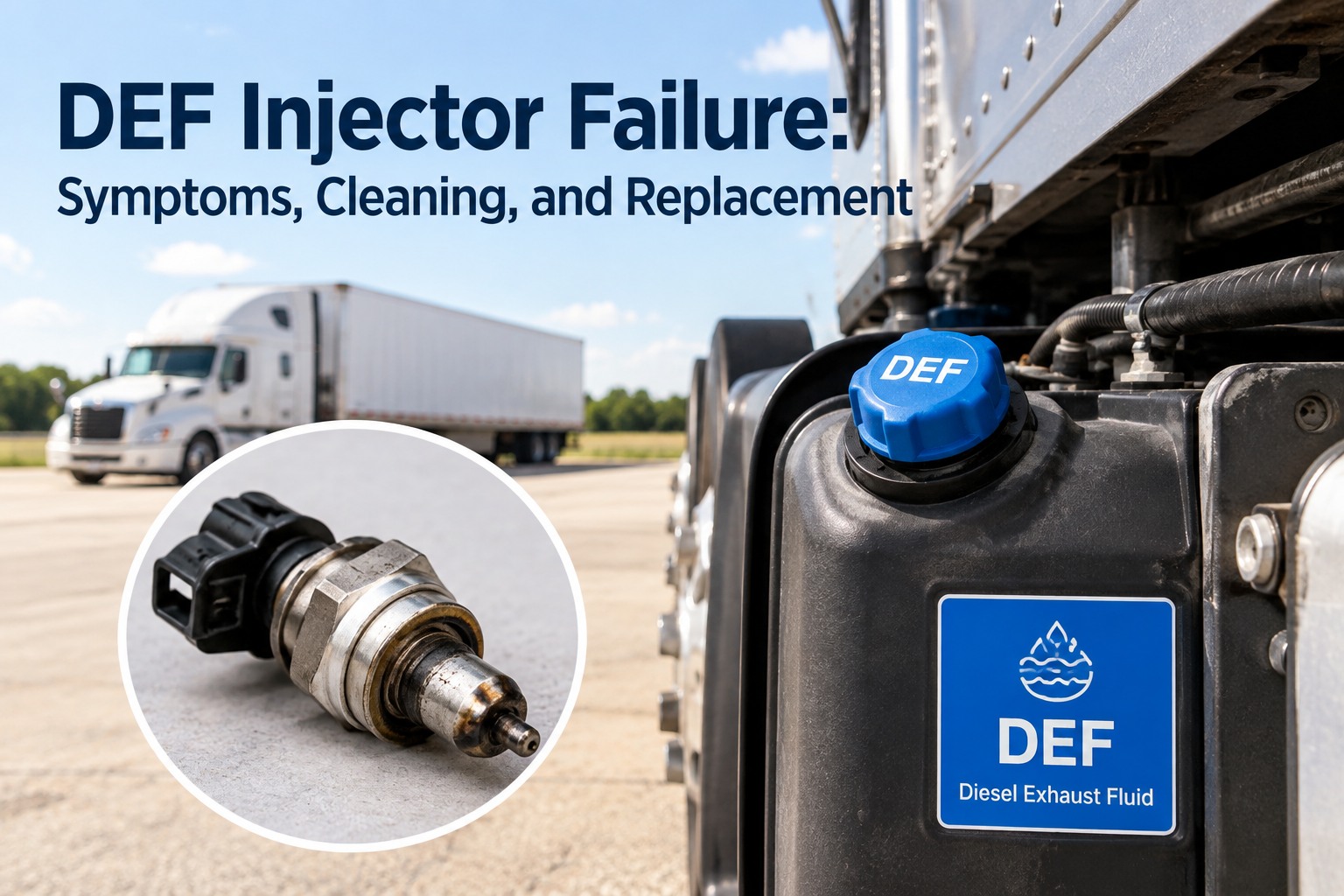
DEF injector failure — a clogged, sticking or electrically failed diesel exhaust fluid doser — usually shows up as SCR or NOx conversion fault codes, a check engine light, rising or falling DEF use, white crystal buildup around the injector and, if ignored, an engine derate. Most injectors don't fail suddenly: urea crystals build up at the nozzle, poor-quality or contaminated DEF leaves deposits, frozen DEF or a failed heater stops flow, or the injector's wiring fails. Crystals can often be cleaned off, but an injector that fails a dosing test or has an electrical fault needs replacing — and the cause has to be fixed either way. This guide covers what the injector does, the symptoms from first warning to derate, five common causes, where crystals form, when cleaning works, how long you have before a derate, what drives the cost and the habits that prevent it. Book a demo to see DEF faults tracked to the repair, or start free with 3 vehicles.
SCR system · DEF injector (doser)
Most DEF Injectors Don't Die Suddenly. They Crust Up Slowly, and the Codes Warn You First.
For maintenance managers, technicians and owner-operators: how to recognize a failing DEF injector, decide between cleaning and replacing it, and stop the next one before it derates a truck.
What a DEF Injector Does and Why It Fails More Often Than Other SCR Parts
The DEF injector sprays a precisely metered mist of diesel exhaust fluid into the hot exhaust ahead of the selective catalytic reduction (SCR) catalyst, where it turns into ammonia and converts nitrogen oxides into nitrogen and water. It sits in the hottest, harshest spot in the system and handles a fluid that leaves solid deposits whenever its water evaporates, which is why it is a common SCR failure point. You can log DEF injector faults and repairs against each truck on a free account.
DEF composition and quality requirement: engine-maker service bulletin on DEF filed with NHTSA and industry DEF guidance.
DEF Injector Failure Symptoms, From the First Warning Sign to an Engine Derate
A failing DEF injector gives several warnings before the truck slows down, and each stage is cheaper to deal with than the next. Train drivers and technicians to report the early ones. We can turn these stages into alerts for your fleet in a demo.
White crystals around the injector or its connector
Seen on a walk-around with the truck cold. Often a leaking seal or incomplete purge.
DEF use that changes for no reason
Lower use can mean a restricted nozzle; higher use can mean a leak or an injector stuck open.
SCR efficiency or NOx conversion fault codes
The downstream NOx sensor sees that too little DEF is reaching the catalyst.
Check engine light and DEF system warnings
An emissions fault is stored and, on many trucks, a derate countdown starts.
Reduced power or a speed limit
The inducement has begun. Repair before the next stage.
Five Common Causes of DEF Injector Failure on Heavy-Duty Diesel Trucks
Almost every DEF injector failure traces back to one of five causes, and knowing which one decides whether cleaning will last. Record the cause on the work order, not just the part replaced. Track the cause behind every DEF repair free.
Urea crystallization at the nozzle
When DEF's water evaporates in a hot, stationary injector or line, urea is left behind as a hard white deposit that restricts or blocks the spray.
Poor-quality, diluted or contaminated DEF
Fluid that isn't certified to ISO 22241, has been diluted with water or picked up dirt, fuel or other fluids leaves deposits and can damage the catalyst.
Freezing and failed heaters
DEF freezes around 12°F. A failed tank or line heater stops flow, and repeated partial thawing can leave crystals in the injector and lines.
Heat damage at the exhaust mount
The injector sits on the exhaust; interrupted DEF flow or cooling lets heat damage the tip and seals.
Electrical and connector faults
Corroded connectors, chafed wiring or a failed injector coil stop the injector opening on command — cleaning won't fix these.
Can You Clean a DEF Injector? When Cleaning Works and When It's Time to Replace
Urea crystals dissolve again in water or fresh DEF, so external deposits and a lightly restricted nozzle can often be cleaned. A Chrysler service bulletin on DEF filed with NHTSA notes that crystals should redissolve when reintroduced to fresh DEF, and that spills should be cleaned with mild soap and water. Cleaning can't fix a failed coil, a cracked tip or an injector that fails its dosing test. Review clean-or-replace decisions on your trucks in a demo.
- Crystals are on the outside or at the nozzle tip
- The injector passes an electrical check
- Spray pattern and dosing quantity test OK after cleaning
- The cause, such as a leaking seal, has been fixed
- There's an open or shorted coil or connector damage at the injector
- The tip is cracked or heat-damaged
- It fails the dosing test after cleaning
- The same fault returns soon after a cleaning
A basic cleaning sequence, after the engine and exhaust have cooled
- Record all SCR and DEF codes before anything is cleared.
- Remove the injector following the engine maker's procedure; replace the gasket.
- Dissolve deposits with warm water; avoid wire brushes on the nozzle.
- Check the connector and coil; run the maker's dosing or quantity test.
- Clear codes, drive, and confirm the SCR efficiency monitor passes.
Stop paying for injectors when the cause is DEF quality or a heater
In 30 minutes we'll show how FleetRabbit keeps every DEF code, cleaning and replacement on the truck's history, so repeat failures point your technician to the real cause.
How Long You Have Before a DEF Injector Fault Derates the Truck
DEF faults are the ones most likely to trigger emissions inducement, so timing matters. Under EPA's August 2025 guidance, heavy-duty trucks with updated engine software give a warning for the first 650 miles or 10 hours, then a 15% power derate, and reach a 25 mph limit only after about 8,400 miles or 160 hours. Trucks without the update can derate far sooner. Track which trucks have the update on a free account.
Source: EPA diesel exhaust fluid guidance for heavy-duty trucks, August 2025, as reported by Waste Advantage and DieselNet. Bar widths are to scale by miles; the final limit is shown as a fixed block.
DEF Injector Repair Cost: What Actually Drives the Bill for a Fleet
The injector is only one line on the invoice; diagnosis, the cause behind the failure and downtime usually matter more. Industry benchmarking by FleetNet America and ATA's Technology & Maintenance Council puts unplanned downtime at about $448 to $760 per truck per day before towing and repair, so a derate on the road can cost more than the part. Estimate your DEF-related downtime with our team.
Relative cost, lowest to highest
Bars show typical relative impact, not prices. Catching crystals on a walk-around keeps a repair at the top of this list instead of the bottom.
DEF Handling and Maintenance Habits That Prevent Injector Failure
Most DEF injector failures are preventable with fluid handling rules and a few scheduled checks. Build the checks into your preventive maintenance and the walk-around into every DVIR, and log anything found on a work order. Set up these checks free on 3 vehicles.
Use only API-certified DEF that meets ISO 22241
Never top up with water or add fuel additives to the DEF tank.
Keep containers sealed, clean and out of heat
Use dedicated funnels and nozzles; evaporation and dirt cause deposits.
Let the system purge before killing battery power
Many SCR systems pump DEF back after shutdown; follow the maker's wait time before using the battery disconnect.
Look for white crystals on the daily walk-around
Around the injector, the DEF cap and connectors — report them on the DVIR.
Check heaters before winter
A failed tank or line heater is a common cause of cold-weather DEF faults.
Replace the DEF filter on the maker's interval
A clogged filter starves the pump and injector.
DEF Injector Failure Questions Technicians and Fleet Managers Ask Most
What are the symptoms of a bad DEF injector?
SCR efficiency or NOx conversion codes, a check engine light with DEF warnings, unusual changes in DEF use, white crystals around the injector, and eventually reduced power or a speed limit. See these patterns across your trucks.
What causes DEF injector failure?
Urea crystallization, poor-quality or contaminated DEF, frozen DEF or failed heaters, heat damage at the exhaust mount, and electrical or connector faults. Record the cause on every repair free.
Can a DEF injector be cleaned?
Often, yes — urea crystals dissolve in warm water or fresh DEF. It needs replacing if it has an electrical fault, a damaged tip, or still fails the dosing test after cleaning. Review clean-or-replace decisions with us.
Will a bad DEF injector derate my truck?
It can. On trucks with updated software, EPA's 2025 guidance allows a warning for 650 miles or 10 hours, then a 15% derate, and a 25 mph limit after about 8,400 miles or 160 hours; older calibrations act sooner. Track derate risk per truck free.
How much does DEF injector repair cost?
Cleaning is the lowest-cost fix, replacement costs more, and related damage or a roadside derate costs the most. Downtime adds roughly $448 to $760 per truck per day by industry benchmarks. Estimate your exposure with our team.
How do I prevent DEF injector problems?
Use certified ISO 22241 DEF, keep it clean and sealed, let the system purge before cutting battery power, check heaters before winter, replace the DEF filter on schedule and look for crystals on every walk-around. Build those checks into PM free.
Keep Every DEF Fault, Cleaning and Replacement on One Record Per Truck
FleetRabbit logs each DEF and SCR code, the cause found, the repair made and whether the fault returned — so the next technician sees the history and your fleet stops buying injectors for DEF quality problems.