Contaminated diesel is one of the few problems that can damage an entire fleet from a single source. A bad delivery into a bulk tank, a microbial colony quietly growing over a slow season, or rust washing out of an aging storage tank can put water, bugs, and grit into every truck that fuels up — and modern common-rail injectors, running at pressures above 30,000 PSI with microscopic tolerances, are ruthless about punishing it. By the time the symptoms reach the engine, you are already in reactive territory: rapid filter clogging, rough idle, power loss, and injector tips that can be blown out by as little as entrained water. The fleets that stay ahead of it treat fuel quality as something to detect, prevent, and document on a schedule — not something to discover at the roadside. This guide covers the four types of diesel fuel contamination, how to detect each one in the field and the lab, how to prevent them, and how inspection software documents fuel-quality issues so they are tracked across the fleet and audit-ready. Start free trial or book a demo to put fuel-quality checks on an automated, documented schedule.
DIAGNOSTICS & REPAIR · FUEL QUALITY
One Bad Tank Can Damage Every Truck That Fuels From It
Water, microbes, and grit don't stay in one place — a contaminated bulk tank or a slow microbial bloom spreads fleet-wide. And modern common-rail injectors, running above 30,000 PSI, have no tolerance for it. The defense is detecting, preventing, and documenting fuel quality before it reaches the engine.
THE FIELD TEST
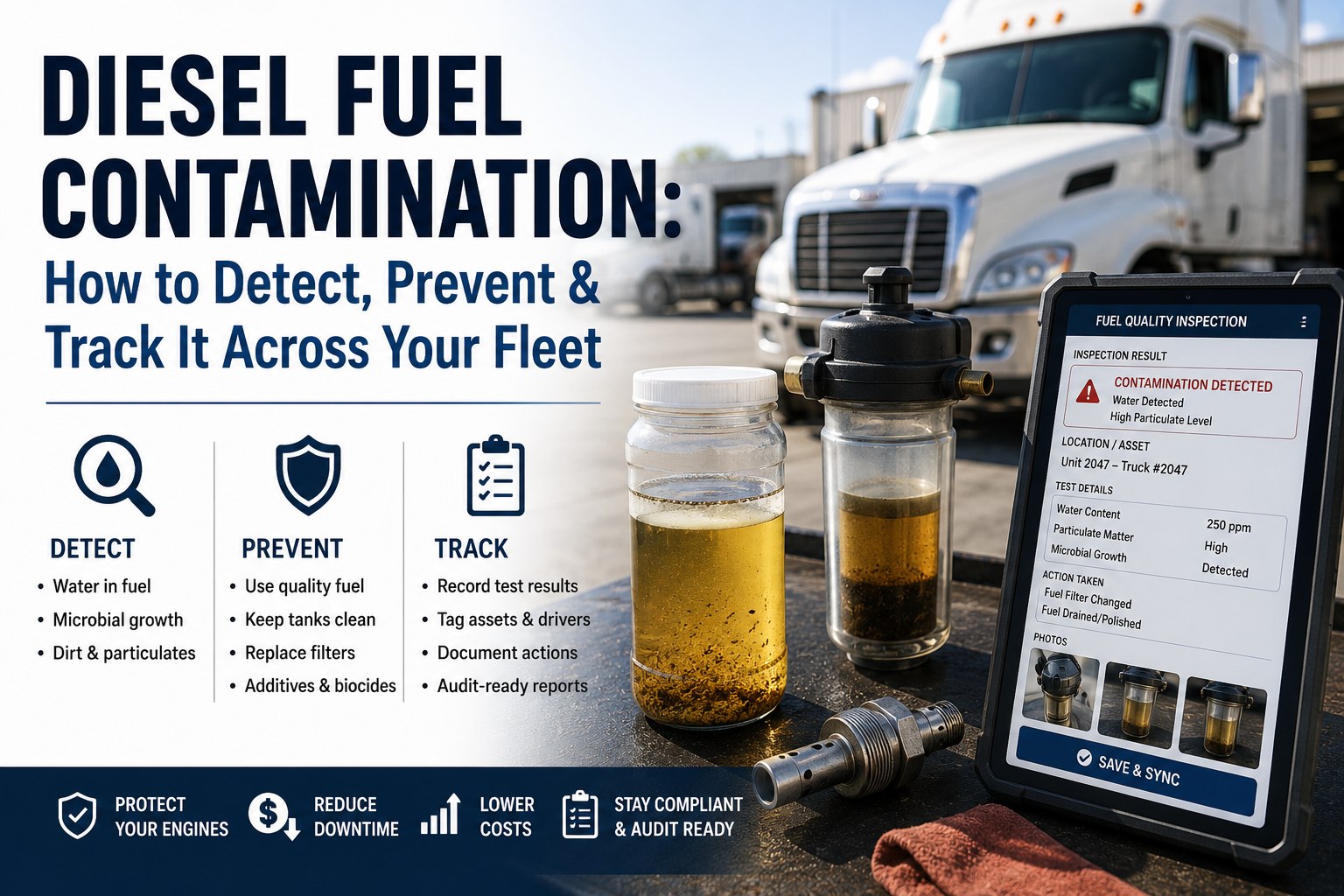
Clear & bright fuel
Water + dark sludge
A clear glass jar in natural light reveals clarity, layering, and odor — the first read before any lab test
0.05%
Water by volume is enough to cause filter plugging and injector damage
200 ppm
Free water threshold (ASTM D6304) that promotes corrosion and microbes
10³
CFU/mL colony count signals active microbial infestation
30,000
PSI common-rail pressure that makes injectors unforgiving of grit
The Four Types of Diesel Fuel Contamination
Contamination is not one problem — it's four, each with different sources, symptoms, and fixes. Recognizing which type you're dealing with is the first step to responding correctly before a minor issue becomes a fleet-wide disaster.
Most common
Enters through condensation, faulty tank seals, or contaminated delivery. Corrodes metal components, kills fuel lubricity, promotes microbial growth, and causes incomplete combustion. Entrained water can blow injector tips outright.
Slow & hidden
Bacteria, yeasts, and fungi colonize the water-fuel interface, feeding on hydrocarbons and excreting acidic waste. They form sludge and biomass that clog filters, accelerate corrosion, and thrive when equipment sits idle. Requires water to survive.
Silent injector killer
Rust, tank scale, pipe debris, and dust introduce solid particles that pass a spent filter and score high-pressure pumps and injectors. On tight-tolerance common-rail systems, this wear degrades spray patterns and triggers derates.
Catastrophic
Accidental mixing with gasoline, lubricating oil, or off-spec biodiesel alters combustion properties and reduces lubricity. Even a small amount can cause catastrophic injector failure, and it's often invisible without a flash-point test.
How to Detect Contamination — Field to Lab
Detection runs on two levels: quick field checks a technician can do in minutes, and lab analysis that quantifies what the eye can't see. The rule is simple — the earlier you catch it, the cheaper it is, because by the time symptoms reach the engine you're already paying for the damage. Swipe the table horizontally on mobile.
← Swipe to see all columns →
i
Your used fuel filter is a snapshot of your fuel. Every filter that comes off a truck has recorded exactly what passed through it — cut one open and the media tells the story: dark gel-like material points to biological contamination, reddish-brown gritty particles mean tank corrosion, and heavy fine sediment signals general degradation. The catch is that a filter cut-open is only useful if someone logs what they found and ties it to the truck and the fuel source. A photo and a note in a documented system turns one filter into fleet-wide intelligence about where your contamination is coming from.
See how logged filter findings pinpoint the bad tank.
The Symptoms Your Drivers Will Report First
Long before a lab result comes back, contamination announces itself in how the truck runs and how often it needs filters. Train drivers and techs to report these — each is a cue to pull a fuel sample and check the source.
Rapid Filter Clogging
Needing filter changes well ahead of schedule is the single clearest sign — the filter is catching a contamination load the fuel shouldn't carry.
Rough Idle & Misfires
Contaminated fuel disrupts combustion, producing a rough idle and misfires as injectors deliver fuel unevenly or foul up.
Black or White Smoke
Excessive black or white exhaust smoke signals incomplete combustion from water or particulate interfering with proper fuel delivery.
Power Loss Under Load
Sluggish acceleration and lost power pulling a grade — the fuel system can't deliver clean fuel at the pressure the engine demands.
Sour or Rotten Odor
A distinct sour smell from the fuel or tank is a hallmark of microbial contamination — the diesel bug excreting acidic waste.
Water-in-Fuel Warning Light
The dash warning means water has reached the separator. Pull over safely and do not restart until it's addressed — driving pushes contamination through sensitive components.
If the water-in-fuel light comes on: stop. When you see the water-in-fuel warning or experience symptoms of severe contamination, pull over safely as soon as possible and do not restart the engine until the contamination is addressed. Continuing to drive pushes contaminated fuel through the high-pressure pump and injectors — the exact components you're trying to protect — and can turn a drain-and-filter job into a full fuel-system replacement.
Book a demo to catch water before the light ever comes on.
A slimy separator drain on one truck is a warning for the whole yard.
Fleet Rabbit logs every water-separator drain, filter finding, and fuel-quality check against the truck and the fuel source — so a contamination pattern surfaces before it reaches the next injector.
Prevention: Stop It Before It Reaches the Engine
Every contamination type is preventable with the right routine. The goal is to keep water out, kill microbes before they bloom, filter particulate before it circulates, and verify fuel quality on a schedule instead of by surprise. Swipe the table horizontally on mobile.
← Swipe to see all columns →
Document Fuel Quality Fleet-Wide — and Make It Audit-Ready
Fleet Rabbit tracks water-separator drains, filter changes, and fuel-quality test results across your entire fleet — logging what came out, which truck, and which fuel source, with photos and timestamps — so nothing falls through the cracks and every fuel-quality record is ready for an audit or a warranty claim. Deploy at $5/vehicle/month, no hardware, live within 72 hours.
Water-separator drain logs
Filter-finding photo records
Fuel-source tracking
Audit-ready fuel-quality history
How Inspection Software Tracks Fuel Quality Across the Fleet
The reason fuel contamination spreads is that individual findings — a slimy drain here, a fast-clogged filter there — never get connected. Inspection software turns scattered observations into a fleet-level early-warning system, and into the documented record an audit requires.
01
Water-Separator Drain Logging
Drivers and techs log each drain with what came out — clear, rusty, or slimy — and the volume, so a water or microbial trend on one truck surfaces before it spreads across the yard.
02
Filter-Finding Photo Records
Cut-open filter findings get photographed and logged against the VIN, turning each filter's snapshot of the fuel into searchable evidence of where contamination is entering.
03
Fuel-Source Tracking
Tie contamination findings to the fueling location or bulk tank, so when multiple trucks show the same problem, the shared source becomes obvious instead of invisible.
04
Rapid-Filter-Change Alerts
When a truck needs filters far ahead of schedule, the system flags it — the clearest early signal of a contamination problem worth a fuel sample right away.
05
Scheduled Fuel-Quality Checks
Water-separator draining, filter inspection, and periodic testing get scheduled as recurring tasks with reminders, so fuel quality is verified on a cadence rather than by surprise.
06
Audit-Ready Documentation
Every drain, test, and filter finding is timestamped and stored against the vehicle, building the fuel-quality record that supports a warranty claim or satisfies an audit in one export.
Frequently Asked Questions
What are the main types of diesel fuel contamination?
There are four. Water is the most common, entering through condensation, faulty seals, or bad delivery. Microbial contamination — the "diesel bug" — is bacteria, yeast, and fungi living at the water-fuel interface, producing sludge and acids. Particulate is rust, scale, and dust that scores injectors and pumps. Cross-contamination is accidental mixing with gasoline, oil, or off-spec biodiesel, which can cause catastrophic injector failure. Each has different sources and fixes, so identifying the type is the first step to responding correctly.
Book a demo.
How do I test diesel fuel for contamination in the field?
Draw a sample from the tank bottom into a clean, clear glass jar and examine it in natural light. Check clarity — hazy or milky almost always means water or fine particulate. Check for layering — water droplets or a dark sludge layer at the bottom means free water contamination. Check odor — a sour or sulfurous smell points to microbial growth. Cutting open a used fuel filter is also revealing: dark gel means biological, rust particles mean corrosion, heavy sediment means degradation. Log color, clarity, layering, and odor with a timestamp before any lab test.
Book a demo.
How much water in diesel fuel is dangerous?
Less than you'd think. As little as 0.05% water by volume can cause filter plugging, microbial growth, injector damage, and even catastrophic engine failure. In lab terms, free water above 200 ppm (the ASTM D6304 threshold) is enough to promote corrosion and microbial growth. The problem is that water contamination is largely invisible to the naked eye until it reaches a critical stage, which is why regular water-separator draining and periodic testing matter so much — you can't rely on seeing it.
Book a demo.
What is the "diesel bug" and how do I get rid of it?
The diesel bug is microbial contamination — bacteria, yeasts, and fungi that colonize the water-fuel interface, feeding on the diesel and excreting acidic waste that forms sludge, clogs filters, and corrodes components. It requires water to survive, so the first line of defense is keeping water out through separator draining and tank maintenance. Once established, it's treated with biocides, and a lab test (ASTM D6469) confirms whether the colony count above 10³ CFU/mL indicates an active infestation. It's especially common in equipment that sits idle.
Book a demo.
What should I do if the water-in-fuel light comes on?
Pull over safely as soon as possible and do not restart the engine until the contamination is addressed. Continuing to drive pushes contaminated fuel through the high-pressure pump and injectors — precisely the sensitive, expensive components you want to protect — and can escalate a drain-and-filter job into a full fuel-system replacement. Drain the water separator, inspect what comes out, and change the filter before returning the truck to service. The light is a late warning, which is why proactive draining and testing matter.
Book a demo.
How does inspection software help with fuel contamination across a fleet?
It connects the findings that would otherwise stay isolated. Every water-separator drain, filter cut-open, and fuel-quality test is logged with photos against the specific truck and tied to the fuel source, so when several trucks show the same problem, the shared bad tank or fueling location becomes obvious. Rapid-filter-change alerts flag the earliest sign of contamination, scheduled checks keep verification on a cadence, and every record is timestamped for audits and warranty claims. It turns fuel quality from a surprise into a tracked, documented, fleet-wide metric.
Book a demo.
Catch Contaminated Fuel Before It Reaches Every Injector You Own.
Fleet Rabbit logs water-separator drains, filter findings, and fuel-quality tests against every truck and fuel source, flags rapid-filter-change patterns, and keeps every record audit-ready — so a bad tank gets caught at the first truck, not the tenth. Integrated with your existing systems in 5–7 working days, at $5/vehicle/month, with no new hardware required.
Free tier for up to 3 vehicles · No credit card required · No hardware installation
July 21, 2026
By Emily Davis
All Articles