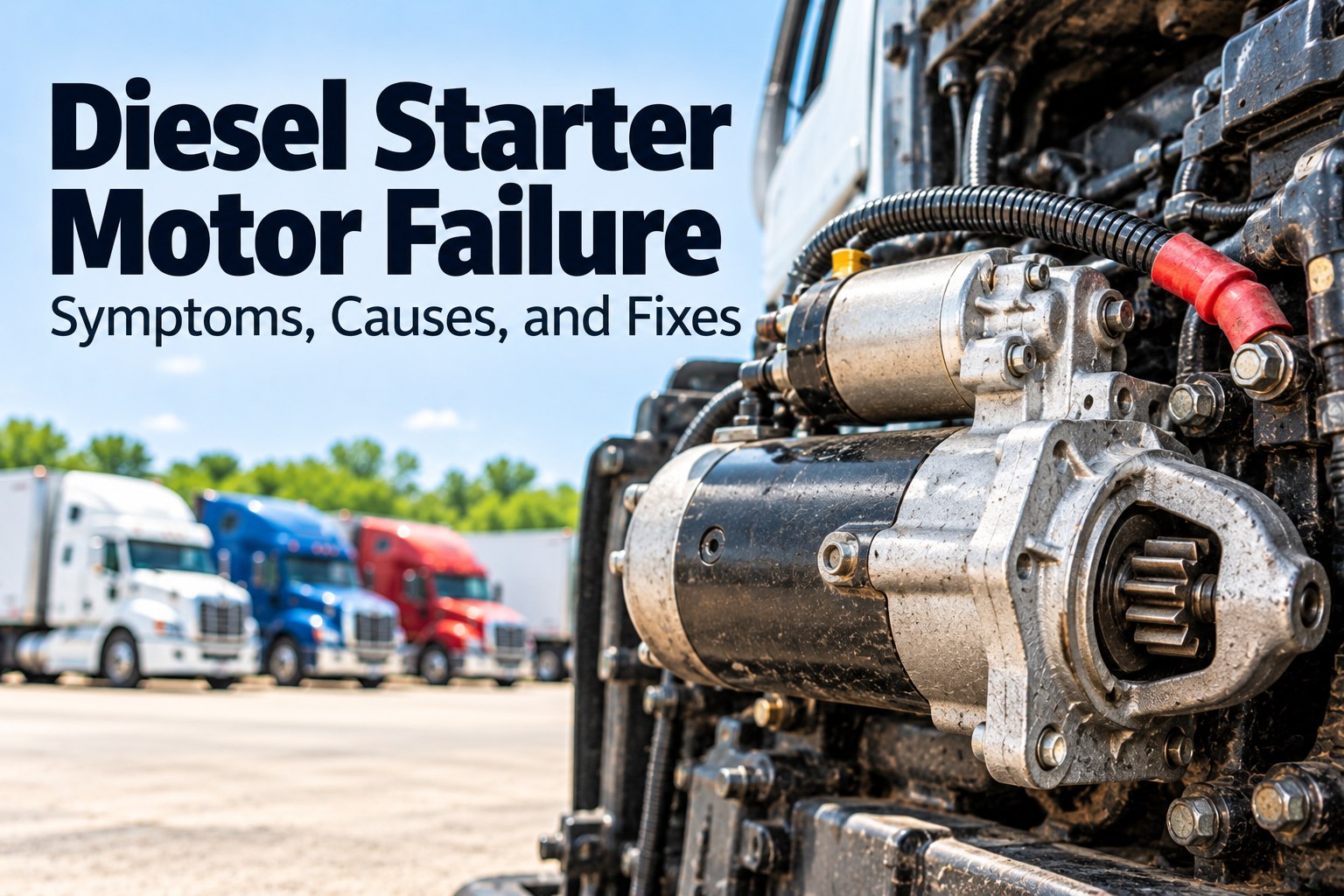
A diesel that will not crank is almost never a starter problem at first — it is an electrical supply problem that ends at the starter. Heavy-duty diagnosis sorts the complaint into three patterns before anyone reaches for a wrench: slow crank, click with no crank, and no click with no crank. Each one points at a different part of the circuit. The measurement that separates them is voltage drop, and the specification is tight: the total drop across the cranking circuit should be less than 0.5 volt. One finding matters more than any other here — voltage drop at the heavy positive post on the solenoid is a leading cause of click and no-click complaints, because that post is where manufacturers tap power for the control circuit. This guide covers the three patterns, the diagnostic order, the real causes, how to avoid replacing a good starter, and what it costs. Book a 30-minute demo to see no-start events tracked to their cause, or start free with 3 vehicles.
Three Different No-Start Sounds. Three Different Faults. One Wrong Guess Costs You a Starter.
For fleet mechanics, shop leads and maintenance managers: how to read slow crank, click-no-crank and no-click-no-crank, and the voltage drop test that settles which one you have.
No credit card required. Works with your existing shop process.
What Do the Three No-Crank Symptoms Actually Mean?
Start here, because the sound the truck makes narrows the fault before any tool comes out. Each pattern has its own first test, and getting this step right is what stops a good starter going in the bin. Record which pattern the driver reported, free on 3 vehicles. Swipe the table on mobile.
| Pattern | What you hear | What it points at | First test |
|---|---|---|---|
| Slow crank | Engine speed rises slowly on the attempt | Voltage getting to the starter, but not enough of it — batteries, cables or grounds | Load test the bank, then voltage drop the main cables |
| Click, no crank | The solenoid pulls in but the motor doesn't turn | Often voltage drop at the heavy positive post on the solenoid, which is where the control circuit is tapped | Voltage drop test at the solenoid before condemning the starter |
| No click, no crank | Nothing happens at all | Control circuit: ignition switch, relay, neutral safety, wiring or the solenoid itself | Verify the control circuit has power and ground at the solenoid |
Symptom categories and the solenoid post finding per Class 8 Truck Parts, "Diagnosing starter cranking problems."
Less than 0.5 V total drop across the cranking circuit
Anything more means the circuit is consuming voltage that should be turning the engine. That loss shows up as slow cranking, clicking, or no response at all — and it is found with a meter, not by swapping parts.
What Causes a Diesel Starter to Fail?
Ordered roughly by how often they turn out to be the answer. The first four are circuit problems that get misdiagnosed as starter problems; the last three are the starter itself. We'll review your repeat no-starts in a demo.
By far the most common no-crank cause, and the cheapest to rule out first
Resistance turns available voltage into heat instead of cranking torque
A weak ground looks exactly like a weak starter on the bench
A leading cause of click and no-click complaints, because the control circuit is fed from there
Burned contacts pass enough current to click and not enough to crank
Brushes, bushings and armature wear, usually after the electrical causes above went unfixed
Chewed teeth from repeated engagement problems — inspect it whenever a starter comes off
How Do You Diagnose a No-Crank on a Heavy-Duty Truck?
Work the circuit in order rather than jumping to the component at the end of it. This sequence follows the standard heavy-duty approach and ends where most shops start. Put the sequence on your work order template free.
Test the bank, then individual batteries if the bank fails. Everything downstream is judged against good batteries.
Measure across the starter main cables under cranking load. Total drop on the circuit should stay under 0.5 volt.
Engine and chassis grounds carry the same current as the positive side and fail just as often.
Especially on click and no-click complaints — confirm the solenoid is actually getting proper power and ground.
Drop at the heavy positive post is a leading cause of these complaints because the control circuit is fed from it.
If the starter is coming off anyway, check the ring gear for damage before the new one goes on.
How Many Starters Did You Replace Last Year That Weren't the Problem?
Most fleets cannot answer that, which is the answer. In 30 minutes we'll pull your no-start history together by unit, show which trucks keep coming back, and set up the diagnostic sequence on the work order so the circuit gets tested before the part gets ordered.
Is It the Starter, the Batteries, or the Cables?
Three components, one symptom, and a simple way to separate them. The rule of thumb: batteries fail gradually and get worse in the cold, cables fail under load, and starters fail after the first two went unfixed. Set this as your triage rule with our team.
- Slow crank that worsens in cold weather
- Recovers after a jump and runs fine
- Bank fails a load test
- Often several units in the fleet at once
- Clicking with good batteries
- Voltage drop above the 0.5 volt limit
- Connections hot after a cranking attempt
- Intermittent, and worse when dirty or wet
- Good batteries, good cables, still no crank
- Grinding or whirring without engagement
- Burned solenoid contacts
- Ring gear damage found on removal
What Does Starter Replacement Cost on a Diesel Truck?
The part is a known quantity; what varies is whether the truck is in your bay or on a customer's yard, and whether the circuit fault that killed the last starter is still there. Industry benchmarking puts unplanned downtime at roughly $448 to $760 per truck per day before towing and repair, and ATRI puts 2025 repair and maintenance cost at $0.215 per mile, up 8.6%. Track your own no-start costs per unit free.
Relative cost by where the no-start happens and whether the cause is fixed, illustrative — not prices. Downtime benchmark: FleetNet America and ATA's Technology & Maintenance Council via industry reporting; per-mile cost: ATRI.
How Do You Prevent the Next No-Start?
Nearly every item here is a five-minute check that already belongs in a service. Put the daily ones on the inspection report and the measured ones into preventive maintenance, especially before winter. Set the schedule free on 3 vehicles.
Diesel Starter Questions Fleet Mechanics Ask
Why does my truck click but not crank?
The solenoid is pulling in but the motor isn't turning, which usually means voltage is being lost before it reaches the motor. Voltage drop at the heavy positive post on the solenoid is a leading cause, because the control circuit is fed from there. Test before replacing. See the test sequence in a demo.
What does it mean when there's no click at all?
The control circuit isn't getting through — ignition switch, relay, wiring or the solenoid itself. Confirm the solenoid is receiving proper power and ground before assuming the starter has failed. Record the pattern per event, free.
How much voltage drop is acceptable on a cranking circuit?
Less than 0.5 volt total across the cranking circuit. Above that, the circuit is absorbing voltage that should be turning the engine, and the symptoms will look like a failing starter. Add the measurement to your work orders.
Can bad batteries destroy a starter?
Low voltage makes a starter draw harder and run hotter to do the same work, so repeated cranking on weak batteries shortens its life. That's why battery testing comes first in the diagnostic order. Track battery tests per unit free.
Why did my new starter fail again?
Almost always because the circuit fault was never fixed — resistance in cables, a poor ground, or a drop at the solenoid post. A second starter on the same truck is a diagnostic result, not bad luck. Review your repeats with our team.
Should we check the ring gear when replacing a starter?
Yes. Standard practice is to inspect the ring gear for damage whenever a starter comes off, because chewed teeth will destroy the new unit and the access will never be cheaper. Put it on the job checklist free.
Test the Circuit Before You Order the Part
FleetRabbit keeps every no-start event, the pattern the driver reported, the tests run and the parts fitted on the truck's record — so a second starter on the same unit shows up as a pattern, and each report becomes a work order with that history attached.
No credit card required. Start with your next no-start.