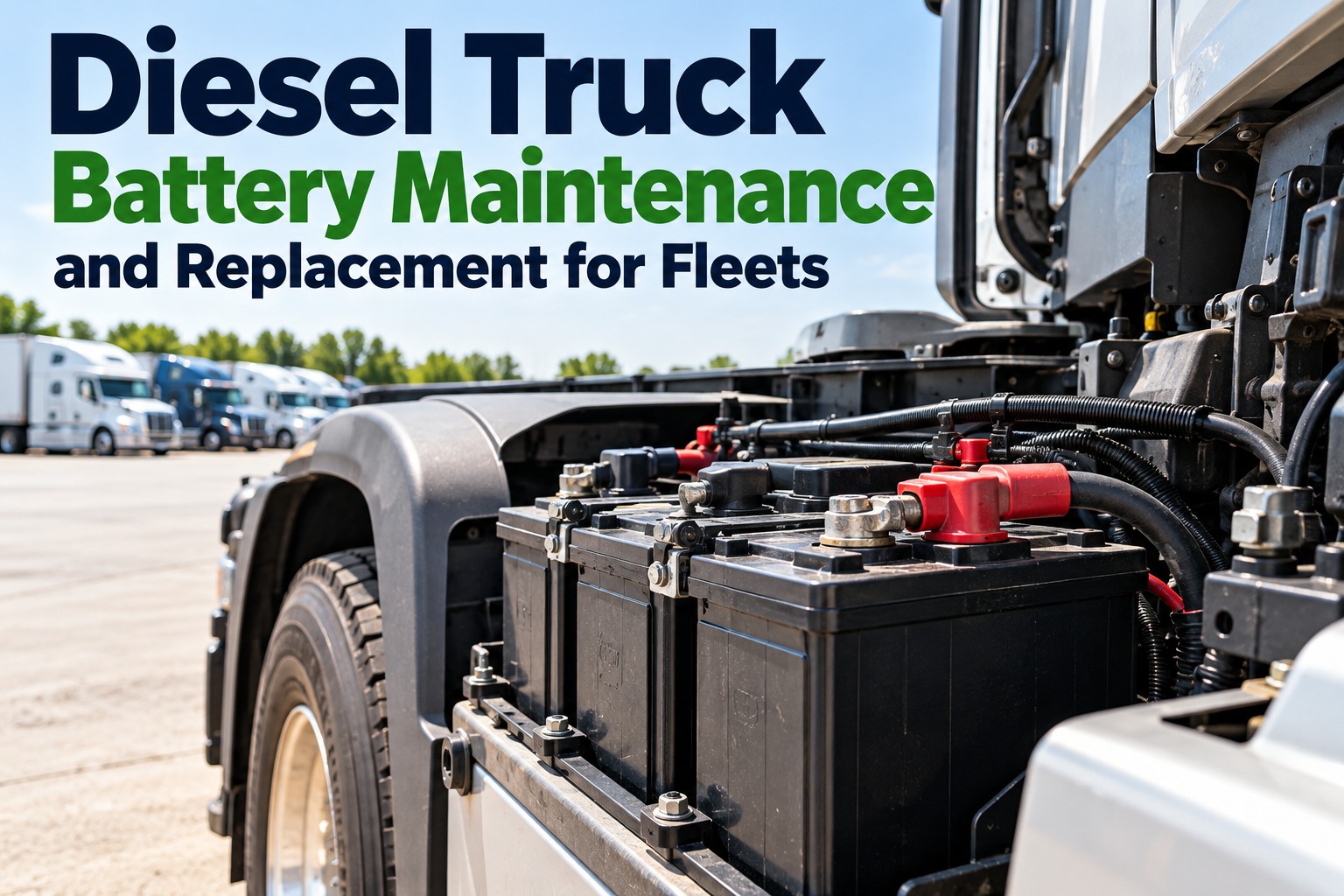
Diesel truck battery failure means one or more batteries in the bank can no longer hold a charge or deliver cranking power, so the truck will not start or the electrical system acts up. The first signs are slow cranking and charging warnings, and the last sign is a no-start on a route. This page covers what the battery bank does, the symptoms, the causes, how to test it, when to replace one battery or the whole bank, the cost and a PM checklist. Schedule a call to put battery checks on a PM schedule.
DIESEL BATTERY UPTIME · FLEET MANAGERS AND SHOPS
A Dead Truck Is Rarely a Surprise to the Voltmeter
Batteries tell you they are tired weeks before the no-start. Read the voltage, test every battery, and fix what is draining or undercharging the bank, not just the unit that died.
REST VOLTAGE, ENGINE OFF 30+ MIN
12.6 - 12.8 VHealthy
12.2 - 12.5 VPartly charged
Below 12.2 VDischarged
A first read before any deeper test.
How a Diesel Truck Battery Bank Works and Why It Gets Worked So Hard
Two to four batteries share the load, and one weak unit pulls the rest down
Heavy-duty trucks typically run two to four batteries in parallel, which keeps the system at 12 volts. Class 6 to 8 trucks mainly use BCI Group 31 batteries, and large diesels often need 1,500 to 2,400 CCA or more. Life is typically three to five years, depending on weather, electrical demand, driving habits and maintenance.
2 - 4
batteries in parallel
1,500 - 2,400+
CCA on large diesels
3 - 5 years
typical battery life
Three battery types fit different duty, so match the type to what the truck runs
Starting (flooded)
LOWEST PRICE
High starting power and little cycling ability. It needs the most upkeep, including electrolyte checks.
Cycle service
CRANKING PLUS LOADS
Handles liftgates, reefer units and hotel loads while still cranking the engine.
AGM
SEALED, VIBRATION TOLERANT
Holds up better under vibration and cycling. Thin plate pure lead designs are the ones recommended.
Diesel Truck Battery Symptoms: What Slow Cranks and Dead Mornings Mean
Six signs show up before a no-start, and each points somewhere different
Slow cranking
LIKELY A WEAK BANK OR HIGH RESISTANCE
Test each battery and the cables before replacing anything.
Intermittent charging warnings
CHARGING SIDE
Check charging voltage before blaming the batteries.
Batteries drain overnight
PARASITIC DRAW
Measure the key-off draw after the modules sleep.
Fails again after a replacement
ROOT CAUSE NOT FIXED
Look at the alternator, cables, grounds and loads.
Hard starts in cold weather
LOW CAPACITY, HIGH DEMAND
Summer damage often shows up in winter.
Corroded terminals or electrical glitches
CONNECTIONS
Clean or replace the connection, then retest the voltage drop.
A dead battery is a symptom, so find out why it died before you replace it
Do not just swap it. After a no-start, have the charging system and the batteries analyzed. Replacing the battery without finding the root cause means the new one fails the same way.
Diesel Truck Battery Causes: Cold, Heat, Parasitic Draw and Poor Connections
Cold takes a third or more of the capacity while the engine needs more current to start
Battery capacity drops about 35 percent at 32°F and up to 60 percent at 0°F, while starting current can more than double at 0°F. A bank that is only partly charged has the least to give when demand is highest.
CAPACITY LEFT IN THE COLD, PERCENT OF A WARM-DAY BATTERY
Warm day, full capacity
100%
Eight causes account for most early failures, and they often stack on one another
Heat and vibration
Summer wear weakens batteries, and the damage shows in winter. Loose hold-downs add vibration damage.
Deep discharge
Running comfort loads on a parked truck, or short run times that never recharge the bank.
Undercharging or overcharging
A weak alternator starves plates, and excess voltage cooks off water and damages them.
Corroded cables and grounds
Resistance blocks current to the starter and from the alternator back to the batteries.
Parasitic loads
Sleeper inverters, stuck HVAC controls, aftermarket accessories and telematics faults.
Sulfation
A battery left discharged for long periods builds lead sulfate crystals on its plates.
One weak battery in a bank
A single aged unit drags the others down.
Dirt and overfilling
Grime reduces charge acceptance, and acid on terminals causes corrosion.
Winter is coming for the weak batteries. Schedule the bank test before the cold does it for you.
Set battery check reminders per truck, and log every slow crank against the unit.
How to Test Diesel Truck Batteries and Find What Is Draining the Bank
Read the voltage in order, because low voltage alone does not prove the alternator is at fault
Rested voltageEngine off, 30+ min
HEALTHY12.6-12.8 V
MARGINAL12.2-12.5 V
FAULTBelow 12.2 V
Cranking voltageUnder starter load
HEALTHYAbove 10.5 V
MARGINAL9.6-10.5 V
FAULTBelow 9.6 V
Charging voltage1,500-2,000 RPM, loads on
HEALTHY13.8-14.7 V
MARGINAL13.5-13.7 V
FAULTBelow 13.5 V or above 15.0 V
Cable voltage dropPer side, under load
HEALTHYBelow 0.2 V
MARGINAL0.2-0.5 V
FAULTAbove 0.5 V
Bank balanceEach battery rested
HEALTHYWithin 0.1 V
MARGINAL0.1-0.2 V apart
FAULTOutlier over 0.2 V low
One guide also says a battery with conductance below 75 percent of rated CCA should be replaced, and that a bank load test at 50 percent of CCA for 15 seconds should not pull voltage below 9.6 V.
Measure the key-off draw after the modules sleep, then work out which load is awake
KEY-OFF PARASITIC DRAW, MILLIAMPS. PURPLE IS THE LIMITS, AMBER IS TYPICAL LOADS
Normal once modules sleep
Below 75 mA
High for a truck
75-200 mA
Investigate now
Above 200 mA
ECM and body modules
20-40 mA
Sleeper HVAC (stuck on: higher)
10-30 mA
Sleeper inverter
50-500 mA
Aftermarket accessories
10-200 mA
Alternator diode leak
50-500 mA
Wait 30 minutes. Measure after the key has been off for at least 30 minutes so the modules have gone to sleep. One guide says a draw above 500 mA can kill a healthy bank overnight.
Diesel Truck Battery Fix: Replace the Bank Together and Repair the Cause
Replacing one battery often costs more later than replacing the bank today
REPLACE ONLY THE FAILED BATTERY
8 - 12 months
One guide reports the new battery often fails early when it is mixed with aged ones.
VS
REPLACE THE WHOLE BANK
3 - 4 years
Many OEMs call for a full bank replacement if any battery is over one year old.
Four rules keep the new batteries alive
1
Match the OE CCA
Never go below the original spec. About 10 percent higher can be acceptable, but far higher can hurt capacity over time.
2
Fix the cables first
Cleaning or replacing the connection solves most cable faults. Retest for under 0.2 V drop per side.
3
Repair the charging system
An alternator that under or overcharges will kill the new bank as well.
4
Remove the parasitic load
Find the inverter, HVAC control, accessory or telematics fault that keeps drawing current.
Diesel Truck Battery Cost: Price Per Battery Versus the Cost of a Dead Truck
The battery is the cheap part, and the tow, the late load and the lost day are not
Battery prices range from about $90 to $1,200, with lithium-ion at about $600 to $1,000. A dead truck battery can cost $1,000 to several thousand dollars once towing, repairs and late deliveries are counted. One fleet manager reported about $2,400 to $3,200 per truck per year in battery replacements alone, which is a single testimonial and not an industry average.
DIESEL TRUCK BATTERY COST RANGES, US DOLLARS. PURPLE IS PRICE, AMBER IS DOWNTIME AND ONE FLEET'S SPEND
Truck battery, price range
$90 - $1,200
Lithium-ion battery
$600 - $1,000
Dead battery, all-in downtime
$1,000 - several thousand
One fleet: yearly battery replacements per truck
$2,400 - $3,200
Diesel Truck Battery Maintenance Checklist for Fleets
Check hold-downs, cables and each battery at every PM, and test the bank before cold weather
At every PM
- Check hold-downs, and confirm no battery can move
- Clean the terminals and test the cables for wear
- Test each battery individually, not just the bank
- Check electrolyte on flooded units, using distilled water only
- Wipe road dirt and grease off the case tops
- Log battery age so the whole bank is replaced together
Seasonal and after a no-start
- Measure rested voltage, then cranking voltage
- Check charging voltage with the loads on
- Measure voltage drop on the positive and ground sides
- Measure the key-off parasitic draw
- Check the battery label for the OE CCA before ordering
- Return the old batteries through a compliant core program
Fleet habits that pay off
- Do a battery check in every shop visit, not only after a no-start
- Prepare the bank in summer, before cold weather exposes the damage
- Put smart maintainers on trucks that sit idle
Stop Diesel Truck Battery Failures Before the Next No-Start: Schedule Battery Tests and Track Every Replacement
FleetRabbit turns a driver's slow-crank note into a work order, then keeps each battery's age, test result and replacement on that truck's record. PM reminders bring the bank test up before cold weather, and repeat battery failures show up as history instead of surprises.
Battery test reminders
Slow-crank reports to work orders
Battery age per truck
Replacement cost per unit
Frequently Asked Questions
Quick answers on diesel truck battery symptoms, causes, fixes and cost
What are the symptoms of a failing diesel truck battery?
Slow cranking, charging warnings, batteries that drain overnight, repeat failures after a replacement, hard starts in cold weather and corroded terminals.
What causes diesel truck batteries to fail?
Cold, heat and vibration, deep discharge, undercharging or overcharging, corroded cables, parasitic loads, sulfation and one weak battery dragging down the bank.
How do you fix diesel truck battery problems?
Test each battery and the charging system, repair the cables and any parasitic draw, then replace the whole bank together if units are aged.
How much do diesel truck batteries cost?
Prices range from about $90 to $1,200 per battery. A dead battery can cost $1,000 to several thousand dollars once towing and late deliveries are counted.
How long do diesel truck batteries last?
Typically three to five years, depending on weather, electrical demand, driving habits and maintenance.
Should I replace one battery or the whole bank?
Many OEMs call for the whole bank if any battery is over one year old. One guide reports that a lone replacement fails in about 8 to 12 months, against 3 to 4 years for a full bank.
What does FleetRabbit cost?
FleetRabbit is free for up to three vehicles and $5 per vehicle per month after that.
Track 3 trucks free.
Catch Diesel Truck Battery Failure Early: Put Every Test and Replacement on Record
A weak battery found at a PM costs a battery. One found on a route costs a tow, a late load and a driver's day. Put the test on the record and let the reminder do the remembering.
Free tier for up to 3 vehicles · No credit card required · Tests and replacements stored per unit
October 10, 2026
By Alex Rowan
All Articles