Differential service is scheduled fleet-wide more often than almost any other driveline item, and it is the one where fleet-wide scheduling does the most damage. A tandem tractor has three gear-oil positions that are not interchangeable: a front axle if it is driven, a forward-rear carrying the inter-axle differential, and a rear-rear. On most Meritor and Dana setups the inter-axle differential shares a sump with the forward drive axle — but not all of them, and some have a separate fill point entirely. Add the fact that the interval itself swings from roughly 100,000 miles on conventional lube to 500,000 on an extended-drain approval, and a single number applied across a spec is guaranteed to be wrong somewhere. The good news is that the authoritative answer is stamped on the housing. Start a free trial to record axle spec and capacity per position and schedule each one independently.
PREVENTIVE MAINTENANCE · DRIVETRAIN
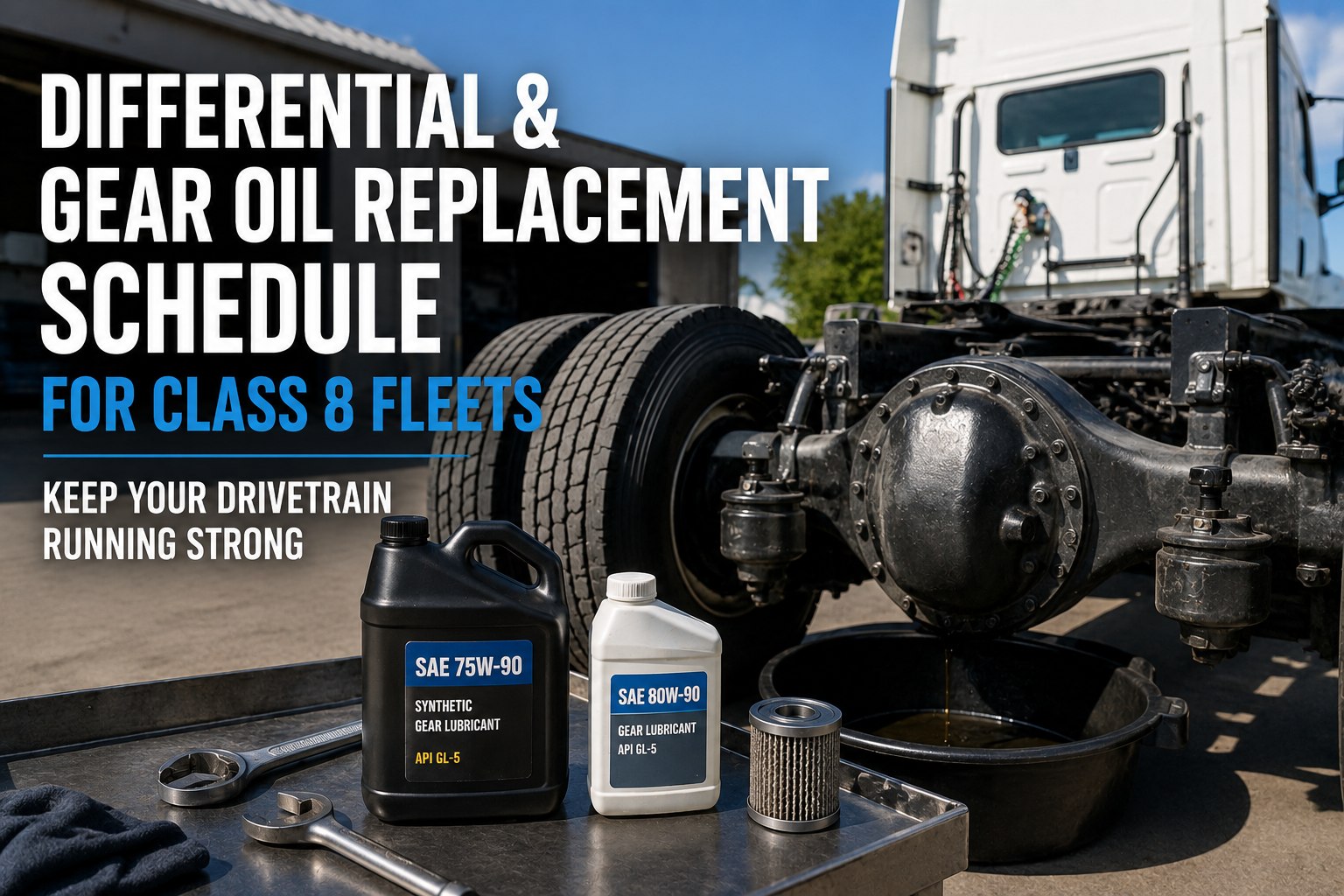
Differential and Gear Oil Replacement Schedule
Three positions, three fill points, and intervals that range from 100,000 to 500,000 miles depending on the approval — plus why the axle tag beats every generic recommendation.
Front axleIf driven
Forward-rearCarries the inter-axle differential
Rear-rearOwn sump, own schedule
Usually one shared sump — but check the fill points before adding
Start at the Tag, Not the Guide
Every differential housing carries a tag or a stamped specification, and the viscosity and fill capacity printed on it override every generic recommendation — including this one. If the tag is missing, pull the axle model number from the housing stamp and look up the OEM service spec before adding anything.
What the tag settles
Viscosity grade for that specific axle
Fill capacity, which differs by position
Axle model, which unlocks the OEM service spec
Whether a limited-slip or locking mechanism is fitted
What it does not settle
The drain interval — that depends on the lubricant approval
Whether the IAD shares a sump or has its own fill
Vocation, which can halve the interval independently
Warranty status, which the lubricant approval affects
Record it once, use it forever
The axle tag is read at the truck, usually by someone lying under it, and then forgotten. Capturing viscosity, capacity and axle model onto the asset record the first time turns every subsequent service into a lookup — and it is the difference between kitting a job correctly and sending a technician out with the wrong grade.
The Approval Decides the Interval
Gear oil intervals are not a property of the axle. They are a property of the lubricant approval that axle manufacturer has granted, and the spread is large enough to matter commercially.
← Swipe to see all columns →
Two things follow. First, a fleet that switched lubricants without changing the PM interval is either servicing far too often or running past an approval it no longer holds. Second, mixing gear oils shortens oil life and reduces the performance benefit — extended drain intervals are generally not supported where oils have been mixed, so a top-up with whatever was on the shelf can quietly void the schedule you are running.
Asset record
Axle model, viscosity, capacity, approval — one lookup instead of one crawl under the truck.
Recorded per position, so the work order carries the right grade and the right volume before the job starts.
The Inter-Axle Differential Trap
The most common gear-oil error on a tandem is not the wrong grade — it is overfilling, and it comes from an incorrect assumption about the sump.
What the IAD does
On tandem rigs the inter-axle differential splits torque between the forward and rear drive axles. It lives in the forward-rear housing and it takes the same lubricant as the differential it sits with.
Where it goes wrong
Most Meritor and Dana inter-axle differentials share the same sump as the forward drive axle differential. Some do not — they have a separate fill point. Assume shared and fill both, and you have overfilled one of them.
The check that prevents it
Identify the fill points on that specific axle before adding fluid. Record how many there are on the asset record so the next technician does not have to work it out again.
Why it matters beyond mess
Overfilling raises operating temperature and forces lube past seals. A power divider failure can also put metal into the housing, which is a reason to look at what comes out on the drain rather than just what goes in.
Limited-Slip and Locking Axles
A separate consideration that catches fleets with mixed vocational equipment, because the symptom appears weeks after the service.
1Friction clutches change the requirementWhere a drive axle uses a limited-slip or locking mechanism with friction clutches, standard GL-5 gear lube can cause chatter.
2The symptom is specificChatter or shudder during slow turns. If it appears after a fluid change on an axle with friction clutches, the fluid is the first thing to look at.
3Friction modifier, one bottle per differentialAdded to the 75W-90 or 75W-140 fill to resolve it — one bottle per differential, and only for the axles that need it.
4Do not add preemptivelyModifier goes in when chatter occurs, not as a routine part of every fill. Adding it as standard practice across a fleet is a habit worth stopping.
Vocation Splits the Interval Again
Even with the same axle and the same approved lubricant, duty cycle moves the number materially — which is why vocation belongs on the asset record alongside the axle spec.
Linehaul
Around 500,000 miles
Steady-state highway operation with an extended-drain approved lubricant. The long end of the range, and the figure most fleets quote.
Vocational
Around 120,000 miles
Between service events on the same driveline components. Roughly a quarter of the linehaul figure, on identical hardware.
The four-to-one problem
Linehaul and vocational figures on the same axles differ by roughly a factor of four. A mixed fleet running one interval across both is either wasting a great deal of lubricant and labour, or running vocational units three times past their service point. Neither shows up until an axle fails, and by then the schedule has been wrong for years.
What to Check While It Is Draining
Six checks that cost minutes and catch failures no lubricant specification prevents.
1What comes out. Metal on the magnet or in the drain pan changes the job from a service to a diagnosis.
2The vent. Road dirt blocking a housing vent pressurises the case and forces lube out past a wheel seal — a leak with a cause that has nothing to do with the seal.
3Level at the fill plug. With the truck level, the oil should sit at the bottom of the plug. Lower means a top-up and an investigation.
4Wheel seals and hub ends. Even a small leak matters here, because low lube level in an axle is a bearing failure waiting for mileage.
5Number and location of fill points, recorded — especially on the forward-rear where the IAD may or may not share the sump.
6The tag itself, photographed onto the record if it has never been captured. Tags become unreadable long before axles wear out.
Setting It Up in Fleet Software
Six fields per unit, and the schedule derives from them rather than from a fleet default.
Axle model and tag data per positionFront, forward-rear and rear-rear held separately, with viscosity and fill capacity from the tag. Different positions, different capacities.
Lubricant approval heldSHAES 234, SHAES 256, O-76-N, O-80, GO-J+ or conventional. This field, not the axle model, sets the interval.
Vocation classLinehaul or vocational, applied per unit. The same chassis with a different body belongs in a different class.
Miles and calendar togetherA three-year limit sits alongside the mileage figure on synthetic extended drains, and low-mileage units hit the calendar first.
Fill point count and IAD sump noteRecorded once so nobody has to determine it under the truck again, and so overfilling stops being a recurring event.
Limited-slip flagMarks the axles where friction modifier may be needed if chatter appears, and keeps it off the ones where it should not be added.
Three positions per truck, scheduled separately
Fleet Rabbit stores axle tag data, lubricant approval and vocation class per position, derives the interval from the approval rather than a fleet default, and triggers on miles and calendar together so the three-year limit is never the one that gets missed.
Frequently Asked Questions
How often should Class 8 differential oil be changed?
It depends on the lubricant approval more than the axle. The OEM baseline on conventional gear lube is typically around 100,000 miles. Dana SHAES 234 covers standard drain up to 250,000 miles, while SHAES 256 covers extended drain up to 500,000. A synthetic severe-gear 75W-140 can reach 250,000 miles or three years for Class 8 linehaul, whichever comes first. Vocation moves all of these — vocational applications commonly run around 120,000 miles between service events against roughly 500,000 for linehaul.
Does the inter-axle differential need separate service?
Usually not a separate fluid, but possibly a separate fill. Most Meritor and Dana inter-axle differentials share the same sump as the forward drive axle differential and use the same lubricant — but some have a separate fill point. Check which arrangement that specific axle uses before adding fluid, because assuming a separate fill on a shared sump is how axles get overfilled. Record the answer on the asset so it is settled permanently.
Which spec do I actually need?
Read the axle tag first. Every differential housing has a tag or stamped spec, and the viscosity and fill capacity on it override everything else. If the tag is missing, take the axle model number from the housing stamp and look up the OEM service spec. Beyond viscosity, the approvals that matter commercially are Dana SHAES 234 and 256, Meritor O-76-N and O-80, and Mack GO-J+ — with API GL-5, MT-1 and similar as the underlying performance categories.
Can I mix gear oils?
Physically usually yes, commercially no. Mixing gear oils shortens oil life expectancy and reduces the performance benefits, and extended drain intervals are generally not supported where oils have been mixed. That makes a casual top-up from a different product a decision to abandon the extended interval you were running — without anyone recording that it happened. Standardise the product per axle approval and note the fill product on the service record.
What causes chatter after a differential service?
A limited-slip or locking mechanism with friction clutches running standard GL-5 gear lube. The symptom is chatter or shudder during slow turns, and the fix is a friction modifier added to the 75W-90 or 75W-140 fill — one bottle per differential. It should be added when chatter occurs rather than preemptively on every fill, so flag which axles have friction clutches on the asset record instead of dosing the whole fleet.
Does a non-approved lubricant affect warranty?
It can. Running a non-approved lubricant in a Meritor axle under warranty puts coverage at risk, and the same logic applies across axle manufacturers with named approvals. Since the approval also determines whether you are entitled to the extended interval, using an unapproved product costs twice — a shorter safe interval and a weaker warranty position. Record the approval held per axle so purchasing and maintenance are working from the same field.
Why does gear lube keep appearing at a wheel seal?
Check the vent before replacing the seal again. Road dirt blocking a housing vent pressurises the case and forces lube out at the weakest point, which is usually a wheel seal — so the seal is a symptom rather than the cause. Overfilling produces the same result, which is another reason to confirm fill points on the forward-rear before adding. Both take seconds to check and both get missed on a repeat seal replacement.
Start a free trial to track repeat repairs per unit.
Schedule the Axle, Not the Fleet
Tag data captured per position, the interval derived from the lubricant approval rather than a default, vocation applied per unit, and the IAD fill arrangement recorded once so nobody overfills it twice.
Always confirm against the axle tag and current OEM service spec · Free tier available · No credit card required